Winter Moon of the Long Nights
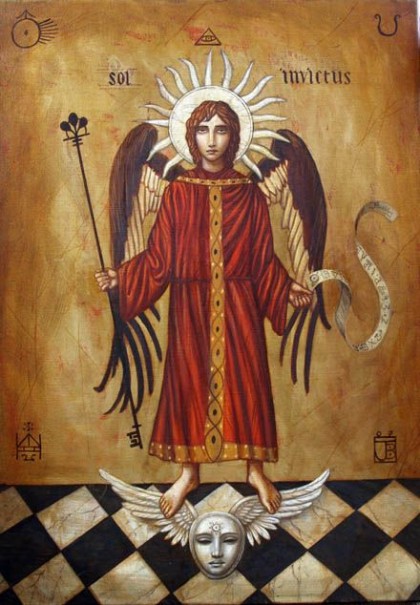 The solstices mark swings to and from extremes, from the longest day to the longest night, there, and as with Bilbo, back again. Darkness and light are never steady in their presence. The earth always shifts in relation to the sun, gradually lengthening the days, then the nights.
Most folks celebrate the Winter Solstice for its moment of change toward increasing light. Sol Invictus, the Roman sun god, added a martial spirit. The ancients feared that the nights would continue to grow in length, and act as a shroud thrown over the earth marking an end to growing seasons, to warmth, to life. It’s no wonder that relief at the return of the sun, revealed by small increases in the length of the day, caused holidays to be born around this subtle astronomical change.
There are also bonfires and songs and drinking and sex on the Summer Solstice. The sun manifests itself as light giver, light bringer, with the longest days. The growing season is well underway then, the miracle of life that the sun’s increasing light creates is the very relief anticipated on the Winter Solstice. Fear and the vanquishing of fear. Sol Invictus, the conquering sun.
Yet even in ancient times there had to be a few outliers like myself. We don’t begrudge the return of the sun, nor deny all the miracles that its return makes possible, that would be silly; but, for some psychic reason, perhaps not clear even to us, we reverse the common sensibility and find succor in the gradual lengthening of the nights that begins at the Summer Solstice and reaches its maximum on the night of the Winter Solstice.
We know that the cold and the darkness, the fallow time whose genesis each year happens on the longest day, is also necessary, also worthy of honor. It is earth’s sabbath, a time for all the generative powers to rest, to regather themselves, to ready themselves for the next florescence. I suspect somehow in our psyches we honor slight dips into depression or melancholy, knowing that in those times we regroup, rest the eager forward creative parts of our souls and the gradual lengthening of the darkness outside mirrors that.
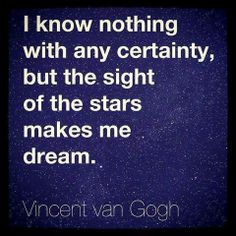 In these long nights the cold often brings clear, cloudless skies. The wonderful Van Gogh quote that I posted a few days ago underscores a virtue of darkness, one we can experience waking or asleep. Dreaming takes us out of the rigors of day to day life and puts us in the realm where ideas and hopes gather. So, the lengthening of the nights increases our opportunity to experience dream time. Whether you believe in Jung’s collective unconscious or not-I do, the rich resources of dreaming are available to us with greater ease when the nights are long and the cold makes sleeping a joy.
It was, too, many years ago when I pushed the notion of transcendence out of my spirituality in favor of immanence, incarnation over a god in the sky. My focus moved to down and in, not up and out. Our inner world is a mystery, a place of fecundity, but also a place often occulted by the demands of the day. When we shift our focus to the night, to the half of the year when darkness grows, we can use that external change as a trigger to lean inside, to find the divine within. If we can make this discovery, the god that we are, we can stiff arm the notion that revelation stopped thousands of years ago.
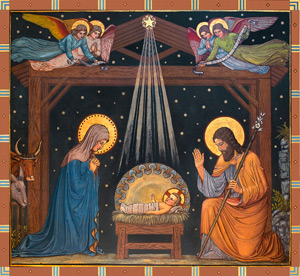
Every moment of our existence is a revelation, the path of a god, the most fundamental ancientrail of all. No, we are not omnipotent, that’s an illusion created by the idea of transcendence, the need to find validation outside of our own soul. This is the true polytheism, the one that folds its hands, says namaste, bows to that of god in everyone, in every animal, in every plant and stone and star.
When you reach out in love to another person, to a dog, to a crocus blooming in the snow, you bring the finger held out by the white haired floating god in Michelangelo’s Sistine Chapel ceiling. That moment of creation is always, ongoing, a joint effort between and among us all, human and inhuman, animate and inanimate, the cosmic dance of Shiva brought into this mundane world. He or She is not out there, waiting to be called by prayer, but in here, waiting to be called by the quiet, by the joy, by the persistence held in the soul container that is you.
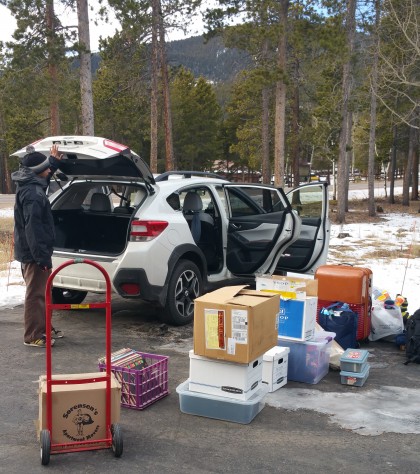
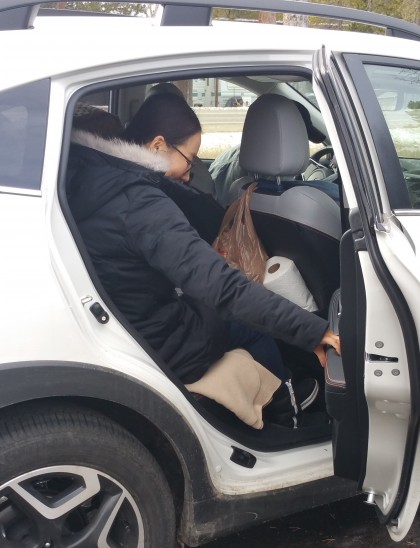
 Ah. In my world mechanical victories, no matter how small, are worthy of celebration. After a snowfall on Wednesday and Thursday, I decided to crank up the snowblower. It had not been started since the end of winter in 2016. My knee surgery coincided with the first few storms of the season last year. It wouldn’t start. Just cranked and cranked. Sigh.
 Winter break continues. The identity crisis has passed as I knew it would. The crisis focused on my passive choices, taking the path of least resistance after college and I did do that, giving up my intentionality about career to a socialization experience with clergy-focused fellow students. But. Within that decision to just follow the education I had chosen as a way to get out of a dead end job and an unhappy marriage, I was intentional.

 In the darkness we can attend to the dark things within us, the places in our souls where our own origins and their ongoing impacts create a climate for our growth, down below the conscious considerations of our day-to-day lives. We can embrace this darkness, not as a thing to fear, but as a part of life, a necessary and fruitful part of life.
 I thought I had my life direction nailed down. College, graduate school. Some sort of professional career, perhaps lawyer, perhaps professor, perhaps something not visible from within the boundaries of an Alexandria, Indiana horizon. Then, my mom died. That threw my final year of high school into turmoil. God, this hurts just writing about it.
 Most kids heading off for college, especially in the fifties and mid-1960’s, had a similar desire. Shape that adult self. Live into an adult role. The expectation was that college would provide room for exploration, trying on this and that persona, in effect researching skills and passions, until something coalesced. Then, earning money and work would merge into an expression of who you were. That’s why college was called then, the moratorium years. College was explicitly a time to be low on commitment, but high on exploration.
 I loved anthropology, too. Enough, it seemed, to make it a career. I combined my interest in philosophy and decided to enter the narrow field of theoretical anthropology, thinking about how anthropology works, how it could work, how it should work. That turned out to be a mistake and one I didn’t recover from. I applied to, and was accepted, at Brandeis and Rice, for graduate programs. But because my field was theoretical anthropology, I got no financial awards. That meant I needed a fellowship and I was nominated for a Danforth. In the end though, the end of college and of a political career based on radical politics at Ball State, I chose to do nothing. Just. Nothing.
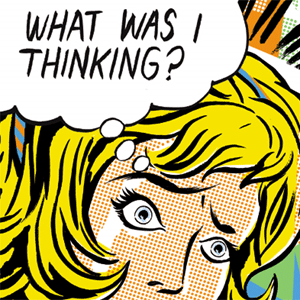 And so, here I am at 70, no career I really chose except writing and that one I couldn’t have sustained had it not been for the grace and love of Kate. There’s my identity crisis. Who have I been? What have I wanted to do with my life? Late in the game to ask these questions though to be honest they’ve surfaced right along since Wabash.
 When Hanukkah ends tonight, it will only be two days to the Winter Solstice. I long ago kicked transcendence out of my religious toolkit, believing it encourages authoritarianism, the patriarchy, and body negativity. How, you might ask? If we find our source of authority outside of ourselves, either up in heaven or with a divine father figure or anywhere outside of our body, we give away our own deepest connection to divinity, the sacred that lies within us. BTW: locating revelation in written texts does the same.
 Got a TV for the kid’s room. A Hanukkah present. Maybe not the most mind nourishing gift, but one they’ll really like. I spent a couple of hours setting it up yesterday, which seems like a lot until you factor in the passwords and fiddling with other settings.
 Right now we’re in a major cultural transition, trying to learn how these tools can be most useful for human life. They will become integrated and less shiny, less compelling as we move on to the next transition, probably to a sustainable human presence on this planet. All civilizational artifacts have ripple effects, often of unsuspected power. Think of the plow. Language. Writing. The printing press. Governance. Bow and arrow. Ships and boats. Ceramics. All had their initial years of adoption, then a clumsy time when their utility seemed swamped by the problems they created. Finally, though, they became part of human life. How did we get across the lake before we invented the boat and paddles? Or the boat and a sail? Speaking our language means we can understand each other better, no more grunting and pointing. Books contain and retain ideas over time and space. How cool is that?
 Maybe I’m a starry eyed optimist, probably am, but I believe we can handle this transition and that it will not save us, nor will it enslave us. A hundred years from now, maybe two hundred, we’ll see the full arc of this change, in an undoubtedly hotter and stormier future. It will have become an ancientrail, one still affording advantage, but no longer scary, at least not in the way it seems to be now.