Monthly Archives: May 2018
The Tao
Beltane Mountain Moon

Black Mountain sits, stoic and massive. No Pele here on Shadow Mountain either though not far away, less than 600 miles, is the supervolcano at Yellowstone. Does Pele feel these others, all these others? Stromboli? Mt. Etna? Montserrat’s Soufrière Hills volcano? Mt. Pinatubo? All those seamounts like Lo’ihi? Are there other Pele’s around the world or is She the one goddess of fire beneath the earth’s surface?

And what of the Rocky Mountains? Is there a Vishnu-like deity here, noted for His calm, stolid presence, a stable and stabilizing force? To be on and among these mountains does not call out terror, does not reveal the raw fierce power of an erupting volcano. The wildfires that can scour their flanks are not of them, but of the soil, of the world of plants and lightning, of drought and human folly. Their orogeny was, of course, violent, a brutal tearing of the earth itself, forcing rock up, up, up, a tectonic plate pushing hard against another. But that was long ago, ended long ago.

The tao here is quiet, steady whereas the tao of Kilauea creates in ropy pahoehoe and ragged aa, in blasts from the magma chambers meeting underground water, by rips in her surface. Yet they are both the tao. No less generative, no less powerful for their difference. The tao here relies on cohesion, aggregation, altitude, the flow of the atmosphere. The tao on the Big Island relies on explosion, heat, creative destruction, movement.
Both are outward expressions of absence, the unceasing, unrelenting power of pure creation. The tao comes into this reality from the ein sof, making the ten thousand things. The same source that births you or me or the ocean or the sun or the Sombrero Galaxy.

(Emperor Ningzong’s poem inscribed in the upper right corner reads, “The wild flowers dance when brushed by my sleeves. Reclusive birds make no sound as they shun the presence of people.”)
Yes, I am one with the calm of Black Mountain, with the hottest lava erupting now on Kilauea’s eastern rift zone, with the gathered strength of the Yellowstone magma, with the flow of the Colorado, the Rio Grande, the Platte with the globe straddling fluidity of the world ocean. So are you. We bring our own uniqueness, self-consciousness, to the tao. We know ourselves as part of the tao. I am stolid, explosive, fluid, distant, near. We are of the tao now, as we were before being thrown into this time, these places, and we will be of the tao after this life we have dissipates, falls away.
Not slowing down
Beltane Mountain Moon
Here is the great wild
Beltane Mountain Moon
Volcanoes of the Big Island
 In the month of the Mountain Moon Kilauea has reminded me that my interest in mountains precedes the Rockies. My first mountain driving experience was Haleakala on Maui. I learned there that you don’t have to brake going up, take your foot off the accelerator and the mountain takes care of you.
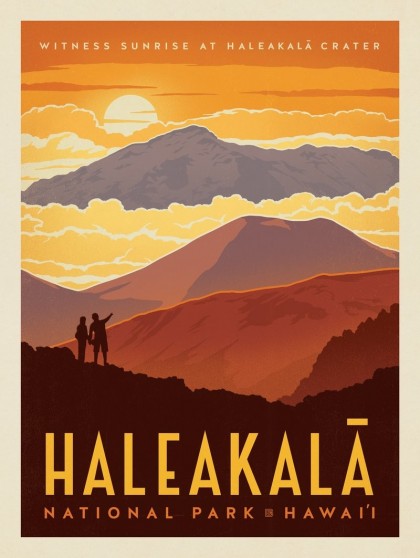
Haleakala means house of the sun and on one of our trips to Maui I did the tourist thing of seeing the sunrise on Haleakala. As we rode in the small van around 4 a.m., the skies were cloudy, rushing across the island, allowing the full moon to become visible, then blocking it out. Even though we were on Maui, a tropical paradise, the early morning temperatures on Haleakala’s summit, 10,023 feet, were cold and windy. Black Mountain, visible from my window here in the loft, is 10,731 feet.
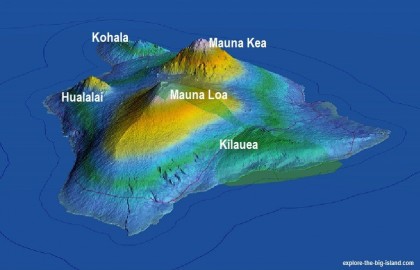
 Hawai’i put vulcanology on my oh this fascinates me list. On a visit to the big island, Hawai’i, we drove the Highway east out of Kona, traversing first Hualalai, which sits just above Kona, then Mauna Loa, the long volcano, and finally, climbing up the eastern flank of Mauna Loa we went past Kilauea. We did not go in that day, driving on to Hilo town. On our way back, later that evening, we drove along the southern flank of Mauna Loa again, the air scented by gardenias and jasmine.
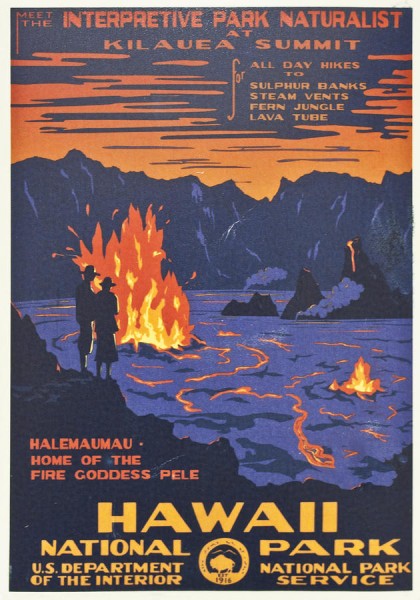
In 1999 we visited the Big Island again, this time staying in Volcanoes National Park at Volcano House. We were there for two weeks. Learning the language of volcanoes was easy there: fumaroles, vents, calderas, pahoehoe, ropy undulating lava, and aa, fragmented sharp blocky lava, lava tubes, magma, magma chambers, and the home of Pele, Halemaʻumaʻu Crater. (see poster above)
Hiking a long path around the summit, walking on lava flows where the Pu’u O’o vent added to the land mass of the Big Island, exploring inside now drained lava tubs with ferns growing from the ceilings and reading about volcanoes gave me both an experiential and intellectual immersion. I’ve followed Kilauea off and on since then and the news coming out of the Big Island has me riveted.
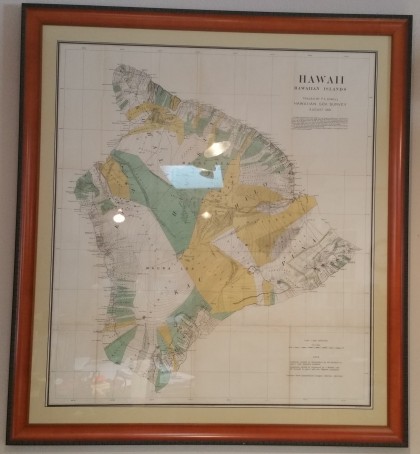 Maps. Kate bought me this wonderful vintage map of the Big Island. It now hangs in a prominent position here in the loft, reminding me of many adventures including our stay at Volcano House. Kilauea is in the yellow portion of the map that extends south to the Pacific and butts up against the large swath of green in the middle. The new eruptions are in the eastern, white segment that extends to the north from the point where Kilauea meets the Pacific. This is Kilauea’s eastern rift zone*. People building there knew about the rift zone, but hoped it wouldn’t affect them, much like we hope our location in the Wildlife Urban Interface, WUI, won’t result in our home burning down. Mother Nature gives no passes for human hopes however. She decides when and where things happen, according to her own laws.
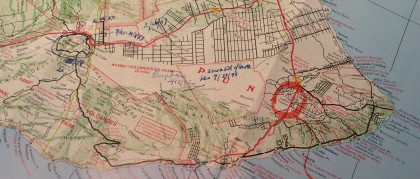 Over years of travel I have purchased maps and annotated them. I did this especially in Hawai’i where we visited often while Kate practiced. It is a popular location for continuing medical education. Each time we visited I would mark where we had gone, the date, sometimes a brief note though the longer explanations were in my notebooks. We spent time on Maui, Hawai’i, and Kaua’i, enjoying all of them in turn. Each has their particular charms.
The section of my Big Island map above shows the eastern rift zone area with our 1999 visit marked by the black circle in the upper left and the current eruptions in the Leilani estates circled in orange. The Lo’ihi seamount, the latest island of the Hawai’ian archipelago forming beneath the sea, is just south of the shoreline shown here. It’s the volcano that is most directly over the hotspot** which has formed the whole archipelago.
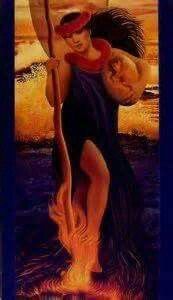 In 1999 I stood on the rim of Halemaʻumaʻu Crater. Next to me were empty bottles of gin and rum, sprays of flowers, especially red ginger and bird of paradise, a lei of gardenias. These were left by native Hawai’ians who came here to worship Pele, the goddess of fire, of volcanoes, of creativity. This is, according to Hawai’ian theology, Pele’s current home though I imagine she will be moving in the next few thousand years to Lo’ihi.
Rudolf Otto, the German religious philosopher who wrote about the nature of the holy, said it combines two elements: awe and the mysterium tremendum et fascinans***. Gazing down over the rim, looking 150 to 200 feet to the crater’s floor, awe came bubbling up at me. In 1999 Pele’s home had no active, visible lava, but just knowing that the magma existed below a thin crust of cooled lava was enough. There is a large lava lake in the crater now.
Otto could have written these words to describe my feeling: “overpoweringness, majesty, might, sense of one’s own nothingness in contrast to its power.”
Wordsworth, too, in the World Is Too Much With Us:
“I’d rather be
A Pagan suckled in a creed outworn;
So might I, standing on this pleasant lea,
Have glimpses that would make me less forlorn;
Have sight of Proteus rising from the sea;
Or hear old Triton blow his wreathèd horn.”
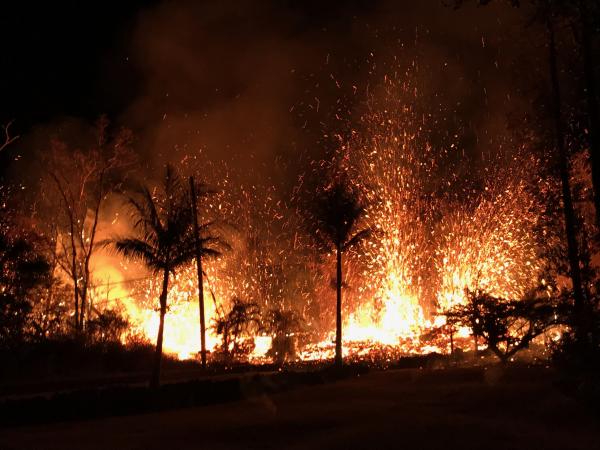
The lava on Kilauea is about 2,200 degrees Fahrenheit. Various magma chambers up to six miles below the surface feed the lava flows into Halemaʻumaʻu Crater, formerly fed (up until this last week) Pu’u O’o and now feed the fissures breaking through the eastern rift zone 21 miles from the Kilauea caldera. Here is the raw power of our wild universe visible in its most primal form, kin to the winds of a hurricane, the awful speed of a tornado, the waters of a tsunami, flooding rivers, avalanches, wildfire, orogeny. Nothing subtle at all in these forces; we ignore them at risk to ourselves and those we love.
I need no book, no prayer, no revelation of another. Here is the great wild, the generative power of the tao laid out for all to see. Stand in a sanctuary and feel no more divinity than in their presence. Visit St. Peter’s or the Temple Mount or the Wailing Wall or Angkor or the Great Medicine Wheel and know no more of the sacred, the holy than when the heat of the lava brushes your delicate skin. Pele’s touch.
*Rift zones are areas where the volcano is rifting or splitting apart. The rock in a rift zone has many cracks and is relatively weak, and thus it is easiest for magma to make its way to the surface through these rift zones.
**Hot spots are places within the mantle where rocks melt to generate magma. The presence of a hot spot is inferred by anomalous volcanism (i.e. not at a plate boundary), such as the Hawaiian volcanoes within the Pacific Plate. The Hawaiian hot spot has been active at least 70 million years, producing a volcanic chain that extends 3,750 miles (6,000 km) across the northwest Pacific Ocean. Hot spots also develop beneath continents. The Yellowstone hot spot has been active at least 15 million years, producing a chain of calderas and volcanic features along the Snake River Plain that extends 400 miles (650 km) westward from northwest Wyoming to the Idaho-Oregon border.
*** Rudolf Otto and the numinous
“Mysterium tremendum et fascinans” (fearful and fascinating mystery):
- “Mysterium“: Wholly Other, experienced with blank wonder, stupor
- “tremendum“:
- awefulness, terror, demonic dread, awe, absolute unapproachability, “wrath” of God
- overpoweringness, majesty, might, sense of one’s own nothingness in contrast to its power
- creature-feeling, sense of objective presence, dependence
- energy, urgency, will, vitality
- “fascinans“: potent charm, attractiveness in spite of fear, terror, etc.
Woke
Beltane Mountain Moon
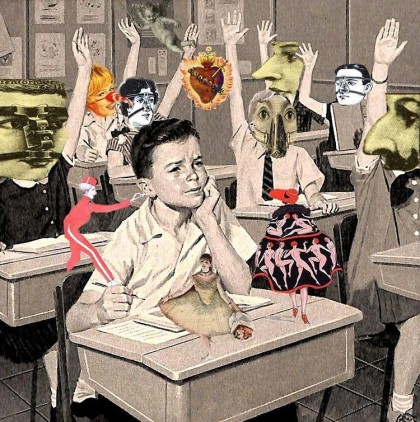 Back in the day, the now further and further away day, I always went to class. I might have missed a few, but it was rare. I enjoyed learning from lectures, getting in the mix of dialogue, thinking out loud. Last night I was the only student in the qabbalah class on Time.
Rabbi Jamie and I had a solid hour together talking about the nature of the sabbath, the notion of sacred time, and, hidden space-time. L’Olam va’ed, translated most often as forever and ever, has another translation, hidden time witnessed. The second translation, a qabbalist’s, points to the intersection of the three dimensions: space, time, and soul. Soul is consciousness in this frame. It is a nexus that is crucial to understanding existence per se. Without all three, space, time and consciousness, the fabric of the universe cannot exist, or, perhaps better, in my opinion, couldn’t be known as we humans know it.
The tao. The tao feels like the central idea that I have learned, even though it’s pretty damned slippery. Putting it into this qabbalistic paradigm, being one with tao is awareness of L’Olam va’ed. When our soul sees hidden time, we see reality as it is, a moving generative force and we can align ourselves with its flow, not impede it.
 Being human is a daunting task, steeped in misdirection, existential isolation, perception clouded by tradition, by language, even by our body. Qabbalists and taoists and ch’an buddhists have worked, hard, to peel the onion of our awareness. They are subtle, in their own way as subtle as particle physics or genetics or neuroscience, attempts to understand this task, the one none of us can jettison, save through suicide. They differentiate from the narrowing tendency of science by insisting on a full, a comprehensive positioning of this strange creature that we are in the wild.
Make no mistake, the universe is the true wilderness and we wander in it as innocents, thrown into it for what reason we do not know, headed toward a destination we do not understand and cursed or blessed with awareness, consciousness, soul as we travel.
 Thought experiments like taoism, qabbala, ch’an or zen buddhism try to shock us out of our stupor, the life lived without seeing the wilderness for what it is, the life lived within the conventions of a particular time, a particular language, a particular place, a life lived without knowing what life is. Most people find little reason to peak behind the curtain of this emerald city that we think is what is. The apparent life, the one with family and money and the NFL and food and houses and sunlight and night, seems to be all that could be. We do not question, we try to paddle the little barque of our body on this river (life) often using only our hands over the edge of the boat.
 And yet there is more, not more in the sense of more layers or more depth, for those layers and depths, the wilderness, always surround us, are the water to which we are the fish, but more in terms of what we can know, what we can access, what we can use to help us become awake. Woke, in the current vernacular, not woke to racism and sexism and oppression in this instance, but woke to the true majesty and wonder of life itself, of this wilderness journey, this most ancient of ancientrails.
Do you want to wake up? Shake off the slumber of convention? Head out into the wilderness knowing it for what it is? If you do, there are paths to take, fellow pilgrims with whom to travel. I honestly don’t know whether it’s important or not to peel the onion, only that in doing so, I’ve become alive, able to see. And I prefer that consciousness, awareness to life as a long sleep.
Generosity of the Heart, Nedivut ha-lev
Beltane Mountain Moon
 Another recovery hallmark. Kate drove yesterday, went out on her own for the first time since March 22nd! The bank, a few groceries, gas. When doing these errands feels routine, they can be mindless or even a nuisance; but, this sort of moment allows us a glimpse into the ordinary miracles that make up what we think of as normal, usual. We can get up from the chair, pick up the keys, start the car, drive to the grocery store, the gas station, the bank.
So different from not being able to get out of the chair, being unable to pick up the keys, being too physically impaired to drive. That milk, the bread, the full gas tank, the money in your pocket then become unobtainable. Not a nuisance, not something to go through as if by habit. No. These are vital, though small, increments of life, necessary and significant in themselves. Worthy of attention, even celebration.
 Mussar Vaad Practice Group last night. Vaad = sharing without comments. Mussar = Jewish ethics focused on developing middah, character traits. This is a group, partly because of its nature, partly because of its members that has become a Woolly Mammoth equivalent for me, a place where I can be transparent, share, look inside, gain from the ancientrails that others walk.
Marilyn brought in an article about a child of pogrom survivors. This woman felt she had to be perfect, show that she was worth saving, worth the sacrifices her parents made. An awful burden. She started her own company by the age of 30, then slowly fell apart in her thirties. Discovering compassion, nedivut ha lev, generosity of the heart, led her to a new way of life. In particular she talked about self-compassion. “Talk,” she said, “to yourself as you would to a good friend.”
Snowing here this morning, fat heavy flakes. Rained and snowed yesterday. All moisture good, welcome.
Beltane Pardon
Beltane Mountain Moon
This is powerful. Worth your attention.
Beltane Mountain Moon
Just Sayin’. Thanks to John Seed
Beltane Mountain Moon
Words
Beltane Mountain Moon
 A session last night with writers who are members of Beth Evergreen. Published writers, that is. Beth Evergreen has a large number of creative people actors, musicians, dancers, painters and writers. Joanne Greenberg who was on the panel has published 20 novels, including the well-known I Never Promised You A Rose Garden. Ron Solomon wrote Broken!, a true story of torture told in fictional form, and has written many screen plays, TV treatments, children’s books, games. Another woman wrote academic and fiction books. Nancy Larner has written a children’s book, A Mouse in the Rabbi’s Study. Marilyn Saltzman writes non-fiction, ghost writes and runs her own public relations firm.
“Writer’s block,” Joanne said, “is your character telling you you’re an idiot.” Nods from the other panelists. “I write with a pencil. And they break.” Ron Solomon. “I meditate a lot. In meditation I try to be with the characters.” Nancy Larner. “I have to work hard to get myself out of the way.” Marilyn Saltzman. “I know when my words are right in my body.” The woman whose name I didn’t get, author of academic books and papers and books like Mirriam’s Well.
Tell the truth. Kill your darlings. It’s hard work, nothing mystical. Lightning strikes. I stand up and move around the room. I read my books out loud listening for clunky dialogue.
Five distinct individuals, very clear about themselves, their work, their inner life. I felt inspired, like I was with my true tribe. You might think that my lack of publishing would make me feel out of place, but I found myself engaged, nodding, feeling with all of them.
Made me think another panel of musicians and actors would be fun, too.