 Lughnasa and the Michaelmas Moon
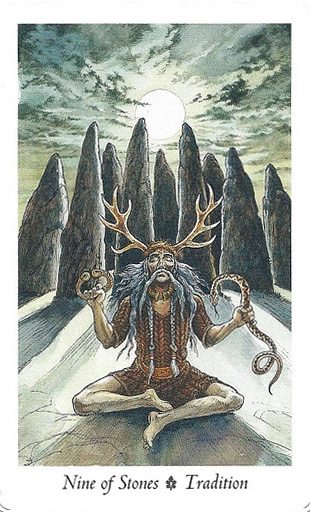
Tarot: Nine of Stones in the Wildwood Deck
Meaning (according to the Wildwood Tarot book-WTB):
Reverence for past wisdom and sacrifice. The ability to relate to ancient knowledge and pass on the lessons of ancestral memory and ritual.
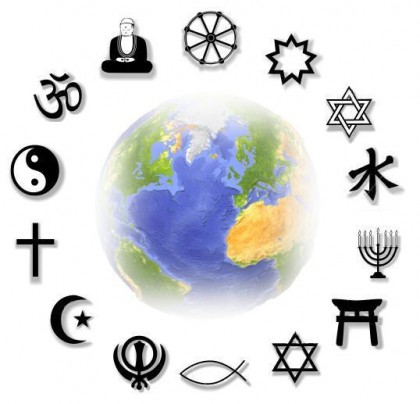
Let me throw in here, too, Ovid. And, my interest in pre-Socratic philosophers like Thales, Anaximander, Heraclitus. Dante. The Tao. The early world of Hinduism. Christianity and Judaism. Those very early shamanic faiths of the Mongols, of the Japanese (Shinto), the Koreans.
Even anthropology. My interest in anthropology was to find the way of other peoples, to know and understand them as much on their own terms as possible. Travel as well. The learning inherent in being the other.
I’m not a syncretist. I’m not an everybody has something to teach us sorta guy. Though there’s a sense in which that’s true. I’m not trying to find the one truth that snakes through all the traditions. There isn’t one. And, yes, I’m pretty sure of that.
There is though this truth. The human body, its limitations and potentials, does remain pretty much the same over time. The brain and its evolution has hardwired certain ways of responding to the world around us. Though there have been dramatic climatic changes like the ice age, the sorts of challenges the world provides in its various regions remain at least similar even today.
What I’ve done, often without knowing it, is to immerse myself in the thought ways, the life ways, the ritual ways of so many different cultures over long periods of time and in very different geographical and geological conditions that I feel like a citizen of multiple cultures, yet beholden to none of them. Including, perhaps most of all, my own.
The tricky part for those of us raised in the West and in the Judaeo-Christian tradition can be capsulized in one word: progress. Progress assumes linear time. Progress assumes one culture can evaluate others qualitatively. Nineteenth century France is better than, nineteenth century England. Or, China’s civilization is superior to everyone else’s outside the Middle Kingdom. Or, we, the USA, will make the world safe for democracy, the obvious best form of government.
Progress both puts blinders on us, makes jingoists of us all, and imagines an unproven and unprovable idea: that next year, next day, next minute things will get better. By whose standards? Mine? Yours? Theirs? The citizens of ancient Ephesus? Of X’ian. Of Kyoto.
Of course, central heating beats a fire in the middle of the hut with a hole in the top to let smoke out. Of course, driving in a motorized vehicle is easier than walking or riding a horse. Of course, air conditioning is preferable to suffocating heat. You can extend this list.
But. Is central heating progress? Depends on the fuel, in one way of looking at it. Natural gas, propane, and heating oil are all common fuels. Think. Climate change.
Same question about driving and air conditioning.
Humans tend to favor the thing they have and know. So, today is better than yesterday.
Meaning (according to the Wildwood Tarot book-WTB):
Reverence for past wisdom and sacrifice. The ability to relate to ancient knowledge and pass on the lessons of ancestral memory and ritual.
As a 1960’s radical, anti-establishment, pushing for new political, military, economic, sexual, intellectual mores, to consider myself one who reveres past wisdom, ancient knowledge? No. No. No.
Yet. There I was studying Socrates. Zoroaster. Ovid. Greek history. Biblical literature. Dante. Taoism. The history of ancient civilizations like Assyria, the Qin dynasty, Middle Kingdom Egypt. Not only studying. Learning. And in that learning, unbeknownst to me, at least partially, being shaped by that learning.
When I went to seminary, I saw the utility of the prophetic tradition in Judaism and Christianity. It could be used to press for change on behalf of the widow and the orphan, the enslaved, the oppressed, the poor and the hungry. I considered this tradition, that of the prophets of Ancient Israel, the real gem in the long years since the death of Jesus.
It was. And, is. But. There is another jewel there, too. One only accessible to the meditator, the reader of scripture, the ascetic, the one willing to face the root of the faith. To get burned by its heat. This is the faith of the Russian Starets, the Welsh peregrinators, mystics like St John of the Cross and Meister Eckhart. And, not faith. Not really.
Why? Because it involved and affirmed an actual experience of the numinous.
My inner world got shaped, in the end, more by this strain of the Judaeo-Christian tradition. Though. Again, I was only partially aware of that at the time.
When I fell too far away from the very idea of theology, of religious institutions, I went into a long period of quiet. I sold my commentaries, no longer engaged in lectio divina, or used the Jesus prayer.
Camus came back to me. Life is absurd. Without meaning. Death is final, extinction. To live is a choice. One that can be altered.
The Great Wheel came into my life sort of through a back door, a way of understanding Celtic thoughts and motivations. But when Kate and I moved to Andover and our long horticultural, beekeeping, canine loving life really began, the Great Wheel slowly seeped into my thinking about the garden, about the life of dogs and people, about the hives and their superorganism.
That was what I had been prepared for. Staring at the root of an ancient faith. I had the inner tools to accept the Great Wheel as the genius of a culture, one that had clear application to what I did every morning with hoe and spade.
Gradually I came to see that this ancient religious calendar spoke as forcefully to my spirit as the Gospel of Luke, as the prayers of Meister Eckhart. More forcefully at that point.
That was what led me to a bare knuckle spirituality, stripping away the accretions to the Great Wheel that had come from well-meaning, but in my view, silly, Wiccans and Druids.
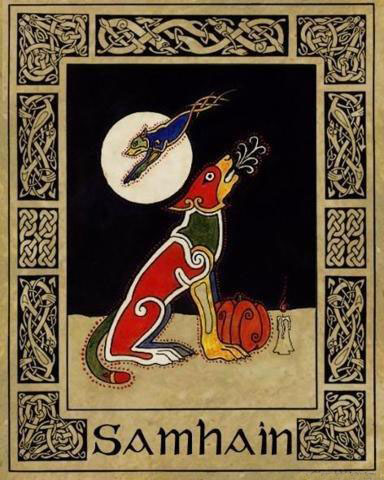
I saw the Great Wheel, and when I did I saw it through Taoist influenced eyes, as not a belief system but as a metaphor with its feet planted in my garden. It was there, right before my eye. Beltane to Lughnasa. To Samain. To the Winter Solstice.
I had embraced an ancient way, a way I had learned from study and practice. I am, sort of, a traditionalist.
So, Nine of Stones. Hear ye, hear ye. Yes, sir!
 Monday gratefuls: My sisters: Mary, BJ, Sarah, Anne. My brother: Mark. My ancient brothers: Tom, Paul, William, Mario. Family. It is both what you make it and part of what made you. Three-hole punch. Internet recipes. Cooking. Inogen. Rain and a cool night. Living on the Mountain top.
 This learning coincided with my leaving the Presbyterian ministry and moving toward Unitarian-Universalism. I found(find) the UU movement liberating, but thin soup. It’s a nice refuge for folks fed up with traditional religious institutions, but in itself it offers only a bland diet of warmed over religious thought disconnected from its roots, decent poetry, and a laudable willingness to take action for social justice.
 Oh, I used the Celtic and Northern European folk traditions in my writing, yes. But, did I believe it? No. How could I?
 At some point I realized I had become a pagan. Not in any particular sense like Wicca, or Druidry, or Witchcraft, just an ordinary pagan, a person who found his religious life adequately nourished by the turning of the seasons, by the natural world, by love.