Here’s Looking At Ye’

Imbolc                                    Garden Planning Moon

Got my self inserted into the Sports Show conversation among MIA docents.  I’ve not had time to check out the catalog or e-mails until today.

My commitment to work at the MIA has kept hold of me, even over the last few weeks where I’ve considered jettisoning it altogether in favor of a more personal, private approach.  Research for this new show and excitement about the Rembrandt and Terra Cotta Warrior show coming up reminded me why I love this work.

It feeds a different part of me than the more masculine, tough-guy, bare-knuckle world of politics.  I’ve had plenty of time with that guy and there are others out there still willing to get in the ring.  I’m stepping back from the political world, at least for now.

But the MIA?  Nope, I’ve decided I love it there, that the work still calls me and so do my friends among the docents.  I’m there to stay.  At least for now.

Imbolc 2012

Imbolc                                        Garden Planning Moon

On the Great Wheel we have moved past winter now and have arrived in a season dedicated to Brigid, the triple goddess of smith, hearth and poetry.  Her fiery inspiration fills the kitchen, the world of artisanry and of the poet.

Her fertile presence in the world is also reflected in the name of this cross-quarter season, Imbolc, or in-the-belly.  In Ireland of old this was the season when the ewes became pregnant, that is, had a lamb in-the-belly.  This meant the ewes freshened and could be milked.

(see more of Wendy’s work at paintingdreams)

After a season of bleakness and no growth fresh milk and the cheese made from it would have added a lot to the diet, protein and calcium in particular, and done it with no need to diminish stores or kill an animal.  This was a seasonal miracle.

In our time we can walk or ride to the grocery store and pick up a half gallon of milk in any season.  Imagine what it would have been like to have had only stored vegetables, probably a lot of porridge made from whatever was still left in the root cellar or pantry, and then, suddenly, to have fresh milk.  And cheese.

A glorious thing, I’m sure.

Today we might look in our pantry and check what’s almost gone.  That is, what in your life has gone out of supply.  Energy?  Love?  Imagination?  Motivation?  Friends?  Family.  Consider those the result of a fallow time, a winter of emotional or relational resources.  We all have them at different times and in different seasons of our life.

Look, then, for the new milk.  What’s quickening in your life?  Perhaps a new project.  A new friend.  Maybe a child.  Could be a feeling of confidence, of new direction.

What do you need, after the fresh milk has invigorated you to bring your little one into the world?  More time to devote to it.  More affection to bestow.  More time with yourself for ideas to emerge?  More time with family and friends to allow your relational life to blossom?

Whatever it is, Brigid is the goddess who represents the creative force necessary to freshen your life.  You might look at her and what she means.  Google Brigid.  There are lots of articles.  Don’t get into the ontological question.  Look at how a presence like Brigid might move into your life and give you new perspectives, new images, new paths.

Open yourself to the things you need to have a fruitful and productive new year.  The season awaits.


Dining In Lima, Peru

Winter                                            Garden Planning Moon

Another bit of photoshop work.  This photo in Pizarro’s house in Lima, Peru.

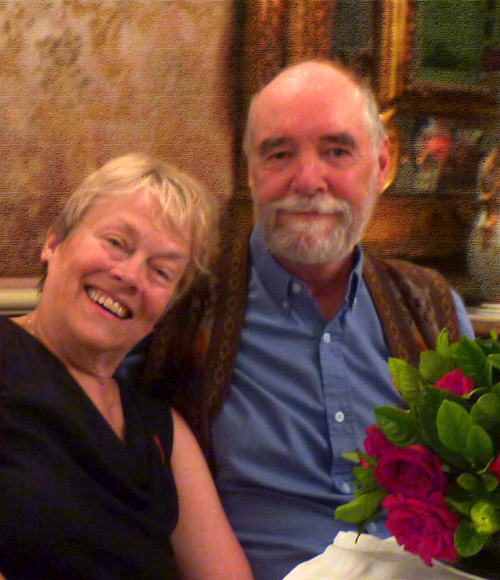
One other odd bit of info.  Tomorrow I go off private health insurance and enter Medicare.  A transition I’m making with this beautiful lady.

Also, look tomorrow for Imbolc posting.

Unchain My TP

Winter                                         Garden Planning Moon

Second (and last of this class) photoshop class tonight.  Boy, is this a complex program and it’s only one in the Creative Suite.  Lot of cool things but they will require a good bit of fiddling with before I get good with them.  A lot of fiddling.

(granddaughter Ruth and lightning)

As I walked to the parking lot from the huge Champlain High School building tonight, it hit me that this is the future for many of us over 65.  Classes, taking up space in buildings occupied by kids during the day.  And what a great deal that we have this kind of learning available.

Last week I used one of the second floor bathrooms.  In the men’s room the toilet paper was on a heavy, padlocked metal chain.  The janitor was there and I asked him about it.  He said you wouldn’t believe the condition of the restrooms at the end of many school days.

Best news.  My cousin Leisa, in a coma for a couple of months following a stroke, has begun to speak.  Stunning and happy news.

A productive day, another 1,500 words on Missing, some tentative stabs at the first essay in Reimagining and a long workout with little knee pain.  Yeah.

Since I’ve shifted to this new work schedule, life seems fuller and busier.  Seems odd, but it’s true.  I guess I’m stuck with an internal engine that will just keep humming along until it can’t work anymore.  There are much worse predicaments.  In fact this may not be a predicament, just life continuing.

Late-Stage or Last Stage Capitalism

Winter                              Garden Planning Moon


Back to late-stage industrial capitalism.  (see a couple of posts down)  In that article from the Atlantic Monthly that I referenced earlier it points out the collapse of middle class wage  manufacturing jobs in the US.  At the same time I heard yesterday that in spite of the fact that wages have increased slightly, consumers seem to be saving the money instead of spending it.

Then, the radio reporter went on to say, 70% of our economy is driven by consumer spending.  Do you see the problem here?  We challenge old-age benefits like social security and medicare, demand people take responsibility for their own retirement (which, if successful, will increase savings–which makes sense).  We also have an economy, a pillar of which, manufacturing, that used to provided millions of middle-class wage level jobs–think auto workers, steel workers, rubber (tire) workers and their like–is now dominated by robotic machinery.  This is done to reduced the work force and hold down wages, both to compete with international manufacturers, such as the ones in China and other parts of Asia.

So, if the economy is driven by consumers (70% is a big chunk!), and the trend in hiring is to use more machines and less workers, and a further trend is to bust unions (see all the right to work laws under consideration in state legislatures) and chip away at employee benefits, then who will be left with money to prop up the economy.

Unemployed people or people employed at below living standard wages don’t line up at Target or Best Buy or head out to restaurants.  Not because they don’t want to.  Because they can’t.

The big contradiction then is this:  our economic engine requires more and more economies on the part of industry and business to stay competitive in global and local trade.  Many of these economies come at the expense of income and benefits for American citizens (read:  consumers), the very ones who drive our economy.  So?


The Anti-Rogaine Hair Loss Treatment

Winter                                       Garden Planning Moon

On a round of errands.  First stop.  CVS.  Two items:  a knee brace, number 2 for my left knee, now complaining because I’ve left it unsupported.  I think.

And, of all things, Nair.  For my head.  Yes, that’s right. I’m about to try something I consider weird.  Sort of the anti-Rogaine approach to hair loss.  This stems from a period, recent past, when my hair grew out and the remaining hair on top insisted on standing up and imitating a mohawk, a really wispy, faint mohawk.  What to do?

Comb it over?  Didn’t work.  Static electricity kept popping it back up.  Kate cut it with the rest of my hair but then the remaining lawn on top had a raggedy look.  So, I took the clippers and shaved the edges.  Ah.  More symmetrical.

Still.  Looked silly.  Next stop.  The razor.  Yes, I shaved my head.  I know, but hey, I said adjusting to the last third of life had its moments.  This is one of them for me.  Kate suggested a hypoallergenic depilatory.  Say that one ten times fast.

I find this product on shelf space devoted to waxing.  Specifically Brazilian bikini waxing.  I know.  Do I want products like that on my head?  Fortunately, the old standard from long ago, Nair, comes in several flavors, one of them for sensitive skin.  Mine.  Gonna try it.

What’s next?  Johnson’s Wax for that all day shine.

The Last Third

Winter                                         Garden Planning Moon

Moving into the last third of life.  Kate’s coming total retirement, no more part time work, probably sometime around March.  The 65th coming up for me.  Markers of a turn the vessel of our lives is making, a long slow turn, no Costa Concordia, this one’s on a chart, at least the first markers then the notation, this way there be the unknown.

In the first third we crank ourselves up, get educated, separated, motivated, maybe even liberated.  In the second third we’re all about output.  Children, money, ambition, advancement.  Then this last third, a part of life with little real road map since folks just didn’t use to live this long.  Or be healthy this long.  Now here we come.  Whee.

The briefcase gets put in the closet one last time.  The suits rotated to the back of the closet.  Paychecks stop.  Driving diminishes.  The old standards, the important ones, the things we got ready for, studied for, prepared for, lived out, no longer apply.

What if the work was it?  What if the identity there was me?  Who am I now?

You might think someone out of the day-to-day workforce for as along as I have been, since 1991, going on 21 years, would have answered those questions.  Maybe not.

The volunteer work I’ve taken on has had work like trappings,work like I did when I worked for the Presbytery.  The Sierra Club and the politics.  Even the occasional preaching and organizational consulting.  What I used to do.  The MIA work has been, I admit, different in content and style, but it had this commonality, complexity and challenge.

And, to be honest, even when I contemplate pulling back toward home, back toward work only I can do, I still see it as work.  That is, a full on expression of who I am, hold nothing back, go for it.

Maybe I’m not able to kick back, relax.  Let the kids do it.  Though.  I’m glad I’ve worked with the Sierra Club because it has introduced to me a younger generation very much in the fight, hands on the banner, no letting the flag waver.  It makes me feel better about pulling back from political work.

Not sure I know quite what I’m trying to say here, at the end.  Maybe I’m worried that my continuing results orientation is a way of avoiding the next turn in our life.  A way of not sighing, watching the moon.  Patting the dog.

Ancor impari.

 

Go Team

Winter                                    Garden Planning Moon

Business meeting this morning.  Kate worked yesterday.  Still fine tuning the budget, but it looks pretty well crafted right now.  Just have to manage it for awhile, get the feel of it.  We checked our calendar out through March, making sure we didn’t conflict on car use.  Moving to one car has, so far, been easier than I had imagined it would be.

Cranking on Missing now.  1,500 words a day.  Challenging, but not too much so that I can’t do it and still do other things.

Still in transition, but the patterns and the rhythm have begun to come clear.  Finally, on Friday, I noticed the benefit of the short burst training I’ve been doing.  Lower heart rate at higher workloads on the easy days.  Increased weight on the resistance work.  Gotta keep changing things up.


Water

Winter                                Garden Planning Moon

Watched “Water” a film by Deepa Mehta.  This is a powerful, powerful film.  I know.  It was made in 2005 and I just got around to watching it.  The effects of living north of 694.

Set in Ghandi’s era in India, it features a group of widows who live together in an ashram supported by a sultry widow sold into prostitution by the corrupt widow who rules the ashram.  Forbidden to remarry, the widows, many widowed young in arranged marriages, must live as if they were, as Ghandi puts it, “strangers to love.”

This movie is a clear slap in the face to an India still struggling to deal with both independence and the changed global community in which some of their traditions appear at best antiquated and at worst oppressive and cruel.

It is part of a trilogy:  Earth, Fire and Water.  Kate and I watched Fire last year.  It, too, is a powerful movie, this time about love between women caught in loveless marriages.

I just ordered Earth.