
All posts by Charles

Bee Diary: August, 2011

Lughnasa                                                                   Waning Honey Extraction Moon

Checked the honey supers this morning.  On the two package colonies that I do not intend to overwinter, we have approximately four full honey supers.  That is, we have for harvest the amount of honey they would have needed for the winter, close to 200 pounds.  Figure that 40 pounds is not recoverable due to drips, stuck on honey comb even after extraction then that should leave around 16o pounds to harvest.
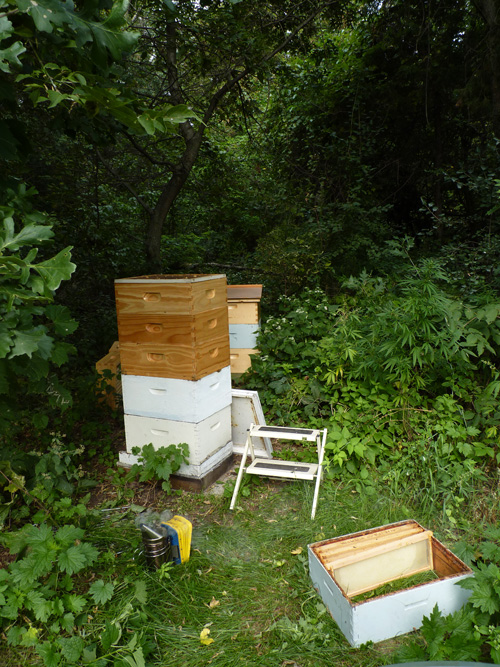
If we chose to sell it at, say $7 a pound, that would create around a $1,ooo in sales after keeping some back for own use and gifts.  After the bee packages at $60 each and amortizing the honey extractor, supers and hive boxes, syrup, hive tools, smoker, pollen, queen excluders, honey jars, top and bottom boards and telescoping covers, we’d still be in the red for the first three years.  Don’t know what we’ll do with it this year, probably give away a lot again.  It’s good for barter and gifts for sure.

Artemis Hives has produced honey two years in a row now, an artisanal honey created by bees aided by the beekeeper, me, and the bee equipment and harvest partner, Kate.

Looking at the gardening year in total we will have a good, not great honey harvest, a good potato harvest, leeks, beets, chard, beans and possibly a decent tomato crop.  Kate has good success with her zucchinis and the decorative gourds have bloomed but produced no fruit yet.  The gardening and beekeeping year will wind down in September, just in time for us to finish our cruise preparations.  Caring for gardens and bees requires a lot of face time with the plants and hives, visits to nurseries, attendance at Hobby Bee Keeper meetings, not to mention all the work of harvesting and putting food by.

I’m at the point in the year when my enthusiasm has run out a while ago and the only thing that keeps me active now is the need to finish, to harvest.  When it’s done, it’s over for the year.


In a Deep Hole

Lughnasa                                                                 Waning Honey Extraction Moon

And here I thought things were going well.  My translation this morning was far, far off the mark.  It was, Greg said, a combination of things.  I don’t know the story.  The poetry makes difficult constructions even more difficult to suss out and there were points of grammar here I hadn’t studied.  Still.  I felt like I had been wading at least in the muck, a marsh maybe, but this morning I dropped into a deep Latin hole.

Sigh.  Even though I know the only solution is to swim back to the surface and try to find the muck, at least, it was disheartening.  No wonder I couldn’t find any entries for the commentary.

Of course, I didn’t start down this ancient trail because I thought the journey would be easy.  And, I was right.

The Late Summer Garden

Lughnasa                                                          Waning Honey Extraction Moon

Working in the late summer garden.  Those creepy pre-beetle organisms continue to gnaw on my potato plants and I gnaw right back.  So far the invasion has not gained a significant beach head thanks to soapy water and the occasional visit to prune out bugs.  Parts of the garden where harvest has happened need to be weeded and green manure sowed.  That’s a weekend task.  The onions didn’t do too well this year.  I think the bed they’re in just doesn’t get enough sun anymore.

Our tomatoes have matured or are close, but we’ve only had a few ripe ones so far.  Too cool.

Kate planted decorative squash.  I took some time to look at them today.  Their tendrils reach out and grasp other branches, stalks, leaves, curl around them and seal themselves off.  These tendrils though look like springs and function like springs.  They give the squash plant some give as winds and rain put tension on the various connections.  It was easy to see how a clever blacksmith could have looked at this plant and been inspired.

With the vegetable garden in a slow period we returned to the three tiered garden in our patio area.  I worked there for an hour and a half or so this morning and it felt like being with an old friend.  I’ve spent many hours on my hands and knees among these plants, each one of which I put in the ground myself.  Well, not the trees and the dogwood, but everything else excepting Kate’s squash and zucchini.


A Latinate Day

Lughnasa                                                                     Waning Honey Extraction Moon

A Latinate day.  The am found me back in Pentheus, a story in the third book of Ovid’s Metamorphoses.  I remember the story from the English version, at least in part.  Pentheus gets torn apart by his mother and her fellow Bacchantes while they are in the grip of a Dionysian frenzy.  As I’ve been translating this story, it’s clear that Pentheus is a tragic figure from Ovid’s perspective, a man’s man faced with hordes of soft, sweet smelling boys worshiping a God of irrational behavior.  Romans were not much into ecstasy unless it involved warfare or the circus.

They were orthopraxic in their religious views, at least most Romans were, that is, they believed that right rituals performed at the right time for the appropriate deity trumped everything else.

I have begun, in a modest way, work on the commentary.  I set up some files in Notes but made no entries.  It’s difficult for me, right now, to know what makes sense, but I’ll figure it out.

My next hurdle is to translate the Latin into idiomatic English.  Sometimes I can get there, often not.  To do that I need to have a solid understanding of the grammar–not yet–and a feel for how the Latin makes its meaning, not there either.  At least I’m no longer staring at the words on the page as if they were hieroglyphics.

There and Back Again

Lughnasa                                                 Waning Honey Extraction Moon

A birthday really marks the spot on the earth’s orbit where you were born.  So, it is not necessarily a function of time in a linear sense, but the count of revolutions on the (roughly) same path.  In other words even the years of our lives do not, at least in this sense, refer to the passage of time so much as they do the passage of the earth around the sun.  I like this because it helps me have a concrete understanding of my years.  I have, for example, gone round the sun 64 times and am about halfway through my 65th.

A space-time co-ordinate.  When we add in our linear sense of time, occasioned by the evident aging process that ends in death (entropy at work), our birthday becomes a space-time co-ordinate, fixing our birth in the 4-dimensional reality of space and time, or Minkowski space.   Our birth date locates not only the 3D version of our birth–the physical locus of our birth–but establishes a reference point in some standard measure of linear time.  In the West we tend to measure time in relation to a fixed point occurring around the birth of Jesus, but it could have as easily been the birth of Socrates or Alexander or Cleopatra.

Linear time, as we measure it, has this odd pliability.  We have no fixed point in reality against which to mark its passage, unless you count revolutions around the sun; but, then we end back in the cyclical view of time, the type of time measured by the Great Wheel, because to indicate linear time we still have to agree on which particular revolution starts our series.

How many revolutions ago was Caesar murdered?  How many revolutions ago was Confucius born?  How many revolutions ago did Homo sapiens emerge out of Africa?  We still have to place our tent peg, our starting point somewhere and it will still be in revolutions around the sun.

No matter how hard we try to escape into chronological accounting, our human estimates still return to our revolutionary experience, the root source, which is, and always will be until we leave this planet for the stars, cyclical.

Happy Birthday, Kate

Lughnasa                                                          Waning Honey Extraction Moon

“Through the years, a man (sic) peoples a space with images of provinces, kingdoms, mountains, bays, ships, islands, fishes, rooms, tools, stars, horses and people. Shortly before his death, he discovers that the patient labyrinth of lines traces the image of his own face.” – Jorge Luis Borges

As the sun retreated behind the spinning earth, Kate and I sat outside at Buona Sera, an Italian restaurant in Champlin.  There was an umbrella over our table and pit a pat from time to time fell acorns, the harvest of fall already underway.  Kate’s birthday itself is tomorrow, but she works, so we celebrated today.

This is my 22 birthday celebration with her and I look forward to 22 more.  We met each other at a point where both of us needed some good luck.  We found it.

There is something satisfying about a dinner with a long time friend, especially on an important event like the day of her birth.  She is a long time friend now and my long term love.  There is a sort of patina that gathers with age and repetition, perhaps akin to the wabi-sabi aesthetic of the Japanese.  After long use, an item, say a humble tea scoop or a water ladle, takes on the character of the one who scoops tea or ladles water with it.

Our bodies, and our faces, are the same; so are the relationships most dear to us.  They take on the character of the two who create them, a lustre of careful attention and loving touch.

As the sun set, we listened to the acorns, drank our coffee and enjoyed the patina of our life together.

3 Minute Critique of Libertarianism

Lughnasa                                                                         Waning Honey Extraction Moon
“Take time to deliberate, but when the time for action has arrived, stop thinking and go in.” – Napoleon Bonaparte

Of course, we know where Bonaparte’s style got him.  Elba.  Even so he does cut against the grain of paralysis by analysis, the peculiar disease of intellectuals where worrying the problem like a bone often stands in for actually doing something about it.

Libertarians have a long, yet rather ineffective, track record in American politics.  That’s because most Americans hold libertarian views on social issues like no draft, keep the government out of the bedroom, no censorship, no government issued identity cards at the national level.  Many also agree with their hands off approach to adult drug use and other matters where personal choice collides with well-meaning, or not well-meaning, social engineers.  Think the pro-life movement, the anti-gay folks, the militarists who want everyone to have national service.

In other words this side of the libertarian thought experiment matches up well with a frontier ethos and the spirit of the bill of the rights.

On the other hand libertarians have had little effect on national politics and on state politics, too. Why?  They want to privatize social security, end all government support to individuals, cut government spending by at least 50% (which would mean closing military bases over seas, at least) and shut down corporate welfare.

Most US citizens agree that self-government should apply to social issues (matters of choice in our private lives), but also agree that there is an appropriate role for government in our public life.  A strong defense is a near universal among US citizens considering an appropriate role for government.  Many of us also agree that the promise of equality extends to such areas as health care, income support and affordable housing.  Since Teddy Roosevelt, we have also recognized government’s role as regulator of the economy, a role it engaged to good affect (though not great affect) in the recent financial crisis.  A free market blinder, worn by advocates of neo-liberal economics, blocks view of the wreckage in personal lives occasioned by capitalism’s creative destruction. (Schumpeter)

Scott Nearing, an economist at the New School, advocated a mixed economy.  We already have a mixed economy.   The government funds or controls defense, police and fire service, mail service, education, infrastructure development and maintenance, social security, medicare and various other combinations of services at state and local levels.  The market economy deals with goods and services outside of those sectors though there are overlaps.   When the goods and services are not necessary for human existence, e.g. cars, bicycles, televisions, phones, computers, appliances, insurance, most legal services, then the market does a good job of allocating capital according to the desires of purchasers of goods and services.

When housing, medical care and food, essential to human existence, are up for sale, then the market usually skews access to these away from the poor and toward the wealthier.  Equality, as a matter of simple justice, demands that we consider this bias toward the wealthy a failing of the market approach to these essentials.

Just how we mix our economy will depend on many things, but to my mind, only a cavalier approach to the obvious human costs of unfettered capitalism will demand that the many surrender access to those things essential for existence to those able to pay for them.  Therefore, I am not a libertarian.

Latino Demographic Trends

Lughnasa                                                Waning Honey Extraction Moon


The following quote comes from the Congressional Research Service, a March, 2011 report:

With the release of the results of the 2000 census, the growing role of Hispanics in the United States became apparent.  Numbering over 35 million at that time—and growing by more than 1.5 annually from both immigration and natural increase—Hispanics are now the nation’s largest minority.69 If current demographic trends continue, the population of Hispanic or Latino origin is projected to steadily increase as a percentage of the total U.S. population through 2050, rising from 12.6% in 2000 (or about one in seven persons) to 30.2% in 2050 (approaching one in every three persons) (see Figure 5).

A Member of the Loyal Opposition

Lughnasa                                              Waning Honey Extraction Moon

Today members of the guide discussion group meet with Katherine Milton at the museum.  We’ve had specific concerns around continuing education and requested this meeting to discuss them with the head of the department that includes Art Adventure, Collection in Focus and Docent programs.

I had this in mind the other day when I wrote about complainers.  Instead of figuring out how to stamp down or stamp out complainers, organizations should welcome honest critics, often the only source of straightforward critique most institutional denizens ever get.   Too often cloaked in a self-justifying cloud of hopes and projects, all folks who work within large organizations of any kind, be they corporate or non-profit, run the risk of filtering evidence through their own biases, unintentionally slanting and weighting feedback.

That’s not say, of course, that every outside critic has the truth, but it is to say that the probability of unbiased feedback rises if it comes from folks whose lives are not intimately entwined with the institution.

My hope is that this process will establish clear channels for guides (all volunteers) and their representatives, that it will open the museum to the voices of that cadre of folks who most often interact with the museum’s public, and that the result will be improved education and resources to the end of excellent tours for museum patrons.

At the Woolly meeting last night we focused on gratitude, especially for those who had touched our lives in a formative way.  I admitted, as I’ve written here before, that I’ve held at a distance folks who would mentor me. (with one unsuccessful exception, Phil Johnson) “I have an oppositional personality,” I said, “Though none of you may have noticed that.”  Everyone chuckled.

It’s not a surprise to me that I’m involved with this effort.  My ear hears the frustrated, the unheard, the fearful and my heart always aches to make them heard and felt.  Mom and Dad, in different ways, both reached out to the avoided, the uncared about and did it in spite of considerable institutionalized opposition.  I suppose that’s why this feeling has an instinctive feel, something taught before language and learning.

We all have our peculiarities, our deep inclinations, this happens to be mine.

Charred meat, cooked on propane, outside

Lughnasa                                                          Waning Honey Extraction Moon

The herd tramped out to Roseville, to Warren’s second house, a gift to be that never found its receiver.  A broad curve of land on a first ring suburban street holds this late 40’s, early 50’s rambler with dark wood, scrolled book cases, formica kitchen counters and an outdoor fireplace built into a concrete patio.  It was someone’s dream, back in the long ago, the second millennium, after the second Great War when we all wanted to huddle down, have kids, read the newspaper and go to church.

This evening it housed this a congregation of graying, even whitening men, who met to discuss at Warren’s call, gratitude.  Who did we feel grateful for in our lives?  Who reached out to us and saw something special in us, something we may not have seen in ourselves?  Who touched us?  Three wrote letters to dead men:  a seminary father figure, a partner in a business, a great-grandfather of many gifts.  One wrote to or about his father, another to his brother.  Two letters were written to former bosses.

We had charred meat, cooked on propane outside, as men’s dinners must be on quiet summer evenings when the weather still has warmth.  We ate together, swapped stories of Maine,  Saudi Arabia, grandkids and grandfatherliness.

After a moment they came up to the counter and said, ‘We go around the country walking into places and visualizing people naked.”  How ’bout that?

He also recalled a George Carlin sketch in which Carlin noted that he was not an atheist, nor an agnostic.  Instead, he said, I think I’m an acrostic.  We all agreed to put that down as our religious preference next time we were asked.

This was the fourth Woolly session that Mark has attended, perhaps the last one for a good while.  He seemed glad to be there and I was glad he had a chance to see this group of adult men who love each other.  Our congregation.