
All posts by Charles

Moving From the Theoretical to the Concrete

Lughnasa                                            Waxing Back to School Moon

Kate has had a nasty cold since Monday and I can feel it trying to claw its way up my esophagus, making my throat scratchy.  My hope is that the recent two time bout I had with some bug in July, then August has revved up my immune system.  With rest I can pound this sucker down before it takes hold.

Starting back on Latin today.  I took part of July, all of August and the last couple of weeks off with the bees and the vegetables and the orchard.  Thought I’d get work done on Ovid, review, but in fact I got very little done.  An old student habit of mine, if it’s not pressing, it’s not getting done.  I’m looking forward to the weekly sessions, building toward enough confidence to tackle Ovid and others on my own.  It’s a project, like the bees, that keeps the gears turning, not giving them a chance to rest.  Best that way.

A few years back it was the MIA docent training.  Then the move into permaculture and vegetables and fruit.  That one’s still underway as I learn the complicated dance of seasons, cultivars, pests, harvest and storage.  The MIA training, for that matter, only gives you enough legs to get into the books and files yourself, training you to look and think about art, but each tour demands specific self-education on the objects and the purpose of that tour.

(Minoan Gold Bee pendant from Crete, circa 2000 BC)

Part of my impatience with the seminary experience is that I’ve moved so deeply into more concrete endeavors.  Art has the object as an anchor, then its history and context.  Latin has words, grammar and literature as well as Roman history.  Vegetables and fruit have real plants, particular plants with needs and products.  The bees have the bees themselves, the colonies, woodenware, hive management, pest control, honey extraction.  This is, probably, the world I was meant to inhabit, but philosophy and the church lead onto another ancientrail, that of the abstract and faraway rather than the particular and the near.  It’s not that I don’t have an affection, even a passion for the theoretical, I do, but I find my life more calm, less stressful when I work with art, with potatoes and garlic, with conjugations and declensions.

I now have almost three decades of life devoted to the theoretical, the abstract and the political so I bring those skills and that learning to my present engagement with the mundane, but I no longer want to live in those worlds.  They are gardens others can tend better than I can.

How Do We Open Ourselves to Mystery?

Lughnasa                                      Waxing Back to School Moon

A very busy three days with something in the evening each night plus events during the day, too.  Glad to get a chance to get back to the bees and the garden.

Some autumn blooming bulbs came in the mail today, so I’ll get a chance to plant them over the weekend.  I need to get outdoors.  Fall bulb planting is one of my favorite garden chores.  Crisp weather and Folk Alley radio, sometimes the Andover Marching Band can be heard in the background.

I’m still trying to come to grips with the unsettling experience I had at the seminary tonight.  I have no patience for the God talk, less for the elaborate hermeneutical dance that goes on in such settings.  I put myself in the room as a favor to Groveland and to Leslie, but I no longer feel like I belong there, a strange feeling after 15 years in the ministry.  These used to be my people; it is my seminary; but, I feel more like an outsider now than I did when I began back in 1970 and I was very outside the norm then.

I hope I’ve not done Leslie a disservice by agreeing to do this.  I still respect the faith journey, the attempt to wrest some purpose out of life, to read the palimpsest of history and of nature, scraping away the latest scribbles to look even deeper, to find a way into the world of divinity, a trace of the sacred on the wind.  These represent the sweetest and the best of human endeavor, those moments when the human vessel becomes a vehicle for discernment.

The institutional expressions of religion, the rationalization of charisma as Max Weber said, do little or nothing, indeed often obfuscate the journey with the insistent demands of institutional maintenance:  credentialing of clergy, fund raising, dogma protecting, seeking new members, building buildings, routinized worship.  Where is the ecstatic?  The mystic?  The awe-some?  Where is the deep calling unto deep?  Where is the fearless acceptance of the human condition?  Dangerous, lovely, cloying, sensual, heady, brutal, wild and untamed, even in the most civilized.  The Methodists and the Presbyterians and the United Church of Christ and the Baptists and even, for no God’s sake, the UU’s have fashioned clay towers with bright windows but no doors and no way outside.

The journey happens at night as sleep comes, when a dream grabs you by the throat and won’t let go.  The journey proceeds as you walk to work, hold hands with a lover, dance in the rain, smile at the gorilla and the lion fish.  It goes forward along the ancientrails of art, literature, dance, music, theater.  Meditation?  Sure.  Quiet moments with fellow travelers?  Yes.  Finance committee meetings?  Don’t think so. Evangelism?  Nope.  The journey deepens when we become vulnerable to ourselves, to the world around us and I’m sorry, but I don’t see the support for that in the pews of any church I’ve ever attended.  Perhaps the monastery holds an echo of it.  The solitary parishioner at prayer.  The Jews at the wailing wall.  Muslims at the Kabah.  Maybe.

But the weak tea I experienced tonight? Unlikely.  And I feel bad about that, sad.

Tired.

Lughnasa                                         Waxing Back to School Moon

The docent luncheon today.  It is always an event where mediocre food meets a droner of a program.  I’s only salvation lies in the persons seated near you.  This is like the platoon in the army.  You wouldn’t go into the trenches for the colonel (Debbie or Sheila), but for your buddies, the folks seated near you, you will endure the whole as if it were something you really wanted to do.  The food this time was Asian, a plus in my opinion, but in name only.  We also had the awarding of various things for various levels of service.  One woman, Sally Lehman had been a docent for 45 years.  That’s a long time.  Even my class got pins for our 5 years of service beginning in 2005.  It’s gold and I have it on the bookshelf beside me.  Beside the five-year pin from the Collection in Focus program.  It’s silver.  Shows ya.

After the luncheon I wandered through the museum and found Embarrassment of Riches under installation.  This is a new photo collection documenting the global expansion and concentration of wealth that has characterized the last 30 years. It looks like it will be a stunner.  The lecture and walk through are next week.

The continuing ed featured the Decorative Arts curator who I found funny and detailed in his knowledge.  He showed a wonderful silver cup that the museum purchased by a Strasbourg silversmith named Baer.  It is his masterpiece, that is, the piece he used to gain admission to the guild of silversmiths in the Silver City.  It is a tour de force of detail and skill, called the most important work in silver of the 20th century to come out of Strasbourg.  Worth a look.

Home for a nap.

The out to UTS for an evening in the field education class.  I have responsibility for an intern this year for Groveland UU.  A disappointing evening.  The talk the talk the talk, a long line of talk.  No wonder lay people get weary of the clergy.  The stuff is fuzzy, emotive and allusive–religious.  I’ve changed since I was in the Seminary in the early 70s.  A lot.

I now find most of the process tedious, though I look forward to working with Leslie.

Integrated Pest Management

Lughnasa                                Waxing Back to School Moon

It’s been a wet, cool few days.  The Apiguard I picked up last night only works above 60 degrees and 70 is better.  It recommends chemical resistant gloves.  I’m using this on two colonies, the parent and the divide.  I tested the divide and its high, putting the colonies winter survival at risk, though I did not test the parent since the divide began with a hive box full of parent colony bees, it seems reasonable to assume it has a high mite count, too.  I don’t like using the medication, but the UofM, which shares my bias toward Integrated Pest Management and leans against treating recommends it.  I did count my mites, too, so I know the divide has a high mite count.  The package colony, which had only 1 mite all together, I will not treat.

The fumigilin-B treats nosema.  In this case the only way to reliably test requires a 400+ microscope, an expensive counter and a bunch of dead bees beat up in a mortar and pestle.  The U, again, recommends treatment this year in particular so I’m following their advice.  Nosema and varroa mites are two of the culprits in colony collapse disorder and often combine to cause the winter loss of a colony.

Integrated pest management for mites and nosema includes using Minnesota hygienic queens, which I have done, and can include use of a drone frame which attracts mites because drones take longer to pupate.  When the drone frame has capped brood cells, the beekeeper removes and freezes it, killing the mites and the drones.  This reduces the overall mite load.

Integrated Pest Management (IPM) has been around for a while.  It’s sort of a middle ground between all organic and contemporary agriculture/horticulture/apiculture techniques.  The idea is to put any chemical treatments as last resorts, utilizing first techniques that either directly mimic nature or are supportive to it.  In gardening, for example, companion planting qualifies.  So does crop rotation.  So does soil improvement.  So does hand picking insects and pruning out diseased branches or plants.  Another involves acknowledging that some level of disease and infestation is a normal part of the natural world.  The problem comes when the level begins to interfere with the plant or animals productive ability or its ability to, say, survive a Minnesota winter in our case.

In apiculture it involves, in addition to what I’ve already mentioned, culling 20% or so of your woodenware as it reaches 5 years of age.  This reduces nosema because the nosema organism lays down spores that can last as long as 75 years.  Another technique involves making sure your colonies have adequate food supplies for the winter.  A colony that struggles for food in early spring has much higher susceptibility to disease.

I use IPM in our perennial flower beds, our vegetable garden and now in the Artemis Hives.  I’ve not started in the orchard yet because fruit trees are still a mystery to me.  Gotta resolve that over the winter.

Jax

Lughnasa                                     Waxing Back to School Moon

After a nap, I headed out again, the second of three busy days.  This time I went to Jax, a return to the 1950’s with dark wood paneling, a lovely buffet table and Jean-Marie’s jax-matchbookmilestone birthday.  Happy Birthday, Jean-Marie matchbooks, the whole Jax touch.  I met Jean-Marie’s daughters and spent a good bit of time chatting with her oldest who until recently was a graduate student under Marla Spivak, the bee goddess of the UofM.  She and Jim of Nature’s Nectar, whom I saw later, convinced me to try and keep my old parent colony.

The elegance of the Jax setting made for a dignified tone.  Other docents came in and I spoke with Joannie Platz, Toni de Lafour, Marilyn Smith and a few others.  I saw Allison as I left.  She has a very fashionable red knee brace.

A long drive out to Stillwater to Nature’s Nectar to pick up Apiguard, Fumigilin-B, shims, hive stands and corks.  Jim’s a knowledgeable guy and easy to talk to.  He gave me some good advice about the parent colony.  He requeens every year, so the need to eliminate the old parent colony is not so high.  With tests and assays I should be able to keep on top of the mites and other diseases, too.

The drive back from Stillwater was in pouring rain; the first time I’ve driven in really heavy rain this year.  Back home now and dry.

Tomorrow is the docent lunch at noon, then the UTS event at 6:00 PM.

This Time, I Moved the Art.

Lughnasa                                  Waxing Back to School Moon

A bit bleary eyed this morning, I ate breakfast, drank some Awake tea and stumbled out the door without my glasses.  I was on my to the U-Haul store to rent a truck, a whole truck to carry one painting.  Jeremiah Miller, my brother-in-law, married to Kate’s sister Sarah, painted it.  Kate bought two of his works quite a while ago.  He’s an accomplished landscape painter living in North Carolina who exhibits and sells mostly in the South East.

His works are usually big, the one I needed the truck to move measures 5′ 10″ by 5′ 10″.  Here’s an example of a recent work for sale on his website:

We put a four inch slice in it while moving it from one room to another.  It had to go into the art doctor, the Midwest Art Conservation Center.  After securing it with a roll of landscaping cloth and a Cuties tangerine box, just the right amount of pressure to keep it flat and in place, I drove it into the MIA where the MACC has space in the basement of the new Target wing.

Loading Dock B has big folding doors, installed to mollify angry neighbors who complained about truck exhaust polluting their neighborhood.  They open up, like the jaws of a leviathan, inviting you in, then closing on you after you park.

At that point a guard comes up and wonders what the heck a u-haul truck is doing in the museum’s dock area.  I explain that Jonathan expects me.  She nods and calls.  Yes, he was.

Jonathan came up and helped me carry the painting up the stairs and onto the MACC’s shiny elevator. This is a very new wing.  We whirred downstairs one floor below ground level and carried the painting out of the elevator and into the painting conservation room, a room I had visited while on a tour about a year ago.  This time it was one of our paintings that would be tended to the by careful ministrations of the conservators.

Art conservation is a rarified world inhabited by people who have both a fondness and talent for fine art and an interest and skill in chemistry and materials management.  Paintings are not the only objects conserved.  The MACC handles conservation work for the Upper Midwest, covering many museums, its usual patrons, and the occasional job for private art owners.  Sculpture and frames constitutes another department, textiles another and works on paper yet another.  Each of these departments has its specialists who know how to remove paint one flake at a time, how to resew a moth eaten tapestry or restore life to an ukiyo-e print damaged by scotch tape.

The process requires a 100 dollar examination fee.  The result of this work is a condition report and a treatment proposal.  We’ll receive ours in one to two weeks.

I drove the truck back to the U-haul store.  I had estimated, off the top of my head, that the trip would require 50 miles.  I went 51.  Not bad.

Busy, Busy

Lughnasa                                  Waxing Back to School Moon

Whew.  The new queen came today in a perforated UPS box, complete with a court of five worker bees.  After spraying them with sugar water, I took them out to the honey queen-bee-mdhouse where I pushed in the cork at the end of her wooden home, inserted a marshmallow (tiny) into it firmly, then opened the divide, took off the honey filled top hive box and inserted the queen in the middle of the second box.  This is called a slow release.  The queen and her workers eat away the marshmallow from one side, workers in the hive from the other.  Over the time this process takes, so the theory goes, the new queen becomes less threatening to the workers, who then allow her to come out and become their new monarch.  If it doesn’t work, they kill her.  I won’t check for another week.
With the queen in her new castle (hopefully), the grocery store was next on my list since Kate has a cold and she likes my chicken noodle soup when she’s sick.  While I made the chicken noodle soup, I also cooked lunch.  After we ate lunch, Kate went back to rest and I went outside and picked yet another several cups of raspberries.  Our bushes have been prolific this year.  The chicken noodle soup had our carrots, onion and garlic.

When the raspberries were inside, I worked downstairs answering e-mails while I waited for the soup to finish cooking so I could add the egg noodles and the peas.  At the end of that.  Nap.

After the nap I had to sort out a vote on legislative priorities for the Sierra Club and respond to a few more e-mails.  This took me up to the time to leave for the Minnesota Hobby Bee Keepers Meeting at the University of Minnesota.  The man who runs nature’s nectary, Jim, was there with a refractometer to measure moisture levels in honey.  Our capped honey was 16.9%, a little thick and the uncapped honey was 18.3%.  Since honey is anything below 18.6%, both of our batches were fine.

Home again where Kate and I ate some soup, watched a little TV, put the dogs to bed and then headed there ourselves.

Death

Lughnasa                                         Waxing Back to School Moon

The thing about death is, it is forever, unlike life.  Once entered there is no return.  It is that one way disappearance that creates the chaos of grief, the sense, the realization that something has been done that cannot be undone.  There is no longer any action to take, no remedy to try, no act of contrition that will change things.  There is here, the living, and there, the dead.

Death comes to humans, dogs, mice, birds, lizards, fish, death comes.  We living things are alike in facing the cessation of our agency, the end of all the striving.

Life has death as its forever dance partner, the danse macabre.  It is a dance like those marathons from the 30’s where the dancers slump along near the end, barely holding each other up as the sun rises and the music slows.  The dance hall begins to take on its daytime character, the cracks in the ceiling come out, the floor has not been mopped, the romance of the contest and the hall slip away and we are left with the one partner who will never let us go.

Death is not life, whatever else it may be.

Tibetan Buddhist thought has a wonderful, I would even say exemplary, way of approaching death.  The photograph here, a partial of a Yamantaka statue, illustrates it iconographically. “Yamāntaka is a Sanskrit name that can be broken down into two primary elements: Yama, the name of the god of death; and antaka, or “terminator”. Thus, Yamāntaka’s name literally means “the terminator of death”.”  This statue shows Yama in cosmic embrace with his consort, thus wisdom and compassion become one.

Meditating on Yamantaka, so I was told by a Tibetan Buddhist, involves imagining your own death in as real a fashion as possible.  The intent of the meditation is to eliminate the fear of death, either in the body or in what Buddhists call the subtle body.  When we achieve an acceptance of our own death, we become free.  This is, if I understand the Buddhist thought correctly, also a path to enlightenment.

Of course, a Buddhist would see this in the context of Buddhist doctrine, with which I am not familiar, but I have embraced this image and this understanding as an important part of my own spiritual journey.

Hilo: Grief Is A Price You Pay For Love.

Lughnasa                         Waxing Back to School Moon

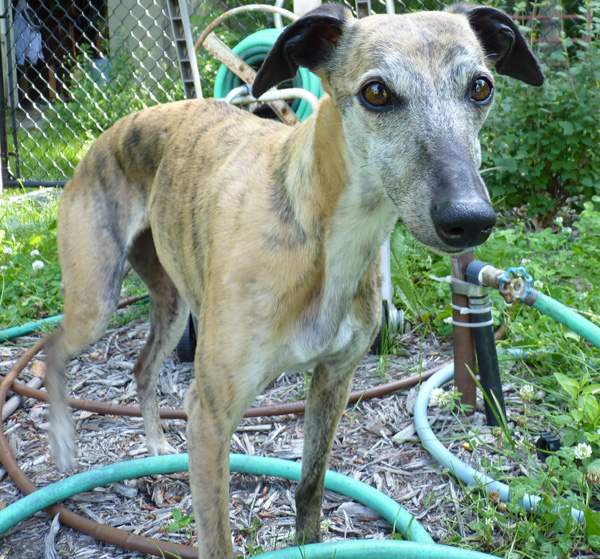
9 years ago Kate and I bought two small whippet puppies, sisters, and named them after two towns on one of our favorite spots on earth, the Big Island of Hawai’i.  The larger of the two, Kona, took her name from the west facing town on the Kohala-Kona coast, the side of the Big Island which has some of the most luxurious resorts in all of Hawai’i.  Hilo, the smaller girl by about half, took her name from the east facing island town of Hilo, a blue collar town of Japanese and Hawai’an workers, a bit rough around the edges and the site of more than one tsunami, the most recent in 1964.

We held them on our laps a lot when they were puppies and even after they were grown they would, from time to time, lobby for us to hold them that way again.  Hilo would 600hilogarden_0128hop eagerly into my lap, sit there for a minute or maybe less, then stand up, moving here and there, trying to achieve some location that felt right to her.  Most often she would jump down.  She had her opinions about all sorts of things and acted on them.

In the morning before we opened their crates Hilo would lead Kona in a high pitched whining chorus with dips and doodles, plaintive and loud.  When upstairs she would bark to be let out and to be let back in.  Though the smallest of all our dogs, she let none of the others take her spot on the couch or get near her food.  She was not ornery, but she was clear about boundaries.

When I went outside to garden, Hilo went with me, sometimes standing right where I wanted to work.  I would gently lift her out of the way and continue.  After I got the bees, Hilo would come right into the bee-yard with me while I worked.  She would stand there, bees buzzing all around and watch me, sometimes lying down in a sunny patch.

An enduring memory from her young puppy hood came when she and Kona dug under the southeastern corner of our fence.  I discovered her not long after they escaped, but she was on the other side of the fence.  I called her name, Hilo.  She looked over her shoulder, gave me a sweet, delighted look, and took off on a path through the forest–away from me–at a full suspension gallop.  She was so happy.

She had some negative kidney function numbers earlier in the year and by the time of her physical in June, they had gotten worse.  Roger Barr told us she had probably two months, nothing to do but allow the disease to play itself out.  We changed her diet, starting giving her rimadyl for pain when she started wicketing.  We extended his two months to three, but she died this morning, just over 9 years old.

Hilo was my friend and close companion.  Often, she would take a nap with me and curl up in the crook of my arm.  When I was outside, she was, too.  She came when I called her, after those early days, and sat with me while I read.  She was a vital, distinctive voice here and I’ll miss her.

Grief is a price you pay for love.

Rigel. Again.

Lughnasa                                             New (Back to School) Moon

The partisans of summer have begun to moan its passing here in the north country.  Those of us who love the fall and the winter have only begun to savor the cooler nights, the lower humidity and the reduction in thunderstorms.  The harvest has begun, though much lies ahead.

Rigel, again.  So, I got up early this morning, took my peavy and my swede saw, and trudged, a bit bleary eyed, back to the fence and the fallen down tree.  The peavy was no help, as I suspected it might not be, because there was no way to achieve leverage with it.  The tree balanced on the fence above the ground.  Nothing for it then but to use the swede saw.  After some huffing and puffing, the trunk broke in two and fell away from the fence on both sides.  I put the electric fence back in place, then walked the entire perimeter to be sure I hadn’t missed anything.  All this before my morning tea.

Got inside, the tea on its way and cereal in the bowl when I noticed a flash out of my eye and saw Vega looking down into the perennial garden.  I got up to find Rigel just on the other side of the gate.  She had pulled herself over it.  Sigh.  This time Kate and I decided what we needed to do and since Kate was on her way to pick up meds and money for my trip she went to her favorite store, Home Depot.

We let Rigel out to eat and I watched her.  She started to pull herself over again.  I went and said, NO.  She moved away from the gate, ate some food, went off in the yard to romp with Vega.  Not five minutes later I saw a blur on the deck.  She had launched herself over the gate from a full run.  Geez.  Kate, the front door.  I’m going after her.  Rigel went into the front yard, ignoring me.  Kate came out and called her.  Rigel ran, not toward Kate, but toward the front door to the house.

She is now in her crate as we seal off yet one more escape route.  She tests our ingenuity.  Regularly.