
Spring New Shoulder Moon

Good conversation yesterday with friend Bill Schmidt. He turned 81 on Friday, a birthday call. He’s deeply involved in a business, UFaceme, (picture above), writing code, doing statistical analysis, using pitch decks to secure investors. May we all be as vital at his age.
My phone call with him took place at the Final Approach, the food court at the cell phone lot for Denver International Airport, while I waited for SeoAh’s text. She flew in from Atlanta yesterday to stay with us until Thursday. Her English has improved significantly and we chatted easily on the way back from the airport.

Been wondering for a while why I’m so damned exhausted. Caretaking seems to demand far more of my psyche than my body. The various chores I do, by themselves, are not physically onerous. Washing dishes. Not hard. Doing the laundry. Not hard. Running the vacuum, picking up. Not hard. Grocery shopping. Not hard. Taking Kate to medical appointments, handling the tasks with her that being one-handed makes difficult. Not hard. Feeding and managing the dogs. Not hard. The sum of them all? Makes me, as evening approaches, short of emotional reserve and wanting to flop in a chair. Why?
 Well, a reason occurred to me. Decision fatigue.* This involves the affective cost of constantly making decisions. The theory suggests that we have a limited amount of attention and choice-making each day. Sleep restores it, but as we make decisions our decision making ability depletes, often quite rapidly, leaving us emotionally drained and less than crisp in whatever we’re doing.
How does this apply to caretaking? All those not hard things each require a certain level of attention and decision making. Do I wash the dishes now or do I wait until after supper? How much laundry soap do I use? Which setting on the machine? Is it time to vacuum again? Does this stuff need to get put away? Where does it go? Why isn’t Rigel eating? What can I do to help her? What’s on the grocery list? Do I need to get gas? You get the idea.
Though none of these things individually are hard, many of them are ones that Kate takes care of in the normal division of labor in our relationship. That means I don’t have settled, habitual ways of handling them that bypass decision making. Over time I would gain those, figure out a way to include all of them in my day without having to find the detergent, measure it, wonder how long the cycle takes. But for now each of them requires a flood of mini-decisions, each of which drains energy.
Just writing about this makes me want to find a chair, flip on the TV and zone out for a while.
*decision fatigue refers to the deteriorating quality of decisions made by an individual after a long session of decision making.[1][2] It is now understood as one of the causes of irrational trade-offs in decision making.[2] For instance, judges in court have been shown to make less favorable decisions later in the day than early in the day. wikipedia

 Beth Evergreen has reached out to us in several ways. Individual members have offered to bring food or otherwise help. Leah, the executive director, called, wanting to know if we needed anything. Several folks from our mussar group responded to my e-mail on Thursday with love and concern. For both of us. A thought that keeps going through my mind: beloved community. Christian churches aspire to this, Beth Evergreen achieves it. I’m proud to be a member of the congregation.


 Last week at mussar we had a fascinating conversation on the essential dourness of both Jewish and northern European cultures stimulated by the Norwegian concern that they had won too many medals in the winter Olympics. In both cases happiness, and by correlation, joy, are suspect. Why are you so happy? What makes you think that will last?


 Thursday afternoon mussar. Talking about joy and sadness, how to cultivate joy. The middot of this month. Middot = character trait. Though the discussion was good, the time immediately afterwards was even better. I shared in vaad (speaking into the group, with no feedback. Concentrated listening.) about melancholy, being there now and having learned to listen to the melancholy instead of trying to fix it. Waiting it out.
 A couple of things have come into focus over the last few days. One, I need to work more with my hands, with my body. Now that the turmoil of our first years here has begun to subside I’m missing the garden, the orchard. Not just the growing, the plant care, the flowers and vegetables and fruits fresh out of our soil, but carrying bags of compost or digging or moving bee hives, tending to the raspberry patch. If I don’t do this, I can get stuck in my head. Not the only part of me I want to nurture.
 And the reading. Oddly, the deeper my immersion into Judaism, the more my interest in Taoism increases. So. Diving into those books, some online educational material. Also, Reimagine. Reconstruct. Reenchant. Material on emergence. James Hillman. Magic and reenchantment. Reinvention of the sacred. The auld Celtic faith.
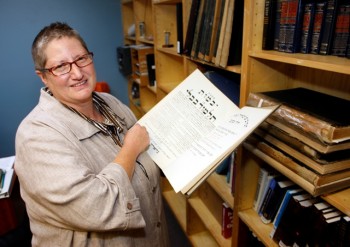 Rabbi Evet teased out characteristics from those stories after a bit and suggested that a way to honor his memory was to figure out how to put back into our little community the attributes lost by his death. His smile. His willingness to help. His commitment to education.
 I meant that and this experience with Rabbi Evet illustrates it. Beth Evergreen is a place where the heart and the mind both get their due. In fact, lev, the Hebrew word for heart, is also the word for mind. There is no other word for mind. Mind and heart are lev.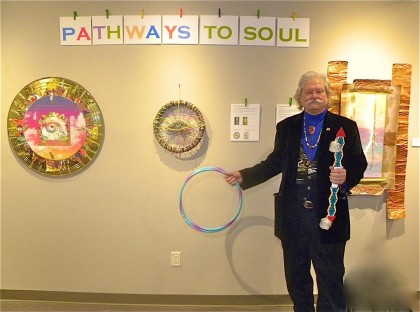

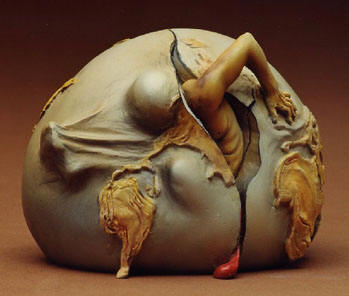 It is axiomatic that each person is unique, a particular example of the human, of life, of the creative process that began at tzimtzum or the big bang, thrown into a particular time and a particular place. It is that particularity that Emerson elevates. It is that particularity which formulates within us, as instantiations of the whole, our own work. When we tap into the sacred, the shard of ohr (divine light) lodged within us, we come to know our work. And, the world needs it because you are the only one with this spark of the divine and the only one in the whole history of the universe who has it. If you don’t express your ancientrail, it will die with you and the world will be poorer.

 Sandy, our house cleaner, who is about to have brain surgery for a second time on the 20th of this month, got her quilt Kate made her yesterday. She’s a strong woman and she’s had a very, very tough year. Unfortunately, the tumor did not debulk as they had hoped after the first surgery. It’s benign, but large. The aftermath of the surgery is awful. Disorientation. Nausea. Headaches. And these last a while. A quilt is such a great gift in this situation, since a lot of time in bed is part of the recovery. Covered in love.