Category Archives: Bees

The Bishop’s Room

Imbolc                                     Waning Bridgit Moon

This room is the Bishop’s bedroom.  B-1 in the Bishop’s wing.  Which has only B-1 and B-2.  When the Bishop comes, he stays in this room, uses this pigeon-hole desk, which I find surprisingly user friendly, and has a whole sitting room for himself and his entourage.

(lined up to reserve this room. this first guy just couldn’t believe they’d let me in ahead of him.)

I imagine I have it because, since Tuesday, I’ve been the sole retreatant.  Just me and 14 monks.  By chance I stayed in B-2 during the Woolly Retreat in February, so I’ve completed a tour of the Bishop’s wing.  This room’s better.  It has this pigeon-hole desk while the other has a flat top desk that would look at home in a down-scale dormitory room at a community college.

The shower here has sliding doors and a plastic molded seat.  B-2 has a narrow stand-up shower almost under a window.  Here, I have a bookcase bed.  In B-2 it was just a bed.  There is also a small nightstand with four drawers and brass handle pulls.  I put my pajamas in there.   Oddly, the drawers all have a divider which makes them less, rather than more, useful.

Tonight, after I wrote in praise of silence, I discovered that the monks kick up their heels on Thursday night, dining in the guest dining area and, wait for it, talking during the whole meal!  I sat with Brother Paul and Brother Chris.  Father Tom joined us, too.

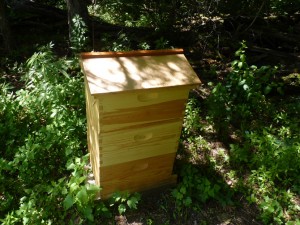
We talked bees.  Brother Paul and Brother Chris are bee-keepers here though they’ve not kept any bees for the last couple of years.  Sounds like they’re going to give it a go again this year.  They have large fields of clover, one of the best honey plants, and alfalfa.

Precious

Imbolc                                                  Waning Bridgit Moon

Sheepshead tonight.  I took in honey for Ed, Dick, Roy and Bill plus honeycake that Kate made from our honey.  Artemis Hives honors the ancient Greek Goddess of the hunt who also had honeybees within her domain.  Worshippers took to her altar honeycake as an offering.  My original idea was to call Artemis honey, “The honeycake honey” and include honeycake recipe and a bit about Artemis with each sale.  Might still happen, some year.

The card gods were good to me tonight, again.  They gave me three good hands when I dealt, a good position when playing sheepshead.  Ed and Bill both spoke about their wives with Bill reporting the good news that Regina’s cancer score has already begun to trend down after only a brief time on the hormone therapy.  That’s the kind of news it’s good to hear.

Ed’s wife has challenges surrounding a knee replacement gone bad compounded by her other health related issues.  She’s in a transitional living facility right now while they try to calm her body down.

As life goes on, I appreciate more and more the precious nature of the relationships I have at this sheepshead table, at the Museum, among the Sierra Club folks and the Woolly Mammoths.  Each place enriches me and gives me a place to just be, be who I am.  What a gift.

So, good night to you and to Artemis Hives matron Goddess.

Carpe this Diem

Imbolc                                                 Waxing Bridgit Moon

OK.  Today is a new day.  I do not plan to torture my computers anymore today in regard to my legacy laserjet printer.  It has been a faithful companion throughout the last 19  years and I do not plan to give up on it yet.  Even so, I’ve experienced my tolerance level of geek futility since I tried to convert it from parallel processing to usb, so it will rest on the sidelines for a while as I install the new multi-function printer later in the day.  If I can find a new laserjet printer for under $300 I may just get one with a native usb connection.  Not sure I’d do with old faithful.  I might bring it in here (the study) and see if I can convince it to mate up with the Gateway in here.  I might give it to somebody with a parallel printer port.

I know, too, that losing colonies is still common for beekeepers and that my experience is not unusual.  In fact, as I said a bit earlier, I was not surprised by the deaths of two of the colonies. Only the package colony’s demise surprised me, since it seemed to have plenty of honey and a healthy group of bees.  Another year is another year.

With temperatures above freezing the dogs are frisky, staying outside longer, bumping, running, tails held high.  They both hunt between the honey house and the play house, noses to the ground, body alert.  Kona still finds the outdoors a bit too cool and no wonder, she no longer has any hair on her butt.  I know how it feels when there’s no hair on the head, probably a similar sensation.  And it is hard for Kona to put a hat or a scarf on that particular location.

I’m inclining toward a Renaissance theme for the Titian tours.  This exhibit showcases the High Renaissance in Venice from its beginnings in the early 1500’s through its end in the 1580’s.  Venice held on to the Renaissance longer than the rest of Italy, though even its extension ended well before the Renaissance limped toward its end in the 1700’s in northern Europe.  The Renaissance gave shape and content to our era, actually doing what those embroiled in it thought they were doing, ushering in the modern age, shifting from the ancien regime to the days of democracy, individualism, capitalism and science, days within which we still live.

Not often do we have the chance to experience such a clear visual record of this dramatic change in the lifeways of Western civilization, a record written not in words, but in the brushstrokes and vital imaginations of artists who distilled the time and painted it.  On canvas.  Using oils.

A No Good Day

Imbolc                                          Waxing Bridgit Moon

Some days.  You know.  This was one.  I got the printer cable.  Spent another 2+ hours fiddling with the printer.  Nothing positive.  Still.  I know it’s a breed fault, but I do prefer to be competent.  At everything I do.  Every time.  Not perfectionism.  It’s competencism.  Things don’t have to be perfect, but they have to display my general competence, or else.  Well.  You may have been down that hole, too.  It can get deep.

Then, I went out to check on the bees.  I suppose I might have missed something, I did last spring, but I don’t think so.  All three dead.  Geez.  I didn’t stop to diagnose the cause.  I just closed the hive boxes up and walked back inside.

I tried yet one more time on the printer.  Well, actually, several more times, flailing at different solutions suggested by this website and that.  Even went into DOS, foreign territory for me.  I got in and got out of DOS unscathed, but no closer to a solution.

If I had any hair left, I’d be pulling it out right about now.  Guess I’m gonna have to call Steve again.  See if he say some words over the machines, toss some holy byte water at them.  I don’t know.  An exorcism?

The good thing is.  Worked out.  Got my endorphins buzzing around the old synapses.  Sweat.

Now.  I can be philosophical.  Never to fail is never to do.  Never to do is to be dead.  I want to be alive.  I want to try things that challenge me.  Guess failure is part of that.  Gotta be.  Otherwise no forward progress.  So, I’ve got two challenges ahead:  get the packages installed in early April.  Do the due diligence before hand to find out what killed the bees.  Fix what I can fix.  Get the printer installed.  One damn way or another.

Grrr.

Disassembled

Imbolc                                         Waxing Bridgit Moon

Looks like I’ll get a chance to peek into the colonies this weekend.  Got my fingers crossed on survival.  Best guess?  Two dead, one alive.  Very glad to be wrong.

Got my second Gateway part way disassembled and still not sure I can get at the pint sized disc I stupidly inserted into the DVD drive vertically.  It fell out of the holder, as I could have guessed it would.  Have to get this in though to make the computer recognize the cable to USB cord.  That will shift my old HP printer to the new gateway, making it accessible directly from the network rather than through my old, now terminally ill, Dell.  Once I’ve accomplished that I can bring online the new HP multi-purpose printer.  When that’s up, I can scan in my Ovid commentary and send it to Greg so we can both have the same info.  I need both of these printers working, but there are these other steps I have take.

On to Latin.  This chapter, chapter 27, contains this section heading:  Adjectives Having Peculiar Forms in the Superlative.  Peculiar forms, eh?  Maximus peculiar.

More Latin today, some Titian, too, in advance of the walkthrough tomorrow with Patrick Noon, the painting’s curator.  I’m looking forward to this since I haven’t seen the paintings yet.  In the evening there is a lecture on Ukiyo-e prints, another favorite genre for me.  A feast of art education, tomorrow.

Bee Diary: 2011

Imbolc                                                           Waxing Bridgit Moon

Out in South Dakota, near Hecla, the ewes have begun to swell, an ancient, very ancientrail.  They will give birth, lambs.  Around that time, lambing time, the fields, too, will freshen with grass, food for the little ones.  Think of the shepherds at Jesus’ birth.  Jacob and his twelve sons.  Shepherds rescued Oedipus, Romulus and Remus.  The shepherd became a metaphor for closeness to nature, a life untrammeled by the woes of civilization, watching over flocks in difficult places, protecting the sheep from wolves and foxes and dogs.  Sheep provide wool for cloth, milk for cheese and meat for the table.

Similar, I suppose, to beekeeping, another very ancientrail.  In both cases the shepherd and the beekeeper are partners in a collaboration between, in one instance, fellow mammals, and in the other, with insects.  In both cases the primary goal is to maintain the flock and the colony in good health, free from disease and predators, and in return receive wool and honey.  It is, to me, a special case though, to enter into an intimate partnership with insects, and not just insects individually, but insects in community, a colony.

This last, this partnership between humans and bees, crosses not only a species barrier, but phyla, both animals yes, but with very different evolutionary paths.  I don’t believe there is much fellow feeling between the bee colony and the beekeeper, at least from the bee’s side, yet the collaboration demands each do their part and I find it entrancing that, when I work in the garden and the bees are there, too, dipping into the flowers, that we are colleagues here at 7 Oaks, the bees of Artemis Hives and the humans of 7 Oaks.

When the weather warms above freezing, I will go out and inspect my three colonies, see how many have survived the winter.  Just a quick check, the only purpose to discover if the colony is alive.  If not, I will order a package for each dead colony.  Also, I will remove the bees and try to diagnose cause of death; since a diseased colony, especially one with American Foulbrood, may require burning of all the frames and scorching of the hive box with a flame thrower.

I hope they’re alive, all of them.  It was a good feeling last spring to find a thriving colony.

The Growing Season Begins. Now.

Winter                                             Waning Moon of the Cold Month   -13 at 8 am today

Just slept 11 hours.  After a two-hour nap.  And ten hours the night before.  My body is at work, fending off this chest cold I have.  I feel pretty good right now, but I don’t think it’s quite done.  Still, fluids, steam baths and rest.  That’s the ticket.

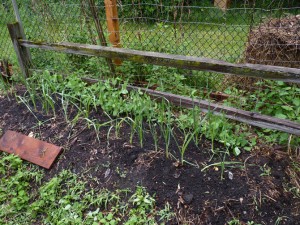
Today I put some seeds in their places:  leeks, lettuce and chard.  The lettuce and chard, once they reach two leaves in size, will go up into the hydroponics for use now.  The leeks will 06-05-10_leeksandpeas670keep on growing, too, also up in the hydroponics once they become youngsters and not babies, but they will go in the ground outside as soon the ground can be worked. (I think.  May be a bit later.)  Over February, March and April other plants will follow the same process, growing up to two leaves, then getting transferred to the nutrient baths of the hydroponics.  Each one, in its own time, will go outside to the waiting beds.  They will augment the garlic, the strawberries, the raspberries, the asparagus already growing there.

This year our planting will be more informed by several years of growing vegetables together, Kate grew some before.  We’ll plant what we need for canning, preserving in other ways like drying and freezing.  We’ve eaten well from our gardens over the last few years, but not as well as we could.  There’s always room for improvement.

One area for improvement is management of the orchard.  That will occupy some serious thought in March and April.  Fruits, especially trees, are different from vegetables, more vulnerable to insects and disease.  We’ll see what there is to do.

This will be the first growing season with Kate home full-time, so we’ll test out how that works.  Bound to help.

Then, too, in April, the bees begin to come out of their winter ball.  I over-wintered three colonies though I’m unsure about their survival.  I’d be surprised if all three pull through the 06-20-10_garden_6703winter, but delighted.  I’d understand if only two made it, but I’d be disappointed with one.  I’ve got a long ways to go before I’m a good bee-keeper, but I have years to go before I sleep.  Time enough.

Keep That Gray Matter Working

Winter                                                            New Moon of the Cold Month

Geez.  I felt affirmed by this paragraph in a longer article by Oliver Sacks.

Whether it is by learning a new language, traveling to a new place, developing a passion for beekeeping or simply thinking about an old problem in a new way, all of us can find ways to stimulate our brains to grow, in the coming year and those to follow. Just as physical activity is essential to maintaining a healthy body, challenging one’s brain, keeping it active, engaged, flexible and playful, is not only fun. It is essential to cognitive fitness.

Oliver Sacks is the author of “The Mind’s Eye.”

It’s About Time

Winter                                                                 Waning Moon of the Winter Solstice

“For last year’s words belong to last year’s language. And next year’s words await another voice. And to make an end is to make a beginning.” – T.S. Eliot

Though the calendar, as reformed by Julius Caesar and then Pope Gregory XIII*, rolls over tonight at midnight, and, confusingly to me, has already rolled over on several midnights already, you might notice that the time I keep remains the same.  Tomorrow we will still be in Winter and the Moon of the Winter Solstice will still be waning.  The Great Wheel does not recognize a calendar; it counts time by terrestrial movement through the heavens, moving, instead of hands, solar radiation and expressing itself not in hours or minutes but by days and nights and seasons.  Of course, an accurate calendar makes sense for the world of humans because we figure time in much smaller units and like to be able to do things according to spans of weeks, months, years though these are not, no matter what some might say, natural measures.  They are measures created by the human mind, invented to follow our fascination with chronological time, that is linear time, probably occasioned by our awareness of death.

Note, however, that measuring time does not create more of it, nor make of it less.  All calendars and clocks do is divide up the turning days and advancing nights, make smaller divisions in the more basic cyclical time generated by spaceship earth in its star-loving path.

We can choose which time we want to emphasize in our lives.  I prefer the cyclical time, the turning of the Great Wheel of the heavens, the coming of light and dark, the changes of spring, summer, fall and winter.  As much as possible I try to order my life and encourage myself to respond to seasonal change, but I, too, live in a world in which I am 63, soon to turn 64 in the year 2011, the third millennia after another bout of terrorism in the Middle East.  In this world people will only release money to me based on the linear trajectory of this body.  As for me, I cherish now the inner life brought on by the long nights, the cold and snow.

When spring breaks winter’s grip and flowers begin to push through the earth, when the garlic and the strawberries and the asparagus start anew to grow and flourish above ground,  then too, will I cherish the smell of moist soil carried to me by moist early spring air.  It will not matter to me whether that time comes in March or April or May.  Oh, it may matter to the horticultural me who needs to get leeks and peas and lettuce and other vegetables planted in their due time, but even those kind of changes cycle, too.  The bees will re-emerge to begin their dance with the blooming things, driven not by the clock, but by the presence or absence of the sun, the bright colors of flowering plants and the demands of the colony.

We have our preferences, I know, and mine for many years was the dayplanner, meeting time, always moving stream of time.  No longer.  At least not when I’m at my best.

*wikipedia  “The Gregorian calendar, also known as the Western calendar or the Christian calendar, is the internationally accepted civil calendar. It was introduced by Pope Gregory XIII, after whom the calendar was named, by a decree signed on 24 February 1582, a papal bull known by its opening words Inter gravissimas.[4] The reformed calendar was adopted later that year by a handful of countries, with other countries adopting it over the following centuries. The motivation for the Gregorian reform was that the Julian calendar assumes that the time between vernal equinoxes is 365.25 days, when in fact it is about 11 minutes less. The accumulated error between these values was about 10 days when the reform was made, resulting in the equinox occurring on March 11 and moving steadily earlier in the calendar. Since the equinox was tied to the celebration of Easter, the Roman Catholic Church considered that this steady movement was undesirable.”

Snow. Deep.

Samhain                                       Waxing Moon of the Winter Solstice

The orchard has at least two feet of snow.  The currant bushes have snow near the top of their branches.  The blueberry beds have almost disappeared.  The garlic lies now beneath a couple of feet of snow cover in the vegetable garden, as do the strawberries and the asparagus.  The bees have huddled up in their balls, all three colonies, rubbing against each other, creating warmth, keeping the colony at 93 degrees, maintaining body heat for the cold blooded individuals, the whole acting as a warm-blooded animal, using their mutual metabolisms to fend off the cold.  There are, too, all the bulbs, the ones planted this fall and those planted in years past, resting now, waiting for the signals, still months away, that will send them seeking sun and warmth.

Out the window shown in the pictures below I often see chickadees and sparrows scurrying from one warren of shrubs to another.  A rabbit or two come by at some point in the winter, as the chipmunks did earlier in the fall.  A squirrel dug a burrow in the snow near the end of November, coming and going several times.  I have not heard the great gray the last two nights, perhaps she’s out hunting in other places.

This is a Minnesota winter, the kind most of us here know well.  I’m glad to see it.