Category Archives: Our Land and Home

A Tour Knocked Together

Samhain                                       Waxing  Thanksgiving Moon

Finished initial work for my tour of the Thaw exhibition.  Some new information will come on Thursday during the Friends lecture focusing on Blackhawk and his ledger book, Elizabeth Hickox and her finely crafted miniature baskets and Maria Martinez, the renowned potter of San Ildefonso Pueblo.  I’ll meld that into the work I’ve just done.

I’m starting on Thursday in the Plains gallery with Judith Fogarty’s martingale and medicine bag for which she won the 1988 best of show at the Santa Fe Indian Art Festival, a prize of distinction in native american arts.  From there we’ll look at the honor shirts and Blackhawk’s ledger book, still in the Plains collection.  The Woodlands gallery, our home region, contains a wonderful bag, probably part of the kit of an Anishinabe shaman of the Midewiwin Society.  In the Arctic and Sub-Arctic I’ll take the group to the Yupik masks.  In the Northwest Coast region we’ll look at the frontlet of Raven-who-owns-the-sun and the bulging sided bent-wood bowl for serving fatty fish.  We’ll end up with a Maria Martinez pot and an Elizabeth Hickox basket.

This is a wonderful opportunity to see the very best of native art covering broad geographic regions.  A rare chance.  Hope you’ll be able to come.

Grounded

Fall                                    Waxing Harvest Moon

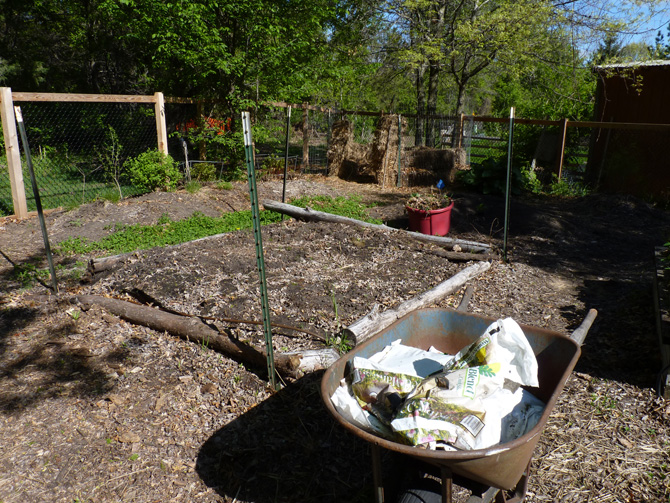
As many readers know, my sister and brother live in Southeast Asia, Mary in Singapore and Mark in Bangkok.  It’s different for me.  Kate and I have lived in Andover, in the same house with potato670050210the same land, for 16 years. I’ve driven the same car for 15 years and Kate’s driven the same truck for 10.  I’ve now been married to Kate much longer than the total of my first two marriages:  22 years versus 15.  I’ve lived in Andover longer than anywhere else:  Oklahoma-2 years, Alexandria-15 years.  I’ve lived in this house far longer than any other residence.

This came up today when Kate and I headed out to lunch.  I feel a part of this land, as if it’s part of me and I of it.  But.  I don’t feel the same about Andover.  There’s no here, here.  I have no memories of school here or my children in school.  My political involvement has been limited, recently to being an election judge.  Andover doesn’t feel like home to me, though 3122 153rd Ave NW does.

You might say I live a grounded life, if not close to the soil, certainly in partnership with it.  Perhaps the uncertainty and turmoil in my late high school and immediate post-high school years lead me to seek some stasis, I don’t know.  What I do know is that with Kate and with this land I have made a home.  And I’m glad.

Photo, Photo On The Wall

Lughnasa                                        New (Artemis) Moon

Sometimes thing go as planned.  Sometimes not.  The session with David Little (curator of photography) this morning did not go as planned.  For whatever reason we had an hour to spare, wandering the wonderful Bergman exhibition as Bill Bomash teased out clues to the stories behind the photographs.  A young girl, wanting to talk about her experience, joined the group and added her observations.  Who’s to say that was wasted time?

David Little comes out of a museum educators background and has a real feel for what is useful to docents.  He showed some new acquisitions including a surprise by Ansel Adam, a surrealist shot of a scissors and thread.  We also wandered into the 55 degree refrigerator, larger than a large meat locker, where the MIA stores it’s 11,500 photographs.  Cool, man.

He also talked about how he makes curatorial decisions, relationships with dealers and photographers, in particular as it relates to borrowing objects.  In the contemporary art and photography realm shows need relevance and he finds working with dealers and photographers much more expeditious than working with museums where the decision turn around for a loan can take as much as a year.

He and Liz Armstrong, the new contemporary arts curator, have a commitment to collecting and exhibiting work being made now and in the recent past.  The two of them, as well as Kaywin Feldman, have brought a fresh energy and verve to the whole museum and I, for one, am glad.  Not that the old museum was bad, it wasn’t, but the new folks have juiced things up, creating new ways to view and understand art.

We finished up with David Little over lunch.  He promised to get us some bibliography and to develop more in depth photography ed as new exhibitions are hung.  A good event with the timing slightly off.  The quality of the contact with David was high.  Thanks, Lisa.

Kate and I had a guy, Glenn, come up tonight and give us a presentation and bid on creating a water feature by the patio.  He seems to know his stuff and have a sensible plan to give us what we want.

Been fighting this same damned virus I had a month or so ago.  Kate says having clusters of illnesses is not unusual in that the body can retain a reservoir of the virus or bacteria.  Your body builds up antibodies and knocks it out at some point.  At least this time I have not had the pink eye or the ear infection.

Bee Diary Supplemental

Summer                                     Full Grandchildren Moon

Kate’s made the woodenware for Artemis Hives.  Dave Schroeder suggested we mark each piece with the year made.  As we start eliminating frames and hive boxes on a five year cycle, we’ve got the record right on the box.  This year, with no marks, will be 2010.  Next year she’ll start marking them year by year.

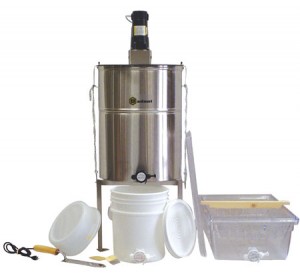
Kate and I have been investigating honey extracting equipment.  It’s not cheap, but it’s not break the bank expensive either.  We have to have a certain level of equipment to lw-pwr-extractorget from honey supers to bottled honey, most of which will go in canning jars, but some will go in fancy jars as gifts or to sell at a farmer’s market.  This is the next to last phase of beekeeping and one still new to me.  The last phase of beekeeping comes after the honey extraction.  The colonies will need inspection for varroa mites and nosema before late fall.  Doing this stuff is also new to me, but I have to learn at some point.

(this is one unit we’re considering right now.)

We had a designer come out to discuss a water feature for our patio area.  He showed us some brochures, talked with us a bit and recommended a pondless solution.  Sounds great to me.  Once you’ve had a swimming pool, you know the hassle pond maintenance brings in its trail.  This one has a pump and running water filtered through sand and rock.  It’s not cheap, however, so we’ll have to decide.

Roasting a chicken.  Brenda Langton suggested some meat, chicken or lamb or turkey, made at the beginning of the week, serving as a meal entre, then as sandwich or salad fixings, finally boiled in a soup.  It’s a nice, straightforward way to plan a week, easy, too.

Seeing What We Really Have Here

Summer                                             Waxing Grandchildren Moon

We are well past midsummer here in the northern latitudes.  The garden’dicentra09s peak bearing season will commence although we have already had blueberries, strawberries, raspberries, currants, garlic, lettuce, greens, onions, parsnips, beets and sugar snap peas.  Ahead of us are tomatoes, green peppers, potatoes, more greens, onions, beets, lettuce, butternut squash, leeks, wild grapes and carrots plus the odd apple.   Our orchard has a ways to go before it matures.  And I have a ways to go before I can care for the fruit trees in the manner to which they need to become accustomed.

All of which opens up the purpose of this little experiment in permaculture and the tending of perennial flowers and plants.  A long while back I bought three quarter-long horticulture classes from the University of Guelph in London, Ontario.  It took me a while to complete it, maybe a year all told.  The course helped me integrate and deepen what I’d learned by trial and error as I cared for the daffodils, tulips, day-lilies, hosta, croci, roses, trees and shrubs that then constituted our gardens.

In its salad days (ha, ha) the notion involved a root-cellar and the possibility of at least making it part way off the food grid.  Fewer trips to the grocery store, healthier food, old fashioned preservation.  A mix of back-to-the-land and exurban living on our own little hectare.  Last year the notion began to include bee-keeping.  Now called Artemis Hives.

As the reality of the size of our raised beds, the likely peak production of the fruits and vegetables possible has become clear to me, I have a more modest though not substantially different goal.  We will eat meals with fresh produce and fruits during the producing part of the growing season.  We will preserve in various ways honey,  grapes, apples, pears, raspberries, strawberries, blueberries, tomatoes, potatoes, onions, garlic, squash, beets, greens and parsnips.  These we will eat during the fallow days that begin as the garden goes into senescence in late August and early September and last through the first lettuce and peas of the next growing season.  We will supplement these with greens grown hydroponically and use the hydroponics to start seeds and create transplants for 2011.

None of this will remove us in any major way from the store bought food chain.  We will not solve or resolve much of our carbon footprint.  But some.  More than most perhaps, but far too little to claim even a modest victory.  So, should we give up?

Not at all.  Why?  Well, there is a richer, deeper lesson here than living wholly off our own land.  That lesson, taught again, day by day and week by week, and again, lies in the rhythm of the plants, the bees, the land and the weather.  An old joke from the 50’s asked, “What do you call people who practice the rhythm method?” (Catholics at the time)  Answer:  “Parents.”  The permaculture and perennial flowers here at Seven Oaks is a rhythm method.  What do you call folks who practice this rhythm method?  Pagans.

Ours is a life that flows in time with the seasonal music of the 45th latitude, the soil on our land, the particularities of the plants we grow, the energy of the bee colonies that work alongside us, the various animal nations that call this place home.  This is the profound lesson of this place.  Seven Oaks is a temple to the movement of heaven and the bees of Artemis Hives are its priestesses.

We Call This Place Home

our-woodsSummer                                New (Grandchildren) Moon

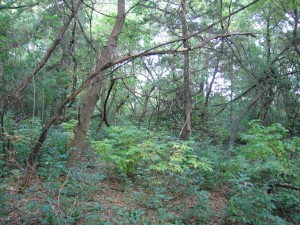
Outside this morning, finishing my tea on the patio, a hummingbird darted in and out of the lilies, gathering the last bits of nectar, passing on final touches of pollen.  Like the possum from yesterday’s adventure the hummingbird shares this patch of land with us, too.  Possum, groundhogs, gophers, chipmunks, squirrels, raccoons, rabbits, deer, hummingbirds, blue jays, goldfinches, red-headed and pileated woodpeckers, a great horned owl, crows, grosbeaks, dogs, mice, skinks, salamanders, garter snakes, garden spiders, wolf spiders, worms, bees, moths, wasps, caterpillars and butterflies and many others, most one-celled or many-celled, I imagine, live here.

They live here as we do,  making a home, finding and preparing food, eating their meals, raising their young, growing to old age, dying.  Our home takes up more space, yes, and our decisions impact the land in dramatic, sometimes even drastic ways, but that we are only one species among hundreds that live here is beyond question.

When we leave, either through death or otherwise, the generations yet unborn of these animals and insectshighrise and other life forms will, perhaps, know no difference.  If fact, if the house became abandoned, many of them would find a use for it as shelter, as a place to raise their families, perhaps as a source of food.

All of us, all of us who live here, are only here for a while.  It is so important that we leave this place a better one for all its inhabitants.  If each of us only took this one objective, a prime objective?, to leave our places better for all those who live in them, wouldn’t the world be safe now and into the future?

Natural Capital

Summer                                    Waning Strawberry Moon

I’ve not written much about permaculture for a while.  Here’s a one-pager* from our landscapers, Ecological Gardens.   It defines a new term for me:  natural capital.  I’ve since discovered that this is a term with a larger history which I haven’t explored fully, but I like the Ecological Gardens version.

Just imagine the kind of revolution we’d have if each person with land–in the whole world or in a whole city or in a whole county like Anoka County–committed themselves to increasing the natural capital of their land.  It’s a little bit like that old boy scout motto:  Leave your campsite better than you found it.

We could, each one of us, take multiple unique tacks on the notion of natural capital.  Some of us might focus on small commercial crops, others might raise chickens for meat and eggs, still others might band together as neighborhoods and grow crops in tandem, some folks doing one thing, others another and producing a local horticultural economy.

A federal or state program that made low cost loans or outright grants for the establishment of permaculture at the local level makes a lot of sense to me.  Like the 160 acres and a mule of yesteryear.  We need a horticulture and an agriculture that increases the carrying capacity of the earth, helps clean up the rivers, streams and lakes.


*Would you like to:
•   Maintain beautiful self-sustaining gardens organically?
•   Pick fresh, nutrient-dense foods from your own backyard?
•   Create habitat for the nature you love?
•   Build resiliency into your landscape to help fight climate change?

These are all products of natural capital. Our first priority at Ecological Gardens is to help you increase the natural capital of your land. This means assessing the unique combination of resources – sunlight, wind, water, and microclimates – and turning them into productive investments that will yield benefits today and for many years to come.
Soil is the foundation for natural capital in our northern temperate climate. Healthy soil creates a condition for healthy plants, produces nutrient-dense foods for humans and wildlife, reduces water use, and minimizes leaching and runoff. Building healthy soil usually requires an investment since most soils are compacted and chemically treated.
Plants are the primary producers of value on the land. They take up sunlight, water, and nutrients turning them into nutritious foods, medicines, fibers, fuels, oils, and wood. Increasing productivity on your land requires an initial investment since plants of low productivity tend to dominate the landscape.
Your return on investment will vary depending on the size of your land and the configuration of resources but will increase exponentially as plant diversity and abundance grows.

Short-term returns (1-5 years)
•   Lower water bills (up to 30%) for yard and garden care
•   Lower maintenance costs for fertilizers and lawn care products
•   Lower food bills as you begin to harvest food, flowers and medicines
•   Greater wildlife value (bees, birds, and beneficial insects)
•   Greater beauty

Intermediate returns (5-15 years)
•   Lower energy costs for air conditioning and heating by strategically locating trees and vines
•   Lower labor requirements as natural processes begin to work for you
•   Increased property values due to abundance and beauty
•   Increased food security as you provide more of your own food

Long-term returns (15 + years)
•   Lower fuel costs as you begin to harvest your own wood [for larger properties]
•   Increased productivity as your land matures

The 4th

Summer                                        Waning Strawberry Moon

The 4th of July.  A time to think about our country, our home, our sea to shining sea.  Are we in decline?  This chestnut has begun hitting the op ed pages again.  I don’t know, they don’t know.  Only history will tell us.  Does it matter?  Not to me.  We’ll still be Americans, just like the British are still British in spite of the collapse of the empire on which the sun never sat.

Are there major problems within our body politic?  Oh, my, yes.  Does this make our time different from any other time?  Emphatically, no.

Here’s an example from a Frederick Douglass speech quoted in the Star-Tribune today:

“Fellow citizens, above your national, tumultuous joy, I hear the mournful wail of millions, whose chains, heavy and grievous yesterday, are today rendered more intolerable by the jubilant shouts that reach them. If I do forget, if I do not remember those bleeding children of sorrow this day, “may my right hand forget her cunning, and may my tongue cleave to the roof of my mouth!”

To forget them, to pass lightly over their wrongs and to chime in with the popular theme would be treason most scandalous and shocking, and would make me a reproach before God and the world.

My subject, then, fellow citizens, is “American Slavery.””

Does this harmony of misery make us any less accountable for the unemployed, the dying lakes and rivers, the immigrants who would live among us and share this land?   Emphatically, no.

Whether in decline or doggedly ascending the hill to that Bright Shining City so beloved of our forefathers, we must attend the great American ideals of liberty and equality, the twin conceptual mounts on which both our past and our future rest.

And not these only.  We now have before us the Great Work, the demanding and joyful task of creating a human presence on this planet that is benign, not malignant.

Here are the things make me believe we will continue to rise to these challenges no matter our relative status in the world:  we ended slavery.  we fought and defeated fascism.  we looked at old age poverty and created social security.  we have a statue at what used to be the main entry point for immigrants; it is a statue of liberty and one which says to the world, give us your huddled masses, yearning to breathe free.  we have brilliant scientists, great laboratories and universities, students even at this moment learning to be the future leaders that we need.  we have poets, movie makers, authors, critics, musicians, painters and sculptors all ready to help us see what we do not see.  we have neighborhood after neighborhood of people who want only a chance, the same chance many of our ancestors have already had.  we are a people who have won great victories for humanity.  we are a land unparalleled in its ruggedness, its beauty, its flora and fauna, rivers and streams, lakes and forests.

All of these things make me happy and hopeful on this 4th of July.

Into the City

Summer Solstice                                   Waxing Strawberry Moon

The Woollies gathered tonight at Charlie Haislet’s place in the Rock Island condos, just north and a bit east of downtown.  We gathered, our numbers shrunk by various summer activities to:  Charlie, Warren, Frank, Scott, Bill, Mark and myself.  The conversation went on as it does, checking in on how folks are, what’s going on, but Charlie turned the conversation toward Father’s day.  It seemed to  me, as I listened, that we have all rooted ourselves in family, our nuclear and extended families, and, further, that as we have grown older, those connections have grown richer and deeper, occupying the central spot in each of our lives that the voice of tradition has suggested they might.

Charlie’s 7th floor (top) condo overlooked downtown; the waxing strawberry moon hung over the glass and stone cityscape, the dying sun reflecting in the mirrored surfaces of the IDS, the Northwest Building and all the modernist architecture there.  I’ve been critical of it as lacking flair and imagination, but tonight, a clear warm summer night, the reflections and the twilight, then the advance of night and the reflections of lights was glorious.  It looked like Oz, as I think of it when I turn on Hwy 610 heading south and see it far away, maybe 15-20 miles.

Before the meeting, I arrived a little early and took advantage of the time to walk through the neighborhood, a now populous community that is no more than 20 years old.  There was a couple with a young boy in a stroller and a dog, a young man with his white shirt half out, tie askew with his dog, a couple with a puppy, all walking, off work and at home.  The buildings were brick, a few old, like the Rock Island and The Creamette, but many new.

Some had iron barred and locked fence doors protecting patios which anyone could easily vault onto from the railing.  There were signs: no walking on the grass, dog waste here, guest parking only, towing $260.00.  The green space that existed had a manicured and distant feel, as if its purpose was to recall, to remind rather thanto be.  The windows had blinds and shutters; thanks to air conditioning almost none were open, so the few people I encountered while walking were all I could see other than tailored walls and well hung windows, the odd bit of decor.  It felt, not empty, but not lively either.

Putting myself there as a resident, I tried to decide if this would work for me.  It has the advantage of being near to the main library, downtown, the shopping around University and Hennepin, the Mississippi and its parks.  There would be neighbors aplenty and the urban feel has a certain up energy to it.

These days, though, when many folks I know have moved or want to move from the burbs into the city, I’d have to say I surprised myself.  It felt too confining, too many neighbors, too many shared walls, too many signs and restrictions.  Too little room to plant, to have dogs run, to exercise a horticultural or apicultural inclination.  It surprised me because I consider myself a city boy, wedded to political work and aesthetic work that require the urban environment for their realization.

I’ve changed.  I’m now an exurban man, grown used to the quiet here, the open space, the land on which we can grow vegetables and flowers, have a bee yard, a honey house and a separate play house for the grandkids.  When I drive by Round Lake, I’ve come home.
The Sublime Gift

Beltane                                       Waning Planting Moon

” Life can’t bring you the sublime gift it has for you until you interrupt your pursuit of a mediocre gift.”

Woolly brother Tom Crane sent this to me.  It took me back to my recent post about Siah Armajani and his personal commitment to staying within his skill set.  When I worked for the church in the now long ago past, I had a boss, Bob Lucas, a good man, who had several sayings he used a lot.  One of them was also similar in spirit, “Don’t major in the minors.”

Stop focusing on the small things you might be able to do well to the exclusion of being challenged by the prajaparmita400serious, important matters.  Stop your pursuit of a mediocre gift.   The tendency to judge our worth by the accumulation of things–a he who dies with the best toys wins mentality–presses us to pursue money or status, power, with all of our gifts.  You may be lucky enough, as Kate is, to use your gifts in a pursuit that also makes decent money; on the other hand if  your work life and your heart life don’t match up, you risk spending your valuable work time and energy in pursuit of a mediocre gift, hiding the sublime one from view.

This is not an affair without risk.  Twenty years ago I shifted from the ministry which had grown cramped and hypocritical for me to what I thought was my sublime gift, writing.  At least from the perspective of public recognition I have to say it has not manifested itself as my sublime gift.  Instead, it allowed me to push away from the confinement of Christian thought and faith.  A gift in itself for me.  The move away from the ministry also opened a space for what I hunch may be my sublime gift, an intense engagement with the world of plants and animals.

This is the world of the yellow and black garden spider my mother and I watched out our kitchen window over 50+ years ago.  It is the world of flowers and vegetables, soil and trees, dogs and bees, the great wheel and the great work.  It is a world bounded not by political borders but connected through the movement of weather, the migration of the birds and the Monarch butterflies.  It is a world that appears here, on our property, as a particular instance of a global network, the interwoven, interlaced, interdependent web of life and its everyday contact with the its necessary partner, the inanimate.

So, you see, the real message is stop pursuit of the mediocre gift.  After that, the sublime gift life has to offer may then begin to pursue you.