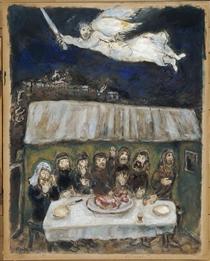
The full new shoulder moon hangs over Black Mountain right now. It’s the middle of Nisan in the Jewish lunar calendar, the first month of the year. Passover is a spring festival, not unlike the ones in Asia that we tend to call Chinese and Korean New Year. It’s especially similar to the Korean Spring Festival. At that festival the whole nation eats tteokguk, rice cake soup. When they finish the soup, they are all one year older. Passover reinforces a sense of tribal (national) identity for Jews all around the world through eating the Seder meal.
Matthias Grunewald
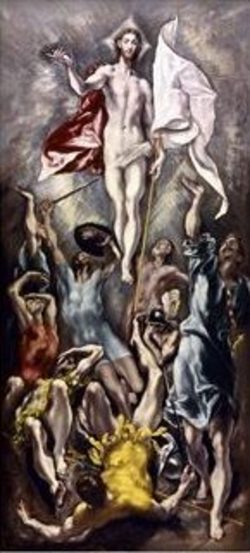
It was also Easter yesterday. Easter marks out Christianity’s most unusual and defining theological belief, that Jesus died on the cross and rose three days later, defeating death. Strip away all the institutional hoo-hah accreted over the last two thousand plus years, all the dogma spun out of the dross of fevered thought, and this is what Christianity means: death is either an illusion or temporary. Without the resurrection Christianity is a watered down Judaism, a Middle Eastern faith borne of a particular moment in time in a particular ethnic space. Resurrection is its bid for universality and a good one.
It was a big weekend for Middle Eastern religion, two of the three distinctive monotheisms, the Abrahamic faiths, celebrated key events in their sacred years. I feel both part of these events and to the side of them. I have incorporated the secular understanding of liberation and Jewish identity underscored by pesach and the pagan meaning of resurrection found in the rites of spring. They are part of me now.
It’s the second night of pesach tonight and tomorrow morning is easter. Liberation and resurrection, or liberation and death’s final bow. Resurrection is hard to integrate since its hard proof lies beyond the veil of this world. Liberation, on the other hand, is much easier to integrate because it applies to so many this worldly situations: slavery, imprisonment, forced poverty, mental illness, racial and gender and sexual preference discrimination, being in Trump’s America.
Both are important to me. I long ago left behind the death is no more school of theology. It seems cruel to me, an assertion confounded at every death bed, every school shooting, every war. Death still rides her pale horse, galloping through the living world and pruning, pruning, pruning.
I do, however, retain my confidence in resurrection; that is, the power of the changing world to incorporate death and decay as precursors for life. Each spring, as our temperate latitude winter fades away, bright green shoots spear their way through the soil’s surface. Flowers bloom. Vegetables grow. Trees leaf out. Lambs and kids and calves and piglets are born. All these are evidence of transubstantiation, the literal changing of grapes and bread into our bodies. This transformation happens regularly and green burial will help us remember that we humans do participate in it, that concrete, water-tight “vaults” and expensive coffins do not shield us from our part in the web of life.
El Greco
This weekend presents to us two powerful stories, stories that have changed the world: the exodus from Egypt of Hebrew slaves and the crucifixion and resurrection of Jesus, known by many as the Christ. Narratives have real potency, the ability to change lives, turn the pages of history, answer our deepest questions, quiet our deepest fears. Oddly, you can see this power even more clearly if you take a stance just outside the metaphysical claims, but not in the camp of folks like the new atheists, who are simply boring.
I’m neither Christian nor Jew, my metaphysics is bound up in the ongoing evolution of the universe and literally rooted in the soil of the midwest and the hard rock of these mountains where I now live. Even so, liberation and resurrection, through the stories of the passover and easter, are important to me, tell me about human possibility, about the human capacity to face enslavement and grief with hope, with the chance to turn both into moments of human triumph.
Though it has taken me a while to learn the rudimentary geology of our immediate neighborhood, I now know that we live among three mountains. We live on Shadow Mountain, up a valley that runs from its base to our home. On the opposite side, the west side of this valley, is Conifer Mountain and then, the mountain most visible from our house, Black Mountain.
Black Mountain
Think of the changes evidenced by these huge landforms. This is rock that was once, millions of years ago, imprisoned far below the earth’s surface, held there by weight and history, perhaps even put there by accretion when another planet slammed into the still forming earth. Yet now I live on it, can see it clearly, far above the surface, pushed out and up by forces wielding power unimaginable, unavailable to us humans.
Is this liberation and resurrection? Not from a human perspective, but from the perspective of our planet, very much so. And yet it does not end there. Once liberated from their stony dungeons wind and water act upon them taking these high mountains gradually down to sea level, then into the ocean itself. In the soil formed in this way plants will grow, animals will feed off the plants. Liberation and resurrection are everywhere, if only we see what we’re looking at.
“All changes, even the most longed for, have their melancholy; for what we leave behind us is a part of ourselves; we must die to one life before we can enter another.”
– Anatole France
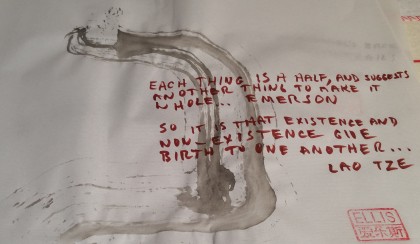
The last letters of the Hebrew alphabet now have renderings in sumi-e, lying on my table ready for quotes and the chop. A member of Beth Evergreen last night referred to me as an artist. Oh. I thought he said audience. Artist is not a word I’ve ever associated with myself so my brain heard something else. A revealing moment. How others see us is not always, perhaps often, not the way we see ourselves.
An obituary on Terry Brazelton had this summary of a major finding of his research: “Development does not occur on a linear path, with each skill building on earlier ones. Rather, it unfolds in a series of major reorganizations in which children temporarily regress before mastering a new developmental milestone.” NYT
Well. That explains melancholy, at least as I’ve experienced it. There’s a plateau effect, then a hesitation, a pause while the psyche incorporates a new way of being, one probably not available to consciousness at the time of the pause. Since it’s inchoate, the reorganization seems like a regression, a stutter. The mind and the body both slow down, awaiting something they don’t understand. Result: melancholy.
Van-Leyden St. Jerome in his Study by Candlelight (1520)
If you’ve read my posts over the last month or so, I think you’ll see what I’m talking about. My psyche had moved on, already aware that I needed more tactile moments in my daily life, already aware that it was time to resort my priorities based on a new constellation of possibilities made real by our move.
Last night at the shabbat service a rabbi friend of Jamie’s gave a short reflection. She had us consider an unusual moment in the Torah when the former Hebrew slaves remembered fondly the foods they had in Egypt. Using this seemingly inscrutable nostalgia for a time of bondage, she suggested that during transitions, a time of instability, wandering in the dessert for example, we often want to return to the stable state we know to ease the anxieties and uncertainties of a transition. Thus, when faced with a period of eating manna during an often frustrating movement toward the land promised, but not yet reached, even slavery seemed to have its charms.
That nostalgia, I think, is the root of melancholy, a hope that the past can ease the upset of the present. The psyche knows that’s a false hope, a trap, but is unable to articulate why. So, stasis, moving neither forward nor backward, which the ego interprets as negative without knowing why. Really, the moment is gestational, a new way awaits its birth. Not back to Egypt, but on to the promised land. Not back to the life of forty years in Minnesota, but on to the new life developing in Colorado.
Under the New Life moon a new life has emerged, related to the old one, but different nonetheless. The trajectory and the distance of the change got a marker last night on the final evening of the kabbalah class on the mysticism of the Hebrew letters.
I had my first art exhibit! (well, since elementary school.) I have done over half of the Hebrew letters in my sumi-e calligraphy, adding a quote I felt highlighted some aspect of the letter’s significance. And finishing them off with the chop. Oddly, the thought of displaying my work didn’t daunt me, as it would have in the old life. In the new life my work is my play. Self consciousness doesn’t enter the field.
Some even called my work beautiful. Wow. Don’t get me wrong though. I was proud of these pieces and as a result was able to appreciate how the others responded to them, not deflect it.
Too, under the new life moon I’ve become the regular dinner cook at our house, experimenting at times, at other times (mostly) using recipes, but enjoying myself immensely. Added to my long practice of working out, even that has a new flavor with the workouts every six weeks or so from On the Move Fitness, I’ve got tactile time each day. I’m using my hands and a non-verbal creative impulse.
The day after my birthday was the new moon. That means these changes have all happened in my 71st year, facilitated by the earlier fall into a melancholic state. So today I speak in favor of sadness, of gloom. Without the stasis and the deep reexamination that melancholy brings this new life would likely not have emerged.
It is no accident, though in real time it was, that this period was also the time of the middot of joy. Joy and sadness are not enemies, rather they are a vital source of learning if we don’t suppress them. Steering away from grief, tamping down joy in favor of a false stability, a false calm defuses the opportunity our soul offers to us through these emotions. They signal the soul’s gladness, the soul’s mourning, both key to a depth appreciation of our journey.
How the rest of my life will adjust, shift in light of these changes is not yet clear to me. And that’s ok.
Before we got to Beth Evergreen yesterday, we stopped at Safeway. Kate had a fun idea. She would buy bite size Almond Joy candy bars and have them for everyone. While in the store, she also found some yellow roses and bought enough to give each person around the table a flower to take home. Though she had to settle for full size Almond Joys, the idea was still there and the flowers were a gentle, beautiful and fragrant memento of the time together.
Kate’s idea for teasing out experiences of joy over a lifetime worked well, too. After she began the afternoon with a chant/song of her own devising, Kate led us in a Hebrew blessing for torah study. She explained how to use her chart with single digit, adolescent, and adulthood as columns.
We then spent an hour plus in an energetic sharing, each person picking one instance from each column. The responses were as varied as the people in the room and the time frames to which they returned while filling them out. “Getting my pilot’s license.” “Grandchildren.” “First kiss.” “Traveling alone, being alone in a strange place.” “Throwing rocks up so bats would follow them down.” “Playing hide and go seek.” “Having sex and finding out you’re not pregnant.” The general tone was joyful, celebratory as we both learned more about each other and got to share in each other’s joy.
When everybody had offered their experiences, I asked if we could use that content to try to define joy. How do we know joy when we see it, feel it?
Here are several words and phrases offered: Joy requires authenticity. It has a definite physiological, embodied component. Joy flows; you can’t hoard it; it’s contagious. Joy mixes awe and gratitude. Many people identified natural settings as joyful. Joy is transpersonal, often involving connection, (I would say intimacy.) with animals, other people, places. We get outside of ourselves, beyond ego, become one with whatever causes our joy. Being with children, especially grandchildren. Constant learning is a source of joy. Degas. Joy is transformative. Joy ignites gratitude. Joy is quiet and internal; happiness loud and external. Joy is a choice.
We skirted the issue, for this afternoon, of the links between joy and sadness, joy and gratitude, joy and generosity. For another time.
We ended with deciding on a practice. A few shared theirs. It was a bright moment and made more joyful for me by sharing the leadership with Kate.
This will be given out at Thursday mussar after we’ve completed Kate’s exercise about joy in three life stages and discussed how our experiences might help us define and seek out joy.
Joy joy brown
“Yesterday, Rich and I sat down and had a short chat about it. Is Joy a verb? Is Joy an emotion? Is it a state of mind or being? And it got me thinking.
What if joy is the energy of life? And what it if manifests as a persistent yet invisible glow or aura that emanates from us at all times… sometimes it’s bright and sometimes dim. The more mindful we are of it, the brighter the glow / aura becomes. We can certainly sense when someone is joyful without them telling us, right? We sense their joyfulness even if they don’t speak (is that charisma?) The Dalai Lama emanates joy. I’ve never met him but I imagine he is joyful even when he is sad or ill (which he must be sometimes, right?) But how can you be sad or ill and still be joyful?
Maybe joy is not a state of well-being, but simply the state of being, period. Not physical, not mental, not emotional, just the fact of being alive is joy. Life is joy. Do trees glow? Do animals glow? Do we feel joy in the forest or in the presence of others? I think so.
My practice is simply going to be to focus on life as joy. Living as joy. Separate from all other things… including pain, sorrow, anger, jealousy. Let me know if you see my glow… because I’ll be looking for yours.” Ron Solomon, by permission
In Everyday HolinessAlan Morinis discusses the middot of simplicity. He identifies three levels of simplicity: acquiring less, becoming happy with what you already have, and nothing more to need. This last level, he says, sets joy free in the heart. “Released from craving and the relentless pursuit of more material satisfactions, perfectly content with what is, the heart bubbles forth with joy that is its potential and natural inclination.”
Marilyn Saltzman found this quote by the Dali Lama: “We can experience happiness at the deeper level through our mind, such as through love, compassion and generosity. What characterizes happiness at this deeper level is the sense of fulfillment that you experience. While the joy of the senses is brief, the joy at the deeper level is much longer lasting. It is true joy.” “The Book of Joy” by Desmond Tutu and the Dalai Lama
A few synonyms from Roget: delight, gladness, rapture, exaltation, exhilaration, transport, abandonment, ecstasy, rejoicing
OED: Joy, sb. (substantive), 1. A vivid emotion of pleasure arising from a sense of well-being, or satisfaction; the feeling or state of being highly please or delighted, exultation of spirit; gladness, delight. 2. A pleasurable state or condition; a state of happiness or felicity; esp. the perfect bliss or beatitude of heaven; hence, the place of bliss, paradise. Joy, v. (verb), 1 To experience joy; to find or take pleasure; to enjoy oneself. 2. To feel or manifest joy; to be glad; to rejoice, exalt. 3. To fill with joy; gladden; delight
“The noun simcha is mentioned in the Bible 94 times and is derived from the verb samach, which appears 154 times in the text. It is rooted in the Akkadian word shamahu meaning sprout or flourish.” Simcha, The Dayton Jewish Observer
A thing of beauty is a joy forever. So says Keats in his Endymion. Kate and I are leading the mussar class on Thursday, focused on joy and sadness. What else is a joy forever?
Most of the material I’ve read about joy distinguishes it from pleasure with a time distinction. A bite of food, a kiss, a winning hand, a new toy brings pleasure in the moment, but the pleasure dissipates quickly. Joy, to paraphrase Keats, is a thing of beauty forever. Joy, in other words, is lasting.
Rabbi Jamie says true joy can be recalled and experienced again whenever we want. Not fully sure about that, but a finger on the scale in favor of a lasting experience seems right to me.
Chagall, Fiddler
Kate has come up with an exercise that will get us started on considering joy in our own lives. She designed a sheet with three columns: single-digit, adolescence, adult. We will write as many instances of joy as we can recall from each of these life phases. My hope is that in telling our stories of joy that we can experience them again and help others experience them with us.
How can we increase joy in our lives? Can we? (A)…rabbinic teaching concerning simcha points to the inner self as the source of contentment and joy. “Aizehu ashir? Hasameach bechelko, Who is rich? He that rejoices in his own portion (Avot 4:1).” ibid
So at least part of joy is perspective. What makes our life rich? Joyful? Knowing what is enough. What is enough? No less than we need, no more than we require. This seems to link joy to gratitude. If we have enough, we are grateful for what we have. Our life gains in simplicity since we don’t end up on the constantly promoted hedonic treadmill.
With simplicity, then, we know deep satisfaction. Not only do we have enough, but we do not waste our energy and our worry on getting more. Ah.
Last week at mussar we had a fascinating conversation on the essential dourness of both Jewish and northern European cultures stimulated by the Norwegian concern that they had won too many medals in the winter Olympics. In both cases happiness, and by correlation, joy, are suspect. Why are you so happy? What makes you think that will last?
In the Jewish instance this trait seems to correlate with the multiple times in Jewish history, starting with slavery in Egypt, that a golden age or at least a comfortable existence had been destroyed by pogroms, the expulsion from Spain, the holocaust. Are you happy now? Just wait.
In the northern European instance it seems to have more to do with seriousness. “For the soul is dead that slumbers, And things are not what they seem. Life is real! Life is earnest! And the grave is not its goal; “Dust thou art, to dust returnest,” Was not spoken of the soul.” Psalm of Life, Henry Wadsworth Longfellow
early cave painting
Both cultures, in other words, find joy and delight and glee and exultation, ecstasy and exhilaration suspicious at best and distracting at worst. Distracting from what? From the possibility of life’s stability being snatched away in an instance. From the need to keep the shoulder to the grindstone, quite literally. From the guardedness that protects us from disappointment, suffering, pain. Joy may make us vulnerable.
So it’s no wonder that joy is a middot, a character trait that needs cultivation. The soil for it is rocky, like that in our backyard here on Shadow Mountain, at least in these two cultures.
Joy Brown, creative joy
How to do that? I chose to scan my life looking for joyful moments. My hope is that I can begin to identify in the now, embrace them, live in them. Looking at my list (it’s posted here.) I can see some common threads. Intimacy: seeing Orion at night, dogs nuzzling, the mountain night sky full of stars, hugging Kate, hearing from Tom, Bill, Mark, seeing them. Challenging myself: learning Latin, using my sumi-e brushes, grinding ink, having a new idea, reading a new book, writing ancientrails. Letting the world in: driving over Kenosha pass and seeing South Park laid out ahead, the golden aspen among the lodgepoles on Black Mountain, paying close attention to the natural world. Being in community: working with Marilyn and Tara and Anshel, setting up for adult education events at Beth Evergreen, having an idea, sharing it, seeing something happen. Travel: hearing the howler monkeys on the road to Angkor, leaving for a trip, rolling retreats (roadtrips), the earthen smells when getting off the plane on Maui, Kauai, Hawai’i. Inner moments: the moment of mystical connection with the universe in 1967, meditation, remembering the two year old me who learned to walk after polio, mindful cooking.
One track for increasing the joy in my life then would be to seek intimate moments, identify new ways to challenge myself, stay alert and let the world in, continue at Beth Evergreen, travel, allow time to cultivate the inner life.
“On the bright side, simcha is a word laden with exhilaration and festive activities. Simcha expresses not only the joy of an event, but it is also the noun which means a happy event.
A holiday is a simcha, a family gathering is a simcha, a wedding is a simcha, the birth of a child is a simcha and a Bar or Bat Mitvah is a simcha.
The host of an event is a baal simcha and the sound of joy resonating from the event is kol simcha.
Simchat yetzirah, a joy of creativity, is a way to describe the exhilaration one feels while being engaged in a creative process…
(A)…rabbinic teaching concerning simcha points to the inner self as the source of contentment and joy. “Aizehu ashir? Hasameach bechelko, Who is rich? He that rejoices in his own portion (Avot 4:1).” ibid
Back to On the Move Fitness for my second session on the new workout. Unusually, I experienced significant discomfort in my hip, quad and lower back after Debbie gave me the new workout on Tuesday. Not the result desired. We both suspected the one leg squats, so she took those out and put in goblin squats, which I’d been doing, holding a weight in both hands in front of your body, then doing a squat. Repeat.
Getting new workouts every 4-6 weeks has been really good for me, keeps things fresh and allows somebody who knows what they’re doing to design progressions into the exercises. And, to pull back when necessary. My leg work will be less intense for the next couple of weeks. Still ouching, but not nearly as bad as Tuesday and Wednesday nights.
Debbie said something odd when I was there on Tuesday. “You’re moving a lot better now than when you first came in. But even then you had a basic strength.” She attributed it to our having Irish Wolfhounds because they’d come up in conversation about her new rescue dog, Finnigan. In fact I’ve been working out since I turned 40 and did often heavy manual labor in Andover for twenty. She saw me about six weeks after I’d finished p.t. for the new knee, so I was not in the best shape. It made me feel good for someone to recognize the effort I’ve put in to keep my body functional.
Thursday afternoon mussar. Talking about joy and sadness, how to cultivate joy. The middot of this month. Middot = character trait. Though the discussion was good, the time immediately afterwards was even better. I shared in vaad (speaking into the group, with no feedback. Concentrated listening.) about melancholy, being there now and having learned to listen to the melancholy instead of trying to fix it. Waiting it out.
After the class brokeup, a guy said he had the same experience , “After my dad died, when I was 50. Since then, every year.” A human moment. Then I spoke to a woman who’d been away for a couple of months. They’d been tough for her and we talked for awhile. Another woman, who played Queen Esther in the Purim play the night before, when complimented on her acting, said, “I just lived out my inner Jewish princess.” We all laughed. This is a group that cares about each other, about the journey, the ancientrail that is life.
Next week Kate and I are presenting. I’ll let you know how it goes.
The full new life moon had a cloudy cover as it rose in the east yesterday, a halo. Driving back from the Purim celebration last night it was moving west, though then in a clear sky, Orion visible nearby. This morning as I came up to the loft it sat near the horizon, visible only through under the branches of our lodgepoles. This bout of melancholy began under the waning Imbolc moon, grew stronger under the first days of the new life moon and now seems likely to be gone during its waning. Maybe a month total. As these visits go, not too bad.
Fellow melancholic and friend, Tom, called yesterday and we talked about the gremlin’s energy sink, its dredging up of old emotions, its general sucking out of life’s marrow. We both have long acquaintance with it. And, long experience does yield some perspective, a hint of how it will probably go. For me, the down is matched by an up, a safer version of the bi-polar depression to mania swing. The up has not come yet, but I can feel it on its way.
A couple of things have come into focus over the last few days. One, I need to work more with my hands, with my body. Now that the turmoil of our first years here has begun to subside I’m missing the garden, the orchard. Not just the growing, the plant care, the flowers and vegetables and fruits fresh out of our soil, but carrying bags of compost or digging or moving bee hives, tending to the raspberry patch. If I don’t do this, I can get stuck in my head. Not the only part of me I want to nurture.
Two, I need to read more, be quiet more. Meditate. I’ve been reading novels, as is my habit, and I read news of all kinds on the web, but I need to shift my reading diet a bit to include more philosophical, theological non-fiction. Example. I began re-reading, as I mentioned, David Miller’s, The New Polytheism. That’s the sort of work I’m talking about. It sends sparks off in so many different directions.
A few possibilities for more tactile activity. Kate and I looked at a greenhouse made by an outfit called Grandio Elite. I’m not interested in the very laborious work it would require to garden in the rocky Shadow Mountain soil. But, in a greenhouse, yes. I miss working with the soil, with plants. And, we could grow plants in the greenhouse and put them outside in containers during our short growing season. Green thumb Kate grew tomatoes here last year. Not easy.
alephs and a mem
Finally got to working with my brushes and ink, rice paper. Still a really, really long way to go before I have any true facility with it, and that’s a good thing, lots of practice required. My presentation for the kabbalah class, unveiling the Hebrew letters, will be certain letters drawn with these ancient Chinese tools and a line of poetry congruent with the letters deeper meanings written below it. Here’s a couple of alephs and a mem.
Hiking, of course. And to that end, more new workouts. Though. Got a new workout Tuesday and my left quad and bursa have complained a lot. Gotta figure out what caused that. Still, these workouts give me more strength and balance, continued ability to be in the world with my body.
And the reading. Oddly, the deeper my immersion into Judaism, the more my interest in Taoism increases. So. Diving into those books, some online educational material. Also, Reimagine. Reconstruct. Reenchant. Material on emergence. James Hillman. Magic and reenchantment. Reinvention of the sacred. The auld Celtic faith.
These things seem to have traction and will be a significant departure from the immediate past. A balancing, or rebalancing, of time, of attention. An outcome I expect from melancholy. Underway now.
Haven’t done a nocturne since I got to Colorado, if I recall correctly. However, driving home tonight with the waxing new life moon shining through the lodgepole pines and Orion high in southwestern sky I wanted to write one.
I’m re-reading an old book, 1974, by a theologian named David Miller, The New Polytheism. It is, in a way, a counterpoint to H. Richard Niebhur’s important essay, “Radical Monotheism and Western Culture.”
The moon and Orion both represent, and are themselves, forces in our culture. Orion, the hunter and warrior. The moon, our light in the darkness, the periodicity most familiar to us after night and day. I could feel them both tonight on the drive up Brook Forest, these old friends, 71 years of nights, 49 since my time in the guard shack in Muncie when Orion and I became friends.
I find polytheism, multiple centers of value in H. Richard Niebhur’s conceptual framework, a much more sensible approach to the diverse and plural world in which we live, and which lives in us.
Night makes this clearer to me, cleans up the distractions of the day. My mind ranges further, makes unusual connections, feels old threads linking now and then, now and tomorrow. Time for bed now. Good night.



 The last letters of the Hebrew alphabet now have renderings in sumi-e, lying on my table ready for quotes and the chop. A member of Beth Evergreen last night referred to me as an artist. Oh. I thought he said audience. Artist is not a word I’ve ever associated with myself so my brain heard something else. A revealing moment. How others see us is not always, perhaps often, not the way we see ourselves.
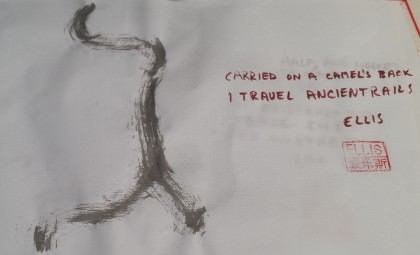 Under the New Life moon a new life has emerged, related to the old one, but different nonetheless. The trajectory and the distance of the change got a marker last night on the final evening of the kabbalah class on the mysticism of the Hebrew letters.
 Too, under the new life moon I’ve become the regular dinner cook at our house, experimenting at times, at other times (mostly) using recipes, but enjoying myself immensely. Added to my long practice of working out, even that has a new flavor with the workouts every six weeks or so from On the Move Fitness, I’ve got tactile time each day. I’m using my hands and a non-verbal creative impulse.
 It is no accident, though in real time it was, that this period was also the time of the middot of joy. Joy and sadness are not enemies, rather they are a vital source of learning if we don’t suppress them. Steering away from grief, tamping down joy in favor of a false stability, a false calm defuses the opportunity our soul offers to us through these emotions. They signal the soul’s gladness, the soul’s mourning, both key to a depth appreciation of our journey.
 Before we got to Beth Evergreen yesterday, we stopped at Safeway. Kate had a fun idea. She would buy bite size Almond Joy candy bars and have them for everyone. While in the store, she also found some yellow roses and bought enough to give each person around the table a flower to take home. Though she had to settle for full size Almond Joys, the idea was still there and the flowers were a gentle, beautiful and fragrant memento of the time together.
 We then spent an hour plus in an energetic sharing, each person picking one instance from each column. The responses were as varied as the people in the room and the time frames to which they returned while filling them out. “Getting my pilot’s license.” “Grandchildren.” “First kiss.” “Traveling alone, being alone in a strange place.” “Throwing rocks up so bats would follow them down.” “Playing hide and go seek.” “Having sex and finding out you’re not pregnant.” The general tone was joyful, celebratory as we both learned more about each other and got to share in each other’s joy.
 Here are several words and phrases offered: Joy requires authenticity. It has a definite physiological, embodied component. Joy flows; you can’t hoard it; it’s contagious. Joy mixes awe and gratitude. Many people identified natural settings as joyful. Joy is transpersonal, often involving connection, (I would say intimacy.) with animals, other people, places. We get outside of ourselves, beyond ego, become one with whatever causes our joy. Being with children, especially grandchildren. Constant learning is a source of joy. Degas. Joy is transformative. Joy ignites gratitude. Joy is quiet and internal; happiness loud and external. Joy is a choice.


 Last week at mussar we had a fascinating conversation on the essential dourness of both Jewish and northern European cultures stimulated by the Norwegian concern that they had won too many medals in the winter Olympics. In both cases happiness, and by correlation, joy, are suspect. Why are you so happy? What makes you think that will last?


 Thursday afternoon mussar. Talking about joy and sadness, how to cultivate joy. The middot of this month. Middot = character trait. Though the discussion was good, the time immediately afterwards was even better. I shared in vaad (speaking into the group, with no feedback. Concentrated listening.) about melancholy, being there now and having learned to listen to the melancholy instead of trying to fix it. Waiting it out.
 A couple of things have come into focus over the last few days. One, I need to work more with my hands, with my body. Now that the turmoil of our first years here has begun to subside I’m missing the garden, the orchard. Not just the growing, the plant care, the flowers and vegetables and fruits fresh out of our soil, but carrying bags of compost or digging or moving bee hives, tending to the raspberry patch. If I don’t do this, I can get stuck in my head. Not the only part of me I want to nurture.
 And the reading. Oddly, the deeper my immersion into Judaism, the more my interest in Taoism increases. So. Diving into those books, some online educational material. Also, Reimagine. Reconstruct. Reenchant. Material on emergence. James Hillman. Magic and reenchantment. Reinvention of the sacred. The auld Celtic faith.