Category Archives: Great Wheel

Distaff Day

Winter and the Moon of the New Year

Christmastide, Day 10: St. Distaff’s Day

Monday gratefuls: CBE services online. Kate’s sisters. Bridgerton. Writers. Books. Ovid. Tolstoy. Ford. Cather. Oliver. Shelley. Whitman. Emerson. Camus. Berry. Electricity. Lights. Darkness. Stars. Ruth’s wisdom teeth. Out today. 16 days. Farewell, so long. Auf wiedersehen. Please be a stranger. Welcome, sanity.


Distaff day. Not sure about the St. That sounds like a Catholic appropriation to me. A quick search indicates that’s correct. There is no St. Distaff. The addition of St. to this more ancient day reveals patriarchal and misogynistic appropriation. Not to put too fine a point on it.


Partly work and partly play
Ye must on S. Distaff’s day:
From the plough soon free your team,
Then come home and fodder them.
If the maids a-spinning go,
Burn the flax and fire the tow;
Scorch their plackets, but beware
That ye singe no maidenhair.
Bring in pails of water, then,
Let the maids bewash the men.
Give S. Distaff all the right,
Then bid Christmas sport good-night;
And next morrow everyone
To his own vocation.

Robert Herrick, Hesperides


Written in the 17th century by poet and cleric, Robert Herrick, this poem gives you the essence of Distaff Day. On this day the Midwinter festival came to an end. Women returned to spinning and weaving. Hence, distaff day. The men, a few days later, would celebrate Plough Monday when they returned to the fields with their teams of oxen.

A return to ordinary time. To domestic and agricultural labors. But not without some play. On Distaff day the men would set fire to the flax or wool the women tied to their distaffs for spinning. The women would have buckets of water ready. To put out the wool and flax, yes, but also to dump on the rowdy young men. Not sure, but it seems neither gender was quite ready to give up the play of the festival time.

Plough Monday, the traditional start of agriculture in England, fell on the first Monday after the Epiphany. This year Plough Monday falls on January 11th. A plough might be pulled through the village by young men, one dressed as a Fool and another as a purser.

The purser would go from house to house collecting money. If the money received seemed adequate, the young men would plow an acre, then dance around it. If the villagers were miserly, they would plow up the street.

I’ve been readying my space for a return to ordinary time after Christmastide. Each morning I’ve taken down a bit of the decorating I did. This morning I removed two wooden bowls in which I’d placed Christmas ornaments. On other days I’ve returned Santa globes to their shelves, folded up Christmas cloth and packed it away.

Tomorrow: the Eve of the Epiphany

Evergreen, Pine, and Conifer

Winter and the Moon of the New Year

Christmastide, Day 9: Evergreen Day

Sunday gratefuls: Coffee. Cold coffee. The Denver Post. All print newspapers still at it. An informed citizenry. Trump, for exposing our weakness. 17 days. Buh, bye orange one. 2021. 2020 in the rear view.  Tara. Marilyn. Rabbi Jamie. Lobster and ribeye.

Vega in the snow

Once again. Pine, Conifer, Evergreen. This is our day in Christmastide. This day and the Snow day have no festivals associated with them, so we celebrate aspects of midwinter that bring us joy.

Matthews cites an interesting Cherokee story about the origin of the evergreen. The Great Spirit created plants and wanted to give them each a special gift, but could not decide which gift would go to which plants.

Second and third year cones. Cones have a lot of resin.

Among the trees, the Great Spirit decided on a contest. He asked all of the trees to keep watch over creation for seven days. After the first night, all the trees remained awake, excited at the opportunity. On the second night some fell asleep, but woke right back up.

As the nights went on, most of the trees began to fall asleep, unable to stay alert for so long. By the seventh day, all but the pine, the cedar, the spruce, the holly, and the laurel had fallen asleep.

“To you,” the Great Spirit said, “I shall give the gift of remaining green forever. You shall guard the forest even in the winter when all your brothers and sisters are sleeping.” And so they do to this day.

At our elevation the Lodgepole guard the Aspen whose golden leaves in the fall proceed their winter sleep. At lower elevations the Ponderosa, the Spruce stand guard. At the treeline ancient Bristlecone Pines patrol. In other parts of Colorado the Douglas Fir, the Engleman Spruce, the Pinon Pine, the Rocky Mountain Juniper, and the White Fir watch. The Great Spirit reminds us each Winter of the Evergreens special gift.

Here is a special Solstice salutation from Italy’s sixteenth century:


I salute you!

There is nothing I can give you which

You have not.

But there is much, that while I cannot give,

You can take.

No heaven can come to us, unless our hearts find

Rest in it today.

Take Heaven!

No peace lies in the future which is not

Hidden in this present instant.

Take Peace!

The gloom of the world is but a shadow.

Behind it, within our reach, is joy.

Take joy!

And so at this Christmastime, I greet you,

With the prayer that for you, now and forever,

The day breaks, and the shadows flee away!

Matthews, p. 200

Let It Snow

Winter and the Moon of the New Year

Christmastide Day 8: Snow Day

Saturday gratefuls: Rigel’s sleeping habits. Keps. Mine. Kate’s. All different. Dogs to feed. Humans to feed. The night Sky. The International Space Station speeding past Ursa Major this morning. The waning full moon. Sleeping through the night. Amazing. Writing, back to Jennie’s Dead. A new schedule. Working. Ribeye and Lobster, today. Held over.


April 2016 Shadow Mountain

Remember Frau Hulda, aka Mother Christmas, from Day 2? Also called Frau Holle in Germany. Midwinter Snows are the feathers shaken from her bedspread. We’ve still got a few feathers on the ground here.

Today we celebrate Snow.

Got into Jack London as a boy. Read Call of the Wild and fell hard for his descriptions of the North. Remember Buck? I fantasized about Pine Trees, Lakes, Dog sledding, and, Snow. Snow that lasted. Snow that did not turn into the slushy melt of Indiana Januaries. Winter as a real season, not a sometimes cold, sometimes chilly, sometimes wet, sometimes icy season.

We had family vacations that took us to Stratford, Ontario for the Shakespeare Festival on the banks of the Avon. Our journey often took us to the MS Norgoma ferry from Tober Mory, Ontario, across the Georgian Bay of Lake Huron and onto Manitoulin Island.

In Stratford we camped in the Ipperswich Provincial Park, also on Lake Huron. Those travels plus Jack London’s novels put living among Pine Trees and Lakes as a stronger desire than I realized while the impressions formed.

2012, Andover

As an adult, when I got the chance, I moved to Wisconsin, Appleton, and from there on to Minneapolis/St. Paul. I lived in the north for over 40 years, a place Jack London and Lake Huron had taught me to love.

The Winters were real. That first Winter in Appleton the temperature dropped to well below zero for a full week and we got a foot of Snow over one weekend. I discovered engine block heaters and knew folks that took their batteries out at night and brought them inside. This was 1969.

Minnesota is cold. It Snows, yes, but the big difference there is that the snow sticks around. The temperatures remain well below freezing for weeks, months. And the Sun hangs low in the Sky. When the Winds howl and the Snow blows, it can, as friend Tom Crane observed, blot out all the boundaries: fences disappear, roads, roofs, front yards and back yards.

January, 2015. Shadow Mountain

After our move to Colorado, we’ve experienced a different Winter. On Shadow Mountain, the second Winter we were here, 2016, 220 inches of Snow fell, four feet in one storm. Minnesota typically gets between 40 and 50 inches.

But. After the Snow in the Mountains, we get warmer weather. Often, a Snow fall, no matter how big, disappears in less than a week. The Solar Snow Shovel. The Sun’s angle is a bit higher than Minnesota and we’re a good bit higher at 8,800 feet. Colorado’s blue Skies mean we get a lot of Sun shine even in the deepest midwinter. This is the arid West. Humidity outside today is 19.

What’s your Snow story? Today’s a good day to go out and play in the Snow if you have some. Perhaps a Snowball fight. A Snowman. Skiing. Snowshoes. A hike.

Tomorrow: Evergreen Day.

Here’s to Thee, Old Man Apple Tree

Winter and the Moon of the New Year

Christmastide, day 7: New Year’s Day

Friday gratefuls: Sherlock Holmes. Cribbage. Ribeye and lobster. Mashed potatoes. Deli salad. Tony’s. Cold. Snow. Low wildfire risk. Rigel between us, sharing her head. Kate’s pillow. Mine. Kep at his spot. 19 days til 1/20 at 9 am. See the back of his head. Tom’s mother, Evelyn. Tom. His sister.


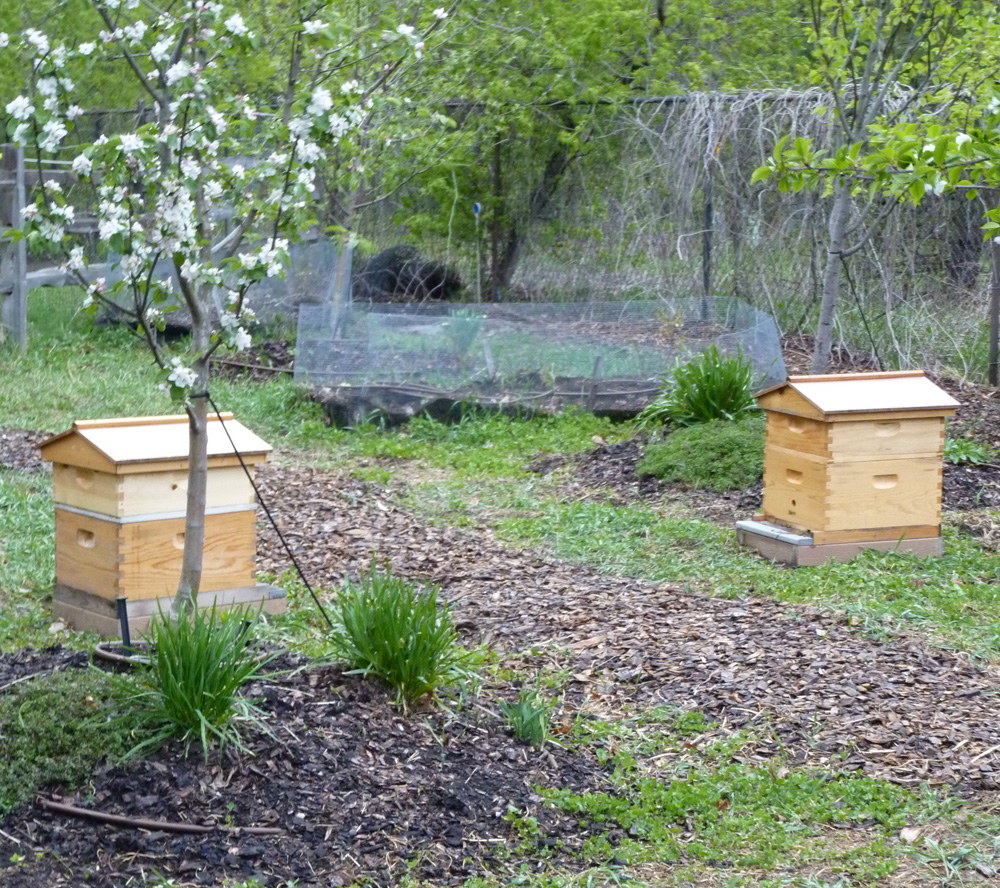
           Andover, 2012, Bees and Apple Blossoms


Paul, here’s an English New Year’s ritual for you. Wassail. You may have heard the word used in relation to wild parties. That’s good too of course. But. In England folks go out to the oldest apple tree in their orchard, usually around noon, and pour cider from a bowl around this tree.

In Devon and Cornwall they add bowing three times to the “Apple-Tree Man.” I like this. The idea is to encourage a large and healthy crop for the fruit season. Pieces of cake and toasted bread were hung from the branches. This was called wassailing the tree. Wassail comes from wase haile, or good health.

They sing:

Here’s to thee, old apple tree

Whence thou may’st bud and

Whence thou may’st blow.

And whence thou may’st

Bear apples anew.

Hats full, Caps full, Bushel,

Bushel sacks full.

And my pockets full too?

Huzzah

Or.

Blow, bear well,

Spring well in April,

Every sprig and every spray

Beat a bushel of apples against

Next New Year’s Day.   

Matthews, 193 for both


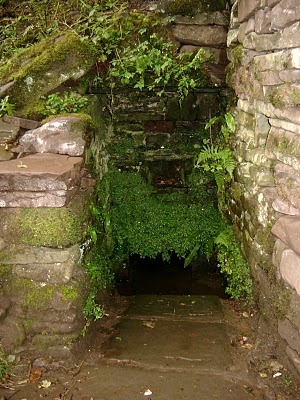
Another New Year’s custom from the Faery Faith involves dressing the wells. In the ancient Celtic way artesian springs were considered dwelling places for faery folk and pathways to the Otherworld. Like some Native American nations, prayer rags tied to trees and shrubs near the well were common. Also, bouquets of flowers, small candles.

In 1995 I visited St. Winifride’s Holy Well in Holywell, Flintshire, Wales. Called by some Catholics the Lourdes of Wales, her well has a stone well casing about three feet high and a large pool which the well fills. When I was there, wheelchairs and crutches lined one of the walls.

St. Winifride’s Holy Well is one of the few locales mentioned in Sir Gawain and the Green Knight. Sir Gawain goes there on his journey to find the Green Chapel. Winifride was a Celtic legend long before the Roman Church and the connection to the tale of the Green Knight involves her beheading by Caradoc, a jilted lover.

The spring rose from where her head hit the ground. Her uncle Beuno, probably a Druid, reattaches her head, and healing became associated with her well.

May the healing power of Beuno and the well of Winifride wash over this new year, this new decade. May our 2021 heal as much as it can, cheer as many as it can, especially on January 20th at noon.

The Grim Boar’s Head Frowned on High

Winter and the full Moon of the New Year

Christmastide Day 5: Bringing in the Boar

Wednesday gratefuls: The full Moon of the New Year hiding in the West behind the Lodgepoles. Chilly weather, a bit of snow. Mountain high. Spiritual and emotional nourishment. 21 days only. See the bad man leave the house. And go away. All dogs. All people who love dogs. Vaccines. Covid. Page turning. Black Lives Matter. Radical police reform. Economic justice.


An interesting day, day 5. It celebrates the bringing of a boar head to a great feast.

Then the grim boar’s head

Frowned on high,

Covered with bay and rosemary.

Sir Walter Scott Marmion

Frowned indeed. And odd that it featured/s for so long in the Twelve Days of Christmas. Why? Because boars were apparently extinct during the reign of King Henry II. He died in 1185.

I say features because bringing in the boar’s head still takes place Queen’s College in Oxford. As it comes, verses of this carol are sung:

The Boar’s head in hand bear I

Bedecked with bays and rosemary;

And I pray you, my masters, be merry

Quot estis in convivo. (so many as are in the feast.)

The Boar’s head, as I understand,

Is the rarest dish in all the land

When thus bedecked with a gay garland

Let us servire cantico. (let us serve with a song)

Matthews suggests leaving an apple or an orange at the backdoor in case the bristled one comes by.

Sæhrímnir, the ever renewing boar of Valhalla, feeds all the einherjar, those Vikings fallen in battle and delivered to the great feasting hall by the Valkyries. He dies each night, is eaten, then revives. In this sense there is some link between the boar and resurrection, much like the einherjar themselves, brought from death to life. The einherjar will join Odin in the great final battle of the gods, Ragnarok.

If you had the chance to read Gawain and the Green Knight, you might remember the hunting expeditions of Bertilak de Hautdesert. The boar is the third and final hunt. Bertilak dismounts and fights him in the water, driving his sword straight into the great beast as it attacks.

Boars were considered as dangerous as a human foe with their sharp tusks, more than human strength, and a wiliness that made them difficult to kill.

Even pagans have a conflicted relationship with nature. Yes, she provides soil for crops, rain and sun from them to grow, and game to supplement domesticated animals like goats and cows and chickens. But she also had predators in the wild like wolves and game animals like the boar, who killed many hunters.

Bringing in the boar’s head, in this context, would signal a human victory. A sort of Roman General’s triumph. And, at the same time, it honors the boar as a worthy foe, symbolic of both the danger and the bounty found in the forest.

Tomorrow: Hogmanay (New Year’s Eve)

Green


Winter and the Moon of the (highly anticipated) New Year

Tuesday gratefuls: The great conjunction of Jupiter-Saturn. Bertilak de Hautdesert. Gawain. Morgan Le Fay.  Arthur. The Celts. Germans. Swiss. English. Irish. Joseph’s new job. Hawai’i. Maps. Friends.
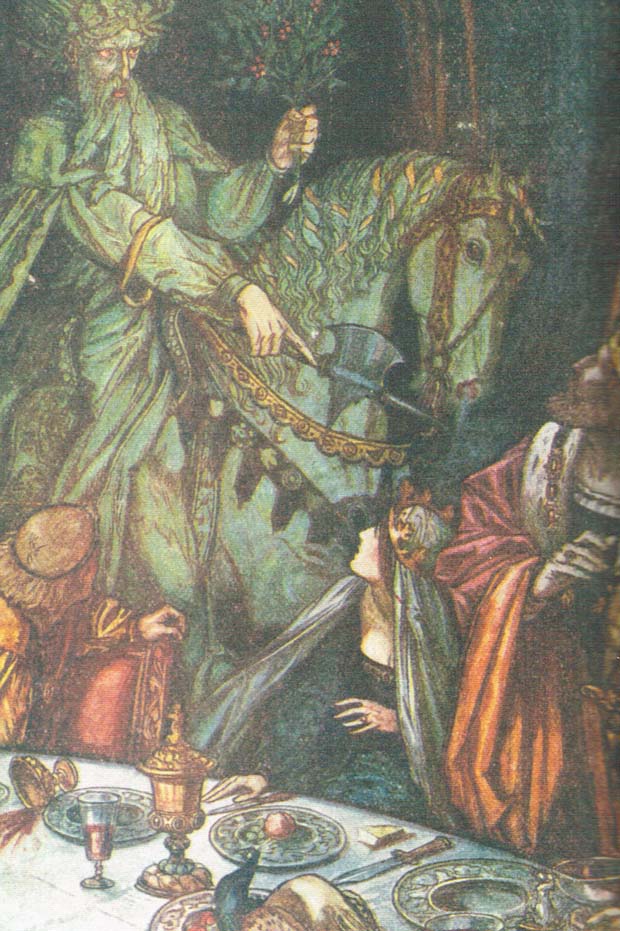


Sir Gawain and the Green Knight summary.* This long poem is part of the Arthurian tales, perhaps the best known outside of Malory’s Le Morte D’Arthur.

The Green Knight is the most important figure in the poem for our Solstice purposes. Sir Gawain takes on the heavy burden of showing the contradictions between courtly love and chivalry. His role is less significant for Solstice thoughts.

Here a few lines from the poem itself.

“Great wonder of the knight
Folk had in hall, I ween,
   Full fierce he was to sight,
And over all bright green.
the hair of the horse’s head was of green, and his fair, flowing locks clung about his shoulders; and a great beard like a bush hung over his breast, and with his noble hair was cut evenly all round above his elbows, and the lower part of his sleeves was fastened like a king’s mantle. The horse’s mane was crisped and gemmed with many a knot, and folded in with gold thread about the fair green with ever a fillet of hair and one of gold, and his tail and head were intertwisted with gold in the same manner, and bound with a band of bright green, and decked with costly stones and tied with a tight knot above; and about them were ringing many full bright bells of burnished gold. Such a horse or his rider were never seen in that hall before…” wayback machine

He and the horse he rode in on. Green. Green. Green.
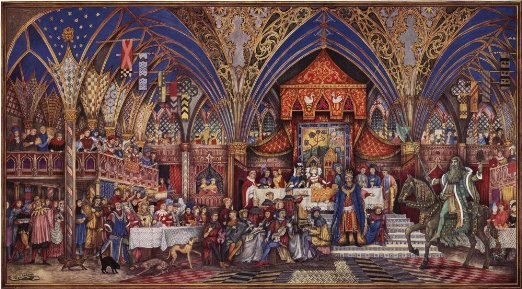
At Camelot the great New Year’s feast only awaits the exchanging of gifts to begin. The knights of the round table, Arthur, and Guinevere sit at long trencher tables, chatting and drinking. Their anticipation fades when a commotion erupts. A knight on horseback has ridden into the hall on his horse.

Arthur, not wanting Camelot to look cowardly, agrees to the Green Knight’s challenge after silence in the hall. Cut off his head tonight. In a year and a day find him and offer your neck in return.

Sir Gawain, not wanting Arthur to put his kingship at stake, takes his place. Off comes the Green Knight’s head. It rolls toward the head table and after a bit of searching the green, headless body finds it, and jumps gracefully back on his saddle.

On New Year’s day a year hence Gawain, after a long search starting on All Saint’s Day, finds the Green Chapel. I am known as the Green Chapel Knight, he told Gawain.

The Green Chapel though is no church building. It’s a green mound with openings, like a burial mound. The Green Knight appears.

After three swings, two missed, and one knick on the neck, the Green Knight declares Gawain’s pledge satisfied.
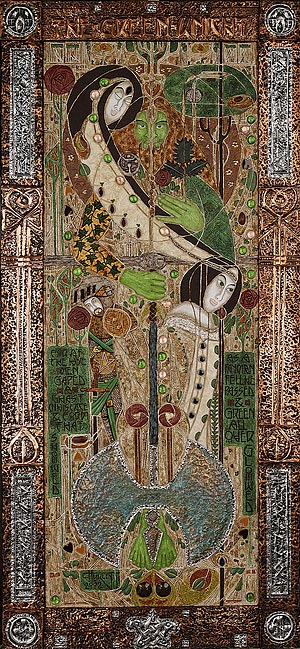
I see two related, but different, relationships to the Winter Solstice in this story. The first, perhaps obvious, perhaps not, concerns the turning of the Great Wheel.

The Green Knight comes to the festive hall on New Year’s eve, not long after the Solstice. The world is still cold. The sun low. Plant life browned and enervated. Chopping off the head of the Green Knight corresponds to the harvest. Even after losing his head, his body, his roots, can find it. He lives yet. Just as plants whose bowed stalks and brown leaves live on underground, ready with stored food for the coming of spring.

All the eating, even the feasting, of the fallow time cannot kill the vegetative life represented by the Green Knight. On the Solstice we stay in the depths, in the darkness, but we also know that on the coming night the light will begin to overtake it. Slowly. Gradually. Until all the Green Heads previously fallen pick themselves up again.

The second correspondence concerns Morgan Le Fay, the withered woman contrasted to the fresh young wife of Bertilak de Hautdesert. A witch and half brother of Arthur, it is Morgan Le Fay who turns Bertilak de Hautdesert into the Green Knight.

Magic. Earth Magic. The green covered burial mound is a chapel. The place of Morgan Le Fay, and the Green Knight may represent the older, nature focused magic, a magic that honored the chaotic reality of the natural world. A magic that confronts the civilized world of revels and knights and governments and agriculture. The organized world. Which can only understand death as finality, not as part of an ongoing cycle.

Christianity adopted a linear view of time. You can see it in a world ending second coming somewhere in the distant future. You can see it in the ominous nature of death. A time of testing, of being sorted, wheat from chaff. Fearing death makes sense if eternal judgment awaits.

Earth magic and the vegetative power of renewal that the Green Knight displays remains in the cyclical world of the Great Wheel. Death. Then, life. Life. Then, death. Decomposition and decay as a good, a way of transforming death into a process, a part of the ongoingness of the Great Wheel.

In both of these interpretations a more ancient, wilder world stands against human conceit. Buildings. Honor. Kings. Not necessarily to displace them, but rather to disrupt them. To remind them of the context of their lives.

Whatever layers we create that push away from the natural world: skyscrapers, airplanes, medicine, family and corporate farms, highways and cars, the natural world is always foundational. Inescapable. The necessary in a contingent world.

Maybe this New Year’s, at a feast near you, a Green Knight will ride in on his Green Horse asking you to cut off his head. What will you do?


*The Green Knight came into Arthur’s hall and asked any one of his knights to trade blows.

Sir Gawain accepted this challenge and he was allowed to strike first. He cut off the Green Knight’s head. The latter calmly picked it up and told Gawain to meet him on New Year’s Morning for his turn.

On his way to this meeting, Gawain lodged with a lord and each agreed to give the other what he had obtained during each day of Gawain’s stay. On the first day, when the lord was out hunting, Gawain received a kiss from his wife which was duly passed on. On the second day, he received a brace of kisses which were also passed on. On the third day he was given three kisses and some green lace which would magically protect him, but only the three kisses were passed on.

Having left the lord’s residence, Gawain arrived at the Green Chapel where he was to meet the Green Knight. He knelt for the blow. The Green Knight aimed three blows at Gawain, but the first two did not make contact and the third but lightly cut his neck.

The Green Knight turned out to be the lord with whom he had been staying and he said he would not have cut Gawain at all had the latter told him about the lace. The Green Knight was called Bertilak and he lived at Castle Hutton.
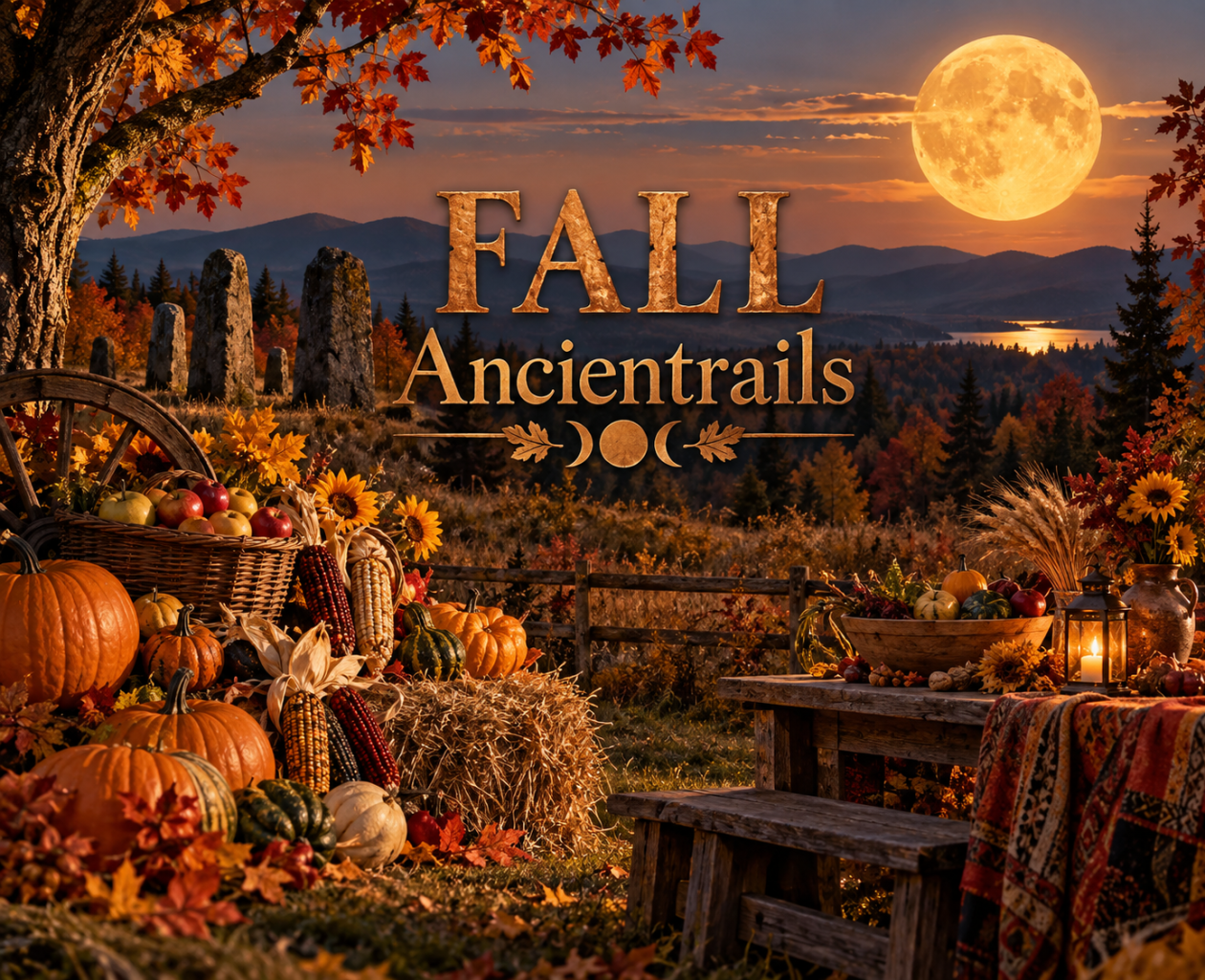
New Grange. Stonehenge.  Chaco Canyon. Goseck Circle. (Germany) Tulum.

Winter and the Moon of the New Year (and the great conjunction of Jupiter and Saturn)

Monday gratefuls: The Winter Solstice. 30 days. Cottagepie from Easy Entrees. Family. Friends. Lights. Jacquie Lawson’s Nordic Advent Calendar. Magic. In an old guy’s heart. Songs. Gifts. The wonder of children.


Ah. Can you sink into the darkness? Feel its fecund cape wrap round your shoulders? Comforting. Nourishing. Deep. Deep as the depths of your soul. Deep as the depths of time, even beyond time, to the Hawking period before the universe began to expand. Deep as the love you feel for those close to you. Deep as the bounty of mother earth is abundant.

The longest night. It comes to you. The sun low in the sky, the day shortened. Cold weather, perhaps. Early on in humanity’s adventure with the stars they knew. The sun had begun to flee. Even at the height of the growing season, on the summer solstice, the nights had begun to increase in length.

This gradual, oh so gradual, slipping away of the light. Would it continue until the night became all there was? How would the crops grow? The animals get fed? The people stay warm and fed?

But, yes, I imagine they also knew. Last year, too. And the sun returned. And the year before that. Let’s see if we can find the moment, capture the day. That way we can assure each other that the sun will not stay away. Let’s build monuments in stone and wood that capture the light of that day, or the position of the stars on that night.

New Grange. Stonehenge.  Chaco Canyon. Goseck Circle. (Germany) Tulum.

This suggests to me that far from being frightened on this night of nights, the ancients anticipated it, probably looked forward to it. But, they also wanted to be sure it would happen again and again, so they spent vast resources ensuring they would know its arrival.

Can you imagine the celebratory feelings when, just as the stone alignments had predicted in the past, the sun came again through the slot, lined up with the stones? The shaman was right! We would get another growing season. See! Life could go on. Ancient science comforting the masses, just as contemporary science comforts us now with vaccines.

Never in my lifetime have we needed the message of the winter solstice more than this year, this 2020 of cursed memory. As the virus claims more lives, infects more people, remains dangerous especially in the richest nation on earth, we need a sign. Tonight is that sign.

Darkness need not lead to despair. These depths, this night, this virus, are not static. Just as fecund darkness enriches all plant life in the fallow season, so does the light of creation shine each year to enrich the plants in the green time. We know that because tonight teaches about darkness and its twin, the Summer Solstice, teaches us about light. Both necessary. Like the symbol of the Tao.

Rising right now, in the Covid darkness, vaccines have begun to dispel the fear and show us that yes, this pandemic can and will end. We are victims neither of darkness nor the glare of a sun that will not set. The earth teaches us this lesson every year. The Great Wheel turns and so do all the vagaries of life.

Wintertide is Coming

Wintertide  December 21 to February 1

Conifer. Evergreen. Pine. Get it? We live in Conifer, often shop in Evergreen, and I pass through Pine once a month on my way to the Happy Camper in Bailey. Though a bit on the nose, if you visited our mountain towns, you would see how these small communities got their names. Lodgepoles. Ponderosa. Spruce. Dominant here. Greening mountain sides. Out my loft/studio window Black Mountain rises up to 10,000 feet, almost a thousand above our home on the peak of Shadow Mountain. The shadows make it appear Black right now, but in other times of day it is green with the Lodgepoles that cover it. Our backyard. Lodgepole.

This is their season. When they stand green while the Aspen and the Willow and the Ash put away their leaves for the winter. Now, as far back in human history, these trees seem to carry on through the cold and Snow of Winter, ever living, their needles green.

Think of it. The Sun sank lower and lower, the nights grew longer, the air colder. The Maple and the Oak and the Elm and the Willow and the Ironwood all lost their leaves, seemed to shrink into themselves. The gardens had only dead stalks of Beans, Tomatoes, Cabbage. They would stick out, above the first winter Snow, sad and fallen. Dead. The Grasses were brown, bowing to the coming of the Winter King. Nothing that bore food lived. Or, so it seemed.

Except. Conifer. Evergreen. Pine. Maybe a Douglas Fir, a soaring Redwood, a Sequoia. A Jackpine. Still green. Yes. These cold fallow days were not all powerful. Even though the sun had begun to disappear, these trees braved the elements. Still green.
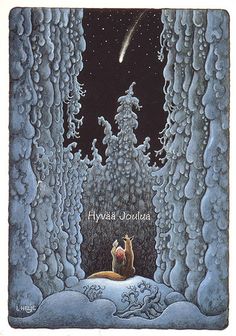
Since Summer’s End, Samain, the time of the last harvest, until Imbolc, February 1st, celebrating the coming of the Ewe’s Milk, there would be no new nourishment from the land, from the world of plants. Even the game in the woods grew thin, suffering the death of the green things as humans did. Fish required chopping through thick ice. Standing in the cold.

Bring in the tree. Bring in the Pine, the Conifer, the Evergreen. Bring them into the house to celebrate the hope, the wish for a new growing season. We need them in the house before the Winter Solstice, when the night and the dark have their victory, light vanquished for as long as it will be all year. Maybe we put stars on them as a Martin Luther tale suggests he did after a Christmas season walk. Or, maybe tree lights remind us of Adam, the first human, who put flaming sticks in the ground for 8 days starting on the Solstice. By the 8th day he trusted the sun would return.

And, bring in a log. A thick one. One that can burn a while. A Yule log. We’ll put it in the fireplace, light it, then put it out each night. At the end of the season we’ll save enough of it to start the fire for the Yule log next Wintertide.

Go outside. Bring in the slash from tree cutting. A few thicker logs. A bonfire! Crackling, sending sparks in the air, up toward the heavens. (not here right now though. wildfires.) Fire. Evergreens. In the fallow time.

Those Romans. Hey, they were something, weren’t they? Saturnalia. Celebrated Jupiter’s overthrow of his father, Saturn. A new world order. It ran from December 17th to December 24th. A lot of decorating,gift giving, feasting, singing songs, giving each other candles to celebrate the eternal light. No Rudolf or Reindeer. Later on.
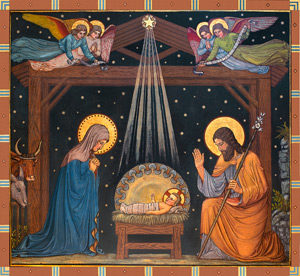
Lots of other links to these holidays. If you’re interested, find a copy of The Winter Solstice: the Sacred Traditions of Christmas, by John Matthews. Also, good suggestions for celebration.

This winter. This particular winter. Wintertide 2020/2021. So much struggle and pain. So many broken promises. So many damaged homes and souls. And, worsening. Right now. As Wintertide comes into its own. Cases in the quarter million or so a day. Deaths over 370,000. Trump still swinging the wrecking ball. Proud Boys in the streets of D.C. Climate change reappearing. Demands to heal centuries of injustice still heating up the body politic. A divided nation. Oh, my.

So what’s Wintertide all about? Those evergreen Trees that live in the cold and fallow months. Conifer, Pine, Evergreen. The Yule log that burns this year and the next. The long journey into darkness finally comes to a climax. The children of wonder whose births have come to be celebrated now: Attis, Mithras, Baal, Tammuz, Apollo and Dionysus, Jesus. All those architectural monuments to the Winter Solstice: Chichen Itza, New Grange, Stone Henge.

each birth, always

They congregate now, in the fallow time, as human markers of lived hope. Look, the Evergreens can survive! Here’s the piece of the Yule log from last year. Last year! This will end.

Happy birthday baby gods. Reminding us that the true power lives in each of us humans. The sun coming through great hall of New Grange to light up the spirals for seventeen minutes. Kulkukan, the feathered serpent, visible on the steps to the top of the temple at Chichen Itza. We’ve been here before. And made it through.

Trump will leave. We’ll gather round to work on our nation together. The vaccines will arrive and Covid will get pushed back into the ranks of a seasonal flu at most. You and I will see each other. Give those hugs and kisses and handshakes and wiggles that have waited through this benighted year. That’s what Wintertide is all about.

So bring in the mistletoe. Hang some green boughs. Light some candles. Make some glog. Sing songs. Read poetry. We’ll be ok.

Oh. We live in interesting times.

Samain and the Moon of the New Year (and the great conjunction of Saturn and Jupiter)

Saturday gratefuls: 32 days. 32! Nearly finished with the cds. A snowy, snow globe day. Rigel and Kep, our bed warmers. Kate. A wise woman. Smart, too. Vaccines. Coming to an arm near you. Soon. That light in the tunnel went up a bit in brightness. The star over Bethlehem explained? The Winter Solstice. Soon. Staycation.


Complex feelings. Friend Tom Crane talked a couple of days ago about the feelings that come up when considering climate change. Made me think about all of us right now. I’ve been labile this week, up and down. Unusual for me. If I get melancholy, I stay there a while. Up and bright? Ditto. But. Covid. Trump. Kate’s long illness. Climate change plus the long road ahead for our nation. Isolation from friends and loved ones.

Bet I’m not the only one experiencing complex emotions. Up. Vaccines. Down. 377,000 deaths. 250,000 + new cases a day. Up. 32 days! Down. Still 32 days left. Up. Renewable energy. Back into the Paris Accords. Down. Baked in heat. Record carbon emissions this year. Up. Jon and Ruth and Gabe on Google Meet. Down. Having to see them on Google Meet. Up. Many good days in a row for Kate. Down. Sudden fatigue yesterday. Up. Good days mean no nausea, no fatigue beyond the usual. Down. Stamina poor.

And these are the big drivers. Every day has mood changes. That unexpected money from the oil well! That crabby e-mail from a relative. Work or relationship stress. Kids. Dogs. Weather. Feelings of self-worth or self-worthlessness. Whatever triggers you. And we all have triggers.

Point. A complex web of stressors has us all dangling in our silken cocoons and each shake of the web warns us that the spider might be coming for her next meal. This is not normal. Where do we go? Out to eat? To a movie? Have friends over? A sabbath service? Take a vacation? Not for most of us. What’s the right metaphor? See-saw. Spider web. Thin ice with cracks. Fingernails on chalkboards. Whatever it is, this is a fraught time. An interesting time.

I’m giving myself permission to feel these movements, up and down, and to react to them. To not be hard on myself for not maintaining an up feeling in down times. Perhaps you need this permission, too.

A Wandering Soul

Samain and the Moon of Thanksgiving

Sunday gratefuls: Paul’s birthday. Mark Ellis. Mary. Diane. Rigel, keeping me warm. Dr. Bachtel. Cod fingers and steak bits. Onion and Cucumber salad. A Colorado blue Sky day. Colorado road builders. Jeffco snowplow drivers. Whoever invented concrete and macadam. Britain. Wales. Scotland. England. Isle of Man. Druids. The Holy Isle. Castle Conwy. Hawarden, Wales. St. Deniol’s residential library. Chester, England. Horse racing there.

I have my toe in the Christmas Spirit pond. Not fully there, but it’s coming. Feels wonderful. Getting ready to dive into some research on Yule and the Winter Solstice. Where most of the Christmas traditions originate. I love learning about Celtic and Northern European religious traditions. Their pantheons. Their myths and legends. Snorri Sturluson. Wagner’s Ring Cycle. Tolkien’s work. Beowulf. Not sure why but these traditions resonate with my inner life. As does Taoism and the lifeways of the Japanese. Much more so than the New Testament or the Torah. Seems strange that it would be so. But, it is.

Even Diwali and Holi. I’d like to experience Holi at least once. Throwing colored powder at each other to celebrate the riotous colors of spring and the triumph of good over evil? Yes. Messy, beautiful, ecstatic.

Buddhism doesn’t do it for me either. Except certain aspects of Tibetan Buddhism. Yamantaka. Bardo. Again, not sure why. Thin soup for me.

Those traditions that find animacy everywhere like Shinto, many Native American traditions. Yes. Roman and Greek myth, legend. Yes, not in a soul way, but as story, as ancient layers below this civilization in which we live.

Perhaps my soul never left the time into which it was born. Maybe during the journey out of Africa when all things were miraculous. When all things moved and lived and had their being right alongside those of us on pilgrimage to humanity’s future. Or, maybe some shamanic ancestor moved directly into this body. Wondering what it was like far from his or her time.

Whatever the explanation. Once I began to see, and then shed, the totalizing myths I’d been steeped in from birth… Well. I can’t unlearn the fragile and human created nature of them. The scent of fear in them, attempting to make certain an uncertain world. Building meaning for lives out of tissue paper and sealing wax. Like the Catholics who built their English churches over Celtic holy wells. Tried to absorb enough of the Faery Faith to draw the Celts away from their pagan practices. It worked. For a while. As Judaism and Islam work for a while, for many. Zoroastrianism.

Not sure about Hinduism. It seems to want those most early, most primal connections with this place. Great stories like the Ramayana and the Rig Veda. I don’t know it well enough. Maybe never will. The Mahabharata. Many mystical practices. Lots of color and fun. Also, the dark side of caste, of killing Muslims.

This month though, the time of deepest darkness, has inspired so much wonderful music. Story. Celebration. At least for those of us in the temperate latitudes. And, I revel in it. Going down with the longest night into the well of my soul. Coming out to light an evergreen tree, hang mistletoe, holly and ivy. Santa Claus. Elves. Snow. Cold. Icicles. Sleighs. Horses with halters. Fire up the yule log. Wish I could lift a glass of grog, or ambrosia, or single malt scotch. But, alas no.

Guess this is my Sunday unsermon. Leaving one way and seeking others.