Imbolc Imbolc Moon
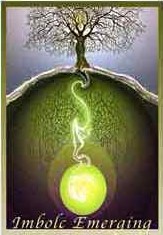 Imbolc, as long time readers of this blog probably recall, means in the belly. This cross-quarter holiday comes between the Winter Solstice and the Spring Equinox. It lies at the most desperate point of the year for an agricultural culture with no refrigeration. If it was a good harvest before the beginning of the fallow season at Samain, all right; but, if it was a poor or even mediocre harvest, then supplies might be running out.
This might mean awful choices must be made. Do you eat the seed grain, which you need to plant next year’s crop? Do you slaughter an animal which you need to breed, because you can’t feed it and your family?
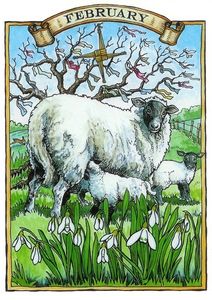
A potential salvation lay in the sheep. The ewes, now pregnant, a lamb in-the-belly, would begin to freshen, produce milk, a source of nourishment that might be enough to get the family, the village, through until spring. Even in good years the freshening of the ewes was a time of celebration. It meant the fallow time was drawing to a close. Spring was near and the growing season would commence.
The Great Wheel turns. The sabbath for the land continues through Imbolc, awaiting the warmer temperatures and rains around the equinox.
 An interesting annual spiritual practice I found at Heron’s Rook, but could not relocate even after searching there, begins at Samain. Heron, the witch who writes this blog, calls the annual focus, the great work. I’m going to reimagine it here. The general idea is hers, but the specifics are as I vaguely remember them or as my reimagining suggests they could be.
We go fallow at Samain, too, letting the last year’s work feed us as we consider what might make for a good crop in the coming year. On the Winter Solstice go deep into your own darkness, celebrate what roots in your soul, what is even now gathering nourishment from the soil of your inner garden.
On Imbolc, where we are right now, let the spiritual or creative elements of that which grows within you come to the surface, give you sustenance as you await the fullness of its birth.What you await is a purpose, a project, a great work strong enough to sustain focused energy over the growing season or several seasons. At Imbolc it’s still nascent, unformed, perhaps unrecognizable as what it will become. But its growth has already begun to feed you.
Around the vernal equinox let it out, bring it into the sunlight of the new spring. Let it gambol in the fields of your heart. Feed it. Embrace its newborn animal nature. You might see it as a puppy or a kitten, a lamb. It’s new in the world and must be fed, but just as much as physical needs it has a need to explore, to greet the new world in which it now lives.
 This is the moment to run like crazy with that potential new work, examine all the ways it can go, let it loose. See what it needs to explore, to learn. By Beltane, the beginning of the growing season, you will know the skeletal structure of your new work. You will have followed its maturation from the dark of the Winter Solstice through its puppy like eagerness, to the now formed project or direction.
Over the course of the growing season you will give this great work for the year what it needs to thrive. Plenty of sunshine, water. You’ll weed around it. Provide it food. If its completion coincides with Samain, then the process will begin again.
As I wrote this, I realized that for me, I’d probably flip it. That is, I’d start the incubation process at Beltane, let the new great work grow over the Summer Solstice, let its creative energy begin to emerge around Lughnasa, bring it into the world around Mabon, or the fall equinox, and get down to serious work on it at Samain. This is because I find the cold and the bleakness of the fallow time most conducive to creative work.
An interesting idea, I think.



 In a bit of nostalgia for me all the seats in the place were taken up by residents from a group home for the developmentally disabled. A young man with a plastic helmet to protect against seizures, another autistic young man davening and crying out, and four Down’s Syndrome young women. When I worked with the developmentally disabled, which I did from 1974 to 1980, taking clients out to places like the laundromat was a pleasant diversion, teaching independent living skills and being away from the residence.
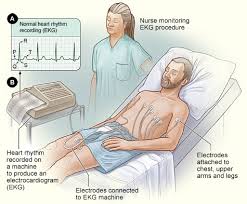 My physical was, at least so far (before lab results), unremarkable. Dull is my favorite medical term. Boring. Nothing happening here. My ekg was like last years. My blood pressure is low enough that Dr. Gidday wondered if I was over medicated. No, I said, I want to keep it low. All those strokes in the family of origin. O2 saturation fine, as it always is when I descend 3,600 feet to her office. Knee? Fine. Other knee? Surprisingly fine. Prostate? Still gone. PSA’s good. No hernia. Lungs and heart sound good. Still upright and moving.
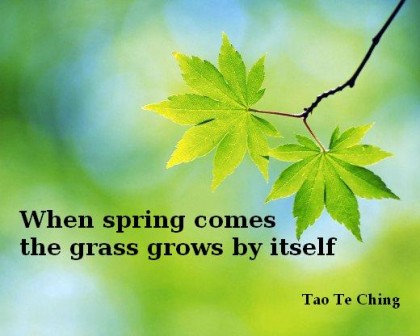 It is the tao of springtime reminding us that winter passes, too, as will all the difficulties; and, that even in the midst of a tough season, underneath is the movement of life itself, struggling to emerge, to take back the moment. All we need to do is follow its cues.
 Mentioned


 Made corned beef and cabbage for dinner last night. Erin go bragh! When I decided to write novels, now long ago, Kate suggested I find an area that I could relate to. I chose my Celtic heritage, both Welsh and Irish. It is a fertile realm, filled with gods and goddesses, fairies and banshees, this world and the other world. Not so deep into it right now with one exception, the Great Wheel.
 Its sumi-e material material, though, was feeble compared to the hole in wall (by comparison), Red Herring. Meiningers’ selection of brushes were all cheap, beginner’s brushes. They did have a couple of Yasumoto inks that I bought, an Ultra Black and a Black Gold. I also picked up an Olfa knife to cut paper, from the kraft roll that came last week and from the rolls of rice paper I bought from Red Herring and Blue Heron, an online sumi-e store.
 In addition to cooking, the sumi-e (ink brush painting), and working out, I mentioned the possibility of a greenhouse. Expensive, so we’ll see about that. But. I began reading a book I’ve had for a while,
  Buddy Bill Schmidt will recognize the quote that begins the chapter on Soil: “See what you’re looking at.” Carey Reams, an unlikely looking radical, used to say this. He was the founder of the outfit from which I purchase soil additives, the High Brix Gardening folks in Farmington, Minnesota. He contended, as do many now in the farm-to-table world, that agriculture went astray long ago, moving toward products that fit mechanized food production rather than human nutrition.
 The vast wheat fields of the Great Plains grow an annual wheat, two varieties that work well in steel rolling mills. Not only have these annual crops destroyed the ten feet or more of top soil that buffalo and deeply rooted grasses developed there, but the steel mills which make this crop profitable separate the germ and bran from the kernel, leaving only fluffy white flour. What’s bad about that? Well, turns out the nutrition in wheat lies in the germ and the bran.
 I guess this is the native Midwesterner in me. I grew up driving past corn fields, pastures filled with Holsteins and Guernseys, pigs and beef cattle. The Andover gardens, the orchard and the bees, along with our small woods satisfied this part of my soul. I’m going to investigate local CSA’s, see if that’s a route back into this world. We have to buy groceries anyway, so why not from folks who share a philosophical position close to my own.
 It was also time to slough off some of the Minnesota based, second phase lingering work. Especially the political. I am going to the caucus this Tuesday; however, I no longer see myself as a dedicated activist. But, and I consider this great news, Ruth told me she was walking out on April 9th, standing outside Mcauliffe, her middle school, for seventeen minutes, one minute for each of the Parkland victims. She’s doing it in spite of the fact that adults tell her no one will listen. Go, Ruth!
 The melancholy also uncovered a tension I’d been feeling between leaning in to the domestic, cooking, for example, and Kate and mine’s presence in the Beth Evergreen community, and what I consider my work. Recalibrating second phase expectations about work, which I have not yet fully done, feels like a task for this time. In fact, I enjoy the domestic part of our lives and it feels good to devote more energy to it.
 A couple of things have come into focus over the last few days. One, I need to work more with my hands, with my body. Now that the turmoil of our first years here has begun to subside I’m missing the garden, the orchard. Not just the growing, the plant care, the flowers and vegetables and fruits fresh out of our soil, but carrying bags of compost or digging or moving bee hives, tending to the raspberry patch. If I don’t do this, I can get stuck in my head. Not the only part of me I want to nurture.
 And the reading. Oddly, the deeper my immersion into Judaism, the more my interest in Taoism increases. So. Diving into those books, some online educational material. Also, Reimagine. Reconstruct. Reenchant. Material on emergence. James Hillman. Magic and reenchantment. Reinvention of the sacred. The auld Celtic faith.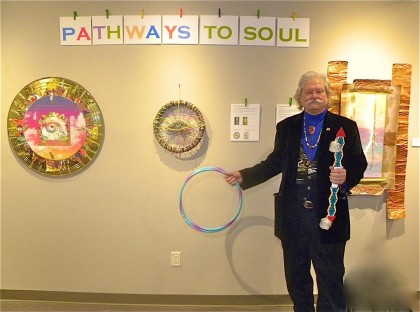
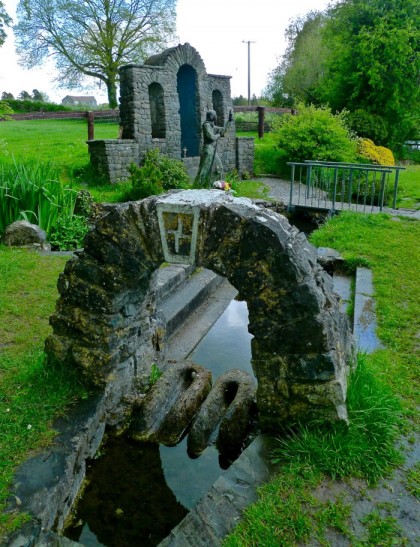
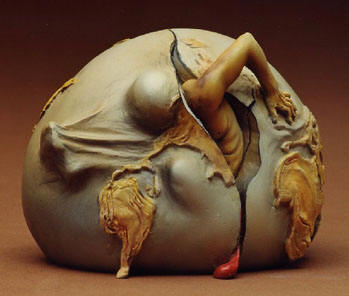 It is axiomatic that each person is unique, a particular example of the human, of life, of the creative process that began at tzimtzum or the big bang, thrown into a particular time and a particular place. It is that particularity that Emerson elevates. It is that particularity which formulates within us, as instantiations of the whole, our own work. When we tap into the sacred, the shard of ohr (divine light) lodged within us, we come to know our work. And, the world needs it because you are the only one with this spark of the divine and the only one in the whole history of the universe who has it. If you don’t express your ancientrail, it will die with you and the world will be poorer.