Beltane Moon of the Summer Solstice
 The shift to Reimagining has happened faster than I thought it would. My mind is like Kepler, our only dog who likes toys. He has a whole box of toys and he goes into it, noses around, finds the one he likes (why that one? no idea.), takes it out and carries it over to a place he’s decided is his toy stash area. I have several ideas that I’ve been playing with for years, e.g. becoming native to this place, emergence, tactile spirituality. In ways I don’t understand my mind goes over to the box of these ideas, hunts around, selects one and puts it front and center for maybe a second, maybe longer. Sometimes I pick up and play with one for awhile.
Right now just prior to sleep seems like a cue to start digging in the toy box. Last night it was an idea I had long ago, back when I started moving away from Christianity and toward a pagan perspective. I got to wondering about origins, about where certain things came from.
 In the shower one day I began to wonder where our water came from. At the time Kate and I lived on Edgcumbe Avenue in St. Paul so the question really was, where did St. Paul get its water? I had no idea. Turns out St. Paul public works pumps water out of the Mississippi and into a chain of lakes including Pleasant Lake and Sucker Lake just across the Anoka County border in Ramsey County north of St. Paul.
At that point I began meditating in the shower (what can I say?), following the water flowing over me back to its source in the Mississippi, then back up river all the way to Itasca State Park and the headwaters there in Lake Itasca. Sometimes I would include the watershed, imagining rivers and streams emptying into the Mississippi on its way south toward the Centerville pumping station. Rainfall, snow and ice melt contribute, too.
 Though I haven’t done it, it would be possible to track back much further to the arrival of water on earth. This is a very interesting topic which I raise only to demonstrate the potential in this kind of thinking.
Last night I recalled this early meditation on water and began to consider what it would be like to homeschool ourselves on the other inputs that come into our apartments, condominiums or single family homes, i.e. electricity, gas, broadband, telephone service (yes, some of us still have landlines). In other words what modes of generation produce the electricity in your home? Where are those power stations located? You might even ask yourself, what is electricity anyhow?
Contemporary life, especially since the early 1900’s, has distanced us further and further from the vast variety of things necessary to keep us alive. Do you know, for example, where the power comes into your house? Or the water? Most of us treat electricity, gas, and water as if they just show up in our taps, our outlets, our furnaces. This is understandable, it doesn’t seem important. As long as they show up reliably, we don’t consider them.
 Open the refrigerator. Where did the food come from? How about the carpet on your floor? The roofing material. Concrete. Paint. How about the car in your garage? Where was it built? What sort of materials go into making it? Where do they come from?
Each and every article of clothing, toothbrush, plate, door knob, seat covering, bicycle tire is a rearrangement of elements secured from somewhere by mining or forestry or chemical engineering. We twenty-first century Americans, even those living in poverty, rely on a vast web of resources, each of which had to be gathered, transported, processed and delivered to our home. While this allows us to live in comfort unknown to most people on earth, even the very wealthy, throughout history, it also literally blinds us to the complex web of activity and materials that make it possible.
One way of reimagining faith is to open ourselves to the way that web of activity actually functions to help us live. Holy water. Holy gas. Holy wool. Holy garlic. Holy stone. Holy sewage. If we take to time to notice, to attend to the wood beneath our feet, the plaster over our heads, the water in our glass, the food on our plate we can begin to reinsert ourselves in that complex web, to be an active part of it, not a dumb recipient.
 The incredible complexity of this web has put a thick wall between our daily lives and the earthiness of all that is around us. We start the car, shift into drive and head out to work or the store or on vacation dulled to the effort expended on the gasoline that fuels it, the rubber in the tires, the precious metals and the not-so precious metals in the body and frame and engine. I’m not talking right now about a car’s implication in climate change, or economic injustice, or urban planning. I’m focusing on getting to know how it came to be, what of our world made it possible.
 Why? Because focusing on these things, deconstructing our things, begins to break the spell of modernism. Modernism offers us in the developed world a world prepackaged for our needs, organized so that we don’t have to till the field anymore, or hitch up the horse, or drop a bucket down a well. In so doing it waves the wand of mystification over our senses, blinding us to the mines, the aquifers, the oil fields, the vegetable fields, the landfills, the seeds and chemicals required to sustain us. This enchantment is the first barrier to a reimagined faith, to placing ourselves once again in the world.
It must go.
 You may not know I have a second blog, ancientrailsgreatwheel.com. I plan to post on it regularly now, on Sunday mornings. It’s a blog focused on the great work, on reimagining faith, on climate change, all related in my world. Give it a look if you’re interested.
 These are bread crumbs, usually no more than that, of the predilections I have, of the circumstances of my life. I say I do it for the grandkids or for folks I know, but really I do it for myself, to have a chance to speak out loud, to be able to follow my own life. So much of our daily life disappears (and probably should) under the onward spiral of time, but I find it interesting to know what June 18th in 2006 or 2010 was like for me.
 Kate continues to struggle with dry mouth, a very sore throat and other symptoms of Sjogren’s syndrome. She’s lost weight as a result. Lab tests don’t suggest anything terminal going on, but her distress is significant. If you know Kate, you know she has an energizer bunny mode, but she’s been on the battery depleted side of that equation for a while now.
 A new seasonal reality for us: pine pollen. All these lodgepole pines insist on involving on us in their reproductive orgy that happens this time of year. A fine yellow dust settles on everything. Coming in easily even through screens, it’s especially apt to settle on things electrical, so the computers and the tv and the microwave all have a coating. It also coats our solar panels, reducing their efficiency. If it rains, a yellow scrim settles over the driveway, pooling where the water does. I wish these pines could figure out a more direct way to make more pines.
 With the first draft of Superior Wolf finished I’m taking this week to do various tasks up in the loft that I’ve deferred. Gonna hang some art, rearrange some (by categories like Latin American, contemporary, Asian) and bring order to some of my disorganized book shelves. I want to get some outside work in, too, maybe get back to limbing and do some stump cutting, check out nurseries for lilac bushes.
 Even so, reimagining is beginning to exert a centripetal force on my thinking, book purchasing, day to day. For example, last night as I went to sleep a cool breeze blew in from the north across my bare arms and shoulder. It was the night itself caressing me. I went from there to the sun’s warm caresses on a late spring day. The embrace of the ocean or a lake or a stream. The support given to our daily walking by the surface of mother earth. The uplift we experience on Shadow Mountain, 8,800 feet above sea level. These are tactile realities, often felt (0r their equivalent).
 Next, eliminate the metaphorical. If we do that, we can immediately jump into a holy moment, a moment when the bonds that tie us to grandmother earth are not figurative, but real. The breeze on my bare arms and shoulders is her embrace. The sun on my face, penetrating my body, is him in direct relationship with me, reaching across 93 million miles, warming me. The ocean or the lake or the pond or the stream cools me, refreshes me, hydrates me, acts of chesed, loving-kindness, from the universe in which we live and move and have our being.
 While hiking and thinking about Reimagining, I realized I’m taking an atelier approach to it. Ateliers train would be artists in the classical mode, using lots of drawing, life models and work with perspective. They’re considered conservative in today’s art world, a sort of throwback to the artist/apprentice studio that dominated art education for so many centuries.
 Yet what I really want to do is rethink what faith is, why we go to the places that we go to for spiritual nourishment and whether there might be a real faith, an approach to the religious life, that emerges naturally from the world in which we live and carry on our daily lives. That is, one without a charismatic founder or an ethnic base, a faith which would help us see the holy ordinary, that would expose the ligatures that bind us to this planet, to the plants and animals and minerals and atmosphere, expose them and help us see them as the loving embrace that they are, not only as limits to our lives.
 Another short trough of time where work here will focus on moving, rearranging, hanging.
 But not yet. The next period of time belongs to another very long term project, reimagining faith. There is that bookshelf filled with works on emergence, of pagan thought, on holiness and sacred time, on the Great Wheel, on the enlightenment, on nature and wilderness. There are file folders to be collected from their various resting places and computer files, too. Printouts to be made of writing already done. Long walks to be taken, using shinrin-yoku to further this work. Drives to be taken in the Rocky Mountains, over to South Park, down to Durango, up again to the Neversummer Wilderness. The Rockies will influence reimagining in ways I don’t yet understand.
 While the world burns, at least the Trump world, kabbalah suggests a bigger world, more worlds, right next to this one. There is, as Rabbi Jamie said, a bigger picture. I learned a similar lesson from Deer Creek Canyon during my cancer season two years ago. These Rocky Mountains, still toddlers as mountains go, were and will be present when we are not. In their lifetime humanity will likely have come and gone.
 Yet. We do not live either in the deep geological past nor in the distant geological future, we live now. Our lives, our mayfly lives from the vantage point of geological time, come into existence and blink out, so we necessarily look at the moment, the brief seventy to one hundred year moment into which, as Heidegger said, we are thrown.
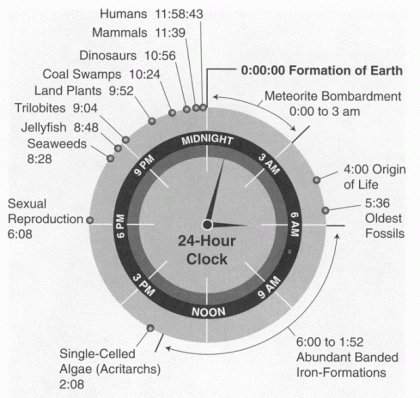 Somehow we have to realize that though our lives are small compared to the immensity of the universe and the imponderable nature of time, they are everything while we have them. As for me, I find all this comforting. Putting my efforts in the larger perspective gives me peace, putting them in the immediacy of my life gives me energy. We will not complete the task, no, we will not. But we are not free to give it up either.
 Back at Superior Wolf. After a month or so of focusing on other things, chiefly that presentation for the mussar class, I’m writing again. The end of the first draft for this novel is near. Once I get it done I’m going to print it out and give it to Kate, then I’m going to move away from it for a while, perhaps three/four months, while I try to push Reimagining Faith further along.
 Yes, mussar and kabbalah require a lot of reading, too, but that’s its own concentrated effort, not competitive with Reimagining. In fact I find the mussar and kabbalah work reinforcing for Reimagining, especially in a Reconstructionist environment. There’s a lot of energy and permission for rethinking fundamentals at Beth Evergreen.
 Came home last night from studying the mysteries of the universe in kabbalah. A nearly full moon of the summer solstice hung high in the sky, giving the lustre of, well, not midday, more like late evening, to the forest below. Brook Forest Road, which becomes Black Mountain Drive, winds along Bear and Maxwell Creeks through a long valley before it gets serious about gaining 1500 feet of elevation. A couple of miles from home, after it has turned to Black Mountain Drive, this two lane asphalt heads uphill through the Arapaho National Forest.
 Heavy rain yesterday afternoon, felt like being back in the humid East. Black Mountain is no longer white; it’s green with its lodgepole and aspen looking healthy. It’s gone from white haired old man to green man. Good to see. Cub Creek, Maxwell Creek, Bear Creek and Blue Creek are all full. The snowpack is well above average. A much better scenario for this summer. Thankful.