Category Archives: Great Wheel

The Vernal Equinox, 2017

Spring                                                                        Anniversary Moon

In the latter half of the 20th century, the spring emergence of leaves, frogs, birds and flowers advanced in the Northern Hemisphere by 2.8 days per decade.”  NYT, The Seasons Aren’t What They Used To Be*, March 19, 2017. See an NYT graphic representation here.
650 2011 04 20_0898


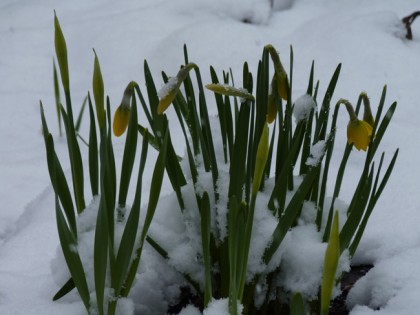
We’re celebrating the spring equinox with yet another red flag warning. We need precipitation. Spring in the mountains is not yet, though the temperatures felt like it this whole last week.

A while ago I asked an entomologist at the Cedar Creek Nature Center in Anoka County what was the key phenological sign of spring. Bloodroot blossoming was his answer. Up here on Shadow Mountain it seems to be pasque flowers and they are blooming. Yet in many years, most years, there would be no pasque flower blooms now due to snow cover.

On the Great Wheel, the spring equinox is the point when the promise of Imbolc’s freshening of the ewes begins to appear in the plant kingdom. Leaves push out. Spring ephemerals hurry up and bloom, getting out ahead of tree and shrub leaf shade. Buds for later blossoms appear. Green pushes out brown. The sound of tractors are heard in the fields.

This storied season has a vital presence in poetry, song and many of the world’s religions. Mother earth seems to defy the fallow season, the cold season by creating life abundant from little more than sun and soil. No wonder the tales of resurrection in Christianity, in the Egyptian legend of Osiris and Isis, and the Greek’s Orpheus and Euridice, Demeter and Persephone have their analogs in spring.
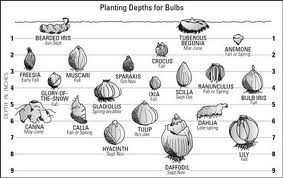
bulbsYet it is not a true analog. Mother earth only seems to defy winter and the fallow time. It is not, in fact, death and resurrection, but a continuum of growth, slowed in the cold, yes, but not stopped forever, then magically restarted. Corms, bulbs, tubers and rhizomes all store energy from the previous growing season and wait only for the right temperature changes to release it. Seeds sown by wind and animal, by human hand are not dead either. They only await water and the right amount of light to send out roots and stalks.
20170318_163044I prefer the actual analog in which human and other animals’ bodies, plant parts and the detritus of other kingdoms, all life, return their borrowed materials to the inanimate cache, allowing them to be reincarnated in plant and animal alike, ad infinitum. Does this deny some metaphysical change, some butterfly-like imaginal cell possibility for the human soul? No. It claims what can be claimed, while reserving judgment on those things that cannot.

After Beth Evergreen’s mediation shabbat service last week, a member of the congregation and I got on to the topic of death. “I think it will be like before I was born,” he said. “Yes, I’m a nihilist, too,” I said. “But, I admit the possibility of being surprised.” He agreed.
Brand-Storytelling-In-The-Post-Truth-EraIt is spring, I think, that gives us this hope, no matter how faint, that death might be only a phase change, a transition from this way of becoming to another. It’s possible.

A necessary complement to the objectivity of science, then, is the subjectivity of experience. An enthusiastic openness to the lives of other species — the timing of tree blooms on city streets, the calls of frogs in wetlands or the arrival of migratory birds — is an act of resistance to deceptions and manipulations that work most powerfully when we’re ignorant. “Post-truth” does not exist in the opening of tree buds.” ibid

 

Learning How To Live

Imbolc                                                          Anniversary Moon

Teeth cleaning a.m. Kate and I now schedule teeth cleaning and annual physicals together. I call it medical entertainment. Just like going to the Tallgrass Spa together. Almost.

mussar

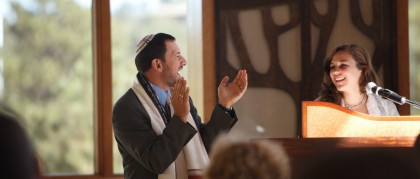
Mussar afternoon. Soul cleaning together, too. I’m learning a lot about Judaism with her. And, I’m impressed with what I’m learning. Here’s the key new insight: Judaism has, from a long time ago, insisted that abstract ideas like mercy, compassion, judgment, faith have embodied reality. That’s what all those laws are about, how to make the faith work in daily life.

This is very different from the Christianity in which I was trained. Christianity unhitched this very earthy, practical religion from the notion of embodied abstractions, letting the abstractions become dominant. This led to a growing gap between dogma and actual practice. Of course, many Christians work at making their faith inform their lives, but the tools are not as good the ones in Judaism. It’s not the laws themselves, but the spirit of actively grappling, every day, every moment with what it means to show mercy, to judge, to practice loving kindness, to exhibit patience that gives Judaism its lived flavor.

Rabbie Jamie and congregant

Still don’t want to be a Jew, no interest in converting, but I have a lot of interest in learning how to live from the community of Beth Evergreen. Probably the best religious experience of my life.

Swinging

Imbolc                                                                 Anniversary Moon

I confess the pendulum powering my inner life has begun to move in eccentric ways since the emergence of the Trump. It swings in its plane, as it always has, tick tocking its energy into the engine of my inner world. Yet the rotating sphere of my inner life, which processes around the poles of birth and death, as the earth rotates around its north and south poles, normally keeping me from stasis in a place where time and space have no purchase, seems to have altered.

This is, for me, a dramatic change and one I have not yet learned to accommodate.  The whole circle which the pendulum scribes moves through these points: love, family, nature, writing, reading, travel, dogs, house, mountains, politics, art, science, friends, sleep, body, mind. In its completeness, as its plane touches the ancientrails of my soul/self, I experience those aspects of my inner me that are my unique identity.

Wrinkleberry Lane, North Devon, England

But now, there is some magnetic pull when the plane of the pendulum finds underneath it the ancientrail of politics. The silver ball wobbles slightly, pulled out of its determined arc across the rotation beneath it. It has, so far, always righted itself, the dynamics of its swing returning it to its usual course, but it feels as if the ancientrail of politics has been altered in some dramatic way, as if its path no longer relates to the world in the ways to which I’m accustomed.

In that place, the place of the political, something new has emerged. It is part fear, a new feeling for me relative to the political; it is part anguish, not new, but intensified; it is part disorientation, definitely new; it is part earthquake, the terra firma of the political moving under my feet, all new feeling. The combination of these changes is trying to alter me, to change the rotation which is, really, my life.

 bdesham's mother
bdesham’s mother

In this extended metaphor my life is the rotation of my Self as it processes around the poles. It does not, in other words, move forward or backward, but in a repeating circle which might from the outside look like a spiral moving from Duncan, Oklahoma, where I was born, to that unknown point where, as far as I know, the sphere implodes and the pendulum stills.

How this will affect me, I don’t know.


Magnum opus

Imbolc                                                                            Valentine Moon

great workDon’t know why it took me so long, but I know how to make America great again. It will not require red baseball hats or xenophobic bluster. No, it only requires listening to the ideas of a Passionate priest, Thomas Berry. Berry wrote a small book, The Great Work. It influenced a turn in my political activity from economic justice to environmental concerns.

This 258 page book is a quick read and it introduces The Great Work. Civilizations, according to Berry, have a quintessential role that only they can perform. The one he identifies for our civilization is this: Creating a sustainable existence for humans on this earth. That is our Great Work. It is the way to make America Great again.

guestsThe phrase, the Great Work, comes from medieval alchemy. The primary, original material of the universe, the prima materia, in the alchemist’s lab can create the philosopher’s stone. The philosopher’s stone could turn base metals into gold or silver and extend the alchemist’s life.
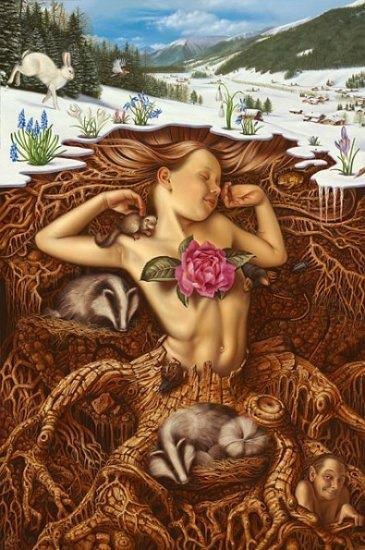
We can take the prima materia of the U.S., its citizens and its land, put them in the alembic created by our need for survival and our need for economic  justice, and turn up the heat until we have our philosopher’s stone. When we have it, we can use it to heal the earth and create good-paying jobs for all.

Then, then America will be great. Not only again, but still and not only still but into the future as well. May it be so.


Imbolc, 2017

Imbolc                                                                                 Valentine Moon


Feb

Imbolc, or in-the-belly, celebrates the time in Ireland when the ewes would freshen. Their pregnancies meant milk would be available after the long fallow season that had begun at Samain, Summer’s End.

Pregnant ewe
Pregnant ewe

Imbolc lies halfway between the Winter Solstice and the Spring Equinox, what the Celt’s called a cross-quarter holiday since it falls between two quarters defined by the solar year. That milk is also a promise, like the gradual lengthening of days after the longest night of the year in late December, that spring and the growing season will come.

It’s easy for us in our refrigerated, grocery stored world to gloss over these signals of the natural world. It seems like we don’t require them anymore. After all we can buy milk, cow’s milk, at any time of the day or night, 365 days a year. And the growing season particular to our latitude and longitude also seems irrelevant since it’s always the growing season somewhere on earth. The occasional gaps that even modern transportation can’t resolve can often be filled by greenhouse or hydroponically grown produce. We’re good, right?

I’m afraid not. Celebrating Imbolc or any of the Great Wheel holidays will not resolve our alienation from the sources of our sustenance, the sun and mother earth, but this ancient tradition exists to call us back home. The Great Wheel is a reminder that the cycle of life continues, even when the fields and animals are barren. The power of the sun, working in harmony with the soil, with plants, with animals that eat the plants does not disappear. It can be trusted.

awakening

It is though, that alienation, evident in so many ways, that drives climate change, that creates produce modified for harvest and storage, not human well-being, that underwrites the paving over of cropland and wetlands. We imagine that somehow the droughts in California will stop there. We hope they’ll be confined to somewhere else, somewhere where we’re not. Global agriculture means we’ll be affected wherever the damage occurs.

Colorado River Basin

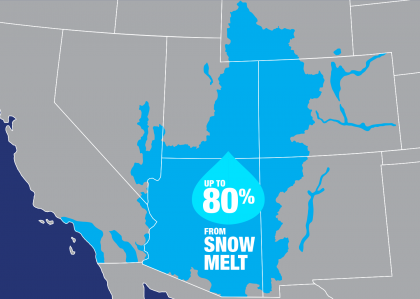
Right here in Colorado we have a key example of the interdependence for which the Great Wheel stands. Our snowpack, high in the Rockies where the Colorado River rises for its journey south toward its ancient destination in the Gulf of California, determines the amount of water available to nine states. Including California. Winter snowfall, melted by the increasing warmth of spring and summer, nourishes millions of people, cities like Las Vegas, Phoenix and Los Angeles.

common ground

In the age of Trump and rising nationalist, right wing populism, the need for the Great Wheel has never been more profound. It softens our in the moment, human conflicts by lifting up the long term, the cycles of life in which all humans, all life participate. The Great Wheel reminds us that there is no other when it comes to living on this planet. We’re all here and bound to one another, connected. My hope is that someday, perhaps someday soon, we’ll all realize that and adjust our politics accordingly.


A Druid and a Radical

Winter                                                                                      Valentine Moon

OK. I admit it. I occasionally take the quizzes that pop up on facebook. I mention this because one set of quizzes seems, well, accurate. The same quiz website offered two recently: What kind of ancient religion would you follow? What kind of philosopher are you?

Druids&Mistletoe
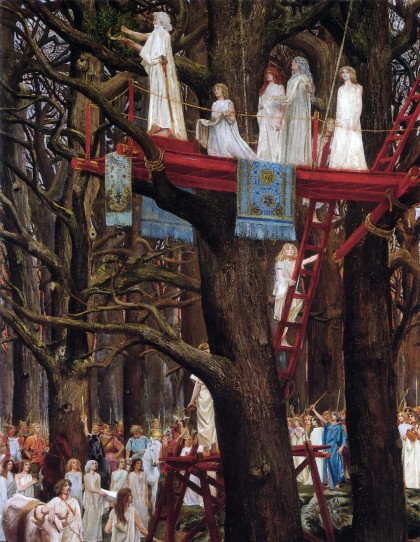
Druid Harvesting Mistletoe

Though I thought I’d saved the piece about ancient religion, I didn’t. Still. The ancient religion that matched my answers? Celtic Druidism. How ’bout that? In the year leading up to my leaving the Presbyterian ministry I was in spiritual direction with John Ackerman at Westminster Presbyterian Church. When I told him I no longer believed in Jesus/God/Holy Spirit, but was more focused now on how I fit into the natural world, he said, “Well, you might be a druid.” He meant it. Not a flippant observation. Prescient.

Since then, the Great Wheel has become my liturgical calendar. I’m much more like what I would once have critiqued as a flat-earth humanist. That is, the metaphysical realms of the world religions seem like poetry to me rather than statements about ontology. I am not a new atheist, a scorner of faith and its many, many permutations. And, yes, I recognize the role religion plays in human conflicts, but I know that most of the time religions gather people of similar demographic characteristics. When conflict emerges, it often has roots in economic and political realities that align closely with religious preferences.

Thomas-Paine-Amazing-quote

I did save the note about which philosopher I’m most like.* This also seemed apposite. It surprised me, in both instances, how the 29 questions they ask managed to get somewhere close to how I see myself.

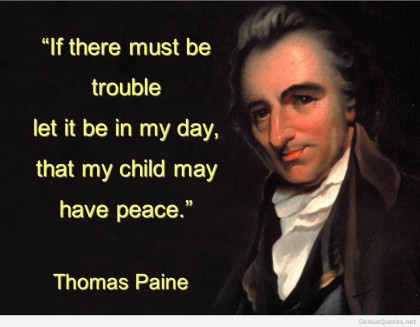
*Your mind works like the philosopher: Thomas Paine

An anarchist who championed reason and free thought, Thomas Paine was never afraid to speak his mind no matter how unpopular or revolutionary his theories were. Like Paine, you see life as full of possibilities and love to shake up the status quo by thinking outside the box. You are spontaneous and communicate confidently and fluidly. Could you write a post to inspire world-transforming events like Paine’s pamphlet ‘Common Sense’ influenced the start of the American Revolution? Who knows? (But we think it might be worth a try.)

Yamantaka for the New Year

Winter                                                              Cold Moon

Existentialism is a philosophy for the third phase. No matter what other metaphysical overlays you may have the tick-tocking grows louder as you pass 65. When this clock finally strikes, it will take you out of the day to day. Forever. Strangely, I find this invigorating.

In case you don’t get it the occasional medical bomb will go off to make sure you pay attention. Last year, prostate cancer. This year, that arthritic left knee. Kate goes in for an endoscopy on January 3rd. She’s waiting approval for a biologic drug to help her rheumatoid arthritis. All these are true signs of the pending end times, but they are not the end itself. These medical footnotes to our lives press us to consider that last medical event.

I’ve followed, off and on, the Buddhist suggestion about contemplating your own corpse. I imagine myself in a coffin, or on a table somewhere prior to cremation. This is the work of Yamantaka, the destroyer of death, in Tibetan Buddhism. I’m not a Buddhist, nor do I play one on TV, but I became enamored of Yamantaka while learning about the art of Tibet and Nepal at the Minneapolis Institute of Art.

yamantaka-mandala
yamantaka-mandala

This mandala is a profound work of art on view in the South Asia gallery (G212). Adepts of Tibetan Buddhism use this mandala as a meditation aid to make the journey from samsara, the outer ring representing the snares that keep us bound to this world, and the innermost blue and orange rectangle where the meditator meets the god himself. The impact this work and the portrait of Yamantaka that hangs near it have had on me is as intimate and important as works of art can evoke.

Death is more usual, more understandable, more definitive than life. Life is an anomaly, a gathering of stardust into a moving, recreating entity. Death returns us to stardust. Yamantaka encourages us to embrace our death, to view it  not as something to fear but as a friend, a punctuation point in what may be a longer journey, perhaps the most ancientrail of all. Whatever death is, aside from the removal of us from the daily pulse, is a mystery. A mystery that has served as muse to artists, musicians, religions and poets.

Yamantaka has helped me accept the vibration between this life and its end. That vibration can be either a strong motivating force for meaningful living (existentialism) or a depressive chord that drains life of its joy. I choose joy, meaningful living. Perhaps you do, too.


Acquainted with the Night

Samain                                                           Moon of the Winter Solstice

“I have been one acquainted with the night.
I have walked out in rain—and back in rain.
I have outwalked the furthest city light.”    Acquainted with the Night, BY ROBERT FROST

The month of the winter solstice has come. The world itself, at least in the northern latitudes, has begun to go dark since the fall equinox. That cycle, repeated each year, reaches its zenith, or nadir depending on your perspective, on Wednesday, December 21st. That will be six months before the longest day on the Summer Solstice.

winter-solstice3During holiseason many cultures celebrate holidays of light: hanukkah, diwali, christmas, for example. They are rituals that stand against the primal fear occasioned by the winter solstice; that the sun will never return, that the world will continue to grow dark. Even last night at mussar we spoke of the light of the candle, finding the light reflected in unusual places, the light that can get us through this period.

I want to speak a word for darkness. I eagerly await, each year, the darkening. On the long night of the winter solstice, I am at my most peaceful, my most tranquil, wrapped in the silence. Darkness is home to fecundity: the seed sleeping in the soil during winter’s cold, the babe in the womb, the slow decay on the forest floor, the next poem or book or painting waiting in the mind’s dark places.

We can, on that night, become one with the darkness. We do not have to banish it with brave strings of light or loud parties or burning huge bonfires. No. We can sit in it, quiet as it is quiet, fecund as it is fecund, joyous as it is joyous. We can let go of our need to see, to touch and embrace the outer darkness just as it is.

This is not to say that I prefer the night to the day. I don’t. I do prefer the alteration, the relief from the day that comes when night falls and, in turn, the rising of the sun.

It does bear mentioning that life is a journey between two profound darknesses, the womb and death. In this perspective the winter solstice can be a holiday to celebrate the beginning and the end of life. And to rejoice in both of them.


Born to Wonder

Samain                                                                                    Thanksgiving Moon

black-fridayWe have entered the corporate zone. Black friday is a religious event in board rooms across this great land, accountants eagerly showing spreadsheets of how much money will be made from poor people desperate for a decent present to give loved ones. Yes, once we’ve put away the gravy boats, the extra large platters, the aluminum foil we can move on to the biggest revenue source-I mean, holiday-of all: Christmas.
Looking out at Christmas from within my pagan earthship and now also from within the friendly confines of Congregation Beth Evergreen, I can marvel at how the Santa Claus, Christmas tree (a pagan German contribution), bright lights, banquets and family gatherings accreted themselves around a minor Christian holiday, the celebration of the incarnation.

This is weird in two ways. First, the accretions are much more fun than the actual holiday. Second, many people think the accretions are the holiday.  Among those people are retailers who want to sell, sell, sell right now.

rudolphThe notion of incarnation and its celebration hooked up with the Roman Saturnalia and the rest is Rudolph the Red Nosed Reindeer. I don’t know what percentage of annual retail sales occur post-Thanksgiving, but I’m sure it’s more than you’d think. According to this site, 30% of all retail sales happen between Thanksgiving and Christmas, 40% for jewelers. Think about that. A holiday focused on a great God’s voluntary assuming of human form focuses now on ringing cash registers.
I know. This is a tired argument and I agree. Still, the irony is so thick at this time of year, I might have to get out my chainsaw to cut it. And, I’m not proposing to put the Christ back in Christmas. In fact, I’d be ok if Jesus (not yet the Christ, the messiah, at his birth) was decoupled from the festival of lights we call Christmas. In my opinion the gift-giving, song singing, wassail guzzling, home decorating holiday is just what we need as the Great Wheel turns toward its deepest darkness. Maybe take the Christ out of Christmas?

Thank about that idea though, the incarnation. Really, a pretty spectacular claim. God, the god of creation, of the flood, of the exodus, of the Sinai, of the ark of the covenant, of the Hebrew prophets, decides, like a genii in the Arabian nights, to decoct himself/herself into a living human body. Now that’s a reason for a holiday. As a cause for celebration, it’s pretty good.
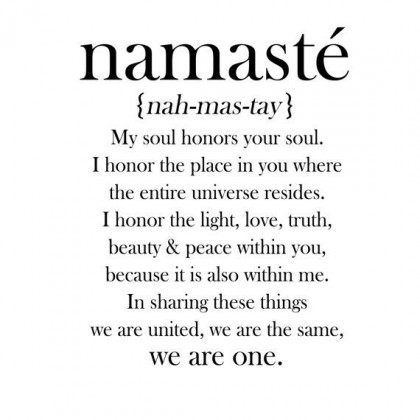
namasteMy version though puts forward not an individual event in Bethlehem, not just incarnation in one child, but an incarnation in every child. Each babe is a true miracle, the universe creating and recreating creatures who can reflect on it. Life, as a random feature of development on this blessed planet, animates, literally, inanimate matter. Life is a godlike power, awesome and equal to any of the claims about the powers of Allah, G*d, Vishnu, Mithras, Ahura-Mazda.

We are born to wonder; there is no need to wonder why we are born. We are here to be in the world, touching and seeing and hearing and tasting and smelling the stuff of very stuff. We are born as witnesses to the furnace of creation inherent in each atom, molecule, dna strand, star, planet and comet. We have no more important duty than to be present as the world creates, recreates, as the cosmos does the same.