Lughnasa Monsoon Moon
Liberal religion. An odd term. Maybe oxymoronic? I mean, what is more conservative than our human wonderings about death and about how to live? What is older than those questions?
And the variety of answers are endless. Taoism, Buddhism, Southern Baptists, Mithraism, Santa Muerte, Hinduism, Catholicism, Judaism and many, many others. Bahai, Druze, Islam. And, no, they don’t all have the same message, hardly.
Back in 1992 or so, I’d given up on one of those answers, Christianity. My reasons were emotional, the rationale came later. Mostly, I’d begun to find my spirituality in a very different locale, in my interior life and in the soil, in plants, in animals. Didn’t work so well in the pulpit.
I needed a place where I could be who I had become. I found a group of folks meeting in a round room over a library. A library. Worshipping in one of my favorite institutions, artifacts of human searching arrayed below us. This was the early Groveland. 25 years later here we are, celebrating your persistence, celebrating the spot you’ve carved out of humanity’s endless quest for knowing how things are with ourselves, with our planet, with time itself.
“The problem lies not with seeking God, but with those who think they’ve found God.” Mordecai Kaplan, founder of Reconstructionist Judaism. In an odd twist to my own seeking, Kate and I have become members of Congregation Beth Evergreen in Evergreen, Colorado, close to our home on Shadow Mountain. It’s a Reconstructionist congregation. No, I’ve not converted. They’re fine with me being what I call, for simplicity’s sake, a pagan.
“The past gets a vote, but not a veto.” Kaplan again. By this he means, quite heretically within traditional Judaism, that Judaism itself is always changing, always reconstructing itself and that literally nothing is sacred. He was not, for example, a supernaturalist.
I tell people that I’m not a Jew, but I am a reconstructionist. And, I am. Here’s the interesting part. According to Rabbi Jamie Arnold, Kaplan got his approach from, drum roll… Emerson. I don’t know that this quote is the exact place, but it’s sentiment is clearly Kaplan’s and current reconstructionist:
“Our age is retrospective. It builds the sepulchres of the fathers. It writes biographies, histories, and criticism. The foregoing generations beheld God and nature face to face; we, through their eyes. Why should not we also enjoy an original relation to the universe? Why should not we have a poetry and philosophy of insight and not of tradition, and a religion by revelation to us, and not the history of theirs? Embosomed for a season in nature, whose floods of life stream around and through us, and invite us by the powers they supply, to action proportioned to nature, why should we grope among the dry bones of the past, or put the living generation into masquerade out of its faded wardrobe? The sun shines to-day also. There is more wool and flax in the fields. There are new lands, new men, new thoughts. Let us demand our own works and laws and worship.”
I offer this brief excursion into Judaism as a way of underscoring the liberal religious pilgrimage. It is one that says, yes the questions of religion are important because they are deeply human questions, so important in fact that we should hold all of the answers loosely, hold them as clues, as trail markers, not as destinations. That we should remain open to new clues, new trails, new ways of approaching this ancient probing of what matters most.
When we do, as Emerson did, as you here at Groveland do, we can never tell the impact of it. We might transform that Muslim cleric, that Hindu priest, or, that Conservative Rabbi, Mordecai Kaplan.
“It is not the seeking of God that is the problem.” No, as Kaplan says, the problem is with those who calcify the pilgrimage, enshrine the past, stop up their ears, their eyes, close their minds. You, Groveland, are caravan serai on the oldest ancientrail of all. And, a necessary one. Necessary for what? Unclear. And that’s the point.


 Kate’s had several days in a row with no nausea. Yeah! That means she feels better and can get some things done. In doing so, however, the extent of her loss of stamina, weight loss and Sjogren’s Syndrome, has become apparent. She still needs to rest frequently. If she can modulate the nausea, either through careful eating or an eventual diagnosis or using medical marijuana, the next step is to get some weight gain, some stamina improvement. If possible. Or, we may have to adjust to a new normal.
 I got the stuffed unicorn on the third or fourth toss. When I tossed it to Alex, Adrienne asked, “Did he break a rule?” All the kids and Jamie nodded. Yes, he had. Why? Alex had already gotten the unicorn. Oh, shit. This was the first interaction between me and these kids as a group and I looked like a doofus. I didn’t remember the rule at all. There were plenty of things to distract me. The continental divide in the distance. A wind blowing through the trees. Trying to concentrate on learning kid’s names. General anxiety about not knowing the kids at all. Whatever it was, my executive function let me go, Oh, fish on bicycle, instead of hearing, no throwing to someone who’s already received it.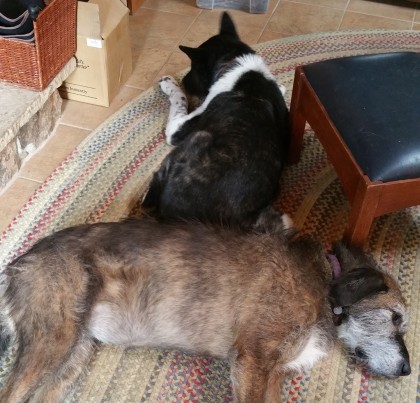
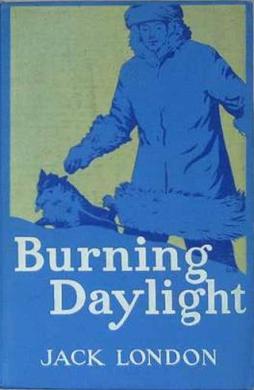 Turns out the Fox River Valley was not that place. The Fox River which runs from the Green Bay through Appleton and finally into Lake Winnebago had no available oxygen for aquatic life thanks to years of dairies and paper mills, two of the worst polluters, dumping effluent. But you could see this north from there. In the Fox River Valley it manifested itself in a tortured way through snowmobile culture and the annual ritual of the deer hunt. Both were violent and dangerous. On winter nights the lights of snowmobiles rake the roadways and countrysides as riders drive their vehicles alongside the roads from bar to bar for a shot and a beer. It was often said that grudges got settled during deer season.
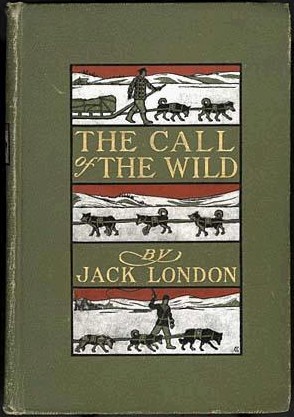 Wisconsin was a bad experience for me. Judy and I had married at 21 and 17. I had graduated from college that spring and had no idea what to do next. So. Get married. By Appleton neither one of us were sure why we’d said yes to the other. The long winter nights found us drinking beer by the case and playing sheepshead with Judy’s family. Her father, a convinced alcoholic, and I, just getting started in my addiction, didn’t really get along. He was a snowmobile racer, a deer hunter, an ink salesman and a Packer fan. I had little interest in any of those things. Our only common ground was his daughter.