Category Archives: Memories

Melancholia

Imbolc                                                         Woodpecker Moon

In what is, I suppose, a good sign, I’m getting fed up with this latest round of melancholy.  As I tried to do my Latin today, my ability to focus just wasn’t there.  The holding of one idea in my head while tracking down another seemed too hard.   I shook my head–ridding it of the annoyance I felt–and went upstairs for lunch.

I have begun a look back and now find that my melancholic episodes probably started in high school and have continued, largely unnoticed, until now.  I say unnoticed because they were usually not incapacitating, though in one instance around 1975 I can recall sitting in a chair for days on end, unable to stop unraveling the patterns in the wallpaper.

I believe I have experienced them as periods of slowing, waning interest or perhaps an unusual run of irritability, but not as episodes cycling through my life, a constant dysthymic hum, sometimes in the background and other times dominant, changing the course of things in my day to day world.

Of course, these cycles interlaced with my drinking, my failed marriages, my occasional angry outbursts.  Perhaps they only reinforced these troubled times or, perhaps, they created some of them.  I don’t know.

If this is right, and I’m pretty sure it is, it also means that I dealt with the death of my mother in 1964 influenced by these cycles.  It is my belief now that the charged, dark feelings of that difficult time still come along for the ride, packed in a baggage car as the melancholy train pulls into the station.

These complicated threads make these cyclic turns difficult to sort out, place in perspective.  It also makes them difficult, as a direct result, to get any particular treatment for.

Anyhow, out there, tomorrow or maybe the next day or if not then soon, the heaviness will lift and I’ll be able to get back to the incredible lightness of being.

The Wide World and Beyond

Imbolc                                                  Woodpecker Moon

A friend, who, like me, recently turned 65, said to me, “I just realized there’s so much to learn.  For example, I don’t know anything about China.”  This is an intelligent, well-read guy.  Hard to imagine someone waking up to the amount of things they don’t know at age 65, but I guess this is a true instance of better late than never.

For some reason this makes me recall those little orange biographies that used to sit in the library, though whether the public or school, I don’t recall.  Not too long, they offered a quick glimpse into famous american’s lives.  The content has either been absorbed or long forgotten, but the world they opened up, a world of people and places I had never experienced, remains.

I mention them because there were so many side streets on the boulevard of learning, some of which I knew well, most poorly, but they were in my consciousness from a very young age.

Another guy, also a friend, said recently that he’d decided if he hasn’t learned it now, he doesn’t need it.  Following that thought he went on to say that he was “giving up introspection.”  In the ensuing explanation it turned out he was really throwing away self-help books, other peoples ways.

In fact, what he was doing was allowing himself to start introspection.  Only when we go into ourselves without a guide, no training wheels, just you and the you you carry along, can we begin to make progress.  The Delphic Oracle said it best, “Know thyself.”

I’ve read people recently who say this is a bad idea, though I forget the arguments right now, but I’ve found it a very good idea.  A project still underway here at chez Ellis.


Yeah, You Betcha

Samain                        Moon of the Winter Solstice

Went out on an errand this afternoon as the sun began to set.  At 4:00 pm.  When I hit Round Lake, I saw a car in the rear view.  It had something on top.  A Christmas tree.  We have one of the metro’s favorite cut your own tree places about 6 miles north of us.

This triggered two memories.  The first, which you’ve encountered if you’ve traveled in the tropics during Christmas, is the jarring sight of Christmas trees, wreaths and lights all atwinkle at 80+ degrees.  In Rio they have applied to Guiness for certification of their floating Christmas tree in the big lake near the funicular for Corcovada (muy grande Jesus).  It’s supposed to be the biggest.  Among a crop of how many floating Christmas trees, I wonder?

An oddity I realized in Rio was that most of these Christmas decorations have a fir or pine as their exemplars.  That was the trigger with the Christmas tree on the car.  When I took my trip to Southeast Asia seven years ago, I was in Singapore at this time.  Same strange thing.  Christmas trees, wreaths, Christmas tree decorations all sprouting from vertical shopping malls in the air conditioned nation.

The second memory triggered by the car with the Christmas tree was the sight of golf carts all loaded up on flat bed trucks headed south for the winter season.  Soon we’ll have the rickety trucks coming to town piled high with cut wood sold door to door for fire places.

We do have a very distinct culture here and it’s visible to me right now, with South America so present to me.

One guy on the cruise asked me about ice fishing.  Seems the word of our palatial fish houses has spread to the larger world.

Yeh, you betcha, we’re our own culture up here.  For sure.

Where Have We Been? Where Are We Going?

Fall                                                                 Waning Autumn Moon

“Trying to determine what is going on in the world by reading newspapers is like trying to tell the time by watching the second hand of a clock.” – Ben Hecht
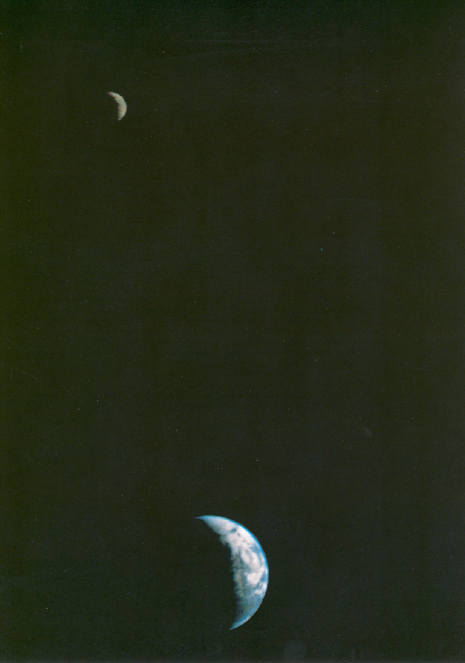
Keyhole history.  A standard assumption among historians.  Decades, even centuries, must pass before we can determine the relevance of particular events in the flow of human history.  Anything said, for example, about the George W. Bush presidency, relies more on bias and hunch that on historical context.

We judge poorly when we judge matters in which we have had some part, even if the part were only reading newspapers.  Hecht’s comment tells the story with a great metaphor.


(This picture of the Earth and Moon in a single frame, the first of its kind ever taken by a spacecraft, was recorded September 18, 1977, by NASAs Voyager 1 when it was 7.25 million miles (11.66 million kilometers) from Earth. The moon is at the top of the picture and beyond the Earth as viewed by Voyager. In the picture are eastern Asia, the western Pacific Ocean and part of the Arctic. Voyager 1 was directly above Mt. Everest (on the night side of the planet at 25 degrees north latitude) when the picture was taken. Voyager 1 was launched September 5, 1977 and Voyager 2 on August 20, 1977. JPL is responsible for the Voyager mission.)

Having said all that, let me give you two instances in which keyhole history does not have wait.  These photographs, amazing images, show historical moments that need no time to pass before their significance becomes clear.  
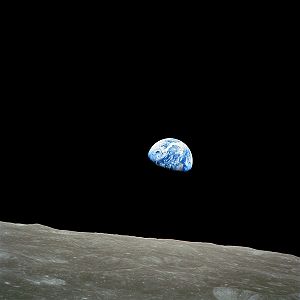
Here humanity achieves a perspective never before possible.  Ever.  Not in the entire history of the human race.  A view of earth from the surface of the moon, the famous 1968 shot by astronaut William Anders, and a God’s eye perspective, looking at our home and its sole satellite in one and the same moment.

Around 60,000 years ago or so homo sapiens left Africa, bound for other continents.  Over the next 45, 000 years this African animal had made its way onto all the continents of our planet and many of its islands.  Since then, we have populated these land masses.

(World map of human migrations, with the North Pole at center. Africa, harboring the start of the migration, is at the bottom right and South America at the far left. Migration patterns are based on studies of mitochondrial (matrilinear) DNA.  Numbers represent thousand years before present.  The blue line represents area covered in ice or tundra during the last great ice age.  The letters are the mitochondrial DNA haplogroups (pure motherly lineages))

Over the last 60,000 years our species has explored the planet’s nooks and crannies (at least those above the surface of the ocean), but in all that time we could never look at our planet whole.  We saw only parts at any one time, we looked at the second hands of earth’s totality.

We could see the moon whole, sort of, but we could never see our own home in the same way.  With William Anders earthrise photograph and the Voyager shot of the earth and moon, our human perspective could position earth and its satellite in the cosmos not through abstract conjecture but by simple visual observation.

Not only were we finally and truly out of Africa, we had gone beyond our planet’s comfortable precincts and into the unimaginable distances of space itself.

No, there is no need to wait on the historical significance of these photographs, we knew it the instant we saw them.
A Carnegie Library

Fall                                                   Waxing Autumn Moon

Reading.  Alexandria, Indiana had a Carnegie library, one of those brick and limestone buildings sprinkled throughout American small towns, so ubiquitous we give them little thought.  Like the water tower they’ve always been there.

Ours had a long flight of steps that went up to the solemn, curved stacks of the adult library, a place visited by kids only when they needed something up there, a rare occurrence.  The library also had a concrete ramp with a slight curve that led down, below ground where the children’s books were.

In the spring and early summer the concrete had a musty scent, cement and soil, a comforting, familiar smell that greeted me often as I made regular trips down the ramp.  The library had summer reading programs complete with prizes and stickers and I loved them.  Prizes for reading!  A thing of wonder to this boy bookworm.

The hours I spent down there, reading or finding books, fed a now lifelong habit and a love of books, not rare editions or signed first editions, but of books themselves, purveyors of wonder and mystery.

My favorite book was the Silver Llama, a story of a young boy and his llama, somewhere in the Andes.  I remember its silver cover, the rounded spine that always felt smooth against my thumb.  Even after I quit reading it, I would visit it from time to time, just to fell the spine and see the dull shine of its silver.

Libraries are still among my favorite places on earth, temples to generosity, human creativity and self education.

Strange Weather

Fall                                                 New Autumn Moon

A strange weather time.  A storm system and winds blowing in from the east.  Our weather systems almost always come from the west, following the planet’s rotation and the jet stream, but this raggedy storm system got stuck over Wisconsin and has begun to retrograde, head back west.

The quiet of night.  A healing time, the darkness.  A moment when the cares of the day can slide away and the still, small voice can speak.  The body can collect itself, relax, replenish.

Think of sleep.  Almost a third of our lives, maybe 25 years, think of that, 25 years asleep.  We are all, in this sense, Rip Van Winkle, unaware as the world changes around us.

In the sleep time our minds create the worlds we inhabit, pluck scenes from stored memories, movie clips, fears and joys, wishes and needs.  Vivid life, times of ecstasy and insight flow through our brains, a stream of cobbled together life, chunks of invention.  We are each novelists while we sleep, drafting narratives with characters about whom we care deeply.

Here’s the tricky part.  If I understand modern neurology, we do the same thing when we’re awake.  Our minds take sensory data and create worlds.  Narratives form so we can keep the world we create coherent, so we can remember the plot of our lives.

There are parts here that elude me, standing just outside my peripheral understanding.  Who is that watches the movie?  Who is the narrator?  Where is the narrator?  Is he a reliable or an unreliable voice?  Can we count on this movie?  By that I mean does it conform to what we, at least in a common sense way, take as real.  True.  Out there.


Growing Up

Lughnasa                                        Waxing Harvest Moon

Mark’s (my brother) days here will end on September 16th provided the Saudi visa process works and it’s on track, though a track with a terminus very near his flight date.  He flies from Minneapolis to Chicago, Chicago to Amman, Jordan and onto Riyadh.

He will spend a few days in Riyadh in an orientation program for new teachers at the English Gate Academy after which he reports to his teaching post.  He asked for Hal’in, but his assignment is not yet certain.

We sat on the couch tonight, after having watched some TV, and did a favorite family thing, trading memories of when we were young, especially memories we did not share.

I told him of climbing up on a chair to find, to my dismay, a door knob above a shelf I could not see over at age 3 or 4.  It looked like a big eye looking back at me.

In the basement of the same place, an apartment building where I lived with Mom and Dad, there was a coal chute. (“Coal?” Mark asked, a bit wide eyed at this ancient heat source.) The coal room connected to the big pot-bellied furnace through an augur that would turn on whenever the thermostat called for more heat.  In other words unpredictably.

When I was down there with Mom while she did the laundry, I would play.  Until the coal augur came to life.  It was loud and came on with surprising swiftness.  The furnace would hiss as the new coal fed the fire.  Made me think of a dragon.

Mark remembered sleeping in Mom and Dad’s bedroom until he was 5 or so, then moving upstairs in our house on Canal Street.  When I went off to college, he took my corner room, the one with a window facing west and another facing south.  Out that west facing window, at midnight, a Nickle Plate train would rumble down the tracks, and sound its warning signal for the crossing on Monroe Street only two and a half blocks from our house.  Mark remembered the train, too.

I’m not sure why I recall this and I don’t know if it was true, but I believe the last steam engine in US pulled its train through our town, sounding its steam whistle every midnight.  Right there on Monroe Street.

Fall-ing

Lughnasa                                                  Waxing Harvest Moon

As August slides away and the sky shifts its colors toward deeper hues, an inner barometer detects higher emotional pressures.  The atmosphere weighs more, cuing those momentary pauses, breaks in attention.  It may signal a storm ahead, but more likely the prediction carries gray skies and mist, perhaps early morning fog.

Melancholy comes calling this time of year, an acquaintance, maybe a friend, of long standing.  Mom died in October, 1964, 47 years ago, a year longer than she lived.

Her death came at different moments in life for all of us.  Mark, 5 at her death, has few memories of her; she lingers in his past as a faint spirit, an enigma.  Mary, 12, has more, a young girl heading into adolescence, becoming a woman, missed the guidance a mature woman could give as she made that critical transition.  At 17 my life had already begun to pull away from the family, in my senior year of high school, the last, college plans in the making, I had her longest of all, only a brief time less than Dad.

When that dark angel comes, and he comes for us all, finality is the hardest lesson to absorb.  No more mom.  No more.  Memories, yes, but memories fade and change as life goes on and here all three of us are, 47 years later.  47 years.  A lifetime.

Why a friend?  How could melancholy be a friend?  Well, in this way.  As life patters on, this event following the other, we can become accustomed to its rhythms, lost in its small decisions and its casual absorption of our energy.  So lost, in fact, that we forget the Self that carries us forward, the Self into which we live and which lives itself into us.

Melancholy can turn us away from the day to day and cause us again to walk down the stairs leading to what Ira Progoff calls the Inner Cathedral.  We often forget this quiet place within, our own sanctuary, and melancholy can call us to visit it again.

So, yes, melancholy can be a friend of the Self, a guide back into the depths and resources of your Self.

As the 10th Anniversary Comes

Lughnasa                                                         Waning Honey Extraction Moon

BJ came today.  She’s a New Yorker and has been since she attended Julliard many years ago.  Over lunch today Mark asked her about 9/11.

She told her story and Schecky’s.  She was in New Jersey and saw the burning building across the grasslands.  At first she and her friends thought it was an accident.  Then the news became clear.  Schecky was at home at the Beacon Hotel, 74th and Broadway.  He’d been asleep, woke up, turned on the TV and thought the scenes he saw were a strange disaster movie.  As he clicked the channels, it was the same movie on all of them.  Relatives had left messages on his answering machine, “Are you ok?”  He thought, why wouldn’t I be?

BJ, who had come to New Jersey by train, found a fellow musician with a car and the two of them spent seven hours trying to get her back to Manhattan, eventually driving far to the north to the Tappan Zee bridge and finding a back way into the Bronx.  Her friend lived in Brooklyn and BJ took a subway back.

Over the next six months BJ said folks looked each other in the eyes on the streets and in the subways, trying to connect.  She rode a bike in Central Park, she had begun training for a race, and she said the atmosphere there was extraordinary.  Like the end of the world might be coming and folks needed to be out with other people.

She spoke of playing music at St. Paul’s Chapel, where many of the rescue workers came for rest and food, part of a volunteer effort by the city’s musicians.  She was also angry that no monument was in place and that so little work had been done on the buildings that would replace the Twin Towers.


See You In September

Lughnasa                                                            Waxing Honey Extraction Moon

The end of the day.  The time when the season turns on a pivot toward fall and away from the Solstice.  My mood has shifted to melancholic.  Not sure why.  Maybe the end of the day, the time of year.  It is around this time in the year when I turn melancholy, a sort of seasonal affective disorder, perhaps more related, to the nearness of the school year.

No, not because of any negative associations with school.  No, maybe because I’m not going back to school.  Not anymore.  School was good to me.  I got lots of strokes from lots of folks, school was feel good time for me.  Yes, I had some troubles that happened during school, but they were extra curricular, the school part, that always grooved.

Well, not quite always.  That first year at Wabash I encountered German.  German and I did not get along.  I found myself near mid-semester and staring at a D.  A D!  I graduated at the top of my high school class.  I didn’t get D’s.  But I was about to get one.  So, I dropped it.  Not my finest hour academically, but it did save my bacon.  Why was I taking German?  I wanted to read philosophers in their own languages and German seemed like a good place to start.

Other than that first semester at Wabash, school was fun.  I enjoyed learning, studying, taking tests, writing papers.  Weird, huh?  Now when See You In September begins to play on the oldy stations, my nostalgia meter hits a high.

Hmmm.  Just occurred to me.  This may be the way successful athletes feel when the school year starts, in those day after their career has ended.  Those were the best years of my life.  That sort of feeling.

No.  That’s not it.  Those weren’t the best years of my life.  These are the best years. Right now.

It may explain why I keep throwing myself into things like the docent program, learning Latin, Tai Chi, always going for the burn that comes from conquering a learning curve.  That life long education idea really took hold in me.  I believe in it, body and soul.

Though I do, each year when the evening’s cool, the leaves begin to change and parents start packing their kids up to take them off to college, I wish, a part of me wishes, I could go along with them.

Here’s something a bit strange.  The song that always comes to mind for me at this time of year is See You In September by the Happenings.  Here’s a youtube version filmed on Lake Calhoun.