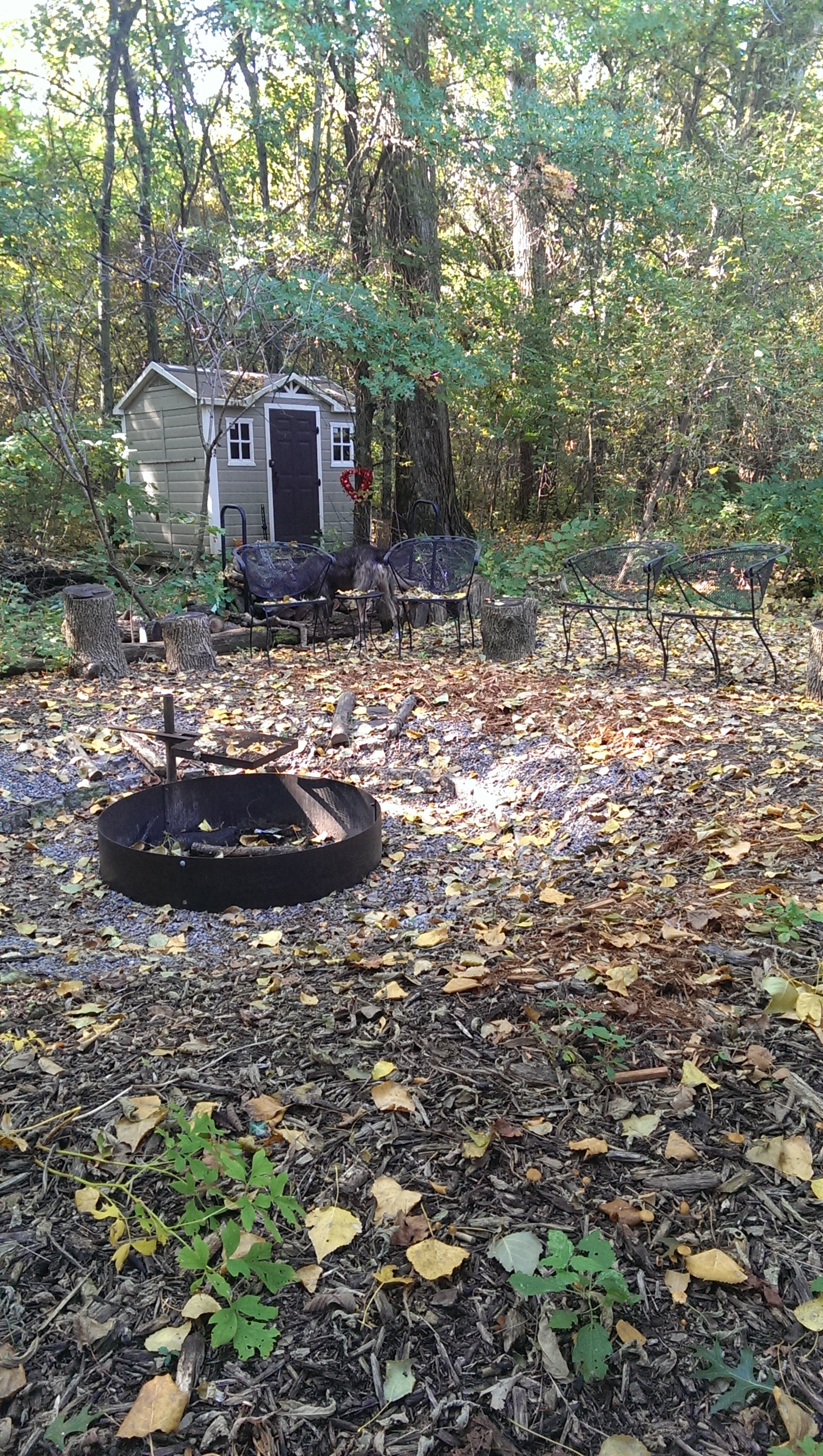
Fall Harvest Moon
 The tree of life, the tree of immortality guarded by the angel with the flaming sword; the tree itself still growing in paradise, concealed by language, by our senses, by the everydayness of our lives; the path back to the garden often forgotten, the exile from paradise a separation so profound that we no longer know the location of the trail head and even harder, we no longer have a desire to search for it.
Metaphor? Of course. But in these three words lie a trap for the unwary, a trap in which I allowed myself to get caught and held, a mindhold trap. My life seems like a sine wave of grasping, then losing the significance of metaphors.
When young, I felt the mystery behind the communion wafers and the grape juice at Alexandria First Methodist. At the tenebrae service, when we extinguished the little candles with their paper drip guards and the sanctuary went dark, I thrilled to the change from ordinary experience, sensed the power rolling over us as the memory of crucifixion and death came hurtling through the centuries to land in our small Indiana town, in the very spot where I sat.
The sunrise services held on Easter morning lit up my whole inside. The power of the tenebrae had been defeated and life did go on forever, death only a mistake, an illusion, misunderstood as a cruelty when in fact it was a gateway. I suppose on those days, repeated over many years, I had a glimpse of the path back to the garden.
My mother’s death, I think, shattered this instinctive faith. Those feelings occasioned by grape juice soaked squares of bread, darkness and the rising of the sun, were a true path and one I lost when the brutal reality of grief smeared the way.
But the memory of that way remained. So I moved up from the instinctive triad of netzach-hod-yesod, forced by fear and loss to skip the next triad chesed-gevurah-tiferet and go to the one easiest for me to access, hochmah-binah-daat. I know these hebrew words may mean nothing at all to you, I’m still at the base of a steep learning curve with them myself, but they do appear on the illustration above so you can see where they are on the tree of life.
In simple, but not simplistic terms, the triads are netzach-hod-yesod, the realm of instinctual behavior, chesed-gevurah-tiferet, the realm of emotions and hochmah-binah-daat, the realm of the intellect. Movement in the tree of life goes from the keter to malchut and back from malchut up to keter, so there is no real top or bottom, only different spots in an ongoing process of creation.
 But here’s the trap. Metaphor, of course! I studied philosophy, religion, anthropology in college. Then, after a few years stuck in unenlightened instinctual behavior-the storied sex, drugs and rock and roll of the sixties and seventies-I moved to seminary. The trap tightened. I learned about the church, scripture old and new, ethics, church history. It was exhilarating, all this knowledge. I soaked it up. I remained though stuck in the intellectual triad, pushing back and forth between the polarity of intuitive wisdom, hochmah, and analytical thought, binah, often not going on to daat, or understanding. I learned, but did not integrate into my soul.
There was a time, after seminary, after ordination, as I groped my way around in the work of ministry, that I found the path again. It was in mystical traditions like the Jesus Prayer, or the use of lectio divina, contemplative prayer. I had spiritual directors who guided my prayer life and I meditated often, daily for years, went on private retreats for days at a time. In those years I found my way back to the netzach-hod-yesod triad, traveling again on the instinctual path formed so long ago.
The trap sprung another time, though, as I got better at my ministry, more able to apply organizational development paradigms to congregational life, more able to pull the levers of political power for the good of various purposes: affordable housing, unemployment policy, economic development for poor neighborhoods, fighting off corporate takeovers of those same poor neighborhoods, more able to navigate the internal politics of Presbytery life. I became stuck in malchut, the material world which we experience everyday. So stuck that eventually I could see nothing else and the path disappeared again.
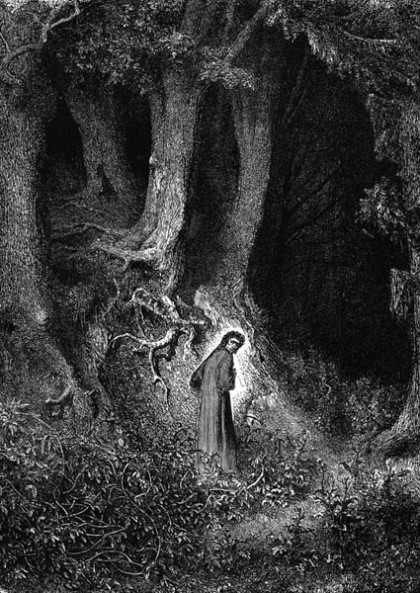 My heart knew I had gotten lost, in exile once again. In Dante’s words in Canto 1 of the Divine Comedy:
“In the middle of the journey of our life, I came to myself, in a dark wood, where the direct way was lost.
It is a hard thing to speak of, how wild, harsh and impenetrable that wood was, so that thinking of it recreates the fear. It is scarcely less bitter than death…
I cannot rightly say how I entered it. I was so full of sleep, at that point where I abandoned the true way.”
This time I knew I had to extricate myself from the subtle trap, get out of the thought world that had me lost in the dark wood, the direct way lost. It was a wild, harsh, seemingly impenetrable forest.
It was clear that for me the Christian faith had gotten muddled up with ambition, immersion in the world of power. And, most problematic of all, it had become part of the metaphor trap. The metaphor had gone stale, had become a barrier instead of a koan. Not the fault of the faith itself, but of my journey within it.
 At the time of its crumbling another path had begun to open for me. Fiction writing emerged when, ironically, I began writing my Doctor of Ministry thesis. Instead of working on it I ended up with 30,000 plus words of what would become my first novel, Even The Gods Must Die. Irony in the title, too, I suppose.
In the train of that shift came a decision to look into my Celtic heritage as a source for my fiction. While researching Celtic religion for the fantasy novels I wanted to write, I discovered the Great Wheel.
It grounded me. So to speak. My spiritual life became tactile, bound up in soil amendments, bulbs, corms, seeds, spades and hoes, fruit trees, raspberries and bees. And, of course, dogs. Always dogs.
Meeting Kate enabled me to move gracefully out of the ministry and into a pagan worldview. I was back in the netzach-hod-yesod triad, but now firmly attached to malchut, the queendom of this world.
Writing fiction found me exploring the chesed-gevurah-tiferet triad, having to reach into my heart for believable characters, story lines. Over the course of those years, the years since leaving the Christian ministry and now, I began to gradually integrate the triads, at least the three: intellectual, emotional and instinctual. The combination of family life, the Andover years, writing, and working as a docent at the MIA began to slowly weave them into my soul.
 Even so, I sat behind the barrier, the flaming sword, the metaphor trap. Beth Evergreen and Rabbi Jamie Arnold have started me on a journey back to where I began, immersed in the dark. Seeking for the light, yes, but happy now in the darkness, too. The Winter Solstice long ago became my favorite holiday of the year.
When I left Christianity and took up my earth-bound spirit, I shut off access to the fourth triad, the one subsumed under keter: faith-joy/pleasure-will, and its source of energy, the ein sof, the infinite One, perhaps god in small letters. Today, as I write this, I’m more pagan than I’ve ever been, more embracing of the body, the mountains, the stars, the elk and the mountain lion, than any words from any source.
 But. At Beth Evergreen I have begun to feel my way back into the fourth triad, the mystery I first encountered on the hard wooden pews in Alexandria, the one pulsing behind the metaphors of tenebrae, of crucifixion, of resurrection, and now of Torah, of language, of a “religious” life. I knew it once, in the depth of my naive young boy’s soul. Now, I may find it again, rooted in the old man he’s become.
 The last letters of the Hebrew alphabet now have renderings in sumi-e, lying on my table ready for quotes and the chop. A member of Beth Evergreen last night referred to me as an artist. Oh. I thought he said audience. Artist is not a word I’ve ever associated with myself so my brain heard something else. A revealing moment. How others see us is not always, perhaps often, not the way we see ourselves.
 In addition to cooking, the sumi-e (ink brush painting), and working out, I mentioned the possibility of a greenhouse. Expensive, so we’ll see about that. But. I began reading a book I’ve had for a while,
  Buddy Bill Schmidt will recognize the quote that begins the chapter on Soil: “See what you’re looking at.” Carey Reams, an unlikely looking radical, used to say this. He was the founder of the outfit from which I purchase soil additives, the High Brix Gardening folks in Farmington, Minnesota. He contended, as do many now in the farm-to-table world, that agriculture went astray long ago, moving toward products that fit mechanized food production rather than human nutrition.
 The vast wheat fields of the Great Plains grow an annual wheat, two varieties that work well in steel rolling mills. Not only have these annual crops destroyed the ten feet or more of top soil that buffalo and deeply rooted grasses developed there, but the steel mills which make this crop profitable separate the germ and bran from the kernel, leaving only fluffy white flour. What’s bad about that? Well, turns out the nutrition in wheat lies in the germ and the bran.
 I guess this is the native Midwesterner in me. I grew up driving past corn fields, pastures filled with Holsteins and Guernseys, pigs and beef cattle. The Andover gardens, the orchard and the bees, along with our small woods satisfied this part of my soul. I’m going to investigate local CSA’s, see if that’s a route back into this world. We have to buy groceries anyway, so why not from folks who share a philosophical position close to my own.

 Last week at mussar we had a fascinating conversation on the essential dourness of both Jewish and northern European cultures stimulated by the Norwegian concern that they had won too many medals in the winter Olympics. In both cases happiness, and by correlation, joy, are suspect. Why are you so happy? What makes you think that will last?


 It was also time to slough off some of the Minnesota based, second phase lingering work. Especially the political. I am going to the caucus this Tuesday; however, I no longer see myself as a dedicated activist. But, and I consider this great news, Ruth told me she was walking out on April 9th, standing outside Mcauliffe, her middle school, for seventeen minutes, one minute for each of the Parkland victims. She’s doing it in spite of the fact that adults tell her no one will listen. Go, Ruth!
 The melancholy also uncovered a tension I’d been feeling between leaning in to the domestic, cooking, for example, and Kate and mine’s presence in the Beth Evergreen community, and what I consider my work. Recalibrating second phase expectations about work, which I have not yet fully done, feels like a task for this time. In fact, I enjoy the domestic part of our lives and it feels good to devote more energy to it.
 The great wheel has turned again, moving Orion further down the southwestern horizon in the early morning. The air is cooler here. A Beth Evergreen friend, Alan, came in to the kabbalah class and announced, “Winter is really here. It’s so cold outside!” It was 22. Now in my fourth winter season here I’ve stopped commenting.
 Those -40 degree nights at Valhelga during one Woolly retreat. Working out on my snowshoes in the woods behind the library in Anoka, -20 degrees. The moments of -50 degree wind chill. Days with the temperature below zero, many days in a row. Minnesota. Not a lot of snow, but pretty damned cold.

 It was a week of this sort of activity, getting ready for the storm, catching up on errands. My exercise, Jennie’s Dead work suffered, but my choice. This week I’m back at all of that, going to On the Move Fitness on Thursday for a new workout.