Groups have begun to emerge. Right here in Conifer there’s a good start, one I intend to join. A couple who make kites has organized it and the general thrust sounds good. Will also be a chance to meet fellow progressives who live here. Beth Evergreen has not, yet, gotten anything started though I believe that will happen.
The Wall of Meat must be checking their bikes right now, making sure their pipes are loud because loud pipes save lives, or so say the bumper stickers. The Rockettes. Wonder what they’re thinking about? All those women. I hope it turns out massive and raucous. Those bibles, Trump’s family bible and Lincoln’s. My question. Will they burst into flame when he puts his hand on them? Just sayin’.
I will spend the day with good friend Tom Crane who’s flying in today. We’ll have dinner here tonight, a fire and conversation. Tomorrow, inauguration day, we’ll motor over to The Happy Camper, where Kate and I buy our maryjane. Not sure, of course, but dispensaries all across the U.S. might see an uptick in sales after tomorrow. Gonna watch cabinet secretary appearances before the Senate? Don’t bogart that joint, my friend. Take it down and pass it over to me.
As to the knee. Which now comes near the end of my thoughts as I write. Little pain, mostly gain. My physical therapist said I was healing “incredibly well.” Good to hear. The big deal now is restrengthening muscles that have weakened over the years of arthritis caused bad biomechanics and lack of exercise post surgery. My right hip muscles are especially weak. Kat and Katie, p.t.’s at Select Physical Therapy, have me putting a small red rubber band around my ankles and walking sideways for two minutes at a time. May not sound like much, but ouch!
Jon and Jen have a good offer on their house. They accepted it and now await inspections, then closing. Provided all goes well this will relieve the last major impediment to moving on after the divorce. Jon will use the money to buy a new house in Aurora, the large Denver suburb where he works as an art teacher. He will be glad to give up the commute from Conifer, returning to riding his bike to work.
2017 will have some upsides, then. Never underestimate the power of unintended consequences, even with the Trump. Could be some positive things there, too.
In spite of the political upheaval life, as it always does, continues, mostly in its old grooves. Here on Shadow Mountain for example the divorce process has entered its waning days. Final orders will be issued late this month though the outline for them, largely fair and equitable is already known. Jon’s anxiety level has receded. Good and heartening to see.
We had Asplundh tree service here on Friday and Monday clearing out the tree cover from the power line easement. I spoke with the workers, current day lumberjacks operating outside the timber industry.
“That’s hard work,” I said.
“Yes, but it’s honest. No shortcuts.” replied the bearded young man in charge of the crew. He’s right about that.
The utility bills from IREA, Intermountain Rural Electric Association, have been, since May, $10, a line fee that supports such work as the Asplundh team. The electricity we use has been produced by our solar panels.
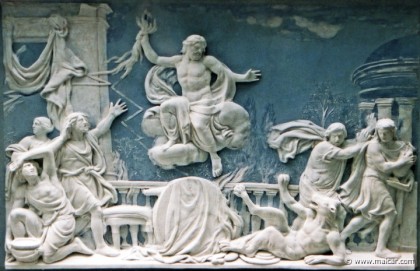
Lycaon
I continue to write, now upwards of 63,000 words (I was a little too early when I said I’d reached 60,000 last week.).
Kate and I are becoming more and more a part of Congregation Beth Evergreen. It’s an interesting experience for me. I’m a participant, not a leader. I like it, being part of a community but not being responsible for it. I can help in modest ways and that feels appropriate to me for right now. That may change though with the political work that is brewing.
It’s dry, no snow. According to the weather services, this could reach a record snowless period for Denver. We’ve had a little snow on Shadow Mountain, but only two instances, rare. This, plus the winds and the low humidity, means the potential fire situation here remains at an elevated risk.
This morning at 10 I have my pre-op physical for my December 1st total knee replacement. The pain in the knee worsens, it seems, by the day. That’s good, I tell Kate, because it’ll feel so much better after the new knee. I’m grateful there’s something that can be done about it.
And, improbably, it will be Thanksgiving next week. There is no hint of over the river and through the woods weather to stimulate that Thanksgiving feeling. We may get a storm on Thursday. That would help.
We’re going to smoke a small turkey. Annie will be here from Waconia, Jon and the grandkids. Unlike the nation we’ll be celebrating Thanksgiving on Wednesday because the grandkids go to their mom’s for Thanksgiving this year. Under the new divorce terms holidays alternate and this year is Jen’s Thanksgiving. It will be good once again to have family (and dogs) underfoot during the holiday.
Just realized in all the election fun I’ve allowed holiseason to get started without any remarks. Look for that to change as we head into the most holiday rich season of the year.
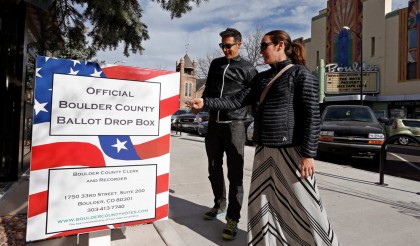
The election is over. At least for Kate and me. We got our ballots in the mail on Tuesday. Yes, in the mail. We opened them and yesterday sat down together to vote. At our beetle kill pine kitchen table. The ballot spread out before us, front and back. The front had Hillary Clinton, Michael Bennet (Senate) and Jared Polis (House of Representatives) in a row, making it easy to vote for these Democrats.
There were several retain or not choices for judges. Don’t know if this happens elsewhere but here judges are appointed for two years then have to stand for a retention election. If retained, they serve eight more years. A state house race, county commissioner, surveyor, those sorts of offices sent us to the computer, checking on candidates and positions. We definitely voted against the Republican candidate for the state house who wanted to separate “School and State.”
On the back of the ballot were several matters up for public decision, most amending the constitution, a couple with only statutory weight. These are placed on the ballot if they get enough signatures in a pre-election petition process. This is referendum politics and I don’t like it. It sounds like direct democracy, but in fact it is too often a place where large organizations run stealth campaigns, hammering the process with lots of money.
On the other hand the matters that make it onto the ballot are often important, sometimes conservative, sometimes progressive. TABOR, a tax revenue limiting referendum passed in Colorado in 1992 is “…is the most restrictive limitation in the country…” (Bell Policy) Conservative. But in 2012 another referendum allowed for the legalization of marijuana for recreational use, expanding the 2000 referendum which allowed medical marijuana.
This year ColoradoCare is on the ballot, a proposal which, if passed, would establish a single-payer health system in the state, so is medical aid in dying, a $1.75 increase in the cigarette tax, and an obscure rule about taxing benefits of using Federal lands.
In effect the polling place became our kitchen table. It was better than a voting booth because we could discuss our votes, look up information on candidates or ballot issues. Today we’ll drop our ballots off at a ballot collection box at the Evergreen library.
Colorado is an odd mix of libertarian, nutjob conservatives, centrists like Governor Hickenlooper and Richard Lamb, and progressives. It shows in the referendums on the ballot, the ones already passed and the mail-in ballot. The trend, thanks to in-migration of millennials and others from blue states like Minnesota, seems to favor the progressive as does the potential for a large turn out the vote campaign among the state’s significant Latino population.
It’s an edgy place, this strange state where the Great Plains end, the Rocky Mountains rise. Though Cozad, Nebraska marks the 100th parallel and the line where average rainfall plummets below 20 inches year, the start of the arid west, it is the Rockies which mark the true border between the agriculturally dominated Midwest and Great Plains and the West.
We are both of the plains and the mountains, a place where Eastern ends and Western begins. The politics here represents that border transition, an uneasy joining of the two. The future, as seen from Shadow Mountain, should be interesting.
Divorce matters seem finally to be breaking Jon’s way. Can’t say more than that right now, but I’m glad.
Took a long ride with Kate out to Elizabeth, Colorado to the Elizabeth Meat Locker. We purchased a quarter side of beef from the Carmichael Cattle Company and they have a contract with the Elizabeth Meat Locker for butchering. We’d not been out this way, south and east of the Denver Metro, so it was an interesting drive. Passing through Parker we both commented on the area’s similarity to Chanhassen, Chaska, Jordan in Minnesota. Then the hilly country began to look like 169 headed to Mankato. Of course, to maintain these similarities we had to keep our eyes from the west where the Front Range rose.
Elizabeth itself is a small rural community that could have been anywhere, usa. It has a small historic downtown; that is, older retail buildings repurposed into boutiques and a fiber art store and antique shops. Mainstreet is Co. Highway 86 and there is the obligatory Walmart anchored, downtown killer of a strip mall on the edge of town.
We ate at the Catalina Diner, a restaurant that would have felt at home in southern Indiana. It had automobile, 1950’s automobiles, posters, high-backed white booths, two lunch counters. Comfort food.
shootout-in-elizabeth
This whole journey was an unusually difficult one, emotional in a way I’ve found strange for over a year. Let me explain. Each time we headed down Shadow Mountain Drive for Aspen Park or Denver, we passed two small fields carved out of a narrow mountain meadow that sits under Conifer Mountain. It has two ponds, a few stands of trees, but is mostly grass.
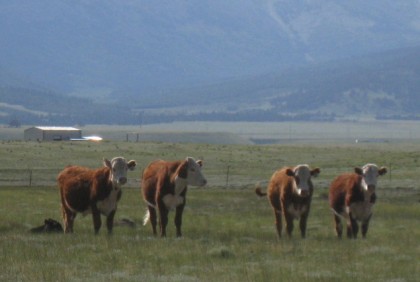
Over the course of the year Carmichael Cattle has fed three angus and one hereford there. As we drove past, I would look for these cattle, tails twitching, heads down. Or, huddled together in the shade in a hot summer sun. Each time I was glad to see them. Glad these animals were there as we drove by. Part of my enjoyment of them was a tie to my rural roots in the Midwest. I miss the ever present signs of agriculture: fields of corn, fields of soybeans, tractors, combines, dairy and beef cattle. These cattle gave me a link back to the roadsides of my former life.
But. I also enjoyed them as individuals, seeing them interact with each other, wander off in search of a good spot to graze, standing next to each other. Each time I went past them I knew it could be that later in the fall I would be eating one of them. This made me sad and a bit forlorn, knowing that my heart was in conflict with my head.
My head says ethnobotany. Our culture chooses our diet for us, decides which foods are tasty, which gross, which taboo. Our bodies are neither obligate carnivore nor obligate vegetarian. We are designed by evolution as omnivores, able, thankfully, to eat what the world places in front of us, be it plant or animal. This is a great advantage for us as a species and has allowed us to thrive in many diverse climates. There is nothing wrong, then, about eating meat, either from a biological or cultural perspective. Meat is simply one source of food.
But. I enjoyed seeing them as individuals. I knew they were individuals. I could tell by they way moved through the field. One seemed to gravitate toward the shade. Another seemed more social, following its colleagues closely. They were, in fact, separate from each other, unique, not cattle sui generis, but this cow, that bull. They were not, in other words, meat in the abstract, but meat on the hoof, meat as the muscle of living creatures, muscle that functioned within these animals I enjoyed.
To purchase their meat was to kill them as surely as if I took a rifle out and shot them. Back in 1974 I moved onto the Peaceable Kingdom, a farm Judy and I bought in Hubbard County, Minnesota, the county home to the headwaters of the Mississippi. We had goats and decided we wanted to barbecue some goat meat. Johnny Lampo, the man who rented our fields and farmed them, gave me his rifle and I killed one of our our goats. I’ve not been the same since. I can’t even euthanize our dogs.
Though raised in the agricultural Midwest, though I attended 4-H fairs in my youth and state fairs in Indiana and Minnesota, though I knew well the connection between actual animals and the wrapped packages of hamburger, the sirloin steak, the lamb chop, the pork tenderloin, I had still been insulated from knowing that this cow, this bull was the source of my pot roast.
It was this awakened sensitivity, perhaps a sentimental one, ok, definitely a sentimental one, a sensitivity awakened in brief moments passing cattle in a mountain meadow that put my heart into conflict with my head. Even in my heart I don’t feel eating meat is wrong, but I do feel that knowing the animal from which my meat comes changes things. A lot.
So this evening when Kate cooks the ribeye steaks thawing right now in our sink, I plan to add a small ritual to the lighting of the shabbos candles and the sharing of challah. We will remember the animal that died so that we may eat, so that our bodies might be strong. We will thank this particular individual for the role he or she plays in our daily life. We will acknowledge the cycle of life, the interlocking web of life and our mutual parts in it.
This is, I think, one of the missing parts of our 21st century life, honoring the plants and animals that have to die to keep us alive. Without the heart connection we are rapers and pillagers of our environment, no better than Big Ag and its ruthless exploitation of the chain of life for profit.
The autumnal equinox will occur while I’m on the way to Minneapolis. Right now I’m in Lincoln, NE. It was 56 when I checked Shadow Mountain yesterday afternoon, 90 here. And humid. I’m well past Cozad, which is on the 100th parallel, the start of the arid West.
The drive from Conifer to Lincoln was straightforward. Get on the highway, put a brick on the accelerator, kick back and let the car go. Almost like a Tesla. Speaking of which, I passed an autotransport loaded with Tesla Model S’s.
The harvest is underway here. Combines in the fields, tractors moving both huge round bales of hay and large square ones. Feedlots are also frequent. Charolais, Angus, even a feed lot full of Holsteins, which I didn’t understand.
Once out of the mountains and onto the Great Plains, agriculture becomes the dominant feature of the landscape. In Colorado it was mostly ranches with herds roaming large, barren looking land, the cattle often clumped up around large sheet metal watering tanks or huge piles of hay. Here in Nebraska wheat fields, other grains, hay and feed lots predominate.
Minneapolis is about six and a half hours away, so I’ve got to get on the old hoss and ride on outta here. Left my Stetson and my cowboy boots at home, can’t wear’em east of Cozad.
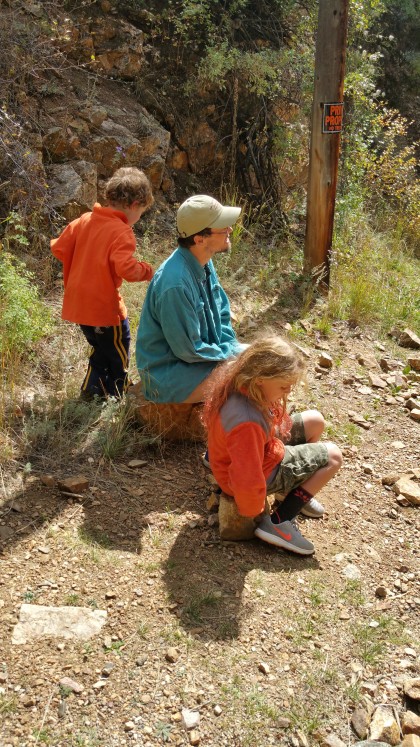
Jon and the grandkids went camping at Upper Maxwell Falls, less than 2 miles from here in the Arapaho National Forest. They watched a fawn come up underneath a doe and whack her underside a couple of times, then drink. Having this kind of opportunity so close to our home makes grandkid life richer. Ours, too. Ruth got cold; Gabe got hot. They ate clam chowder with sourdough bread and drank hot chocolate. Breakfast was back here.
Jon leaving the Double Eagle
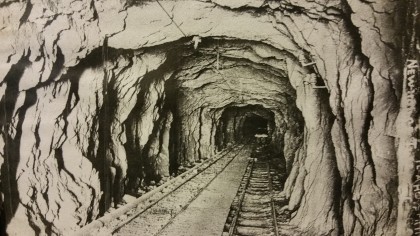
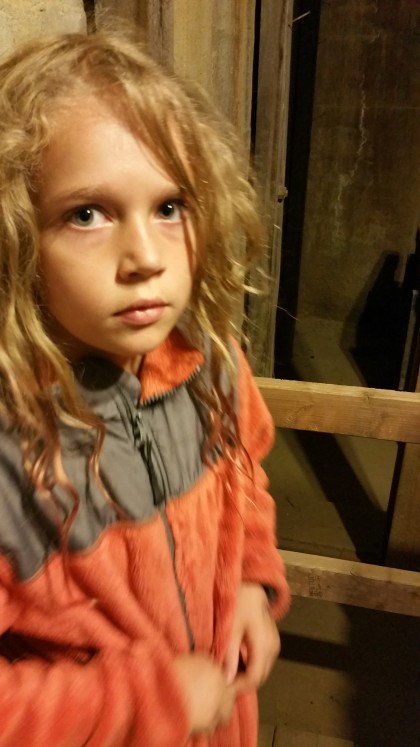
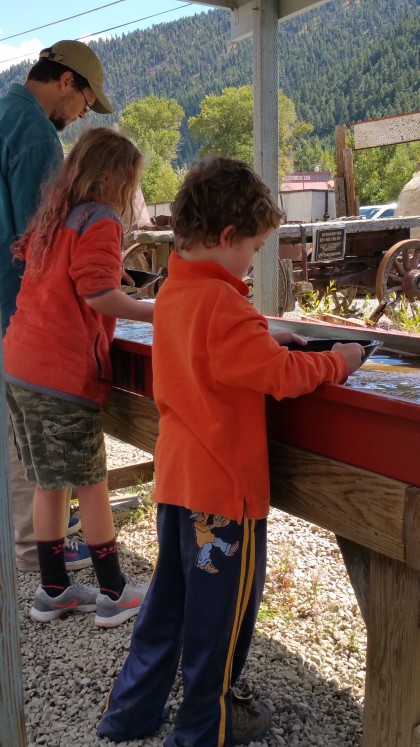
The trip to the Argo Gold Mine was a promise to Ruth, made after I took Gabe there last year. It was much better this time since new owners had a guide that went with us on the whole tour, including the Double Eagle Mine. The Double Eagle was dug by hand, went back maybe two hundred feet, following a vein of quartz (gold shows up near the quartz). It was called the Double Eagle because the entire mine netted its two miners only $20, a double eagle coin. A helluva lot of work for 20 bucks, even in the late 19th century.
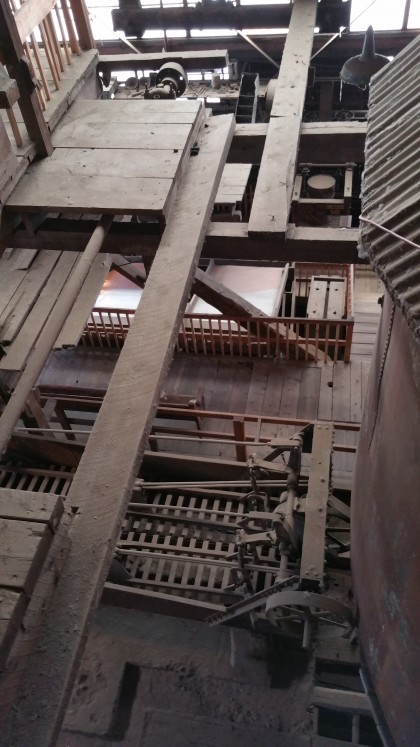
The tour is really of the Argo mill, the processing plant that received, through the Argo Tunnel, ore from 800 mines. The tunnel, 4.2 miles long, ran from upslope Central City to a spot just above the processing plant.
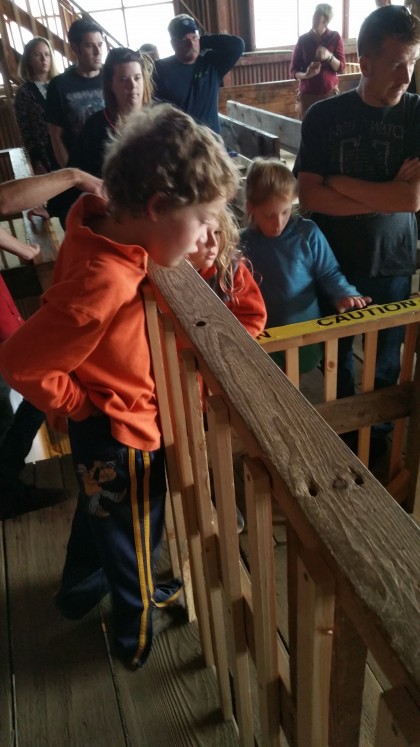
An assayer’s office determined the percentage of the big five metals in each ore cart: gold, silver, copper, lead, zinc. The mill purchased the ore cart based on the value of the metals. Then the ore cart moved over to the receiving pits. The cart tipped over on its side, spilling the ore into these deep bins.
Interior of the mill
From there the ore went to stamping mills for crushing of larger chunks of ore, through chemical slurries and ball mills and finally onto sorting tables. The process used vaporized mercury at one point and a cyanide leaching tank for the gold. Added to the physical dangers in the wooden mill, criss-crossed by belts to drive various machines and filled with the noise of the stamping mills that could be hear fourteen miles away, the poisons used made the mill a dangerous place to work.
This all came to an end when 5 miners, trying to retrieve gold from a vein when the mines were shut down, set off an explosion that drained older mines of water built up in their drifts. This sent a pulse of water jetting through the 12 foot wide Argo Tunnel, killing four of the miners, shooting a one ton ore cart a mile in the air and making the tunnel unfit for use.
The Argo mill shut down the next day. No way to get ore out of the mines and to the mill.
Standing Rock Pipeline. This reminds me, on a much larger scale, of the occupation of Wounded Knee back in 1973. Wounded Knee had the ever-present danger of violence. Radical veterans of the Vietnam War had brought their rifles and placed themselves between the Federal Marshals and the A.I.M. folks in Wounded Knee.
The action in 1973 involved only a few individuals, most of the Lakota and Anishinabe tribes. Today 280 plus tribes have come together with two messages: 1. Water is life. 2. Water and oil don’t mix. These are incredibly important ideas, simple yet profound.
It may turn out though that there is a meta-message here that is even more important. 280 communities, 280 nations, 280 tribes and their disparate traditions, customs and histories have come together to speak with one voice. This could change the politics of Indian Country forever. I hope it will.
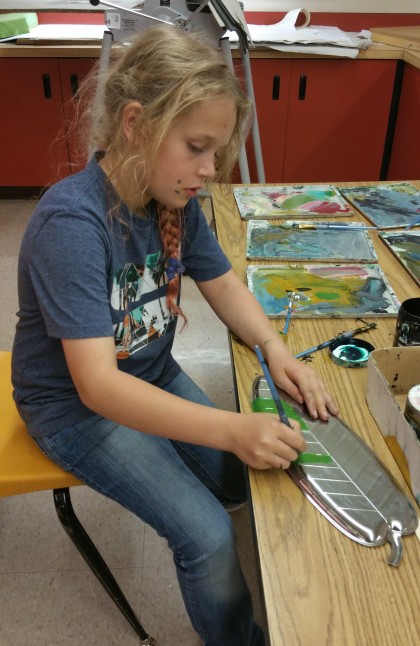
Spent another evening at Montview Elementary with Jon, Ruth and Gabe. We ate a light supper of foods selected at King Sooper (grocery store chain here), then began to make more prints. Ruth has gotten into the spirit of found objects used as surfaces for print making. She bought some things at Goodwill to print: a leaf shaped metal serving dish and a small metal kitchen utensil that looks surprisingly like a giraffe when inked. I printed another spoon, gray-white this time. Gabe made wheeled objects with something like tinker-toys.
The whole divorce matter, which moves like boulders pressed underneath a glacier, slowly and with a lot of friction, has begun to move into more hopeful territory. But the pace. Lawyers love proposals and counter proposals. Sometimes it feels like the lawyers have oppositional defiance disorder. If you say yes, I say no. If you say up, I say down. Very frustrating. Not to mention expensive. Still, the glimmers of a positive solution appeared yesterday.
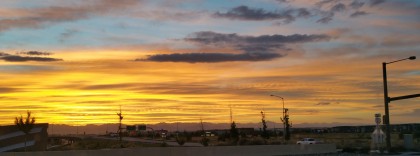
After the printmaking, Jen picked up Ruth and Gabe. I headed over to I-70, turned onto it going west and drove into this amazing sunset. The mountain silhouette in the evenings often looks like a Potemkin village, a prop set against the backdrop of a falling sun. This night it was something.
Kate was in Evergreen at the Beau Thai restaurant, waiting on me for a ride home. She had completed her first class in an 18 week Hebrew class at Beth Evergreen. After I picked her up, we got on the familiar Colorado 74, one of two main highways, 73 and 74, that intersect in Evergreen. At the base of a long hill there were three fire trucks and a police car parked in the middle of the road.
bull with water lily September 2015 in Evergreen
The elk crossing sign had been flashing yellow as we descended. This is the month of the rut so elk behavior is not as predictable as at other times. When we moved around the nearest fire engine, a yellow and chrome vehicle from Evergreen Fire, I looked to my left and saw two black helmeted, yellow uniformed fire fighters bent over, pulling. They had a large elk doe by the feet and were dragging her away from a Toyota Rav4 that had hit her. Shattered safety glass dotted her path across the highway.
Palisade, Colorado has had a bumper peach harvest. There is a small area on the Western Slope that has an ideal peach growing microclimate. They have other crops, too: lavender, apples, sweet corn, strawberries and vegetables. The newspapers have carried photo spreads of workers in the orchards with peach baskets gently picking and placing the delicate fruit into baskets. Back in Andover, this time of year, the honey harvest would be in, the raspberries just beginning. I would be out planting garlic and pulling the last plantings of carrots, beets, leeks and onions. This is the peak harvest season, when the land and its workers combine to feed millions, even billions of people.
Sitting up here on Shadow Mountain, with a heavy mist slowly creeping down the face of Black Mountain, the harvest season has little sway. A few folks have gardens, true, but there is no large commercial agriculture. The cattle company that raises grass fed beef, for example, has five cows, four angus and one hereford, grazing in a mountain meadow about half way down Shadow Mountain.
Being so far removed from farms and large truck gardens feels strange to this former Midwestern lifer. No more so than in this long harvest season. Corn pickers and combines have begun to roll through fields. The state fairs have swept up 4-H’er raised cattle, pigs, sheep, chickens. The vegetable harvest has peaked. Self pick apple orchards have hayrides and cider stations set out. Not there, though.
In the mountains this season sees the first glints of gold across the evergreen forests of lodgepole pine. The aspen begin to turn. The nights cool down. Canadian blue skies dominate our days.
Labor Day does mark the winding down of one season long harvest up here: tourist dollars from Denver folks. July and August are the heaviest tourist months for our favorite mountain town, Evergreen. We’re not a winter tourist destination, at least not like the ski resorts, so the roads will have less traffic and fewer visitors in Evergreen’s restaurants.
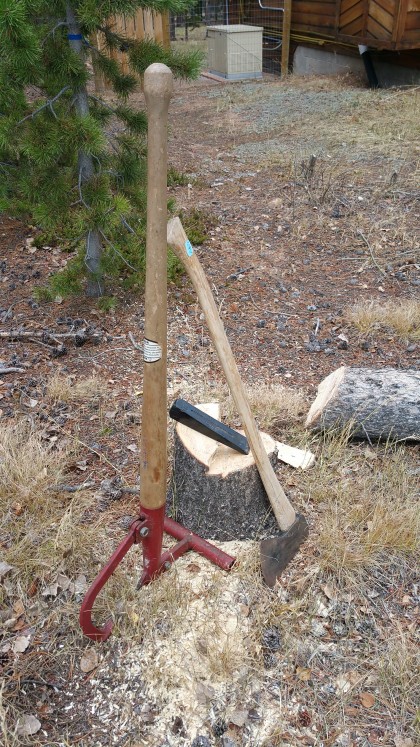
Soon it will be time to start splitting the logs I cut last fall in the first round of fire mitigation. Takes about a year for pine to season. The remaining logs in the back will be seasoned next spring. Log splitting is a seasonal activity both here and in the Midwest. Looking forward to it.
 And, improbably, it will be Thanksgiving next week. There is no hint of over the river and through the woods weather to stimulate that Thanksgiving feeling. We may get a storm on Thursday. That would help.
 The election is over. At least for Kate and me. We got our ballots in the mail on Tuesday. Yes, in the mail. We opened them and yesterday sat down together to vote. At our beetle kill pine kitchen table. The ballot spread out before us, front and back. The front had Hillary Clinton, Michael Bennet (Senate) and Jared Polis (House of Representatives) in a row, making it easy to vote for these Democrats.
 On the back of the ballot were several matters up for public decision, most amending the constitution, a couple with only statutory weight. These are placed on the ballot if they get enough signatures in a pre-election petition process. This is referendum politics and I don’t like it. It sounds like direct democracy, but in fact it is too often a place where large organizations run stealth campaigns, hammering the process with lots of money.
 In effect the polling place became our kitchen table. It was better than a voting booth because we could discuss our votes, look up information on candidates or ballot issues. Today we’ll drop our ballots off at a ballot collection box at the Evergreen library.
 Divorce matters seem finally to be breaking Jon’s way. Can’t say more than that right now, but I’m glad.
 Elizabeth itself is a small rural community that could have been anywhere, usa. It has a small historic downtown; that is, older retail buildings repurposed into boutiques and a fiber art store and antique shops. Mainstreet is Co. Highway 86 and there is the obligatory Walmart anchored, downtown killer of a strip mall on the edge of town.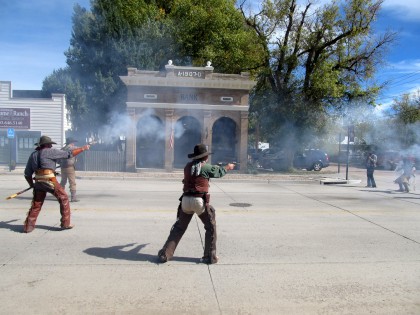
 My head says ethnobotany. Our culture chooses our diet for us, decides which foods are tasty, which gross, which taboo. Our bodies are neither obligate carnivore nor obligate vegetarian. We are designed by evolution as omnivores, able, thankfully, to eat what the world places in front of us, be it plant or animal. This is a great advantage for us as a species and has allowed us to thrive in many diverse climates. There is nothing wrong, then, about eating meat, either from a biological or cultural perspective. Meat is simply one source of food.
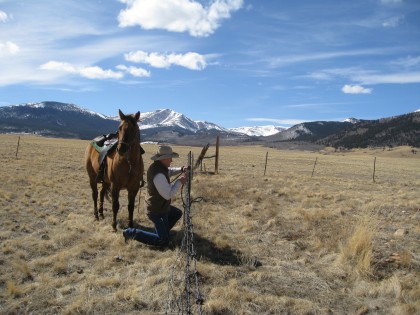 To purchase their meat was to kill them as surely as if I took a rifle out and shot them. Back in 1974 I moved onto the Peaceable Kingdom, a farm Judy and I bought in Hubbard County, Minnesota, the county home to the headwaters of the Mississippi. We had goats and decided we wanted to barbecue some goat meat. Johnny Lampo, the man who rented our fields and farmed them, gave me his rifle and I killed one of our our goats. I’ve not been the same since. I can’t even euthanize our dogs.
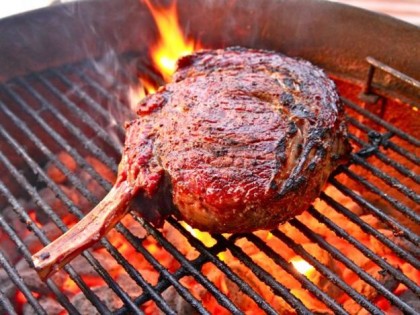 So this evening when Kate cooks the ribeye steaks thawing right now in our sink, I plan to add a small ritual to the lighting of the shabbos candles and the sharing of challah. We will remember the animal that died so that we may eat, so that our bodies might be strong. We will thank this particular individual for the role he or she plays in our daily life. We will acknowledge the cycle of life, the interlocking web of life and our mutual parts in it.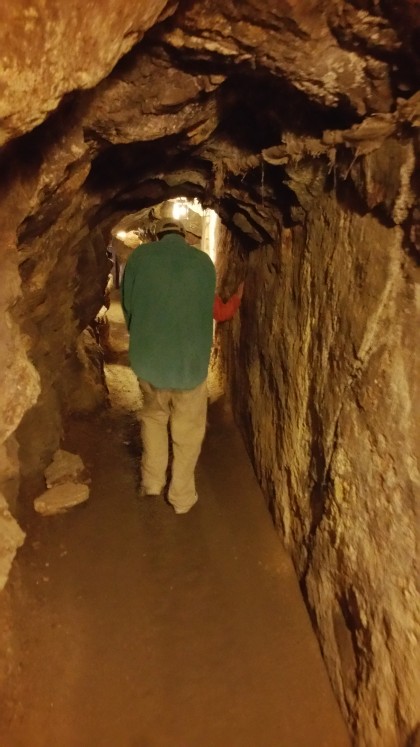

 Standing Rock Pipeline. This reminds me, on a much larger scale, of the occupation of Wounded Knee back in 1973. Wounded Knee had the ever-present danger of violence. Radical veterans of the Vietnam War had brought their rifles and placed themselves between the Federal Marshals and the A.I.M. folks in Wounded Knee.
 Spent another evening at Montview Elementary with Jon, Ruth and Gabe. We ate a light supper of foods selected at King Sooper (grocery store chain here), then began to make more prints. Ruth has gotten into the spirit of found objects used as surfaces for print making. She bought some things at Goodwill to print: a leaf shaped metal serving dish and a small metal kitchen utensil that looks surprisingly like a giraffe when inked. I printed another spoon, gray-white this time. Gabe made wheeled objects with something like tinker-toys.
 After the printmaking, Jen picked up Ruth and Gabe. I headed over to I-70, turned onto it going west and drove into this amazing sunset. The mountain silhouette in the evenings often looks like a Potemkin village, a prop set against the backdrop of a falling sun. This night it was something.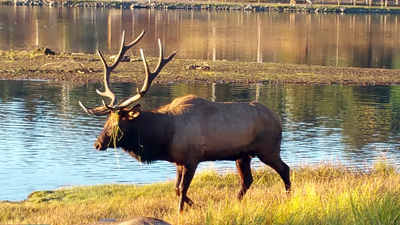
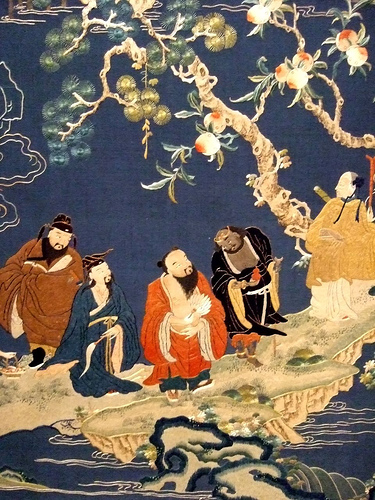 Palisade, Colorado has had a bumper peach harvest. There is a small area on the Western Slope that has an ideal peach growing microclimate. They have other crops, too: lavender, apples, sweet corn, strawberries and vegetables. The newspapers have carried photo spreads of workers in the orchards with peach baskets gently picking and placing the delicate fruit into baskets. Back in Andover, this time of year, the honey harvest would be in, the raspberries just beginning. I would be out planting garlic and pulling the last plantings of carrots, beets, leeks and onions. This is the peak harvest season, when the land and its workers combine to feed millions, even billions of people.
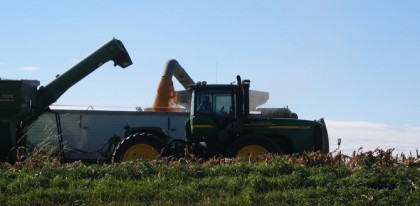 Being so far removed from farms and large truck gardens feels strange to this former Midwestern lifer. No more so than in this long harvest season. Corn pickers and combines have begun to roll through fields. The state fairs have swept up 4-H’er raised cattle, pigs, sheep, chickens. The vegetable harvest has peaked. Self pick apple orchards have hayrides and cider stations set out. Not there, though.
 Labor Day does mark the winding down of one season long harvest up here: tourist dollars from Denver folks. July and August are the heaviest tourist months for our favorite mountain town, Evergreen. We’re not a winter tourist destination, at least not like the ski resorts, so the roads will have less traffic and fewer visitors in Evergreen’s restaurants.