Happy to report that the two friends with critical life moments had good news, one through medical surveillance and one through a lifetime of work brought into clear focus. May the congregation say, Amen. Or, blessed be.
Under the Woolly Mammoth Moon two natural wonders continue apace. The 416 fire, though now reporting 37% containment, has increased in size to 47,000 acres plus and further information on the inciweb site for it indicate weather conditions are favorable for the fire to continue to grow. In addition to its location only 13 miles north of Durango, where my buddies and I spent a weekend, it’s also very close to Mesa Verde and the Canyon of the Ancients. This fire began on June 1st and has lasted into the difficult fire conditions of midsummer.
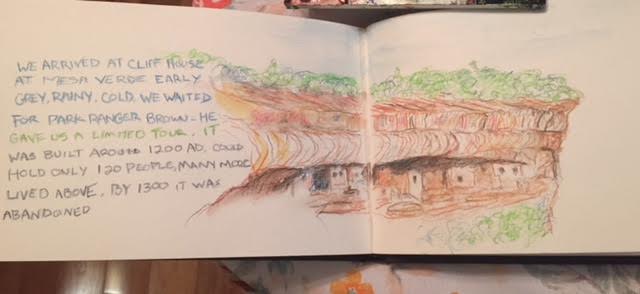
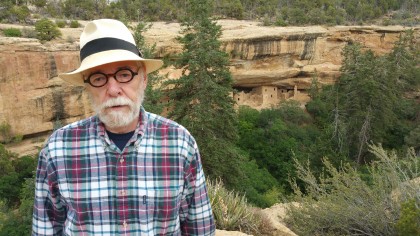
Cliff Palace of Mesa Verde, Mark Odegard
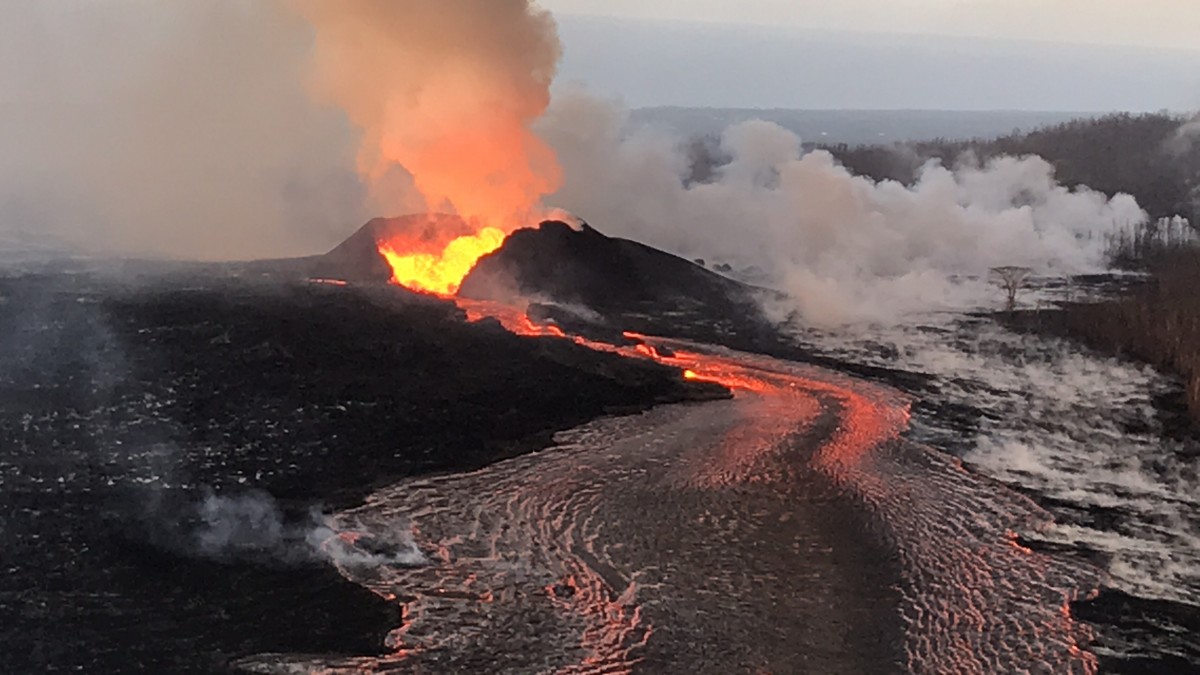
Back on the Big Island, Kilauea continues to erupt.
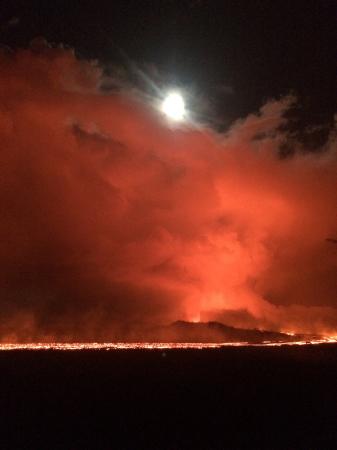
June 27 fissure 8 cone supplies lava to the ocean overflows USGS. The cone is now nearly 180 feet high.June 28 Night view of the lava channel toward fissure 8 under a nearly full moon. USGS
At the Kilauea caldera, Halemaʻumaʻu crater, home of the goddess Pele, continues to deepen and subside, the floor now 1,300 feet below what used to be the overlook area. The USGS reports that the popular parking lot next to the crater is no more, having fallen into Halemaʻumaʻu.
Well, it’s incremental. Down from 14:59 to 14:58 today but the needle has begun to move. By the end of the month daylight will have decreased to 14:56, but, by the end of July, to 14:16. August 13:05. September 11:49. December 21 9:21. That’s for Colorado, of course. Other locations will vary. A lot. But the trend is the same. And, on top of this mountain, welcome.
Started working on lesson plans, a first for me. My task involves the 6th graders of our religious school. Rabbi Jamie has a worksheet I’m using with four columns: Hebrew, Torah, Middah, and Mitzvah. Guess what? The first column is in Hebrew. That makes it a challenge for me. But, in this wonderful age of quick information access I can plug in the word to google’s task bar and get at least a clue quickly.
Glad I learned the quote, “Confusion is the sweat of the intellect.” After yesterday’s work on the lesson plans the metaphorical sweat came easily. It’s no easy feat stepping into another tradition, even one with which I have some familiarity. Yet, it is also rich, resonant.
Not a Jew, but a reconstructionist. That realization about my comfort level at Beth Evergreen has given me a broader insight. It’s a little strange, so bear with me, please.
Spruce Tree House, Mesa Verde
I love definite, strong connections to the past, both Christianity and Judaism offer that to their adherents. So does travel. And reading. Among my favorite places to visit are ancient ruins like Ephesus, Angkor Wat, the Great Wall, sites of ancient Rome, Pompeii, Bath, Delphi, Delos, Cahokia, Mesa Verde, Chaco Canyon, even the castles of North Wales like Conway and Dinas Bran, encyclopedic art museums, and worlds created by writers like Ovid, Homer, Dante.
This could make me a conservative, a thinker and an actor with a preference for things as they were, a reluctance to change what works. But, oddly, it has had the opposite effect. I find in the ancient world a panoply of human possibility, ways of coping with this odd gift, life. How we think today, how we feel, has its roots in this vast web of life’s journey. We don’t have to experience everything as brand new, don’t have to figure everything out for ourselves. Others have loved, have doubted, have feared, have wondered, have hoped. So can we.
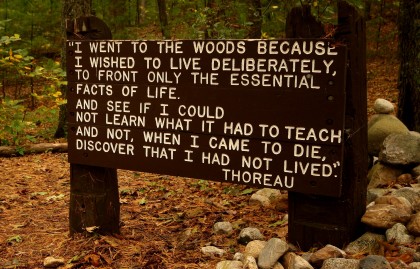
But, and I might call this the Emersonian turn, we cannot use the offerings of the past without remembering his introduction to Nature: “The foregoing generations beheld God and nature face to face; we, through their eyes. Why should not we also enjoy an original relation to the universe? Why should not we have a poetry and philosophy of insight and not of tradition, and a religion by revelation to us, and not the history of theirs?”
When we wittingly or unwittingly chain ourselves to the experience of others, especially those others from the distant past, we disrespect both them and ourselves. We disrespect them by claiming their authority as if something we had earned. We disrespect ourselves because we cheat ourselves of the present, of our own deep intuition, of our own revelations.
When we recognize though that those previous generations did behold God (bracket content) and nature face to face, that they did have an original relation to the universe, that they did create poetry and philosophy of their own insight, that they did create their religions by access to their own revelation, we learn an important, perhaps the important, lesson. We too live in this world with the same faculties, the same powers of observation and discernment that they had.
Gawain and the Green Knight
It was not those who had a religion of revelation to them that blinded us though. It was men, yes mostly men, of institutions, who tried to make the words of the past govern us. Those who declared scripture inerrant and infallible meant they knew what it meant, once and for all, and we had to obey. Well, I call bull shit on that. Those original beholders of God and nature opened themselves, in their present moments, to the awe and wonder all round about them. What a thing of beauty! Think how the mere record of their lives has effected us down to this day.
It is, though, the record of their lives. Only that. In our present, in this sacred moment, we have the same opportunity that they had, we have the same responsibility that they had. Think how the mere record of your life might effect others as distant from us in tomorrow as those are in yesterday.
Open up. Lighten up. Dance to the music of our time. Rip back the cloth from the temple gate in your life. Peak inside. Tell us what you see. We need to know.
Remember this. Always. “In the coming world they will not ask me—Why were you not Moses? They will ask me—Why were you not Zusya?” Rabbi Zusha of Hanipol
The mountain moon will disappear over the next few days; but, its impact, like that of the new shoulder moon, will continue. I’m now picking up mountain facts, art, poetry, science, including a lot of vulcanology. The mountains that I see everyday speak to me in new ways. See what you’re looking at.
Here’s an example. While on our way to Evergreen the other day, Kate said, “Oh, look. Leaves on the aspens!” This was near the entrance to the Cub Creek trailhead. Sure enough, a grove of aspen (clones of each other) had small bright green leaves. But. As we went further down Brook Forest Drive, the aspens were not leafed out. Their leaves were still furled, mostly colorless. Why? What about the soil, water, location with other trees made that one batch of aspen leaf out earlier than almost all the others we saw further down? Still don’t know.
Another. The last few days have been rainy and foggy. As we passed rock faces bare of trees, the fog and mist on them gave a perfect simulacrum of the Song dynasty paintings that I love, mountains seeming to emerge from and disappear into the clouds.
Another and ongoing aspect of becoming native to this place.
Still fascinated by the eruption of Kilauea. The Leilani Estates, houses bursting into flame, residents standing dazed by their vehicles after evacuating, monster movie scenes like the one below, show humans as do many Song dynasty paintings, small and insignificant next to mountains and rivers.
Listening to residents of the Leilani estates describe the shock is a lesson in reenchantment of the world. There were expressions of grief, of course, and bewilderment. All knew this possibility existed, but, like residents of flood plains and the wildlife-urban interface (us here on Shadow Mountain), hoped they would be spared. The lure is beauty. Always beauty. We take risks to live in beautiful places.
At the Columbian Exposition
Some said things like, “Well, if madame Pele wants the land…” “Pele goes where she wants.” There was, in these remarks, no irony that I could detect. No wink, wink, you know what I really mean. The native Hawai’ian’s faith in Pele, given witness by the offerings at Halemaʻumaʻu Crater and numerous legends and dances, has, at least partially, reenchanted the Big Island for haoles (non natives). Whether they believe in a real, physical goddess or not, probably not, I sense the feelings of awe and the mysterium tremendum et fascinans that Rudolf Otto associates with the numinous, the essential components of the holy.
What’s happening at Leilani Estates is similar, perhaps the same, as my experience here on Shadow Mountain when I came for the closing on our home. The three mule deer bucks in our backyard, curious and welcoming, were mountain spirits blessing our move. I knew it while standing there with them, present with them in this new, strange place. It is not, in other words, that the numinous has disappeared from our encounters, only that we have unlearned how to know it. The reductive nature of scientism, that attempt to totalize our understanding with numbers and equations and laws, and the restrictive arrogant nature of religions certain that they know truth, has blinded us to the numinous.
Reenchantment has a precursor experience, a moment when we embrace the awe and the mystery, a feeling that we each experience, perhaps even experience often (childbirth, death, sunrise, the greening and flowering of spring, a snowstorm, bitter cold, blazing heat, the vastness of the ocean, love), but a feeling we have allowed others to reframe for us. The laws and beauty of scientific understanding do not explain away, as many assume. They are descriptive, a language of their own about the world in which we live. But they have not stripped out awe and mystery though men like Richard Dawkins, Sam Harris, and Christopher Hitchens insist on it. Empiricists, fed by scientism, want to suggest only through data and analysis can we know the truth.
Or, the experience of the Celts and the Roman Catholic church is instructive here, one faith’s certainty can leave no room for the numinous anywhere but in their dogma, their rituals. Catholics built churches over Celtic holy wells. They deployed words like heretics and blasphemers and pagans to undercut the authority of the old faith. They appropriated Celtic holidays by turning Lugnasa into Lammas, Samain into All Saints. Mordecai Kaplan, the founder of Reconstructionist Judaism says it well, “It is not the seeking of God that is the problem, it is the certainty of those who believe they have found God that is the problem.”
We can learn from the residents of Leilani Estates. We live in a wild universe, one well beyond our capacity to either control or understand. When we can set aside the certainty of others, the narrow thinking, and open ourselves to awefull and wonder of wilderness home, then we can know the ordinary holy, the secular sacred, the profane faith of those whose revelations no longer come from books or laboratories, but from that wilderness itself. That is reenchantment, that is reconstruction, that is a reimagined faith.
Earth has come round the sun again to the second half of the Celtic year, marked by Beltane or Mayday, the start of the growing season. I’m going to try something new this Beltane and introduce at least a half year’s emphasis, a theme of sorts. Mountains. Yes, I’m working on Jennie’s Dead and the sumi-e and qabbalah, but I want to extend the mountain moon’s influence to Samain, to Summer’s End, six months away. On that day, the Celtic New Year, I’ll reassess.
Beltane is the day when the horned god, Cernunnos, and the Maiden aspect of the triple goddess consummate their sacred marriage which fertilizes mother earth and gives energy to plant and animal life for the season of sun and warmth. The spring ephemerals lance their way toward the sun daffodils, grape hyacinths, bitter-root, crocus among others. The color palette shifts from grays and whites and browns to wild purples, vibrant yellows, subtle whites, deep blues. Buds come on the trees. Animal babies begin their perilous lives here in the mountains. This is the true easter, the moment of resurrection. Celebrate, celebrate, dance to the music.
On this day a market week would commence among the ancient Celts, one where handfast marriages could be performed, women would leap over fires to enhance fertility, cattle would be driven between bonfires to ward off disease and young couples would go into the fields and imitate the marriage of Cernunnos and the Maid, adding their magic to that of the god and the goddess.
I want to take into myself that energy, the fecund moment that Beltane offers us, and use it to enhance my appreciation of our mountain home as the earth blossoms forth with food and flowers, new life of all kinds.
Holocaust Is Fading From Memory, Survey Finds. NYT
Anti-Semitic Incidents Surged 57 Percent in 2017, Report Finds. NYT
Sho’ah is Hebrew for catastrophe and has come to refer explicitly to the catastrophe for Jews after slavery in Egypt, the Holocaust. On the 27th of Nisan, April 12th this year, Jews celebrate Yom ha-Sho’ah, or Holocaust Remembrance, on the anniversary of the Warsaw Uprising. This is a crucial twist to Holocaust remembrance because it frames the day with a symbol of Jewish resistance to the Nazi’s.
One thing I’ve been privileged to observe over our time so far at Beth Evergreen is the complicated relationship Jews have with the Holocaust. It is horror beyond imagining, yet there are photographs and family memories and its dispiriting constancy in everyday Jewish life. Rabbi Jamie tries, each time he refers to the Holocaust, to inoculate the congregation against an attitude of victimization. Victims have little agency and the worst sequelae of the Holocaust would be a self-enforced powerlessness.
It’s a tragedy so outsized, so without precedent as an act of calculated evil, that how to approach its remembrance, its historicity, is fraught. Words and analysis, though important in certain venues, cannot touch the emotional complex around its reality. Congregation Beth Evergreen, this Sunday, tried another approach. Dance and music.
Beth Evergreen commissioned The Thomas Dance Troupe, five members of the Colorado Ballet who work together outside of the Ballet, to come up with works that could serve as, well, I’d say, a cri de coeur. They performed with a select few members of the Evergreen Chorale, a pianist, and a violinist.
It was a powerful program, aimed straight at the heart and it arrived. Many of the most important truths which we humans can access are not communicable in words, in the language of reasoned discourse. Those we must find in art.
Life still trickling by. A bit of snow over the last few days, colder now, in the Colorado measure of that term. So relative. Saw a facebook meme with Texans in parkas at 70 degrees. Could have countered that with a Minnesotan in shorts at ten below. Meanwhile 11, last night, felt pretty cold after three years here. These gross physical acclimatizations are easy to spot, but what about the more subtle mental adjustments?
How does the mind change, for example, when it goes up and down mountains, around curves into canyons, rather than coasting across the flat lands of the Midwest? Or, what about looking up and seeing ovular lenticular clouds, high flying cirrus against blue sky? When fall comes and the changes are only in the aspen, a mass of gold variations, what happens to the heart used to deciduous colors?
Political colorations are different here, too. That thick vein of let me alone libertarianism too often gets mined for political results that would make even conservative Minnesotans cringe. Immigrants to the state, like Kate and me, drag along with us expectations that government should be of, by and most of all, for the people. This is a far from universal sentiment in the West. We’re adding new strata to the political geography, but the whole still feels very alien to me.
This is all by way of becoming native to this place, a key element in my pagan creed borrowed from Wes Jackson at the Land Institute. Sounds like an oxymoron, right? That’s why I love it, the challenging notion that we can be of a new place in a very old, intimate way, through what Rabbi Jamie would call Torah study, close attention, close attention to details and to our own inner world, compassionate attention willing to be shaped by what we find.
Kate and I did it on the Great Anoka Sand Plain. Over the Andover years we listened to the soil, to the rhythms of the growing season. We stuck our hands in the soil, partnered with it. We planted trees and fruit bearing shrubs. There was the open prairie we cultivated on either sides of the more traditional suburban lawn carpet. Bees, with whom we partnered, for honey. Dogs who used the woods as their home and hunting ground. By the time we left we were native to that place. Its rhythms shaped our own and together we created a place to live.
It’s happening here, too. A long and nuanced process, still in its early days, but one that has promise for the Great Work, creating a sustainable presence for humans on this planet.
Hippity hop to the ortho shop. Kate’s got an appointment at Panorama Orthopedics today. Her right shoulder. She can no longer hold things up with her right arm and has to use two hands to put dishes away, sometimes to lift a cup. Annoying and painful. Screws up her sleep, too. She needs some kind of solution, more than likely a shoulder replacement. This is the first step, a consult to see what her options are.
A friend of Kate and mine is having surgery for breast cancer today, too. It’s a cancer that has the improbable, but very desirable, cure rate of 100%. In the sort of piling on that getting older can deliver, her husband, only a week later, got a diagnosis of idiopathic pulmonary fibrosis. It’s a killer, but slow, maybe 5-10 years. He’s mid-70’s. Mortality is always stalking us, but seems to knock on the door more often past three score and ten.
Sister Mary tells me she’s been invited as a visiting professor to a university in Kobe, Japan this summer. Very close to Kyoto. And, great beef. Congrats to Mary. Brother Mark is in Bangkok right now, chillin’ in the tropical heat.
An interesting week ahead. A session on green burial tomorrow night at CBE. It’s part of a conversation about creating a Jewish cemetery up here in the Evergreen/Conifer area. Oddly, I think I’d like to work on that. The next night, Wednesday, is Tu B’Shevat, the New Year of the Trees. Judaism has a lot of pagan inflections, Tu B’Shevat and Sukkot, a harvest festival at the end of the High Holidays, for example. Looking forward to this one because there’s a seder, too, with seven species of fruit and nuts. I’ll explain more on Wednesday. After the this celebration is another Kabbalah session, more double letters in the Hebrew alphabet.
Rigel has her second appointment at the Vet Referral Clinic with Dr. Bayliss this Friday, too. I’m excited about it because we’ll get a clearer picture of what’s going on with her. And, it’s not the dire prognosis we anticipated when we took her in a week ago last Friday.
Meanwhile, I’ve finally levered myself back into writing, now on both Jennie’s Dead and Rocky Mountain Vampire (only a working title). Not sure exactly how I did it, just did it, I think.
Getting closer to using the sumi-e brushes, maybe today. Yesterday I tied string at the base of each new brush after applying a bit of glue all round, too. That had to set for a day. I gathered some towels, watched a couple more videos. Youtube is a fantastic resource for all kinds of things. Jon watches Japanese woodcrafting videos to calm down, for example.
Next week is Kate’s quilting retreat in Buena Vista.
Being sick, even mildly sick as I’ve been for four or five days now, takes me into strange territory. Mortality flits across the mind. All the obituaries that include the phrase, “after a brief illness.” Labile. When I saw this video about Ronnie the Donkey, I cried. And, too, when I read about this special organization, Cayleb’s Senior Dog Rescue. Kate and I donated.
Donkey And His Mom Celebrate Their Emotional Journey This donkey was so depressed after he lost his baby boy. But the woman who adopted him knew exactly what he was going through and figured out the sweetest way to make him feel at home. Today on Party Animals, Ronnie’s mom is throwing him a very emotional 5th rescue-versary party to celebrate their amazing journey 😍
Posted by Party Animals on Saturday, January 6, 2018
Got to wondering about being labile. Why is that part of illness?
I asked Kate. Less energy to maintain your defenses, she said, in essence.
Castle Dinas Bran, Llangollen, North Wales
Which raises a second question. Why the defenses? Why would I need to place a barrier between my feelings and my expression of them, especially feelings of tenderness? Is it too difficult for my sanity to rock my inner world? Somehow I don’t think so. It seems more likely that big boys don’t cry. As our president might say, Sad. Why not recognize when the heart softens, when it takes in a moment of love and responds? Why not just go ahead and cry? Tear up.
Maybe one of the functions of illness is to remind us of our heart truth. When the body feels threatened, insulted, perhaps the mind takes the opportunity to reexamine our spot in this world. Perhaps it allows the cultural constructions, the moats and castle walls we put up, to crumble a bit, so we can know they exist. We do tend to forget about those fortifications, the ones built by stereotype, by social convention.
dinas bran. I visited these ruins in 1995.
We northern Europeans seem to have well-built walls. Perhaps that’s why we can be gulled too easily by ideologues who have burnished their fear of the other, who take their fear and embarrassment as cues for violence rather than compassion. It is a danger we could altogether eliminate, if we let the right feelings in.
As for me, I’m going to try. The moat drained, the walls down. Good. Let them stay that way.
“The more I have looked into the Quest for the Grail, it is clear it is a Western form of Zen. There is no grail, it is understanding that the veil is the mystery of existence, it is nothing, but our interactions with everyone and everything.” Woolly and friend, Mark Odegard
Mark is an artist, an author, a sweet guy and a friend of 30 years. He’s done many retreats at a Zen Buddhist retreat center in Minnesota and done calligraphy with that giant brush Zen monks use. He has an ability to come at ideas from the side, or behind, seeing what cannot be seen; the Zen work has informed his sight in substantive ways.
He’s asking the Woolly Mammoths this New Year’s question for their next meeting:
“What personal tool/skill do I need to refine for my quest for the grail’? I will write down your answer to this, and ask you again at the end of the year.
The story represents our own encounter with the mystery of life (often occurring in our late teen years). The meaning is veiled for us, what do you need to lift the veil.”
Mark’s question made me start because I’d just written this, only two or three days ago here on Ancientrails:
“Torah study is about loving attentiveness. It is a way of engaging the sacred world which we can know first from within our own person and which permeates that which we encounter throughout our lives…
God lit up for me. Ah, if I do Torah study, if I engage in loving attentiveness to my Self, my own Soul, and those of others and of the broader natural world, then I can find the knowledge which permeates all things, that very same shards of the sacred that shattered just after the tzimtzum to create our universe. That is God being available everywhere. This is far different from the Latinate imponderable of omnipresence, sort of an elf on the shelf deity lurking in every spot, finding you everywhere. And judging.
No. God is another word for the intimate linkage between and among all things, from the smallest gluon to the largest star. God is neither a superparent nor a cosmic Santa Claus writing down your behaviors in the book of deeds; God is a metaphor for the sacred knowledge which permeates the perceivable, and the unperceivable, world.” Ancientrails
I’m not trying to revive the word God here, nor am I trying to reinsert myself into the thought world which includes God. I’m on the same grail quest I started years ago in Alexandria First Methodist sitting beside the huge stained glass window of Jesus praying in the Garden of Gethsemane. Back then I read the Bible as history, not as mythology. Back then it mattered if there was a Jesus who prayed in that Garden that the burden of crucifixion be lifted.
I pushed those beliefs away long ago, passing through a moment, a long moment of second naivete with them, then moving into the world of the Great Wheel and the cyclical, spiraling time through which all life moves, in fact, all things. Over the last year or so my intense program of Jewish immersion has taken me another big step along this ancientrail, a true Grail quest began when, as a sixteen year old, I began to doubt the stories I’d heard growing up.
Frederick J. Waugh, The Knight of the Holy Grail, c. 1912
My true philosophical (qua religious) home, existentialism, found me in the aftermath of that doubting and my first encounter with philosophy at Wabash College. When I went into my Christian immersion, through seminary and in the Presbyterian years, my faith went mystical, seeing the divine as divinely personal, as a bright light shining within the darkness of my inner world, a light whose purpose was not to dispel the darkness, but to integrate, Taoist style, both of them.
Now, with Rabbi Jamie, I’m studying the kabbalah. Like Zen it insists on not seeing with eyes alone, but with the heart, with a poetic sensibility that understands religious language, I think all religious language, as metaphor, even and especially for the kabbalists, the written Torah.
The veil is a very important metaphor in kabbalistic thought. Like Mark observed above the kabbalists know there is a veil between us and the mystery of existence. The veil underscores the humility necessary for this work and without humility the quest will fail.
canterbury pilgrims
This idea is ultimately significant. Or not. We cannot penetrate the veil. Ever. Yet we all stand together on the other side of it. To see through the veil, to actually find the Grail, is not given to us, yet that place which we see through a glass darkly is the place where we stand right now. Yes, right now the Grail is in our hands, a cup from which we can drink at any moment.
This ancientrail, the quest for the Grail, the turning of the Great Wheel, the lifting of the burden of our crucifixion, flowing up and down with divine energy through the Tree of Life, is our life, is the life of this world, this cosmic pulsing brilliant reality. Yet we let so many things: work, fear, hope, pride blind us.
The Woolly Mammoths have been my companions, fellow pilgrims, on the way to Canterbury. Or, fellow Tibetan Buddhists inch worming their way around the sacred mountain, Meru. Or, my fellow Torah scholars, davening as we read the sacred texts. Or, fellow Lakotas, our skin pierced and tied to the world tree during the Sun Dance. Or, friends traveling through this life together until it ends.
“What personal tool/skill do I need to refine for my quest for the grail?” Out of far left field, I’m going to answer, “A Sumi brush, rice paper, an ink stone. And the courage to use them.”
 But, and I might call this the Emersonian turn, we cannot use the offerings of the past without remembering his introduction to Nature: “The foregoing generations beheld God and nature face to face; we, through their eyes. Why should not we also enjoy an original relation to the universe? Why should not we have a poetry and philosophy of insight and not of tradition, and a religion by revelation to us, and not the history of theirs?”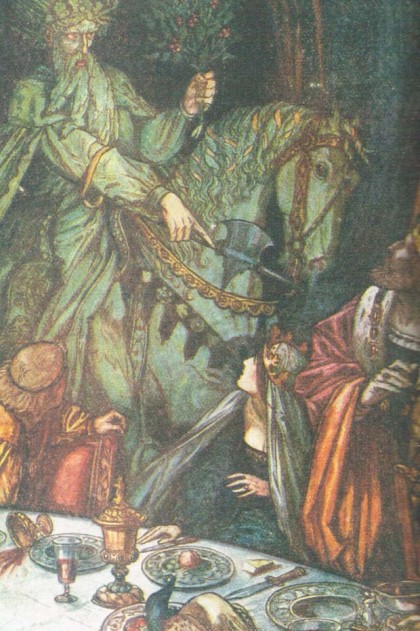


 Reenchantment has a precursor experience, a moment when we embrace the awe and the mystery, a feeling that we each experience, perhaps even experience often (childbirth, death, sunrise, the greening and flowering of spring, a snowstorm, bitter cold, blazing heat, the vastness of the ocean, love), but a feeling we have allowed others to reframe for us. The laws and beauty of scientific understanding do not explain away, as many assume. They are descriptive, a language of their own about the world in which we live. But they have not stripped out awe and mystery though men like Richard Dawkins, Sam Harris, and Christopher Hitchens insist on it. Empiricists, fed by scientism, want to suggest only through data and analysis can we know the truth.
 Or, the experience of the Celts and the Roman Catholic church is instructive here, one faith’s certainty can leave no room for the numinous anywhere but in their dogma, their rituals. Catholics built churches over Celtic holy wells. They deployed words like heretics and blasphemers and pagans to undercut the authority of the old faith. They appropriated Celtic holidays by turning Lugnasa into Lammas, Samain into All Saints. Mordecai Kaplan, the founder of Reconstructionist Judaism says it well, “It is not the seeking of God that is the problem, it is the certainty of those who believe they have found God that is the problem.”
 Earth has come round the sun again to the second half of the Celtic year, marked by Beltane or Mayday, the start of the growing season. I’m going to try something new this Beltane and introduce at least a half year’s emphasis, a theme of sorts. Mountains. Yes, I’m working on Jennie’s Dead and the sumi-e and qabbalah, but I want to extend the mountain moon’s influence to Samain, to Summer’s End, six months away. On that day, the Celtic New Year, I’ll reassess.
 On this day a market week would commence among the ancient Celts, one where handfast marriages could be performed, women would leap over fires to enhance fertility, cattle would be driven between bonfires to ward off disease and young couples would go into the fields and imitate the marriage of Cernunnos and the Maid, adding their magic to that of the god and the goddess.
 Sho’ah is Hebrew for catastrophe and has come to refer explicitly to the catastrophe for Jews after slavery in Egypt, the Holocaust. On the 27th of Nisan, April 12th this year, Jews celebrate Yom ha-Sho’ah, or Holocaust Remembrance, on the anniversary of the Warsaw Uprising. This is a crucial twist to Holocaust remembrance because it frames the day with a symbol of Jewish resistance to the Nazi’s.
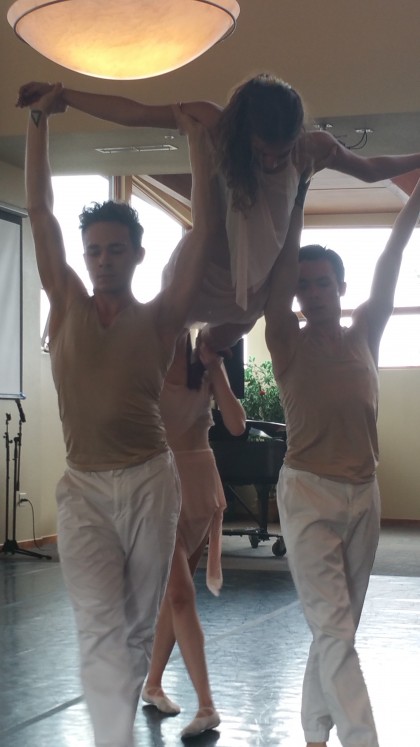 It’s a tragedy so outsized, so without precedent as an act of calculated evil, that how to approach its remembrance, its historicity, is fraught. Words and analysis, though important in certain venues, cannot touch the emotional complex around its reality. Congregation Beth Evergreen, this Sunday, tried another approach. Dance and music.
 Life still trickling by. A bit of snow over the last few days, colder now, in the Colorado measure of that term. So relative. Saw a facebook meme with Texans in parkas at 70 degrees. Could have countered that with a Minnesotan in shorts at ten below. Meanwhile 11, last night, felt pretty cold after three years here. These gross physical acclimatizations are easy to spot, but what about the more subtle mental adjustments?
 This is all by way of becoming native to this place, a key element in my pagan creed borrowed from Wes Jackson at the
  Kate and I did it on the Great Anoka Sand Plain. Over the Andover years we listened to the soil, to the rhythms of the growing season. We stuck our hands in the soil, partnered with it. We planted trees and fruit bearing shrubs. There was the open prairie we cultivated on either sides of the more traditional suburban lawn carpet. Bees, with whom we partnered, for honey. Dogs who used the woods as their home and hunting ground. By the time we left we were native to that place. Its rhythms shaped our own and together we created a place to live.
 Hippity hop to the ortho shop. Kate’s got an appointment at Panorama Orthopedics today. Her right shoulder. She can no longer hold things up with her right arm and has to use two hands to put dishes away, sometimes to lift a cup. Annoying and painful. Screws up her sleep, too. She needs some kind of solution, more than likely a shoulder replacement. This is the first step, a consult to see what her options are.
 An interesting week ahead. A session on green burial tomorrow night at CBE. It’s part of a conversation about creating a Jewish cemetery up here in the Evergreen/Conifer area. Oddly, I think I’d like to work on that. The next night, Wednesday, is Tu B’Shevat, the New Year of the Trees. Judaism has a lot of pagan inflections, Tu B’Shevat and Sukkot, a harvest festival at the end of the High Holidays, for example. Looking forward to this one because there’s a seder, too, with seven species of fruit and nuts. I’ll explain more on Wednesday. After the this celebration is another Kabbalah session, more double letters in the Hebrew alphabet.
 Rigel has her second appointment at the Vet Referral Clinic with Dr. Bayliss this Friday, too. I’m excited about it because we’ll get a clearer picture of what’s going on with her. And, it’s not the dire prognosis we anticipated when we took her in a week ago last Friday.

 “The more I have looked into the Quest for the Grail, it is clear it is a Western form of Zen. There is no grail, it is understanding that the veil is the mystery of existence, it is nothing, but our interactions with everyone and everything.” Woolly and friend, Mark Odegard

 The Woolly Mammoths have been my companions, fellow pilgrims, on the way to Canterbury. Or, fellow Tibetan Buddhists inch worming their way around the sacred mountain, Meru. Or, my fellow Torah scholars, davening as we read the sacred texts. Or, fellow Lakotas, our skin pierced and tied to the world tree during the Sun Dance. Or, friends traveling through this life together until it ends.