Tomorrow is the Summer Solstice. The day of the sun’s maximum presence for the year. On the solstices the day/night balance shifts. On the Summer Solstice, the longest day of the year (though if you check the time tables the difference between June 21st and July 21st is only 13 minutes), the night begins to encroach, slowly.
Whatever guides my soul prefers the dark days, the fallow time. I celebrate on this holiday not the victory of the light, but the coming dominance of the night. I do like the bright blue days here in Colorado, not saying I don’t. Just that my soul gains more richness, more depth as darkness grows. Probably one of the reasons I felt so much at home in Minnesota, at the 45th latitude, half-way to the Northpole.
As a gardener, of course, I relished the light for the vegetables and fruits, for the flowers that fed our bees. The summer solstice signals the growing warmth and long days that nourish all plant life. It was also the time, though, that bugs grew more troublesome, when the humid weather encouraged fungus and mold, viral infections in the plants.
In Sweden, Scotland, and other Gaelic and Scandinavian countries the auld religion still calls to its people. Bonfires. Nudity. Parties through the night. Feasts. I like the idea of them. If there were one close by, I might go.
My relationship with neo-paganism is as fraught as my relationship with Christianity. Judaism, too, at the doctrinal level. There’s so much intellectualizing, writing of ideas, logic. I’ve come to believe that elaborating our feelings toward the natural world in a Wiccan or Asatru way, a neo-pagan syncretic way, is as damaging to the soul as the dogmas and laws of other religions.
In the language of Taoism, the one lens which seems to consciously push away dogma, I would say it this way: The religion that is written and elaborated is not religion. Barriers between our soul and its path.
Emerson has influenced me here and he was, in turn, influenced by Taoism. If you’ve read me for any length of time, you’ll have read these words more than once:
“Our age is retrospective. It builds the sepulchres of the fathers. It writes biographies, histories, and criticism. The foregoing generations beheld God and nature face to face; we, through their eyes. Why should not we also enjoy an original relation to the universe? Why should not we have a poetry and philosophy of insight and not of tradition, and a religion by revelation to us, and not the history of theirs? Embosomed for a season in nature, whose floods of life stream around and through us, and invite us by the powers they supply, to action proportioned to nature, why should we grope among the dry bones of the past, or put the living generation into masquerade out of its faded wardrobe? The sun shines to-day also.” Emerson’s Introduction to his essay, Nature.
It is this sensibility that I celebrate as each of the Great Wheel holidays roll round. The sensibility that helps us become native to the various places where we live. The sensibility that finds the soul’s interaction with the seasons enough. The sensibility that drags down, pulls away the words to look directly at this universe into which we are born. The sensibility that does not fight the turning of the wheel, but sees the seasons of our lives as one with the changing seasons. This is my understand of wu wei, conforming our life to what is, not what might be.
What I encourage is the sun on your face. Your hands in the soil. Your feet on a hiking path. Your ears alive to the buzzing of bees, the bugle of the elk, the bark of the dog, the words of your friends. What I encourage is living your life as it comes, knowing that it leads to death, yes, but that until death you are alive.
Just to show you I’m not only about death and cancer. Here’s a response I wrote to Bill Schmidt after reading this article, “Modernity, Faith, and Martin Buber,” from the New Yorker. He passed it along from his friend Nancy.
Bill, it took me a while, but I did get around to the Buber article yesterday. Interesting. I’d not read a synopsis like this before.
He was a contemporary of Mordecai Kaplan, the founder of Reconstructionist Judaism and the only rabbi excommunicated by the Orthodox rabbinate in the U.S. My kinda guy.
Martin Buber
I would put Buber, Dewey, Kaplan, and Emerson together. They all questioned received wisdom, hankered to get below the surface of thought to find the substrata. Dewey (and William James) as a pragmatist might be the outlier here, but the pragmatists were a unique American contribution to Western philosophy and as such took issue with the philosophical tradition they had been given from European thinkers. Buber, of course, is the only one of the three that is not an American, but he took Jewish thought in a direction I think is very congenial with Kaplan.
In a quick search I couldn’t find any evidence that Kaplan used Buber’s work, but their mutual insistence on a human centered approach to religion, perhaps even in Buber a human/pagan approach: “When something does emerge from among things, something living, and becomes a being for me… It is for me nothing but You!” and on Judaism’s culture, as opposed to dogma, makes them simpatico. “Buber exhorted his listeners…not to abandon their Judaism but to reinvent it.” Reconstruct it.
This is congruent, too, with Emerson who wanted a book of revelation to us, not the dry bones of revelation to them. Emerson I know had a lot of Taoist influence, don’t know about Buber.
Mordecai Kaplan
We might find a distinctly American twist on religious sensibility by looking at all of these thinkers, even though Buber was German. I’d say my project about reimagining or reinventing faith is in this tradition. That tradition seems to say, take nothing from books as true. Test their ideas against reality, test them against reality at its deepest in your Self and at its broadest in the world beyond the Self. Be ready for the sacred to surprise you in the petals of a flower, the flow of an avalanche, the innocence of a puppy. Find the divine within your Self and bow to the divine within the other, be it rock, animal, fungus, or human.
The gooseberries and me
In my work I’ve found the soil, the power of plants, perfect examples. When we consider our reliance on the first six inches of top soil, on the mystery of photosynthesis, on the divine miracle that is life whether green or furry or pink or barked, then, we don’t need to go to Luke or the Torah. My scripture and its most profound secrets exist in the wonder of rootlets reaching into the dark for the nutrients held for them in living soil.
Lots of Catholic kitsch in the Mother Cabrini giftshop. I mean, lots. In fact, that’s almost all they have. St. Expeditius here is my favorite, especially his arms.This is a refrigerator magnet and there are others. Including St. Gregory the Wonder Worker invoked in desperate situations.
But, there’s more, so much more. I may pick up an action figure of St. Michael since I find Michaelmas an important holiday. The springtime of the soul, September 29th.
Mother Cabrini action figures, too, some of them very well made. Crucifixes. Prayer cards for particular ills and problems. Mugs with www.anamazingparish on them. Mother Cabrini shrine mugs. Medallions. Jewelry. Lots.
Wandered through the gift shop on the way into the refectory. Good food. Fish, rice, vegetables and a wonderful cherry pie.
The first segment of the workshop is over. It’s called Life Context. The Progoff process plows up the unconscious, kicks up into consciousness both bits from your own unconscious and from what Progoff calls the underground stream. Progoff studied under Jung and the Jungian collective unconscious seems to have influenced him in a profound way.
Another exercise, I mentioned steppingstones yesterday, is inner wisdom dialogue. Progoff wondered, after his time in the army during WWII and the holocaust, what would happen if all the sacred texts disappeared. We would, he decided, write others. After all, we wrote the first ones and that knowledge has to be out there still. Or, better, in here.
Each intensive journal, Progoff believed, is a sacred scripture, a bible of the writer’s own creation. Why? Because it draws on the same source as the Koran, the Torah, the New Testament, the Tao Te Ching, the Diamond Sutra-the underground stream. This is a radical claim, but comports well with, say, Buber, the mystics, Emerson.
The inner wisdom dialogue predicates the underground stream. Each of us made our own list of as many wisdom figures as we could. These wisdom figures can be living or dead, mythological or literary, organic or inorganic. Among mine were Lao Tse, Emerson, Herman Hesse, Shadow Mountain, and the tree I used to visit at the Boot Lake Scientific and Natural Area. It abutted the Carlos Avery Wildlife Reserve in Anoka County.
After entering into a twilight state, a way of getting below the intellect to tap into the unconscious and the underground stream, I wrote my dialogue. I spoke with my tree. It’s a back and forth, leading wherever it goes. The pen follows the deeper you, not the rational mind. At least if the exercise is working well. Mine did.
That tree, with a curved, forked trunk, got passed by when the lumberjacks came because it was not straight enough for lumber; a tall white pine, it grows on an earthen island between two marshy areas. Boot Lake is largely marsh. I scattered Tully’s ashes, some of them, there. I snowshoed to this tree in the winter, walked to in the spring, summer, and fall. I often sat with my back up against its trunk, nestled between two thick roots.
It spoke to me of rootedness, of choosing your place, of reaching deep for what you need, of climbing high for the energy from above. I asked my tree about cancer and it answered. Trust your arborist. Follow through on your treatments. The tree knew of its kindred who have died due to the pine bark beetle. We know illness and death, the tree said.
We also did dialogues with persons important to us, our body, and our creative work.
Took Kate to Bailey yesterday, the social hall of St. Mary’s of the Rockies. She stayed several hours for a meeting of the Bailey Patchworkers. It was the first time she’d been back since August, a session when she piled up the good eats for a quilt documentation day. That was also the day I backed into her friend’s car. With said friend in it. Sigh. Kate’s stamina has improved markedly. So good to see.
After Bailey, I drove not home, but to Evergreen where I had lunch with Tara and Alan. Murphy’s sits right on Bear Creek, a lovely place in the spring, summer, and fall for an outside lunch. Tara and Alan and I talked CBE religious school. Alan returned Saturday from a couple of weeks in Argentina. In Patagonia, at a national park, he was told, no, you can’t walk on the glacier. You’re over 65. Didn’t know glaciers took notice of such brief lifespans; but, it was Argentina.
I’m responsible for the next lesson, tomorrow, as I was last week, but with Alan as back up this time. Last week we worked with the middah, character trait in the Jewish ethical discipline of mussar, chesed, or loving-kindness. This week we stay in mussar, but focus on yirah. Yirah often translates as fear in the Torah, as in “the fear of the Lord.” I prefer awe as a translation, but it does mean both and we’ll use that in the class.
Rudolf Otto, a famous theologian of the early 20th century, wrote a book called, The Idea of the Holy. I mentioned his thinking from this work in a post a couple of days ago. It’s one of a handful of theological texts that have had a radical effect on my thinking. Another is Moses and Monotheism by H. Richard Niebuhr. In both cases the authors try to dig behind religious concepts often simply accepted to find their phenomenal roots. Otto wants to understand the strange nature of the sacred. Niebuhr was after the psychic meaning of monotheism.
Otto’s work has a lot to do with yirah. His idea of the numinous, a distinctive feeling we often equate with the holy or the sacred, has two components: mysterium tremendum et fascinans. When we encounter the numinous, we encounter mystery, a mystery that both attracts us, we want to move toward the experience (awe, yirah, fascinans), and repels us, (fear, yirah, tremendum).
I have had many encounters of this kind and they vary in which characteristic of the Holy they emphasize. I’ve written before about my mystical experience on the quad at Ball State. Fascinans dominated. I wanted to be there, in a state of total linkage with all. I wanted to stay. In high school I attended a summer church camp at Epworth Forest in Indiana. We learned a lot about communion and in particular I took to the heart the idea that if we didn’t reconcile with others, we might “eat and drink our own damnation.” OK. I was an impressionable guy in that moment. But the fear occasioned by that idea made me find a young woman whom I’d teased and ask for her forgiveness. Stepping into the Sistine Chapel. Awe. Driving to Bailey and seeing the Continental Divide capped with snow. Awe. Contemplating my own death. Fear moving toward awe.
Another. In Ely, Minnesota at the International Wolf Center, during a week long wolf studies immersion, we did a necroposy on a collared wolf that had been hit by a car. When we opened his rib cage, a space opened up in front of me where the mystery of life and death vibrated, took me in, absorbed me. This was both fascinans and tremendum. I wanted to look away, to be elsewhere. Right now. I wanted to dive in, swim in the galaxy revealed by this too intimate experience.
How about you? Got any experiences of the holy or the sacred? I especially encourage considering Otto’s point that an experience of the Holy is without moral freight. It simply is. We apply the morality later, much later.
iottoru001p1
*”In his most famous book, Das Heilige, Otto turned from a critical philosophical account of the possibility of religious experience to a descriptive psychology of the content of that experience and its relationship to the “rational,” symbolic dimension of religion. To designate religious feelings at their most distinctive he coined the word numinous, which referred, he said, to the Holy or Sacred minus the moral dimension. But he soon encountered a methodological limitation. Conscious experience is only available to the person who has it; therefore, it is possible to formulate a descriptive account of religious feelings only on the basis of introspection, informed by apparent similarities in what others have said. In other words, in order to study the experience that is the ultimate source of religion, a scholar must have a sensus numinis, an ability to experience numinous feelings—just as the description of color in painting or pitch in music requires certain kinds of perceptual abilities. Those who have such abilities, Otto suggested, experience the numinous as a mysterium tremendum et fascinans. As a mysterium, it is completely other, beyond the realm of ordinary existence, apprehensible but not comprehensible, evoking in human beings the feeling of stupor and stunned silence. People find this mysterium both attractive (fascinans ) and repulsive (tremendum ). On the one hand, it arouses the sense of grace, love, and mercy. On the other, it arouses feelings of terror and awe and the conviction that human beings are in reality nothing—feelings to which Otto, countering tendencies to equate genuine religion with love, gave a great deal of attention.” encyclopedia.com
Richard Feynman, the physicist, had a technique for learning. It’s pretty straight forward in its explanation:
Choose a Concept
Teach it to a child
Identify Gaps and Go Back to The Source Material
Review and Simplify (optional)
I’ve not used it before, but I’m going to try now with reimagining/reconstructing faith. I hope that by clarifying it this way, I can further my year theme: Seeking the myth beyond reason.
To Gabe. What do you need to stay alive? Food, yes. Oxygen, yes. Anything else? A house or place to live, yes.
OK. Let’s start with food. Where does food come from? The grocery store. Well, that’s where we buy it. But where does the grocery store get the food? From trucks? OK. How about the trucks. Where do they get the food?
From farms? Right. And, gardens. And, orchards. And, the ocean. Can you guess my next question? Where do the farms and the gardens and the orchards and the ocean get the food? What’s that? Plants and animals? Right again. You’ve got this, Gabe.
Think about the animals for a minute, Gabe. What kind of animals do we eat? Pigs and chickens. Check. Cows. Check. Fish. Check. Shrimp and turkeys. Check. That’s enough for now. So. Where do the pigs, chickens, cows, fish, shrimp, and turkey get their food? You don’t know? What’s that? Grass. Yes, good. Cows eat grass don’t they? What about chickens? Insects? For sure. How about pigs? Well, some pigs eat acorns. Others eat roots, fruit, fish. Yes, fish. That seems strange doesn’t it? What about shrimp? What do they eat? They eat tiny, tiny plants that live and grow in the water. Fish? What do they eat? Some eat plants that grow in the water, some eat insects, some eat other fish and other ocean animals.
Did you notice that a lot of the food the animals eat comes from plants? Acorns, grass, roots, tiny plants that live in water? What about the rest? Insects, other fish? What do insects eat? Some do eat other insects, that’s right. Praying mantises, for example. But most insects eat plants. Grasshoppers do. Leafchewers. Some eat plant roots. Some eat the nectar, like bees.
Here’s the thing, Gabe. When you really, really look at what animals eat, even if they eat other animals, you’ll find that the animals they eat get their food from plants. That’s strange isn’t it? Does that mean we all get our food from plants? Well, yes, in a way. If the hamburger you like tastes good, it’s because the cows ate grass and corn and beans. Can you guess my next question?
Exactly. Where do the plants get their food? What an interesting question. Land based plants dig deep into the soil with their roots. Their roots take water from the soil and some other things the plant needs to live. Here’s what might seem like a weird question. What color are plants?
Green. That’s right, Gabe! What part of the plants are green? Their leaves. Right again. What? Oh, their stalks, too? Yes. On many plants that’s right. They’re green, too. Here’s the really, really weird part, Gabe. Those green leaves? They make food for the plant from sunlight and water and vitamins from the soil.
How do they do it? Even scientists have a hard time explaining it, but somehow the leaves take sunlight, water, and other things from the soil and make what the plant needs to live. Amazing, right? Sunlight, water, and nourishment from the soil. Nourishment? What does it mean? It just means anything that helps you live, or helps plants live. And you know what’s also amazing? Guess what the plants send out into the air when they’re done making food? Oxygen! That’s right, plants feed animals and they give off the thing we need to breathe to stay alive. Wow. Go, plants!
Now let’s see. Where are we, Gabe? You told me you need food to stay alive. And, oxygen. What’s that? Water. Water, too. We tracked down where food comes from, didn’t we? It all starts with plants and the sun and the soil and water. Plants get what they need from the sun, from mother earth and from the water on mother earth.
Sun. Mother Earth. Oxygen. Water. Without any of them, Gabe, you and Ruth and your mom and dad couldn’t stay alive. You’d die without oxygen which plants put into the air. You’d die without food, which plants create from the sun and water and nourishment (remember what nourishment is?) from mother earth.
Sol Invictus by Jake Baddeley
When it comes to what I’m thankful for Gabe, I’m grateful for you, of course, and your family, but I’m also grateful for the sun. The sun provides us with light, heat, and now we know it also plays a key role in providing us with food. Without sun the plants can’t make their own food. I’m grateful for mother earth. She provides nourishment for the plants and through them for us. I’m grateful for the water we have to drink. Did you know it gets made good to drink by going into clouds and coming back down as rain and snow? It’s true. I’m grateful for clouds and rain and snow, too. I like fresh water to drink.
Gabe, I know you’ve been raised Jewish. That’s the religion of your mom. I don’t know how important it is to you right now, but I remember it was important enough that you didn’t like Christmas when you were five. There are a lot of religions, aren’t there? Let’s see if we can name some. Christianity. Judaism. Islam. Hinduism. Do you know that one? It comes from India. Buddhism. Taoism. You may not know that one. It comes from China. Lots and lots more, too.
I used to be a Christian, a while back. But, not anymore. What is a religion, do you think? There’s so many different ones that it’s hard to say. To me religions are about what is most important to you. What matters. It might be your relationships with your mom and dad, or Ruth, or your friends. How are you supposed to treat those close to you? It might be about animals and how you’re supposed to treat them. Do you remember when Herschel died? Your great-grandma? Your great-grandpa? Did you ever wonder what happened to Herschel and your great-grandparents after they die? Me, too. I’m not sure, but it is a question most religions try to answer.
Do you suppose a religion could be about food and where it comes from? Oxygen and where it comes from? Staying alive is pretty important. We agreed on that earlier. Right now my religion, my thoughts on what are most important, is about food, oxygen, and the things that make them. The sun and mother earth are like a god and a goddess to me. Together they make it possible for you and me to be alive. Through their children, the plants and the animals, they make possible the whole wonderful world of zebras, dogs, Ruth, you Gabe, forests, seaweed, whales, tuna, peanuts, apples, and oranges. Pretty amazing.
Think of it, Gabe. The sun, that distant star that gives us daytime, the one we see everyday, provides us with the heat and energy to live. Mother earth, the ground we walk on everyday, that holds us up, that we see in parks and farm fields and mountains, provides a home for us and nourishment for the plants. The plants provide food for animals. And animals and plants make food for us. They also make our oxygen. You just breathed some in right now.
That’s enough for me, Gabe. The sun, mother earth. Their children. Us. When I drive through the forest, I’m driving in my church, my synagogue. When the rain or the snow falls on my head, it’s a holy act made possible by mother earth through her clouds. What’s that? You don’t know the word holy?
I think of the holy as something both amazing and mysterious. Imagine all the time you spent inside your mom’s womb, growing from two cells into the boy you are now. Amazing and mysterious. Think about a plant’s leaf taking energy from sunlight, mixing it somehow with water and nourishment from the soil to create food, give off oxygen. Amazing and mysterious. Or, how about the change from winter to spring when the cold goes away. Flowers come up. Trees put out their leaves. Grass turns green. Up here in the mountains you see fawns and elk calves. Amazing and mysterious. All holy.
And here’s one more amazing and mysterious piece. You were born on April 22nd, Earth Day, a day dedicated to Mother Earth. And, guess what. April 22nd was a Sunday that year. So you were also born on the day of the week that honors the sun. The sun and mother earth. You share a special relationship with them, Gabe.
A year theme. I mentioned buddy Paul Strickland’s choice: Bumping into Wonder. A few resolute type sentences* laid out some trails I want to follow in the new year, trails I’m already on, none of them new.
If there’s a thread underlying them, I don’t see it. There is, however, a potential theme occasioned by my reading of Cosmos and Psyche. In it Richard Tarnas taught me that skepticism is a tool, not a lifestyle. He chooses to deploy this insight as he begins an apology for astrology. I’ve followed him down that rabbit hole, ending up in a Wonderland that has Chesire cats, Tweedledees and Tweedeldums, Red Queens, and a few rascally rabbits.
What I’m seeking in Wonderland is a synthesis Tarnas contends is necessary for us now, a different sort of Great Work than Thomas Berry’s, yet related to it, I think. Berry, if you recall, said that the Great Work of our time is the creation of a sustainable human presence on earth. Not goin’ so well. Tarnas wants to take the ancient, ensouled universe that prevailed until the Enlightenment, mash it into the disenchanted universe occasioned by rationalism and the hegemony of science, and come up with a Hegelian synthesis that can move us out of the stuck place created by their tension.
Ensouled and disenchanted, the sequel. Living into the next. Curing metaphysical skepticism. Myth and reason, together at last. Seeking a new enchantment. (note: not a re-enchantment since that implies a return to the old ensouled universe.) This is hard. These two worldviews are so far apart it’s difficult to see the path forward, past them.
Not there. Hmm. Mining for ohr. That’s not bad. Ohr = the primordial light of creation now inhabiting every thing in the universe, fractionated, but wanting to be whole. Dreaming a new world. Also not bad. Seeking a new ancientrail. Well, these are a start.
Unergründlich (The Unfathomable), 1874.
Seeking a myth beyond reason. I like that. Might be it.
*Eat no processed meats. Write new novel. (primal ensouled universe/enlightenment disenchanted universe. Next?) Keep painting, learning more techniques. Back to 3 days resistance, 3 days cardio. Learn how to read birth charts. Become a better teacher. Cook Korean and salt/fat/heat/acid. Continue kabbalah and mussar. Hike.
Aging brings with it an inevitable glance over the shoulder. Did I matter? If so, how? If not, why? Does it matter if I mattered? I suppose it would be possible to disappear into regrets or vanity or even anguish. But, why?
The past, though we can change its role in our life by reframing, paradigm shifting, or, best in my opinion, acceptance, ended a moment ago. No do overs.
Interestingly, the New Year brings the same glance over the shoulder. At or around January 1st we become Janus* faced, looking squarely at the past year and the one upcoming. He’s the Ganesh of Roman mythology, the one you want on your side as you change jobs, get married, have a child. Wonder about the year ahead. And, the one behind.
As we inch past 70, Janus becomes a god with whom we must contend, one we may worship, even without knowing. He is the archetype for being of two minds, for that part of us that feels pulled back or pushed forward out of the moment.
When tomorrow comes and resolutions start to form, if you do resolutions, they will be concrete expressions of Janus in you. What were things out of the past year I might change for the better? Or out of my whole past? Resolutions express a regret and a hope. Wish I’d been less angry, more loving. Eaten a healthier diet. Been more aware of my authentic yearnings. And followed them. Wish I’d fallen in love. Or gotten out of that damned relationship. As a heuristic, a motivator for positive change, letting Janus take over for a limited time makes sense.
With him in the forefront we can see what was, imagine what might have been, then look forward to how we might live differently. But he is a god and you can’t let him take control. If all your time is spent with Janus’ two-faced view, you will be constantly out of the now, always taking a step back or a step ahead. If you look longer with his past oriented visage, you will tend toward depression. If your gaze looks toward the future overly long, you will tend toward anxiety.
Perhaps a shrine or an altar to Janus could help with this. The Numa Janus shrine** had gates that could be opened or closed. Open, Rome was at war. Closed, Rome was at peace. A small shrine at home might have a door that could be open or closed. When open, you’re consulting the Janus moments in your life, staying open to the truth of the past and its importance for your future. When closed, you’re trying to remain in the present, not get pulled away to what was or ahead to what to might be.
On December 31st, the Days of Awe, and maybe your birthday or anniversary, open the gate of your own shrine. Sit with Janus for a while. Feel in your person the frisson between the face that sees yesterday and the face that sees tomorrow. Consider what that feeling means for your life, not as a route to depression or anxiety, but as a way of knowing how they link together, or better, how they might link together. Take yesterday’s lessons and let them inform life as it moves toward tomorrow. After that, close the gate and live now.
*…the god of beginnings, gates, transitions, time, duality, doorways, passages, and endings.” Wiki
**”Janus presided over the beginning and ending of conflict, and hence war and peace. The gates of a building in Rome named after him (not a temple, as it is often called, but an open enclosure with gates at each end) were opened in time of war, and closed to mark the arrival of peace (which did not happen very often)…Numa built the Ianus geminus (also Janus Bifrons, Janus Quirinus or Portae Belli), a passage ritually opened at times of war, and shut again when Roman arms rested.[49] It formed a walled enclosure with gates at each end, situated between the old Roman Forum and that of Julius Caesar, which had been consecrated by Numa Pompilius himself.” op cit.
Kate’s once again on the 8th floor at Swedish, the general surgery floor. This, I imagine, in case she needs another bowel resection due to this most recent bleed. God, I hope not, but… I’m going in in an hour or so to see her, find out what we now know. Her hemoglobin level has been around 10.4 and she had had no new bleeds since the first one as of last night. Both good news. I hope we will get that stent in today or at the latest tomorrow.
I’m distracted and stressed, yes, but not dysfunctional. Ate a good dinner, slept well, put a little paint on my newest work. Fed the dogs, that sort of thing. Not dispirited. Hopeful. That the stent will go in well and solve her nausea and stomach cramping. That she’ll finally be able to gain some weight. Those two things would be wonderful holiday presents.
Tomorrow is the winter solstice. I haven’t gotten yet to the six new rituals I found in Lapham’s, but I will either later today or tomorrow. The dark, the long night, to me symbolizes healing, fecundity, a depth experience for the Self, a soulful journey. It’s what I need right now, a time out of time, time with the ancientrail that winds in and down, following the shamans toward the center of the earth, the center of the soul.
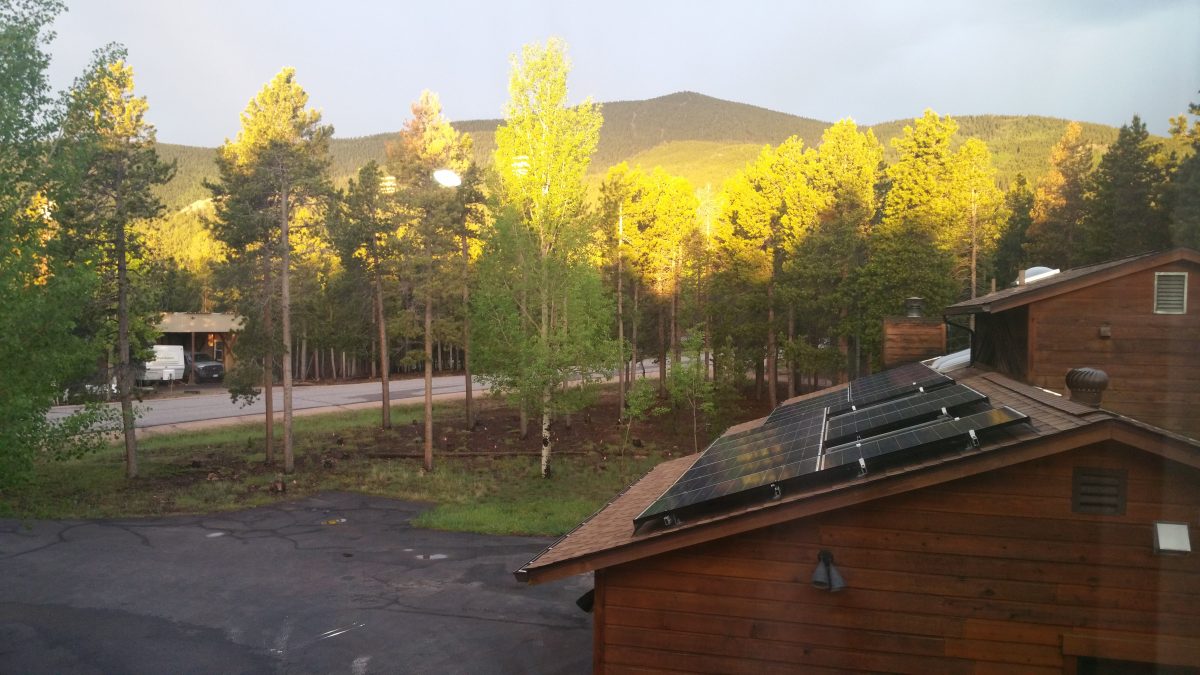
Our house in the early morning, light on Shadow Mountain
Tarnas uses Jung to make a bridge to astrology. First, he credits depth psychology, especially Freud and Jung, with moving Enlightenment rationality into the realm of a neo-primal worldview. The collective unconscious is a vast sea in which we all swim, our inner life effected by and effecting this outer context. That makes the modern self at least a semi-permeable membrane. Synchronicity, a Jungian notion, encourages us to look to how the outside may be speaking to our inside and vice versa.
I was with him on this line of thinking. It was synchronicity that brought the three mountain spirits, mule deer bucks, to our backyard here on Shadow Mountain the afternoon I closed on the purchase. We spent time together, present to each other, maybe thirty feet apart, seeing each other and being seen. It was clear to me that the mountains welcomed us, had given us their blessing for moving here.
Kate and I saw a stand of aspen that leafed out before all the others. Yes, I wondered about it from an arbor culture perspective, what made them favored over the many other groves? But, I also saw it as an affirmation of growth at different rates, even among members of the same species.
When Orion rises, as he does each year, and I see him for the first time, it is the same feeling as seeing an old friend again. The same feeling. Orion has been with me and I with him since the guard shack in Muncie, Indiana where he graced my night shift attention. Orion is not merely starry objects far away, arranged in a distinctive pattern, though he is that. He is a part of the universe with which I have a personal relation. Is that relationship reciprocated? I don’t know. But, it feels like it.
There is more. Long ago, after reading the Creation of Patriarchy by Gerda Lerner, I saw the perniciousness of transcendence, a move that diminishes the human by placing our ultimate validation outside the Self. Tarnas critiques this, too, as a transcendent god emptied out the cosmos, disenchanting the universe by creating a special creature, humans. Thus, the locii of significance, of vitality, of meaning was either in the godhead, up and away from creaturely existence, or in his creation, humankind. All else was an object created for the pleasure or sustenance of one or the other.
By choosing to locate my spirituality in the garden, its plants, in the animals who were our neighbors, in the community of other humans that I experience and deep within my own self, going in and down into the collective pool of archetypes and symbols Jung called the collective unconscious, I pushed at the boundaries of my Self as an isolate, beginning to break down the formidable, even hermetic, seal around it banged into place by Enlightenment reason.
The current signature line on my e-mails is from John Muir, “You are not in the mountains, the mountains are in you.” Yes. In this discussion that includes depth psychology it’s appropriate to notice the synchronicity of living on Shadow Mountain, that massif within the psyche that contains all that we fear, that we reject, that we push away. How bout that? And beyond my study window is Black Mountain.
When I got a cancer diagnosis back in 2015, I wrote about the Consolation of Deer Creek Canyon and during Kate’s recent crisis, about the Laramide Consolation. In both cases the mountains spoke to me. I imagined their rootedness, their difficult and wrenching time as they were pushed up, up, up by the tectonic motion of our planet’s crust, the deep geological time that they represent, lives millions of years long already, with millions more before they become low ranges like the much older Appalachians. Our mayfly life compared to these stolid eminences. The particulars of our mortality vanish in the mountains. We are water running down from the peak, coursing through Maxwell Creek, emptying into Bear Creek, then the Platte, onto the Mississippi and the Gulf of Mexico. We join the vast ocean of the dead.
As we try, some of us intuitively like me, some of us more systematically like Tarnas, to heal the rupture between the human and the living universe, we find a drag chute attached to our thought: 500 or so years of human autonomy, freedom, even liberation, 500 years of human probing, learning, knowing about the world seemingly disconnected from our Selves. The more classically educated you are, the more broad your learning, the more likely you are to feel something wrong with this line of thinking. It doesn’t add up. How can the universe have intention, consciousness? It’s the objective reality we probe with minds like Einstein, Bohr, Sagan, Darwin, Pasteur, Curie. We’ve found its regularities, its laws, its patterns, and we can use them to predict natural behavior and therefore exploit it.
How’s that going? Our hubris is killing us. We can find oil, so we do. We can refine oil for many different uses, so we do. We burn oil and let its byproducts drift off into our atmosphere. You know the end of this tale. An earth too hot for most human life. Would a sensibility that places us in the cosmos AND of it, do something so stupid? Or, perhaps better, once we discovered the implications of what we were doing, would we continue? No.
Tarnas, in the last pages of the second section of his book, suggests astrology as a means of expressing the intricate dance between our selves and the cosmos into which we were thrown at birth. Just how this works in his understanding I don’t know yet; but, I do know that his analysis of the crippling anomie occasioned by our Selves walled off from the rest of the place we inhabit has compelled me to give this idea a fair hearing.
Hard freeze. 23 this morning with some snow, mostly ice. A neighbor reported on Next Door Shadow Mountain that Shadow Mountain, 285 and even 470 were icy and in thick fog. Bad driving. But, poor conditions for a wildfire. That’s something.
Ode’s portrait. At Blue Sky Abbey, some years ago
Feeling a bit down this morning. Nothing 12 days of Kate’s hospitalization + general exhaustion doesn’t explain. We’ve both been thinking about death. She told me yesterday if things go south that her friend (and mine) Jamie Bernstein can take care of all her sewing stuff. I handled that poorly. “I don’t want to hear that. That’s not what you want is it?” “No,” she said. But she had breached that barrier and I pushed it away, out of my own fear, I suppose. Gonna rectify that today.
I’ve slept in our bed now for 12 nights without her there. She’s gone from the house and her absence is palpable, a thing in itself. She’s not on the bench in the morning. Not in her chair in the evening. Her sewing machine is back from the repair folks, but sits still in its rolling container. No hugs. No I love you’s before leaving and on return. Nothing can, in fact, be something.
Thoughts of a permanent absence, death, come easily in this situation. I don’t shove them away, I don’t embrace them. I acknowledge them as the mind running scenarios, what ifs, based on current reality. I also imagine her return, negotiating the steps, setting up the bedroom and the downstairs for her. All part of the I don’t like surprises part of the mind. A survival tool that can seem cold, unfeeling. It’s not. Just stuff that needs consideration, not rejecting.
Yamantanka
Yamantaka teaches us that considering our own death in an unblinking way can cure our fear of it. I both believe that and believe I have reached that point in my own soul. I suppose there’s an analog here about Kate’s death. Hers is as inevitable as mine. And, considering it doesn’t make it more or less likely. It simply means that I’ve accepted an assured reality though the timing is, as always, unknown.
OK. That’s out in the open. Not an obsession. What’s happening occasionally.
Another hard part right now is odd. On Friday we’ll be at two weeks since Kate went into the E.R. Am I supposed to collect myself, get back in the groove, accept this bifurcated existence, her in medical care, me at home? I definitely have to spend time tomorrow sorting through the bills and starting to pay them. Something she does.
I’ve been cooking, doing laundry, keeping the house picked up, feeding the dogs, playing with them, driving in to see Kate, trying to keep up with the medical information. But, I’ve set aside working out. Gonna pick that back up today or tomorrow. I’ve set aside teaching in the religious school, attending mussar or the adult ed committee. I canceled the first Jewish Studies Sunday Sampler.
Vanitas by Jan Sanders van Hemessen
I’m struggling with what’s a normal response in an abnormal situation. Is it ok to just focus on the domestic, on Kate and on home? Or, do I rob myself of the emotional support I’d get from being back in the mix at CBE? What about the things I’ve agreed to do?
Or, am I too soon in thinking about any of this? How will I know? A sort of strange twilight right now, matters shrunk down to the nub, life at its most basic with questions of health, the future, even death in every moment.
Let me finish with this. I am not depressed. Even my slight down feeling I mentioned earlier has lifted somewhat as I’ve written myself into my current reality, leaving it all out there, not hiding. This is my life and unless my health changes it will be my life until clarity declares itself either toward Kate’s recovery or a continued decline, perhaps even death.
End note. I realized as I wrote that last paragraph that a key sticking point right now is uncertainty. Will Kate’s various medical issues resolve? That is, will she get well enough to leave for rehab? If so, when? If she’s in rehab, how long? How much care will she need when she comes home? I’m not wracked by any of these questions, but they illustrate the fundamental issues in play right now, with no clarity about any of them available. That’s what makes knowing how I might react so difficult right now.


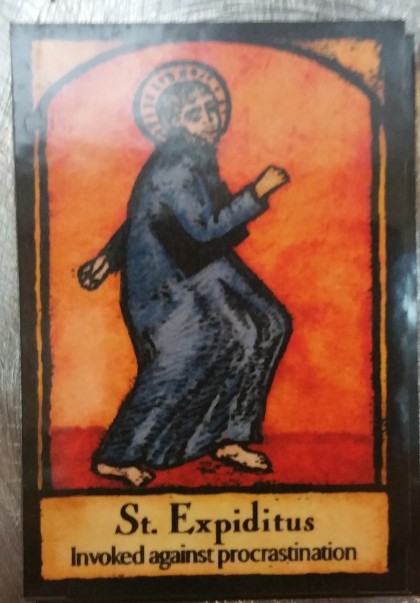 Lots of Catholic kitsch in the Mother Cabrini giftshop. I mean, lots. In fact, that’s almost all they have. St. Expeditius here is my favorite, especially his arms.This is a refrigerator magnet and there are others. Including St. Gregory the Wonder Worker invoked in desperate situations.
 I’m responsible for the next lesson, tomorrow, as I was last week, but with Alan as back up this time. Last week we worked with the middah, character trait in the Jewish ethical discipline of
 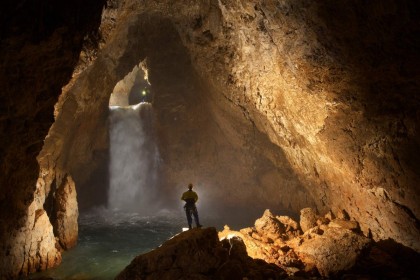 I have had many encounters of this kind and they vary in which characteristic of the Holy they emphasize. I’ve written before about my mystical experience on the quad at Ball State. Fascinans dominated. I wanted to be there, in a state of total linkage with all. I wanted to stay. In high school I attended a summer church camp at Epworth Forest in Indiana. We learned a lot about communion and in particular I took to the heart the idea that if we didn’t reconcile with others, we might “eat and drink our own damnation.” OK. I was an impressionable guy in that moment. But the fear occasioned by that idea made me find a young woman whom I’d teased and ask for her forgiveness. Stepping into the Sistine Chapel. Awe. Driving to Bailey and seeing the Continental Divide capped with snow. Awe. Contemplating my own death. Fear moving toward awe.
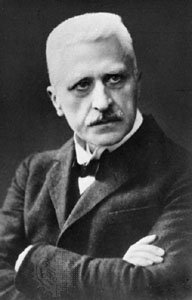
 Richard Feynman, the physicist, had
  OK. Let’s start with food. Where does food come from? The grocery store. Well, that’s where we buy it. But where does the grocery store get the food? From trucks? OK. How about the trucks. Where do they get the food?
 Did you notice that a lot of the food the animals eat comes from plants? Acorns, grass, roots, tiny plants that live in water? What about the rest? Insects, other fish? What do insects eat? Some do eat other insects, that’s right. Praying mantises, for example. But most insects eat plants. Grasshoppers do. Leafchewers. Some eat plant roots. Some eat the nectar, like bees.
 How do they do it? Even scientists have a hard time explaining it, but somehow the leaves take sunlight, water, and other things from the soil and make what the plant needs to live. Amazing, right? Sunlight, water, and nourishment from the soil. Nourishment? What does it mean? It just means anything that helps you live, or helps plants live. And you know what’s also amazing? Guess what the plants send out into the air when they’re done making food? Oxygen! That’s right, plants feed animals and they give off the thing we need to breathe to stay alive. Wow. Go, plants!
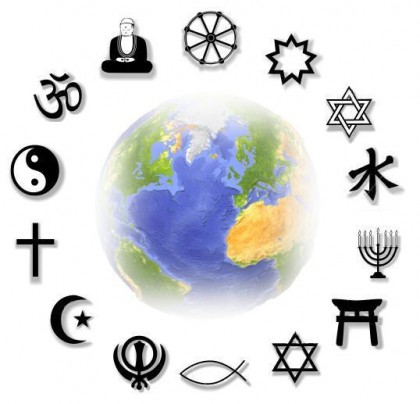 I used to be a Christian, a while back. But, not anymore. What is a religion, do you think? There’s so many different ones that it’s hard to say. To me religions are about what is most important to you. What matters. It might be your relationships with your mom and dad, or Ruth, or your friends. How are you supposed to treat those close to you? It might be about animals and how you’re supposed to treat them. Do you remember when Herschel died? Your great-grandma? Your great-grandpa? Did you ever wonder what happened to Herschel and your great-grandparents after they die? Me, too. I’m not sure, but it is a question most religions try to answer.
 Think of it, Gabe. The sun, that distant star that gives us daytime, the one we see everyday, provides us with the heat and energy to live. Mother earth, the ground we walk on everyday, that holds us up, that we see in parks and farm fields and mountains, provides a home for us and nourishment for the plants. The plants provide food for animals. And animals and plants make food for us. They also make our oxygen. You just breathed some in right now.
 I think of the holy as something both amazing and mysterious. Imagine all the time you spent inside your mom’s womb, growing from two cells into the boy you are now. Amazing and mysterious. Think about a plant’s leaf taking energy from sunlight, mixing it somehow with water and nourishment from the soil to create food, give off oxygen. Amazing and mysterious. Or, how about the change from winter to spring when the cold goes away. Flowers come up. Trees put out their leaves. Grass turns green. Up here in the mountains you see fawns and elk calves. Amazing and mysterious. All holy.
 What I’m seeking in Wonderland is a synthesis Tarnas contends is necessary for us now, a different sort of Great Work than Thomas Berry’s, yet related to it, I think. Berry, if you recall, said that the Great Work of our time is the creation of a sustainable human presence on earth. Not goin’ so well. Tarnas wants to take the ancient, ensouled universe that prevailed until the Enlightenment, mash it into the disenchanted universe occasioned by rationalism and the hegemony of science, and come up with a Hegelian synthesis that can move us out of the stuck place created by their tension.
 Aging brings with it an inevitable glance over the shoulder. Did I matter? If so, how? If not, why? Does it matter if I mattered? I suppose it would be possible to disappear into regrets or vanity or even anguish. But, why?

 Tomorrow is the winter solstice. I haven’t gotten yet to the six new rituals I found in Lapham’s, but I will either later today or tomorrow. The dark, the long night, to me symbolizes healing, fecundity, a depth experience for the Self, a soulful journey. It’s what I need right now, a time out of time, time with the ancientrail that winds in and down, following the shamans toward the center of the earth, the center of the soul.
 When Orion rises, as he does each year, and I see him for the first time, it is the same feeling as seeing an old friend again. The same feeling. Orion has been with me and I with him since the guard shack in Muncie, Indiana where he graced my night shift attention. Orion is not merely starry objects far away, arranged in a distinctive pattern, though he is that. He is a part of the universe with which I have a personal relation. Is that relationship reciprocated? I don’t know. But, it feels like it.
 The current signature line on my e-mails is from John Muir, “You are not in the mountains, the mountains are in you.” Yes. In this discussion that includes depth psychology it’s appropriate to notice the synchronicity of living on Shadow Mountain, that massif within the psyche that contains all that we fear, that we reject, that we push away. How bout that? And beyond my study window is Black Mountain.
 As we try, some of us intuitively like me, some of us more systematically like Tarnas, to heal the rupture between the human and the living universe, we find a drag chute attached to our thought: 500 or so years of human autonomy, freedom, even liberation, 500 years of human probing, learning, knowing about the world seemingly disconnected from our Selves. The more classically educated you are, the more broad your learning, the more likely you are to feel something wrong with this line of thinking. It doesn’t add up. How can the universe have intention, consciousness? It’s the objective reality we probe with minds like Einstein, Bohr, Sagan, Darwin, Pasteur, Curie. We’ve found its regularities, its laws, its patterns, and we can use them to predict natural behavior and therefore exploit it.


 End note. I realized as I wrote that last paragraph that a key sticking point right now is uncertainty. Will Kate’s various medical issues resolve? That is, will she get well enough to leave for rehab? If so, when? If she’s in rehab, how long? How much care will she need when she comes home? I’m not wracked by any of these questions, but they illustrate the fundamental issues in play right now, with no clarity about any of them available. That’s what makes knowing how I might react so difficult right now.