Summer Monsoon Moon
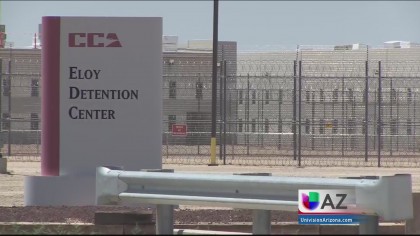 Sad. Mad. Incredulous. Shocked. Mystified. Hurt. The Florence Project. Kate and I went to Beth Evergreen last night to hear Valentina Montoya*. She’s a mental health attorney for the project, which means that her clients are not only caught in the detention trap, but have serious mental illness as well.
Reading about family separation, shaking our heads, how can they? That’s one experience. Hearing Ms. Montoya talk about children in detention, five month olds, toddlers, blind children, physically and mentally disabled children, children who have no apparent medical care or educational opportunities, children who know their parents as mama and daddy, but don’t know their given names, children separated from their parents with no tracking or identifying system in place, one four-year old boy, for example, who refused to change his clothes because he was afraid his parents wouldn’t recognize him, that’s another.
 Ms. Montoya became too emotional to talk. Several times. She answered question after question from this audience of maybe 75 people, all outraged, most wanting to do something. Kate stood up and asked what kind of medical care did these children receive? Ms. Montoya said no particular medical care was available. That means diabetes goes untreated. Other chronic conditions, too. Another asked what kind of education the kids were getting? Ms. Montoya said, “The kids speak Spanish; all the guards and caretakers speak English.”
This was an especially poignant topic for Beth Evergreen. As Renee said, “I’m a child of holocaust survivors. I’m uniquely qualified to call these what they are, concentration camps.” I hadn’t thought of it that way, but it’s true. No Zyklon B. For now. But, as Renee said, “If they can come for them, they can come for me. Maybe next, maybe three, four down the line.”

Here’s a thing I’d not paid attention to in the news reports. The families separated in Florence, Arizona, a distant, isolated location for an ICE detention facility (not an accident) are asylum seekers. That means they came to a U.S. port of entry and, as required by our law, asked for asylum. These are legal immigrants who have fled horrific conditions of gang violence, local drug cartels, domestic abuse, government oppression and seek refuge here. Let me say that again, these folks are LEGAL immigrants.
The bad elf, Jeff Sessions, has done everything he can to undercut the law by, for example, offering a biblical rationale for family separation, trying to defund basic legal orientation services. DHS lawyers raise jurisdictional issues in immigration proceedings to obfuscate and extend detention proceedings.
 Part of the problem for legal projects like Florence and Rocky Mountain Immigration Advocates is immigration law itself. It’s a hodgepodge of laws, rules, exceptions that have accreted like barnacles over the years, making it an area of the law for which even its specialists can claim only partial knowledge. That means even willing pro bono lawyers are often not competent to help. This makes it even easier for mendacious buffoons like Trump, Sessions and DHS Secretary Kirstjen Michele Nielsen to throw forks and knives into the wheels of justice.
It was, all in all, a heart rending evening. Unimaginable suffering. Detention is different from prison. In prison you know when you’re going to get out. Detention is indeterminant. Until Sessions quashed it, each detainee used to get a bond hearing every six months. That hearing at least offered a review of your circumstances and a possibility of release. With that bond hearing eliminated, there is no legal requirement for a time certain when your case will be heard. If at all. This out Kafka’s Kafka. And, it is definitely, a first step toward Nazi area solutions for folks we don’t like.
 *Valentina Restrepo Montoya was born in Boston to Colombian-immigrant parents. She earned her J.D. from Berkeley Law, where she advocated on behalf of asylum seekers, latinx workers, latinx tenants, and indigent defendants in criminal cases. Valentina clerked for The Southern Center for Human Rights, where she investigated language access to adult and juvenile courts. After law school, she joined The Southern Poverty Law Center, dedicating herself to litigation against The Alabama Department of Corrections for providing constitutionally inadequate medical and mental health care to prisoners, and not complying with The Americans with Disabilities Act. Prior to joining The Florence Project, Valentina was an assistant public defender in Birmingham, Alabama. She enjoys playing soccer, reading The New Yorker, practicing intersectional feminism, and rooting for The New England Patriots.
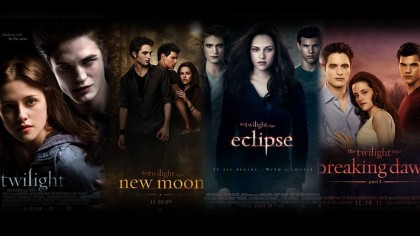 Modern technology is so wonderful. Over the last few days I watched all five of the much maligned Twilight movies. You might ask why, at 71, I would subject myself to all those teen hormones, questionable dialogue, and odd acting. First answer, I’m easily entertained. Second answer, I’m revising Superior Wolf right now. Werewolves from their source. Also, a project I work on from time to time is Rocky Mountain Vampire. So, the Twilight saga is in the same genre as my own work, though aimed more at a young adult, tween to teen audience. Which is, I might add, a very lucrative market. Maybe, it just occurred to me, some of them will be interested in my work as a result of their exposure to the Twilight books and movies.
 The supernatural is a dominant theme in my life, from religion to magic to ancient myths and legends to fairy tales and folklore. My world has enchantment around every bend, every mountain stream, every cloud covered mountain peak. No, I don’t know if there are faeries and elves and Shivas and Lokis and witches who eat children. I don’t know if anyone ever set out on a quest for the golden fleece or angels got thrown out of heaven. Don’t need to. We wonder about what happens after death, a common horror experience often and always. If we’re thoughtful, we wonder about what happened before life. Where were we before?
 Our senses limit us to a particular spectrum of light, a particular range of sounds, a particular grouping of smells and tastes, yet we know about the infrared, low and high frequency sounds, the more nuanced world of smells available to dogs. We’re locked inside our bodies, yet we know that there are multiverses in every person we meet, just like in us. We know we were thrown into a particular moment, yet know very little of the moments the other billions of us got thrown into. My point is that our understanding of the natural is very, very limited, in spite of all the sophisticated scientific and humanistic and technological tools we can bring to bear. Most of what exists is outside our usual understanding of natural, certainly outside our sensory experience.
 At the Mussar Vaad Practice group we all come up with a practice for the coming month, a practice based on that month’s middah or character trait. Each month the congregation has a middah of the month. Emunah, or faith was the middah last month. My practice focused on sharpening doubt, a practice that made me feel more alive, more grounded in faith as a necessary human act.
 That same fear is the one I faced after the Durango trip, writing
  I’m embarrassed to write this, ashamed I’ve been so fearful, yet I have been both embarrassed and ashamed for most of the most of the time I’ve been writing. Now is not different. The only way I can make it different is by finding publishers and agents and getting my work to them.
 Oh. Sometimes the sweetness of life becomes palpable. More and more of late. Not drowned out by the drumbeat of illness, family struggle, heat it underscores that life, our lives, are moveable feasts. The meaning of life itself lies in this realization, not in achievement or wealth or knowledge or belongings. Why? Because no thing in life carries permanence, not joy, not hate, not anger, not even love. All is transitory, the matter of a moment, then it will change.

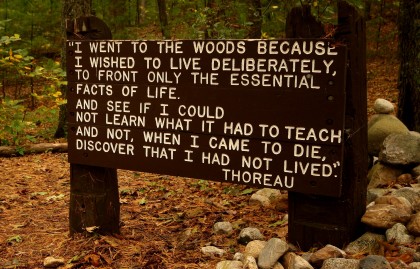 But, and I might call this the Emersonian turn, we cannot use the offerings of the past without remembering his introduction to Nature: “The foregoing generations beheld God and nature face to face; we, through their eyes. Why should not we also enjoy an original relation to the universe? Why should not we have a poetry and philosophy of insight and not of tradition, and a religion by revelation to us, and not the history of theirs?”
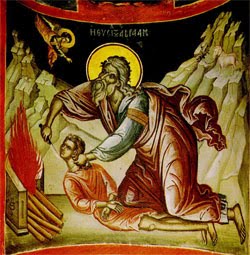 Been thinking about revelation. In a way I’m not sure is new, but I don’t recall seeing it anywhere. So, we have all these sacred scriptures. What makes them sacred? The claim is their autographic nature, written in some mysterious way by the hand of a god or gods. I’m going to bracket the claim of divine authorship and ask not about the content of the tales, at least not the content usually involved in exegesis and hermeneutics, but about the way revelation shows up in them.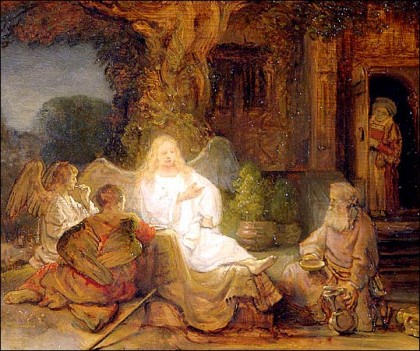

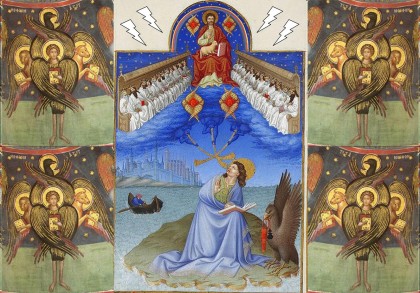 My first suspicion is that it is much like the nativity story, and perhaps the crucifixion and resurrection narratives, too, ex post facto events created to explain the origins and influence of remarkable individuals. Who would receive communications from beyond this reality? Individuals who’ve already been established as significant, powerful, influential. Like that guy Abraham, warlord, father of many children, father of our nation. How did he get where he is? He heard the still small voice. He understood things others of us missed. He was in touch with, what? Something many of us ignored, perhaps.
 Started a long project yesterday. I’m printing out all of Ancientrails. Been wanting to do a total backup and I will at some point, but if it’s going to be useful to my ongoing work, hard copy is better. Besides, think how satisfying it will be to hold a copy of all this. Then, I got to thinking. Oh, but a fire! I’m going to make a copy of the copy when it’s done, then make copies of all my hard copies of my novels. I’m going to ask Jon if I can store those copies in his garage in Aurora. Yes, all the novels are on flashdrives (and in a safety deposit box, all except my work on Jennie’s Dead and Rocky Mountain Vampire) and all of Ancientrails is in the cloud, but the hard copies are important, too. The things that come up before we fall asleep.
 If I’m understanding his primary argument, time at the Newtonian level is a result of blurring. This may seem like an odd idea, and it is, but it’s not so hard to grasp if you think about the blurring that is necessary for us to perceive the world around us. Example. If you shrank to the atomic level and tried to walk across a table top, you’d fall in. It’s blurring of the quantum world that makes the table seem solid to us. Time is a result, again if I’m getting this, of the blurring of the transitions from event to event which, at the quantum level have no prescribed order.
 Rabbi
Rabbi  As soul we become aware of our direct links to other people, to the world we live in and we understand them as part of us and ourselves as part of them. Shapiro says that such dictums as love thy neighbor as thyself become axiomatic at the soul level. When we know the true face of the other, which we can do at soul level, then we have to treat them with loving kindness. This includes the earth.
 He refers to himself as a perennialist. Here’s what that means:

 Reenchantment has a precursor experience, a moment when we embrace the awe and the mystery, a feeling that we each experience, perhaps even experience often (childbirth, death, sunrise, the greening and flowering of spring, a snowstorm, bitter cold, blazing heat, the vastness of the ocean, love), but a feeling we have allowed others to reframe for us. The laws and beauty of scientific understanding do not explain away, as many assume. They are descriptive, a language of their own about the world in which we live. But they have not stripped out awe and mystery though men like Richard Dawkins, Sam Harris, and Christopher Hitchens insist on it. Empiricists, fed by scientism, want to suggest only through data and analysis can we know the truth.
 Or, the experience of the Celts and the Roman Catholic church is instructive here, one faith’s certainty can leave no room for the numinous anywhere but in their dogma, their rituals. Catholics built churches over Celtic holy wells. They deployed words like heretics and blasphemers and pagans to undercut the authority of the old faith. They appropriated Celtic holidays by turning Lugnasa into Lammas, Samain into All Saints. Mordecai Kaplan, the founder of Reconstructionist Judaism says it well, “It is not the seeking of God that is the problem, it is the certainty of those who believe they have found God that is the problem.”
 Besides the quirky reputation of Atlas Obscura, which draw me in, I also went because Joy said she would discuss qabbalah and the tarot. Only a couple of mentions but they were there. Here’s a for instance in this blurry photograph of one of her slides. In another spot she mentions the correspondence between qabbalah (translation note: Rabbi Jamie says the q is the correct translation) and the qabbalistic Tree of Life with its ten sephirots. Not a detailed examination of the relationship, but enough to make me want to explore it further.
 Tarot by itself has fascinated me for a long time and I have three decks of my own. I like the iconography and the mythical, archetypal leanings of current Tarot readers. That doesn’t mean I put much stock in the readings themselves, though I do believe any sincere examination of self, whether occasioned by a hallucinogen, meditation, an analyst or a Tarot reader can be of benefit.