Our next Sierra Club meeting will be on June 19th, one day before the summer solstice. Sierra Club work is paganism stripped bare of its mythic content. There is passion for sure, but not the poetry, no ritual, no inner work. It’s all outer work: hike, lobby, analyze, network, persuade. We may, for example, show the next Al Gore movie, Inconvenient Sequel: Truth to Power. See trailer below.*
The work is good, necessary. It is even, as Thomas Berry said, the great work of our generation, but it often feels mechanical to me. Pull this lever. Have this meeting. Create this sign. Monitor Polymet. Call the governor. Write your Senator. Hike this trail. In its mechanistic form this does not feel like my love for our home, this earth, this planet, third rock from the sun.
Somehow I need to find a way for my inner work to imbue my outer work. Todd, a long-time member of the Mt. Evan’s local group to which I belong, talked about a hike he took yesterday in Reynold’s Park. He named a particular orchid that he found and his face lit up. “A bullsnake, too.” It may be that these folks, tied to the very local region encompassed by our borders, find their inner work in being on the trail, hiking Mt. Bierstadt, taking the Mt. Evan’s road, helping clear trail.
The hike I took at Flying J Ranch (see posts below) was shinrin-yoku, forest bathing. Perhaps that’s a way to combine the inner work with the outer work. Or, perhaps I could follow the mussar notion of outer work affecting the inner work. Not sure. But, there is a need for me to more closely match my spiritual journey with this work. Maybe the mountain art notion will fit here, too. More to come.
Irv Saltzman invited us to a performance by his singing group, the Renaissance Singers. It was held in a wooden Episcopal Church, St. Laurence’s, which is near our home. Directed by a Chinese national, Hannah Woo, who is finishing her Ph.D. in musicology, they were 8, four men and four women. As a group, they matched each other well. April, a soprano, had a lovely clear voice and a large range. Irv, formerly a tenor, has now transitioned into a bass/baritone role. Their performance was wonderful. At a meal afterwards we discovered April is our neighbor.
Renaissance choral music and instrumental renaissance music has always captivated me. It’s easy to see courtiers in colorful costumes listening to this music in a palace, brown robed and cowled monks hearing it in a morning prayer service, or small groups performing at home for their own amusement. It’s also the music most often heard at Renaissance festivals. Sorta makes sense, eh?
The sanctuary had a vaulted ceiling with exposed beams and two large, clear windows that looked out to the east, toward Shadow, Evergreen and Bear mountains. It rained while we were there and the mountains were in mist, the windows covered with raindrops slowly moving from top to bottom. There were individual chairs, padded with kneelers, arranged in a three sided configuration, making the sanctuary a sort of thrust proscenium stage, an ideal arrangement for a small group of singers.
A church artist had painted the stations of the cross and they were around the sanctuary, set off by bent sheet metal frames. A copper baptistry, large, sat over a cinerarium where the congregation deposits cremation remains and memorializes the dead with small plaques.
Between the two windows hung a large crucifix, a cross made of bare, light wood and a bronze Jesus hung by two nails. I had an odd sensation while listening to this music I’ve often heard in monastic settings on retreat. It carried me back into the spiritual space of an ascetic Christianity that often comforted me. This time though I came into the space as a peri-Jew, identifying more with Marilyn and Irv and Kate, with the still new to me spiritual space of Beth Evergreen, than the theological world represented by this spare, but beautiful sanctuary.
The crucifix stimulated the strongest, strangest and most unexpected feeling. I saw, instead of the Jesus of Christianity, a hung Jew, a member of the tribe. More than that, I felt the vast apparatus and historical punch created by his followers, followers of a man who shared much of the new faith world in which I now find myself. It was an odd feeling, as if this whole religion was an offshoot, a historical by-blow that somehow got way out of hand.
These feelings signaled to me how far I’d moved into the cultural world of reconstructionist Judaism. I see now with eyes and a heart shaped by the Torah and mussar and interaction with a rabbi and the congregants of Beth Evergreen.
This was an afternoon filled with the metaphysical whiplash I’ve experienced often over the last year, a clashing of deep thought currents, spiritual longings. This process is a challenge to my more recent flat-earth humanism, a pagan faith grounded not in the next world, but in this one. Literally grounded.
What’s pushing me now is not a desire to change religious traditions, but to again look toward the unseen, the powerful forces just outside of the electromagnetic spectrum and incorporate them again into my ancientrail of faith. This makes me feel odd, as if I’m abandoning convictions hard won, but I don’t think that’s actually what’s going on. There is now an opening to press further into my paganism, to probe further into the mystery of life, of our place in the unfoldingness of the universe, to feel and know what lies beyond reason and the senses.
Two things. Turning left yesterday after visiting the Colorado Potters Guild spring show, I looked up and noticed I had executed a left turn in front of an oncoming SUV. We missed each other, though it could have been otherwise. Later, turning a corner onto 8th Avenue heading out of Denver, I banged the right rear of the Rav4 against a curb. It’s important to be honest about such a critical skill as driving and right now, I’m lacking something. Maybe it’s attention, maybe it’s an inability to drive and chew gum at the same time. I don’t know. But I need to do something about it.
Goya ‘I am Still Learning’
Second thing. When I was a little boy, my dad had two nicknames for me: tech and crit. Neither were positive. The first, tech, was short for technical. He said I was very precise, very techincal in an argument. I would pick at things that others wouldn’t notice or didn’t care about. True. Still do it. It is, for better and worse, the way my mind works.
The second, crit, summarized my tendency, linked to tech, to be more critical than most. True. If I see something, I say something. An irritating habit, I know, for those around me, but, again, it’s the way my mind sees the world. Over time I’ve become aware of the way these tendencies affect others, but being able to modulate them is very difficult for me.
Why? Well, later in life I found the Meyers-Briggs personality inventory and discovered my INTP personality type. It fits. Here is a recognized weakness of this personality type:
Insensitive – Oftentimes INTP personalities get so caught up in their logic that they forget any kind of emotional consideration – they dismiss subjectivity as irrational and tradition as an attempt to bar much-needed progress. Purely emotional situations are often utterly puzzling to INTPs, and their lack of timely sympathy can easily offend.
Oh? Well. Tech and crit-me-manifested very, very early. Dad focused on an interactive aspect of my personality that is designed to irritate others. It’s not the only aspect, hardly, but having it emphasized was difficult for me. Actually, it still is.
But here’s another way to look at it, this time as a strength:
Honest and Straightforward – To know one thing and say another would be terribly disingenuous – INTPs don’t often go around intentionally hurting feelings, but they believe that the truth is the most important factor, and they expect that to be appreciated and reciprocated.
This is a strength that has an obvious downside, or weakness. I want to modulate the hurtful aspect of this character trait through the middah of chesed, or loving kindness. This does not mean I will change the way my mind works. Don’t think I can after a good deal of experience. It does mean that I can introduce a pause between my observation, which will still exist, and its articulation. In that way I can assess whether the truth in a particular situation is helpful or hurtful.
My focus phrase for this will be: see the good, too. Always.
“Everyone sees the unseen in proportion to the clarity of his heart, and that depends on how much he has polished it. Whoever has polished more, sees more, unseen forms become manifest to him.” -Jalal ad-Din Rumi
Bonnie, a rabbi in training and a former high level bureaucrat for the U.S. National Forest Service based in D.C., led our mussar class yesterday. Mussar is an odd (to me) blend of ethics and spirituality, a way of living the 613 mitzvot, or laws, found in the Torah. Since the laws themselves have the unified purpose of leading the faithful on a sacred journey that carries them closer and closer to God, mussar (ethics in Hebrew) is technically an ethical system with a spiritual aim, one embedded in the unique cultural experience of Jewish history.
Mussar intends to guide this sacred journey through measurable development of character traits, or middah. The measurability comes in as mussar students, like Kate and me, learn a particular middah, then decide on incremental steps we can take to increase its presence in our lives. We record our progress in a journal and reinforce it through the use of focus phrases. Well, that’s the theory anyhow. It’s taken me nearly a year to get my intellectual footing, so I’ve focused on learning about learning mussar rather than using those tools. I do see their value.
An intriguing pagan element runs throughout the Judaism I’ve been exposed to at Beth Evergreen. The Jewish liturgical year is on a lunar calendar. Shabbat begins at sundown on Friday and Friday shabbat services are held at night. Sukkot is a harvest festival, held outdoors in a sukkot booth. Tu BiShvat is new year for the trees. Judaism is also very body positive, actively opposing ascetic practices that exist in some forms of Christian monasticism, and encouraging the enjoyment of sex.
Bonnie highlighted that element yesterday in her mussar lesson on the middah of clarity, clarity of self and soul. Tahara is the Hebrew word for clarity. Her examples for achieving and practicing clarity focused on the medieval four elements: earth, air, wind and fire.
Water – Bonnie offered a quote from the novelist Julian Barnes: “Mystification is easy; clarity is the hardest thing of all.”
She then described still water, with the sediment settled out, as an instance of crystal clarity. Bonnie suggested three examples of how water facilitates clarity in Jewish ritual life: the mikveh, tevilah and netilat yadayim. The mikveh and the tevilah are ritual immersion in water, the first in a bath, the second in running water. Netilat yadayim is handwashing after contact with a corpse, burial or visiting a cemetery. The water carries away any tumah, spiritual impurity.
Finally, she gave ways of embodying this mussar practice:
Swim, float, dangle your bare feet in water. Take a dip in a bubble bath or a hot spring. Stay out in the rain, don’t run for cover, splash. Get out/in/near open water.
tevilah, immersion in running water
Interestingly, in Judaism the soul is pure. As the Psalmist says: The soul that you, my God, has given me, is pure. You created it, you formed it, you breathed it into me. No original sin here. The water rituals wash away shmutz, a film or a build up, spiritual impurity, that clouds the pure soul. Result: clarity.
Thinking of clarity, a clearly seen pure soul, in this way helps any encounter with water, air, earth or fire act as a spiritual practice, reminding us of the need for clarity while helping us scrape off the shmutz.
This marriage of the elemental and the spiritual resonates for me. I once referred to gardening as a tactile spirituality. These ideas expand that notion in a helpful way. The reimagining faith project intersects with this approach to mussar.
Fog this morning over Black Mountain. It comes in and out of view as the mist moves toward us. Now it’s gone altogether. There’s a thin scrim of icy snow on the solar panels. Colder last night.
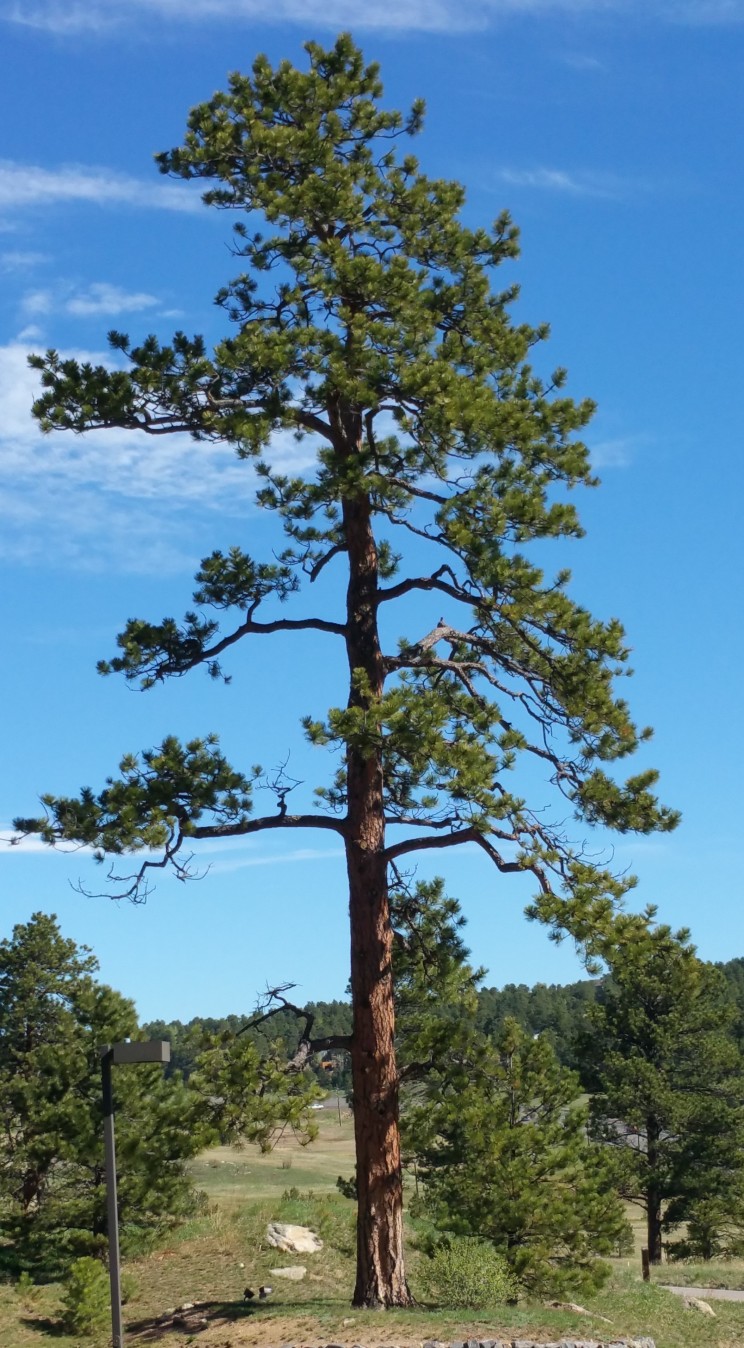
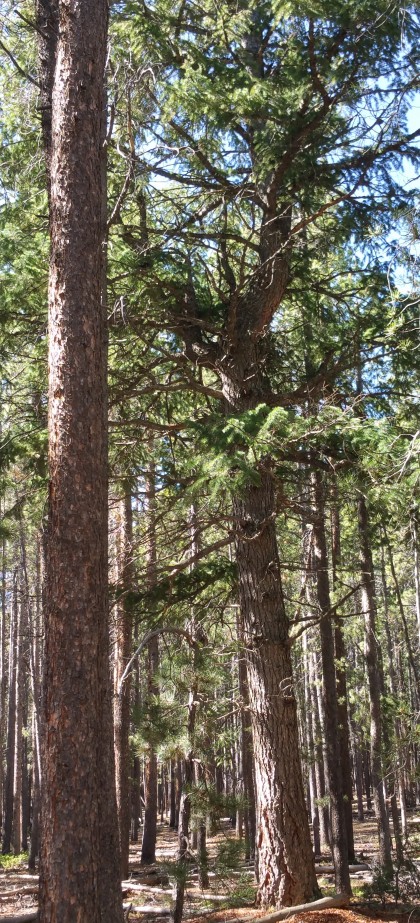
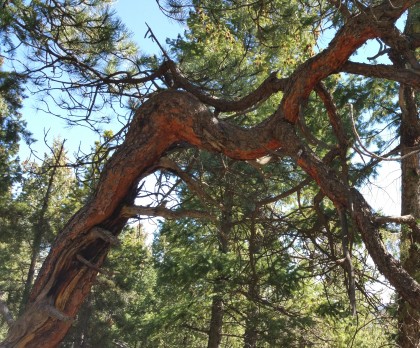
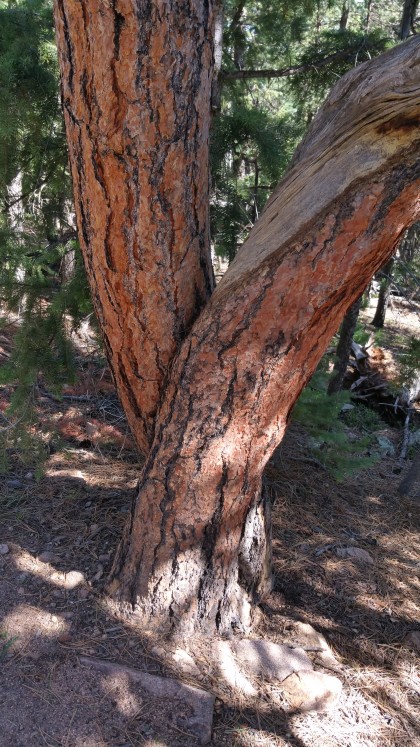
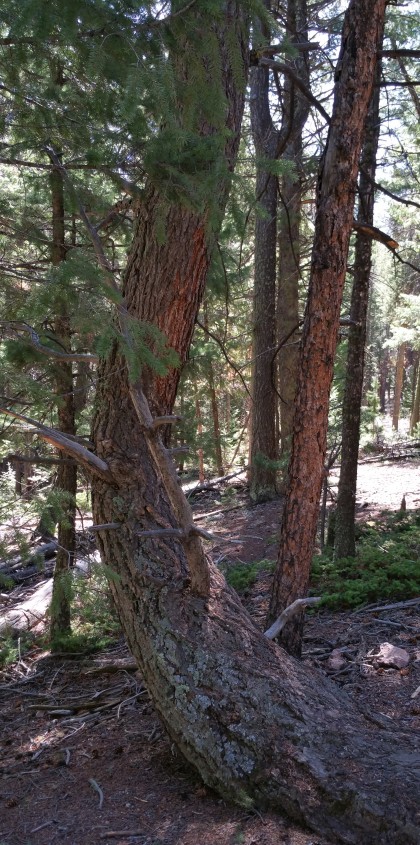
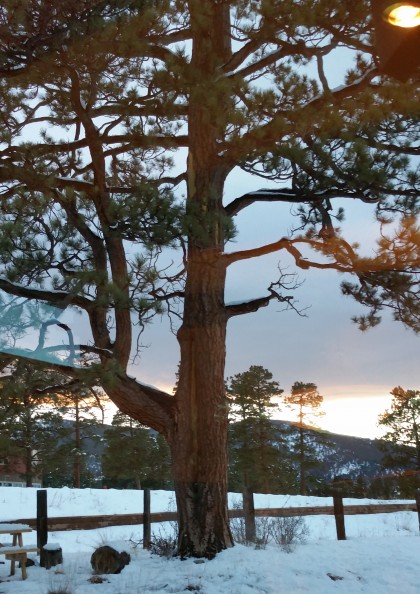
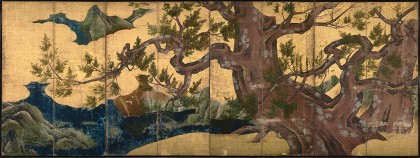
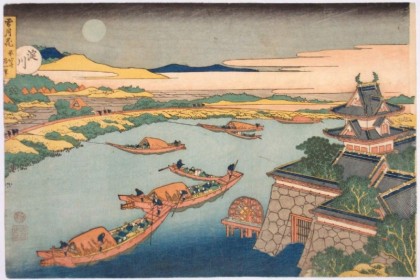
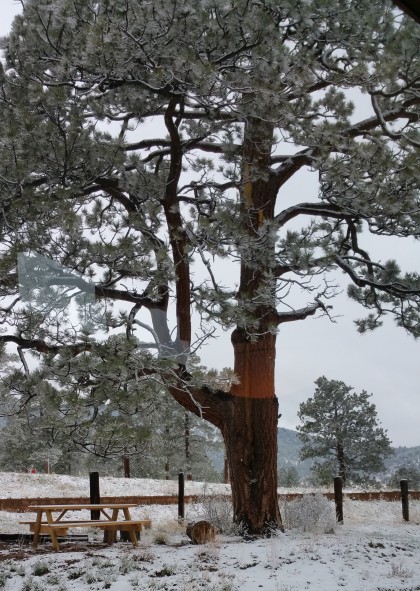
My Japanese informed aesthetic often finds resonance here in the mountains. The ponderosa pines that surround Beth Evergreen’s synagogue present heavily crenulated bark, twisted branches and a sturdy calm. From the sanctuary, looking south and east, one window pane has an especially crooked branch that reaches up like a hand. When the snow comes, it looks like a portion of a Kano school gold screen. Ravens and crows land on these branches, too, also emulating the scenery that inspired so many Japanese painters and printers.
Moon watching, a Japanese pastime, has its analogue here as well. The moon rising and setting among the mountain peaks, clouds placing a thin gauze in front of it, the stars as its context, emphasize the moon’s romance. I can stand on my deck here off the loft and watch clouds cross the moon’s face. Its silvered light makes beautiful shadows of the lodgepole pine.
Hokusai (1760-1849), Boats and Moon, an ukiyo-e print
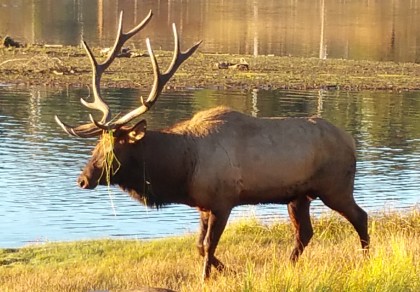
Big eared mule deer and thick, tall elk come down to Maxwell and Cub creeks, lapping up the cold fresh melted snow. Mountain lions slip noiselessly through the undergrowth, lie prone on rock cliffs waiting for them to pass nearby. Bears root up tubers. Minx, bobcats, pine martens, smaller predators, hunt for prey. Rabbits and squirrels and mice feed, look over their shoulder. The web of life is vibrant.
Bull Elk, Evergreen, 2015
Ichi-go ichi-eis a Japanese phrase often associated with the tea ceremony. The tea master arranges art in the tokinama, chooses teas and sweets, decides which tea bowls and tea pots and tea utensils to use, then greets their guests as they arrive, often no more than one or two. He does this to create an ichi-go ichi-e, a once in a lifetime moment or for this moment only. It connotes the treasure of each meeting between or among people.
Each moment of the day Black Mountain offers ichi-go ichi-e to those of us who live near it, if only we stop and look. To appreciate ichi-go ichi-e though we need to pause, or as mussar teaches us, put a space between the match and the flame. If we slow down our glance, our gaze, let it come to rest, if we take a breath and consider what is right there in front of us, then we find once in a lifetime moments happening throughout our day.
Ponderosa Pine, Beth Evergreen, April, 2017
These do not, as you might think, cheapen or dilute over time, rather they enhance our experience of the world. We recognize the fleeting nature of life, of this moment and that moment, of the unique and precious and irreplaceable flavor to each encounter. Nothing is old, all is new, always.
In fact, to the extent that we can gain an appreciation of ichi-go ichi-e, then we never age.
April was fraught. Physicals and other medical matters created, if not anxiety, then very close attention. Kate’s shortness of breath and fatigue triggered imaging, a chest x-ray and an echocardiogram. There’s a physician’s nostrum that goes: if you look, you’ll find something. And so it was. Some scarring on her lungs, a short list of heart issues that “do not require surgery at this time.” For us anyhow, knowing is better than not knowing and the increased clarity eased concerns about her overall health. At least right now.
Ruth and Gabe turned 11 and 9. With the divorce birthdays have become contentious. Jen planned a birthday party for Ruth that didn’t include Jon. Ouch. Still in its first months after final orders the divorce means Jon and Jen have to establish new norms about how to deal with such things. Not easy when the breakup itself created more conflict.
Jon also needs to buy a home, get back into the city so his commute won’t be so long. Once he has a new place the custody arrangement will become more equal and parenting should be easier for him. The spring housing market is the right time, lots of houses on the market, though the still heated Denver housing market, one of the hottest in the country, affects affordability.
He’s been here almost a year and our garage plus outside it has overflow from his storage unit, enough to make our capacious garage (space for four cars) feel cramped. We’re ready to get back to our quieter, septuagenarian lifestyle, too.
April included several events at Beth Evergreen. A passover cooking class, a community seder, and the three day presence of Rabbi David Jaffe. Kate and I took the cooking class and helped set it up. We also did several different things for the Rabbi Jaffe events.
We spent a night and a day at a hotel in Lone Tree learning about hemophilia.
April, Eliot said, is the cruelest month. Maybe not exactly cruel this year, but stressful? Yep.
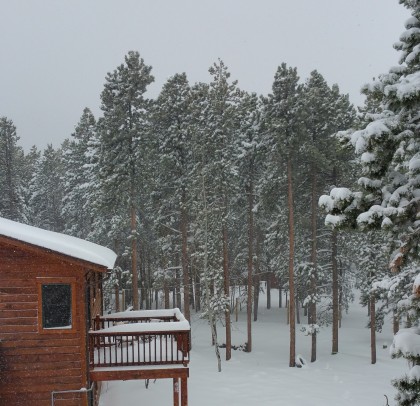
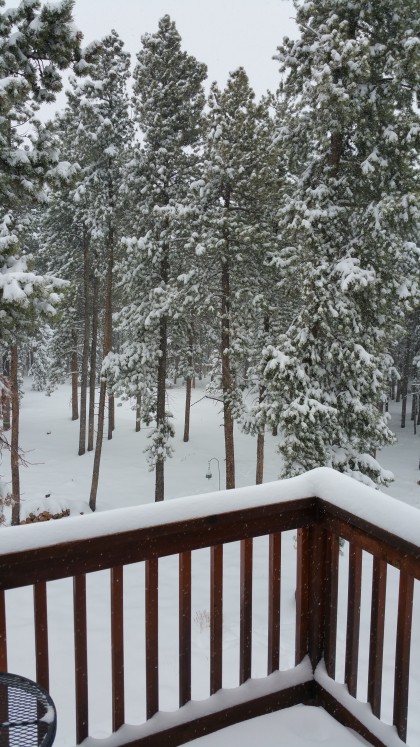
The last day of spring. Solar panels covered. Roof covered. Driveway plowed. 16-24 inches of new snow Friday night through yesterday. Delightful, but hardly springlike. In our spring fantasies, that is. The ones that have tulips and iris and crocus and lilacs and wisteria in them. For a mountain spring though, welcome and not unexpected.
Kate and I are still recovering from our three days of cooking and helping out at Beth Evergreen. Geez. Still, we have the time and the dogs have the patience. This pack anyhow. Vega would not have let us sleep in like Kep, Gertie and Rigel do. She had very clear ideas about when to go to sleep and when to wake up.
We spent most of yesterday admiring the falling snow. A snow globe day, refreshing and beautiful.
9 days ago
Still learning the mountains, how they change. Snow. Light. Rain. Fall. Flowers. Rapidly flowing streams. Clouds. Freeze and thaw. Fire. The animals they nurture move in and around and on them. Night and day. The stars and the moon. The sun as it arcs across the sky. All wonderful, all different.
In one of the sessions with Rabbi Jaffe a member of the board referred to the Beth Evergreen folk as mountain Jews. I liked that. I’m a mountain pagan, a mountain docent, an old man of the mountain. And a fellow traveler with the mountain Jews. Welcome to the journey.
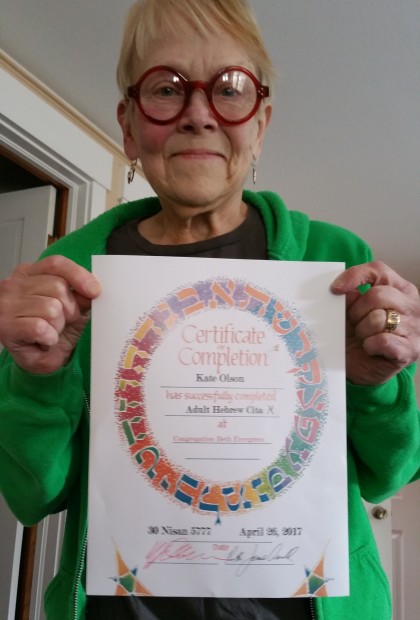
Kate with her graduation certificate for adult Hebrew
Missed yesterday. A very busy two days for both Kate and me. A visiting scholar at Beth Evergreen, Rabbi David Jaffe, came into town on Thursday morning. His first event was a potluck, then a mussar (Jewish ethics) session. Kate and I went early to set up.
Then, that evening Rabbi Jaffe walked the board and other leaders of the synagogue through what he called a soul curriculum for the organization as a whole. I resonated most with this presentation. Kate and I were there because I’m a member of the Adult Education committee. Both of us contributed soups to the soup and salad meal. I made chicken noodle soup and Kate made Vietnamese Pho.
After getting home around 9:30 (our bedtime is 8pm) we got up the next morning and drove into the Denver Performing Arts Center to see grandson Gabe perform in the Denver Public Schools Shakespeare Festival. This ended up taking longer than intended, but we got home in time for a nap before returning to Beth Evergreen yesterday at 4:30. This time we helped set up for Rabbi Jaffe’s lecture, preceded by a congregational meal.
After helping set up tables, arrange flowers, distribute utensils to each place, we attended the James Taylor shabbat. Rabbi Jamie Arnold, Beth Evergreen’s rabbi, is a talented musician who does covers and writes his own music. He often modifies familiar songs with Jewish prayer book language and writes Hebrew verses for them, too.
The meal, catered by Ali Baba, a Golden Lebanese restaurant, and paid for by a generous congregant, fed about 80 people. The tables filled the social hall plus a table set up in the entry way. It was exciting to have that many people together, eating and sharing stories.
Afterward Rabbi Jaffe gave a lecture on mussar. It was more sparsely attended than it might have been due to the heavily falling snow and the predictions-now fulfilled-of around a foot of accumulation.
We again got home around 9:30pm. Late to bed twice in a row. Harder and harder these days.
Today was the People’s Climate March in Denver, which I intended to attend, but the roads going down the hill are icy and snow covered. Climate change is, as I said in an earlier post, once again the focus of my political energy so I’ll only miss the gathering, not the action.
This late spring snow challenged our Rav4 on the way home last night. Hwy. 78, aka Brook Forest Drive/Black Mountain Drive/Shadow Mountain Drive winds up the mountains from Evergreen. It was snowing hard, the roads were not plowed and the shoulders are narrow. No sudden plummets, but sufficient curves and changing elevations to make the drive interesting. Plus, I was ready to be asleep an hour before we left Beth Evergreen.
Today, though, and the next week, too, we have a quieter time. No grandkids this weekend and only one scheduled event in the next week.
Today I’m making chicken noodle soup and Kate’s making Vietnamese pho. We’ll serve this at a Beth Evergreen leadership dinner for Rabbi David Jaffe, author of Changing the World from the Inside Out, a Jewish Approach to Social Change. Along with our friend Marilyn Saltzman, chair of the adult education committee, who is making a vegetarian squash soup, we’ll provide the soups for a soup and salad meal. I really like this low key involvement. It feels manageable.
Although. I am hoping that Rabbi Jaffe’s time here at Beth Evergreen, tomorrow through Saturday as a visiting scholar, will spur the creation of an activist group focused on some form of response to the Trump/oligarch era. In that instance I’m willing to move into a more upfront role, though I would prefer to remain a follower.
Then, there’s the Sierra Club. I wrote here about my excitement with Organizing for Action, Conifer. That was back in January, I think. Lots of people, lots of energy. Good analysis. I thought, wow. Here’s my group. Then, I never heard from them again, my e-mails went unanswered. Weird, but true. Weird and disqualifying for a group that’s organizing political work.
So I renewed my effort to connect with the Mt. Evans’ local group of the Rocky Mountain Chapter of the Sierra Club. Colorado seems to work more through these regional clusters than as a whole. There are nine of them, covering the entire state. The Mt. Evans’ group includes our part of Jefferson County, Clear Creek County and a northern portion of Park County. It’s titular feature, Mt. Evans, is a fourteener (over fourteen thousand feet high) which has the highest paved road in North America leading to its summit. According to locals here it’s also the weathermaker for our part of Conifer.
I finally made it to a meeting a couple of weeks ago. When I came back, Kate said, “You seem energized.” I did. And, I hadn’t noticed. Something about that small group plugged me back into my reigning political passion of the last six or seven years: climate change. Oh, yeah. With OFA I’d tried to head back toward economic justice, my long standing motivation for political work, dating back to the UAW influences I picked up as a teenager in Alexandria. Guess the universe understood me better than I understood myself. Not much of a surprise there.
My mind began ticking over, running through organizing scenarios, figuring out how we could (note the we) raise the visibility of the Mt. Evans group, gain more members, influence local policy. This is my brain on politics. I might be willing to play a more upfront role here, too, though I want to explore other ways of being helpful first.
Anyhow, between these two, I’m sure I’ll get my political mojo working in some way. And that feels good. Want some soup?
 Our next Sierra Club meeting will be on June 19th, one day before the summer solstice. Sierra Club work is paganism stripped bare of its mythic content. There is passion for sure, but not the poetry, no ritual, no inner work. It’s all outer work: hike, lobby, analyze, network, persuade. We may, for example, show the next Al Gore movie, Inconvenient Sequel: Truth to Power. See trailer below.*
 Somehow I need to find a way for my inner work to imbue my outer work. Todd, a long-time member of the Mt. Evan’s local group to which I belong, talked about a hike he took yesterday in Reynold’s Park. He named a particular orchid that he found and his face lit up. “A bullsnake, too.” It may be that these folks, tied to the very local region encompassed by our borders, find their inner work in being on the trail, hiking Mt. Bierstadt, taking the Mt. Evan’s road, helping clear trail.
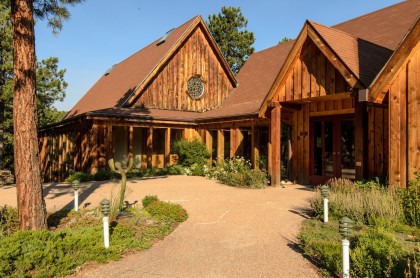 Irv Saltzman invited us to a performance by his singing group, the Renaissance Singers. It was held in a wooden Episcopal Church, St. Laurence’s, which is near our home. Directed by a Chinese national, Hannah Woo, who is finishing her Ph.D. in musicology, they were 8, four men and four women. As a group, they matched each other well. April, a soprano, had a lovely clear voice and a large range. Irv, formerly a tenor, has now transitioned into a bass/baritone role. Their performance was wonderful. At a meal afterwards we discovered April is our neighbor.
 Renaissance choral music and instrumental renaissance music has always captivated me. It’s easy to see courtiers in colorful costumes listening to this music in a palace, brown robed and cowled monks hearing it in a morning prayer service, or small groups performing at home for their own amusement. It’s also the music most often heard at Renaissance festivals. Sorta makes sense, eh?
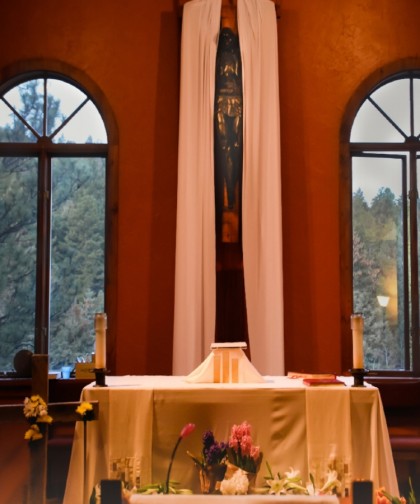 Between the two windows hung a large crucifix, a cross made of bare, light wood and a bronze Jesus hung by two nails. I had an odd sensation while listening to this music I’ve often heard in monastic settings on retreat. It carried me back into the spiritual space of an ascetic Christianity that often comforted me. This time though I came into the space as a peri-Jew, identifying more with Marilyn and Irv and Kate, with the still new to me spiritual space of Beth Evergreen, than the theological world represented by this spare, but beautiful sanctuary.
 This was an afternoon filled with the metaphysical whiplash I’ve experienced often over the last year, a clashing of deep thought currents, spiritual longings. This process is a challenge to my more recent flat-earth humanism, a pagan faith grounded not in the next world, but in this one. Literally grounded.
 Two things. Turning left yesterday after visiting the Colorado Potters Guild spring show, I looked up and noticed I had executed a left turn in front of an oncoming SUV. We missed each other, though it could have been otherwise. Later, turning a corner onto 8th Avenue heading out of Denver, I banged the right rear of the Rav4 against a curb. It’s important to be honest about such a critical skill as driving and right now, I’m lacking something. Maybe it’s attention, maybe it’s an inability to drive and chew gum at the same time. I don’t know. But I need to do something about it.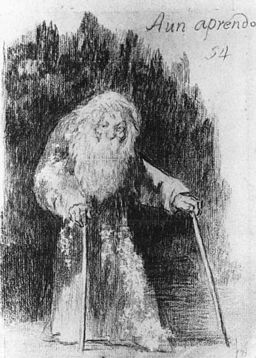
 Oh? Well. Tech and crit-me-manifested very, very early. Dad focused on an interactive aspect of my personality that is designed to irritate others. It’s not the only aspect, hardly, but having it emphasized was difficult for me. Actually, it still is.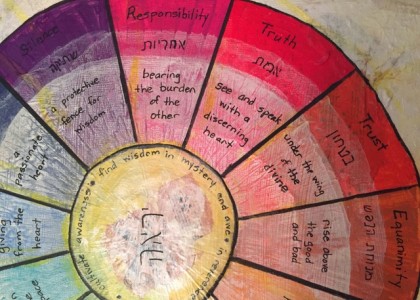
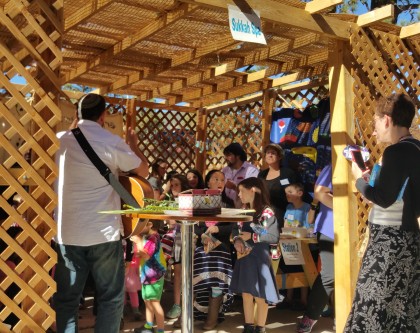 An intriguing pagan element runs throughout the Judaism I’ve been exposed to at Beth Evergreen. The Jewish liturgical year is on a lunar calendar. Shabbat begins at sundown on Friday and Friday shabbat services are held at night. Sukkot is a harvest festival, held outdoors in a sukkot booth. Tu BiShvat is new year for the trees. Judaism is also very body positive, actively opposing ascetic practices that exist in some forms of Christian monasticism, and encouraging the enjoyment of sex.
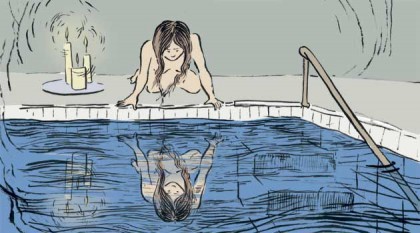 Water – Bonnie offered a quote from the novelist Julian Barnes: “Mystification is easy; clarity is the hardest thing of all.”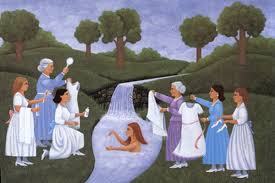

 Ruth and Gabe turned 11 and 9. With the divorce birthdays have become contentious. Jen planned a birthday party for Ruth that didn’t include Jon. Ouch. Still in its first months after final orders the divorce means Jon and Jen have to establish new norms about how to deal with such things. Not easy when the breakup itself created more conflict.
 The last day of spring. Solar panels covered. Roof covered. Driveway plowed. 16-24 inches of new snow Friday night through yesterday. Delightful, but hardly springlike. In our spring fantasies, that is. The ones that have tulips and iris and crocus and lilacs and wisteria in them. For a mountain spring though, welcome and not unexpected.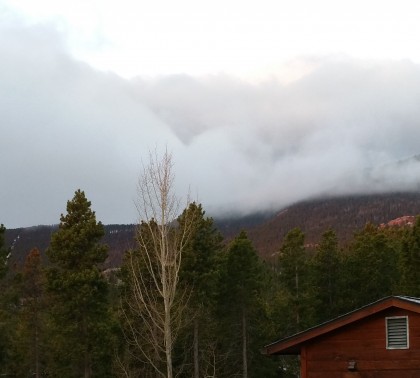
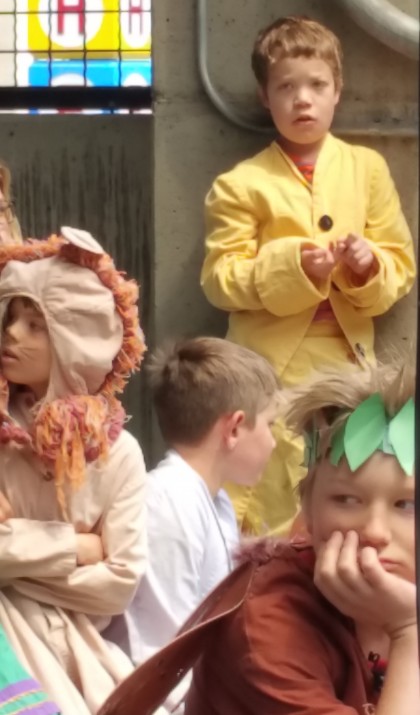 After getting home around 9:30 (our bedtime is 8pm) we got up the next morning and drove into the Denver Performing Arts Center to see grandson Gabe perform in the Denver Public Schools Shakespeare Festival. This ended up taking longer than intended, but we got home in time for a nap before returning to Beth Evergreen yesterday at 4:30. This time we helped set up for Rabbi Jaffe’s lecture, preceded by a congregational meal.
 Today was the People’s Climate March in Denver, which I intended to attend, but the roads going down the hill are icy and snow covered. Climate change is, as I said in an earlier post, once again the focus of my political energy so I’ll only miss the gathering, not the action.
 Today I’m making chicken noodle soup and Kate’s making Vietnamese pho. We’ll serve this at a Beth Evergreen leadership dinner for
 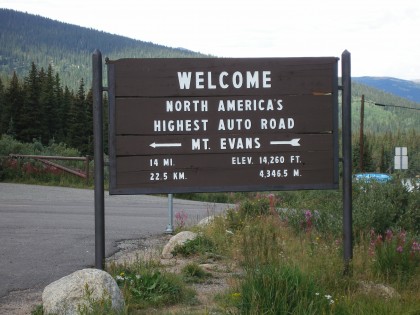 So I renewed my effort to connect with the Mt. Evans’ local group of the Rocky Mountain Chapter of the Sierra Club. Colorado seems to work more through these regional clusters than as a whole. There are nine of them, covering the entire state. The Mt. Evans’ group includes our part of Jefferson County, Clear Creek County and a northern portion of Park County. It’s titular feature, Mt. Evans, is a fourteener (over fourteen thousand feet high) which has the highest paved road in North America leading to its summit. According to locals here it’s also the weathermaker for our part of Conifer.