Category Archives: Humanities

Still Reading Romance of the Three Kingdoms

Summer                                              Waning Strawberry Moon

“if your vision is for a year, plant wheat. If your vision is for ten years, plant trees. If your vision is for a lifetime, plant people.”- Chinese Proverb

Ever have days that just happen, disappear with little trace?  The last couple have been like that for me.  The ear, the fuzz from the infection and a slow take on things.  That’s the extent of it.

I’m now in the last quarter of the Romance of the Three Kingdoms.  I’ve been at it since sometime early June, late May.  Now, I’ve been a little slow, I admit, but it is 2,340 pages long in print.  I’m reading it on the Kindle.  It carries a slow, but steady course in Chinese logic, especially as related to war and politics, Confucian and Taoist influences on Chinese culture in general and the courts and military in particular and a careful rendering of the demise of one of Empire, the Han.  The Han Empire, the Tang, the Song and the Ming have pride of place as golden ages of the Chinese people.

(this is the entry way to the tomb of Cao Cao, the arch villain of the Romance of the Three Kingdoms.  Chinese archaeologists discovered it last year and opened it on Chinese television last month.  this stuff is still very relevant.)

It’s interesting to consider that the Chinese have not one golden age, but four when culture flourished and the nation was at peace.  I don’t know the whole well enough to say for sure, but one of the long lasting appeals of this 14th century (Song dynasty) novel may be the dissolution of the first of those.

My interest in China will never be more than that of a journeyman’s, perhaps no more than an  apprentice, but it fascinates me.  Part of that fascination is imagining what it would be like to live in a culture with that much depth, where a person in Shanghai today could read the Romance of the Three Kingdoms and recognize not only names, but the culture of this ancient past.

In one view those of in the United States can look only as far back as 1776, in another 1602.  If we stretch our gaze back further, we can cross into European history and follow it back into the world of ancient Rome and further back yet, ancient Greece, but there, for the most part, it stops.  Yes, you can argue the history of the Jews and the Egyptians are also our history and they are in terms of influences intellectual and artistic, but I don’t have a personal bond even with the ancient Greeks.

The closest I can get in experience to that of the contemporary Chinese is to follow my Celtic line back into the mists of Celtic myth and legend.

Anyhow, it’s been an interesting read and I’ll be sorry when I’m finished.  Not sorry enough, however, to pick up another Chinese classic for a few months.

Bee Diary: July 7, 2010

Summer                                  Waning Strawberry Moon

Dave Schroeder, president of the Minnesota Hobby Beekeepers, came by this morning to look at my bees.  We opened up the package colony first.  “They’re drawing out comb, look good.”  He gave me a tip about keeping megan173/8″ inch between foundations–bee space. “If they have more space than than, they’ll fill it with comb.  Wasting their time.”  “You moved a frame up from below. Good.  Just like you’re supposed to do.”

(a fellow docent’s daughter, Megan.  she was a graduate student in the bee department at the time.)

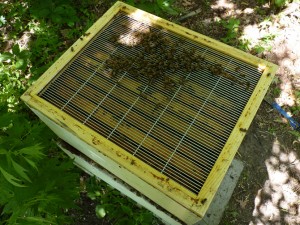
We cracked the parent colony.  Taking the telescoping cover off he placed it bottom side up.  “That’s where I put the supers,”  he said, “Helps you avoid killing bees.”

As I lifted the top two off, he asked, “Any weight to’em?”

“Nope.”

He checked them.  I then took the fullest honey super off.  It weighs about 50 pounds.  Heavy, man.  And the next one.  A bit more weight on that one than last Friday.

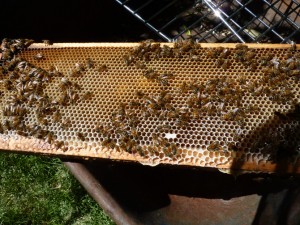
We checked the colony itself, in this case I wanted him to take a look, give me his impression.  “That on top is drone comb.  That means you’ve got a happy colony.  Now, I always scrape this off.”  He took his hive tool, scraped along the top of the frame, lifted off the drone cells with their white larvae exposed and dumped them in front of the hive.  “It’s just neater.”

He made sure each box was square and fit perfectly on the next one.  I like to do that, too, but the heat or the weight of the box sometimes makes it hard for me.  I’m a little guy.

After that, we replaced the queen excluder, the honey supers and moved 05-31-10_queenexcluder1over to the divide.  Oh, he did tell me I had the queen excluder on upside down.  Ooops.

Commercial beekeepers apparently refer to queen excluders as honey excluders.  The bees don’t like to climb through’em, so it slows down honey production.

On the divide, the one that prompted me to connect with him, we removed the two honey supers I’d put on as he suggested.  Then we looked at the top hive box which had honey on almost all of its frames.  There he showed me about moving end frames into the middle of the box.  “The bees won’t draw out comb on the side facing the box.  This way they will.”

“Yeah.  This is plugged with honey.  If you don’t put supers on, they’ll crawl up here (into the third hive box), think, well, we’re done.  Ready for winter.  Then they won’t go up into the supers.”  I’m not clear why putting the honey supers on solves this problem.

He suggested I take the queen excluder off  this one for a week.  That will encourage the bees to go up.  “Bees like to go up.”  Takes one barrier away.

After we closed this colony, he said, “Where did I shake out those bees?”  Dave had shaken bees off the queen excluder as we checked it in the parent colony.  “Oh, yeah.  Let me show you another trick.”  He searched around, found a stick a bit thicker than a thumb and round.  Breaking it off at about 8 inches, he put it in the middle of the bees on the ground and rested the other end against the hive entrance.  “They’ll climb up that and get back in the colony a lot faster.”

As we finished, he said he likes to have all his colonies facing south and in the open. “That way, they come to the entrance, look out, go, Oh, it’s sunny!  Think I’ll go out and go to work.”

A lot of the comments he made were straight forward tips gained from years in bee-yards.  He’s been at it since 1974, 46 years by my count.

(Got this on 7/8 from Bill Schmidt.  Why I’m not a scientist.  By the way, your math on the beekeepers years with bees needs attention.  2010 – 1974 = 36 years, not 46.)

After we finished the hive inspections, “Your bees are doing good.” we sat in front of the honey house and talked bees for about a half an hour.

He keeps about 100 colonies and plans to take them to California this fall.  “Out there they can work.  Get strong.  Here, they’re just struggling to survive.”05-31-10_filledhoneysuper

He told about honey extracting, the relative merits of different kinds of equipment, about the high trailer he uses to store honey supers near his colonies, the years he spent working for his brother-in-law, “I wouldn’t take no money.  I was just in it for the education.”

He says 100 doesn’t make him commercial.  When I asked him what does make a commercial bee-keeper, he said, “Oh, 400-500 colonies at least.”

It was a pleasure to have him over and very useful.

You Say You Want A Revolution? Yep.

Summer                                            Waning Strawberry Moon

It’s been done, I know.  Still, I’d like to put in a call for a 2nd American revolution.  Oh, ok, I don’t care what number it is.  I’ll settle for another American revolution.

My American revolution has a bit of  Norman Rockwell, a touch of Helen and Scott Nearing, more than a dab of Herbert Marcuse, Paul Goodman and C. Wright Mills, some Benjamin Franklin, the spirit of pioneers and native Americans alike when they relied upon on this seemingly limitless land for food and space.  There’s a Victory Garden or two in there as well, plus generations of smart women who canned, dried, jellied, smoked and pickled all sorts of produce and meat.  This New American Revolution demands no marches, no banners, no barricades, no guns and no repression.  And you can dance all you want.

What is it?  It is a revolution of and for and with the land.  It is a revolution that takes the wisdom of a 7th generation Iroquois medicine man who said:  “We two-leggeds are so fragile that we must pray and care for all the four leggeds, the winged ones, those who swim in the waters and the plants that grow.  Only in their survival lies the possibility of ours.”

What is it?  It is a revolution of and for and by the human spirit.  It is a revolution that insists, but gently, that we each put our hand and our back to something that feral nature can alter.   It could be a garden.  It could be a deer hunt.  It could be a potted plant outside where the changing seasons affect its growth and life.  It could be a regular hike in a park, through all the changes of the seasons, seeing how winter’s quiet fallow time gives ways to springs wild, wet exuberance, the color palette changing from grays, rusts and white to greens, yellows, blues, reds the whole riot.

What is it?  In its fullest realization this revolution would see each person responsible for at least some of their own food, food they grow or catch or kill.  In its fullest realization each person would use whatever land they share with the future in such a way as to increase its natural capital, using the land in such a way that it improves with age and gains in its capacity to support human, animal and plant life.

What is it?  In its fullest realization this revolution would find each person closer, much closer to the source of their electricity, their transportation and its fuel, their work and their family.  In its fullest realization this revolution would shut down the coal-fired generating plants, shutter the nuclear generating plants and have maximum and optimum use of wind, geothermal, hydro, solar and biomass generation. In its fullest realization each person would eat food that had traveled only short distances to their table, the shorter the better, the best being from backyard or front yard garden to the table.

What is it?  Well, we have a ways to go yet.  Perhaps a long ways, but if we want our descendants to have a chance to enjoy the same wonders in this land that we have known, we will have to change.  We will have to change radically.  We need, as I suggested, another American revolution.

The 4th

Summer                                        Waning Strawberry Moon

The 4th of July.  A time to think about our country, our home, our sea to shining sea.  Are we in decline?  This chestnut has begun hitting the op ed pages again.  I don’t know, they don’t know.  Only history will tell us.  Does it matter?  Not to me.  We’ll still be Americans, just like the British are still British in spite of the collapse of the empire on which the sun never sat.

Are there major problems within our body politic?  Oh, my, yes.  Does this make our time different from any other time?  Emphatically, no.

Here’s an example from a Frederick Douglass speech quoted in the Star-Tribune today:

“Fellow citizens, above your national, tumultuous joy, I hear the mournful wail of millions, whose chains, heavy and grievous yesterday, are today rendered more intolerable by the jubilant shouts that reach them. If I do forget, if I do not remember those bleeding children of sorrow this day, “may my right hand forget her cunning, and may my tongue cleave to the roof of my mouth!”

To forget them, to pass lightly over their wrongs and to chime in with the popular theme would be treason most scandalous and shocking, and would make me a reproach before God and the world.

My subject, then, fellow citizens, is “American Slavery.””

Does this harmony of misery make us any less accountable for the unemployed, the dying lakes and rivers, the immigrants who would live among us and share this land?   Emphatically, no.

Whether in decline or doggedly ascending the hill to that Bright Shining City so beloved of our forefathers, we must attend the great American ideals of liberty and equality, the twin conceptual mounts on which both our past and our future rest.

And not these only.  We now have before us the Great Work, the demanding and joyful task of creating a human presence on this planet that is benign, not malignant.

Here are the things make me believe we will continue to rise to these challenges no matter our relative status in the world:  we ended slavery.  we fought and defeated fascism.  we looked at old age poverty and created social security.  we have a statue at what used to be the main entry point for immigrants; it is a statue of liberty and one which says to the world, give us your huddled masses, yearning to breathe free.  we have brilliant scientists, great laboratories and universities, students even at this moment learning to be the future leaders that we need.  we have poets, movie makers, authors, critics, musicians, painters and sculptors all ready to help us see what we do not see.  we have neighborhood after neighborhood of people who want only a chance, the same chance many of our ancestors have already had.  we are a people who have won great victories for humanity.  we are a land unparalleled in its ruggedness, its beauty, its flora and fauna, rivers and streams, lakes and forests.

All of these things make me happy and hopeful on this 4th of July.

Kate is Home.

Summer                                            Waning Strawberry Moon

Kate is home.  She looks amazing, walking without the characteristic roll she had developed while favoring her right hip.  We went to Lucias, site of our first date, and ate at their outdoor tables.  Kate savored the wind, the freedom and “being on this side of the windows.”  Doc Heller says 2 to 2 1/2 weeks and she should be able to walk without the walker.

While we had a snack at Lucias, a stead stream of young singles and young couples with children came by, strolling in their neighborhood.  I realized I seldom see this many young adults.  The MIA docents are an older crowds, the Woollies, too; only the Sierra Club, of the groups I see with any regularity has a mix of youth and older adults.

One of the younger  couples that came by was a young man in scruffy jeans like I wore at his age and a woman in a print dress, black hair done up in tufts, Goth  eye shadow and lip stick, smoking a cigarette and wearing Doc Martens.  She was not happy with the parking ticket the laid back parking meter attendant had given her only a few minutes before.

Here’s another sign of the shift I’ve made from city boy to exurban man.  The traffic, the crowds, the heat, the buildings felt too close, too vibrant, more energy than I could inhale.  I look forward to breaking free of the urban heat island, the jockeying for position.   Never used to feel that way.  Now I like our little patch of land, the quiet here, our dogs.

Science Is A Poisonous Net

Summer                                            Waning Strawberry Moon

The bee goddess piece in this video comes over half-way through, but the rest got my attention as well.  The quote in the title comes from the bee goddess shaman.

In addition, I saw an animated movie last night called The Man Who Planted Trees.  It is a fictional account of a shepherd who begins to plant oak trees.  He goes on to plant beech and birch as well.  He plants 100 trees a day and the story follows the eventual growth of the forest and how it transforms a barren and desolate mountain into a watery, fertile realm.  It’s a beautiful fable, well worth seeing.

In this video the old woman planting rice reminded me of the Man Who Planted Trees.  I think these folks are Hmong or close relations thereto.

I’ll Be Glad When She’s Home.

Summer                                     Waning Strawberry Moon

Tomorrow hive inspections, then into see Kate.  The original plan was for her to come home on Saturday.  I hope that  holds up.

Having her away, yet close, seems almost more distance than when she was in San Francisco.

We have a lovely summer night, warm but not hot, a clear sky, the drinking gourd poised in its summer position, the bowl headed north and the pointer stars, as they always do, showing the way to Polaris.

I finished my review of my Latin, mechanically locating the verb, the subject and the object in each of the sententiae antiquae I had translated in the last three chapters.  Greg’s right, this approach makes grabbing ahold of the sentence’s intent much easier.  That’s why he’s the tutor.  I’m going to go ahead and finish chapter 20, which will put me half-way through Wheelock.

Oh, You’re So Pragmatic.

Summer                                    Full Strawberry Moon

“My experience is what I agree to attend to.” – William James

Pragmatism and pragmatists are an original American (US) contribution to the history of Western philosophy.  Since I can’t get my hands around it well, I’ll not try to explain it, though on its on my list.

But.  William James was among its founders and early proponents along with Charles Saunders Pierce and John Dewey.  He was also an early American psychologist as was Dewey.  So.  James is an important guy in philosophy, psychology and the psychology of religion, The Varieties of Religious Experience.

His quote above is disarmingly simple.  On the face of it you might say, well, yeah.  Whatever, old dude.  If you took that perspective, you probably skipped over two important words:  I agree.  Now, I’m not going to get into the free will debate, very complicated at this moment in cognitive science, so I interpret this as our attention will go where we intend for it to go.  It’s the intentional nature of the I agree that I want to lift out and underline.

Why?  It reminded me of a dilemma I spoke with Kate about just this week, “Kate, there are several things, for example, pragmatism, Taoism, aesthetics, the Enlightenment that I would like to explore in greater depth.  The problem is that to do it I have to have sit down time, lots of it, to read complicated material and absorb it.”

“Yes,” she said, “There are just aren’t enough hours in a day.”

Just so.  We have a limited amount of time, that’s a given, both day to day, and in this finite trip, life.  How I agree to direct my attention will determine the nature of my experience.  If I choose to garden, I will not be reading Dewey’s Reconstruction of Philosophy.  If I choose to do Latin and translate the Metamorphosis, I cannot, at the same time, read Chuang Tzu.  If I use time writing this blog, I cannot use the same time to write a novel.  And so on.  And on.

Just using those examples I have chosen to direct my experience toward the garden, the soil and complex interactions within them both.  I have chosen to fill some of my experience with Latin grammar and vocabulary and learning how to translate.  I choose to write this blog and so have the experience of an ongoing journal/diary/weblog.

Is there anything bad about these choices?  No, at least not in my opinion.  I do, though, have to reckon with what James identifies.  Each of those choices makes other choices if not impossible at least less likely, therefore directing my stream of attention and with it my experience in one direction and not another.

The point here is that you decide the type and quality of the experiences you have and those experience not only shape your life, they are your life.  So, choose well.  And know what your choices mean.

Gyatsho Tshering: My Friend

Summer                                     Waxing Strawberry Moon

Gyatsho Tshering* died a year ago  today.  He left his wife and daughter who live in a neat  home in a first ring suburb of Minneapolis, Columbia Heights.

Regret is not a big part of my vocabulary.  What’s past is  past and cannot be changed.  A healthy life, I tibetflagbelieve, leaves yearnings for past deeds, past achievements and lost loves behind us, where, I believe, they belong.

I do have regrets about Gyatsho.  Read the material below and  you will learn what an amazing man he was.  I sat in a class with him on South and Southeast Asian Art that he, no doubt, could have taught himself.  He was a shy man, a bit introverted, although that could have been partly his immersion, late in life, in U.S. culture.

He loved to share his knowledge, to speak from within his own experience and learning.  He was a sweet man, and, as I told Scott Simpson today, I don’t meet many sweet people, a result, no  doubt, of the company I keep.

We had plans, Gyatsho and I, but we both tarried in fulfilling them.  I was going to eat at his house, learn more about Tibetan Buddhism, just spend time with him.  He didn’t call.  I didn’t call.  Then, he died.  Tarrying has a cost.

As a result, I went to his house today with a lump in my throat, a combination of grief and yearning, grief for Gyatsho’s absence and yearning for the time we did not get to spend together.

Tibetan Buddhists, as in the Jewish tradition, commemorate a loved one on the anniversary of the death.  Monks come to chant, friends and family prepare food, people sit on folding chairs and eat from styrofoam plates using plastic spoons and forks.  Sound familiar?

Gyatsho’s gracious wife,  Namgyal Dolma, received guests and guided us in the ritual.  Scott, Yin and I went in, one at a time into the tiny corner bedroom transformed into a small temple with thangkas and prayer flags, an altar with offerings and the monks on low cushions and the smell of incense.  The chanting was remarkable, mesmerizing.  I wanted to be there, bowing first to the monks, hands folded in a namaste like position, then to the altar.

The chanting fell over me like a shroud, no, like a prayer shawl, a tefillin.  It moved me into a sacred space at once, the repetition soothing.  One of the monks, thick of shoulder with a magenta robe crossed over one shoulder, the other shoulder bare chanted in two tones, the throat singing that has gained some fame here.  The other three, with magenta robes and gold, chanted in a single tone.  They began at 10:00 am and will end around 5 pm, with, as Namgyal said, a break for lunch.

Namgyal said, “He was my husband,” she paused, “and my teacher, too.  He still lives here.”  Her hands swept over her body.  Me, too.  In a much less intense way of course, but his presence lives on for me, as well.

In a setting back home in Dharamsala or Tibet the monks would have been at one end of a long room, the food and the guests distributed further back.  Every one would pray.  In the more cramped conditions of a 1960’s working class suburban home, the whole became fragments:  the monks in the corner temple room, the guests outside under an amazing orange tent, food being cooked in the garage with propane burners and woks.

So, yes, I admit it.  I regret not pursuing with more vigor and intention my relationship with Gyatsho.  Not many, but this is one.

*Obituary: Gyatsho Tshering, Eminent Scholar of Tibetan Studies
Phayul[Monday, June 29, 2009 12:17]

by Bhuchung K. Tsering

His Holiness the Dalai Lama inspecting the Library’s construction plans with former director of LTWA Mr Gyatso Tsering (Left) (Photo: Tibet.net/file)

His Holiness the Dalai Lama inspecting the Library’s construction plans with former director of LTWA Mr Gyatso Tsering (Left) (Photo: Tibet.net/file)

Gyatsho Tshering, former director of the Library of Tibetan Works & Archives and a respected scholar, passed away on June 25, 2009 at a hospital in Minneapolis, MN, after a brief illness. He was 73.

Born in 1936 in Sikkim to Lobsang Lama and Nyima Dolma, he finished his college education from the University of Calcutta. Following his studies, Ku-ngo Gyatsho la worked in the Ministry of External Affairs and the Ministry of Home Affairs of the Government of India, and had served at the Indian Mission in Lhasa. He also served in the Government of Sikkim.

He joined the service of the Central Tibetan Administration in 1963 and worked in various departments until his retirement in the late 1990s. He served in the publications and translation department in 1965. In 1966 he was transferred to the Foreign Department and in 1967 to the Department of Religion and Culture. During his stint there he was a member of the entourage of H.H. the Dalai Lama during his first trip to Japan and Thailand. Subsequently he was promoted as a Secretary in the Department and later as Assistant Kalon. In 1972, he became the acting Director of the newly established the Library of Tibetan Works & Archives (LTWA) until the appointment of Prof. Thubten Jigme Norbu as the Director in June of that year. He was appointed by His Holiness the Dalai Lama as the new Director of the Library of Tibetan Works and Archives in 1974 and served in that capacity from March 1, 1974 until his retirement. Following his retirement he joined his wife, Namgyal Dolma, in the United States and they settled in Minneapolis, MN.

He was an unassuming individual who shunned publicity, but was totally dedicated to his work. He came to serve the Tibetan community during those years when there was a dearth of educated Tibetans with adequate knowledge of the English language or exposure to the world. His most significant contribution would be the development of LTWA as the pre-eminent center for Tibetan studies internationally. He nurtured several Tibetans in the field of Tibetan studies at the LTWA. Also, it may not be incorrect to say that almost all of the Tibetologists serving in various research institutes and universities throughout the world currently have had some educational stint at the LTWA during his tenure there.

His simplicity and his readiness to be of assistance endeared him to all those he came in contact with. Personally, he has been a source of encouragement to me from the time I started working in Dharamsala in the early 1980s. I benefitted greatly from his advices.

As a subject of Sikkim and a citizen of India, Ku-ngo Gyatsho la had quite many work opportunities, often with more attractive compensation than the one he was getting at the LTWA. However, his reverence and loyalty to His Holiness the Dalai Lama and his love of the Tibetan people made him reject all such job offers and to continue with his work in the Tibetan community.

He liked gardening and used to have a neat but small garden at his official residence at the LTWA.

He is survived by his wife Namgyal Dolma and daughter Yiga Lhamo.

A Home for the Tibetan Mind: The Legacy of Gyatsho Tshering

Phayul[Wednesday, July 01, 2009 18:59]

by Rebecca Novick

When the young Gyatsho Tshering approached the Tibetan government with the idea to build a library he was told that he was crazy. “They said, ‘This is impossible. You’re just dreaming.’” Tshering could see their point. “But I am a dreamer. I just go on trying and trying.”

Gyatsho Tshering (1936 - 25th June 2009)

Gyatsho Tshering (1936 – 25th June 2009)

It was 1967, during the early and challenging days of exile. The re-established Tibetan government, overwhelmed and under-funded, was struggling to provide for 100,000 traumatized and penniless refugees, flooding over the Himalayas fleeing the Chinese occupation. But Tshering had his sights set further than the immediate needs of food and shelter.

Tibetan Buddhist texts had been arriving in the sub-continent across Tibet’s borders since 1959—carried on the backs of these same refugees. Tshering was profoundly impressed by how many people, only able to bring with them what they could carry from their homes, chose to rescue dharma objects from their altars; pechas (Buddhist texts) statues and thangkas (sacred scroll paintings) rather than items of monetary value.

Tshering was deeply concerned that the millennium-old heritage of Tibetan wisdom was being destroyed by Communist forces in Tibet. Inspired by the stories of the great library of Alexandria in ancient Egypt built to house the knowledge of the world, he wanted to create a safe repository to preserve “the skill of the Tibetan mind.” He finally took his “impossible” dream to His Holiness the Dalai Lama who gave the project his blessing. “He was very pleased,” Tshering recalls. “He said, ‘Why not? Go ahead.’”

But there were a few considerations. Firstly, there was no money. “We didn’t have any funds,” said Tshering. “Not one cent. Not one penny.” During visits to the West, he would always try to bring up his vision with potential supporters. He was repeatedly, if politely, turned down, with the explanation that the library would be a religious rather than educational establishment. But Tshering refused to become disheartened and he eventually found an ally in the Catholic Church that understood the importance of religious archives. “They were very generous,” he said. After this, other funders gradually began to come on board.

The texts that managed to survive the punishing conditions of high altitude passes and a rugged month-long trek in the packs of Tibetans dodging Chinese bullets, formed the library’s very first collections which can still be seen today. Manuscripts were landing on Tshering’s desk battered and torn, with missing pages and passages smudged beyond recognition from snow and rain. It was clear that the challenges went far beyond those of cataloguing and archiving. This was first and foremost a restoration project.

A team of the most learned Tibetan scholars was assembled—monks who had spent decades studying in the great monastic institutions of Tibet. “It had been part of their study to commit many of the texts to memory,” said Tshering. They worked from dawn often into the late hours of the night, filling in the missing parts of the texts by hand with nothing but their own memory as a reference.

Gyatsho Tshering expressed his regret that with the computer-age Tibetan calligraphy is fast becoming a lost art. “Tibetan calligraphy has power. It has energy. That is something that I miss. But what can we do? The times have changed.”

The manuscript restoration team lived without electricity in shacks that before them had housed cows. “We were living hand to mouth, but we didn’t care. We spent whatever we had that day even though we didn’t know what we would eat tomorrow.” Lamp oil was considered more precious than food. “Every day was a day of excitement for us because every day we discovered a new and rare manuscript.”

Gyatsho Tshering’s most vivid memory of that time was the support that he and his team received from His Holiness the Dalai Lama. “He would personally take the time to come down and encourage each one of us.”

The construction of the library building began in 1969 and took four years to complete and became known as the Library of Tibetan Works and Archives. But just as it was mostly the contributions of ordinary Tibetans who filled its shelves, it was the contribution of the poorest and most disenfranchised Tibetans that stood out in its construction.

In those days, many Tibetans were literally carving out a living on road crews in the harsh North Indian mountain states, sleeping and eating in dust-filled tents, and earning a meager 3 rupees a day. Many of these workers put aside one rupee and donated it to the construction of the library. Others even took unpaid leave to come to Dharamsala to volunteer as laborers on the building project. Said Tshering “They built it as if it was for themselves. That was very moving.”

As the Library of Tibetan Works and Archives began to gain international recognition acquisitions started to arrive not just from Tibet but also from Mongolia, Germany, and America. Private individuals began donating their personal collections, including a number of gifts that had been given to them or their family members by the Thirteenth Dalai Lama. Tibetan scholars and academics from around the world began making regular visits to Dharamsala to the library that was becoming renowned for its rich and comprehensive collection of authentic Tibetan texts. Tshering recalled people like Jeffrey Hopkins, Robert Thurman, Stephen Batchelor, Alan Wallace and Alexander Berzin who went on to become seminal figures in the Tibetan Buddhist movement in the West. “I remember every one of them,” he said fondly.

Today, the Tibetan Library houses the entire collections of Tengyur and Kangyur —the complete Indian commentaries on the Buddha’s sutras and the Tibetan Buddhist canon respectively. Every evening you can find Tibetans, generally the older ones, ambling clockwise around the building, rolling prayer beads through their fingers. “Wherever you find the collection of Tengyur and Kangyur, you will find people doing circumambulation around them,” noted Tshering. “Whenever they feel sad, whenever there is someone sick in their home, or when they want to find consolation, they go to the library and pray.”

“The library was a pioneering institution in many ways. We started a thangka painting school, a woodcarving school, a philosophy school. We had the cream of the scholars. Each one of them was a specialist in some field of Tibetan learning.” The original idea was for the library to house only written works, but Tibetans were arriving with so many statues, and other religious artifacts that Tshering saw the need to also incorporate a museum. “To outsiders it’s a museum, but to Tibetans it’s something living.”

Tibetans going back and forth from Tibet in the 60s and 70s were often requested to look out for missing parts of key manuscripts that made up the monastic curriculum, and without which monks could not complete their studies. Although they risked arrest and imprisonment for bringing such items out of Tibet, to Tshering’s knowledge no one ever got caught. He believed that there are still many important texts and documents languishing in drawers and file cabinets in Tibet, some that could prove politically “sensitive” for the Chinese authorities who have no interest in seeing them made public.

Born in 1936 in Gangtok, Sikkim, a country where Tibetan Buddhism dominates, Gyatsho Tshering grew up with a love of Tibetan culture, particularly its literature. “The attitude of the Tibetan people towards Buddhist philosophy was very different to now,” he observed. The generation of which he was a part, was in his view motivated by a purity of purpose and a sense of altruism that’s becoming harder to find in the Tibetan community. “Nobody thought to extend their hand to outside help,” he said. “We all thought, if we don’t do it, who will do it for us?”

Tshering served as the director of the Tibetan Library from up until 1998, after which he moved to the United States because he said, “I needed some rest”. He also wanted to have more time for his personal spiritual practice—an ironic reversal of the West-East trail that has led legions of Westerners to seek spiritual opportunities in Asia.

“I feel very satisfied that I was able to do something that was very much of benefit not only to Tibetans but also to people around the world. I’m a very lucky person in that I led a useful life. I have no regrets. When I die, I will die in peace.”

Gyatsho Tshering passed away at the age of 73 on 25th June 2009.

—–
This article is based on an interview with Gyatsho Tshering that took place in the summer of 2007 in Dharamsala. Rebecca Novick is a regular contributor to The Huffington Post and the founding producer of The Tibet Connection radio program online at thetibetconnection.org


What Time Is It?

Summer                         Waxing Strawberry Moon

A bit more on time.  Cybermage, Woolly Brother and sheepshead player William Schmidt begs to differ on the notion of cyclical time.  He references the geology of Minnesota and, I imagine, the information about the evolution of the universe which he so wonderfully makes understandable with lights and rope.

It is difficult to understand the two apparently conflicting ways of understanding time, the cyclical view that I suggested yesterday over against the deep time recorded in our genes,  our own earth’s mantle and the red shifted lights in the heavens.  Let me see if I can be a little clearer about what I think.

Instead of time as a characteristic of the natural world, that is, an experience of things occurring in sequence:  t1, t2, t3, t4 out there, beyond the reach of our sensory apparatus, I see it as a means of ordering that same sensory experience, a means imposed on it by our mind’s need for order, order that can have a useful meaning for us.  In other words, time and space, both, in this view, exist to help us survive in a world of chaotic events happening in overwhelming numbers.

They create a sort of mental short hand that gives us a way of predicting, in a probabilistic manner, the outcome of things we perceive as happening outside us, things important to us as an animal:  will that animal be beyond that tree when I shoot this arrow? will the arrow actually travel through the apparent intervening distance and strike the animal?  how long will it take me to hike to the berry patch?  Or, contemporary equivalents:  do I have enough time to go to the grocery store after work and before the kids get home?  Can I fit in a round of golf before the rain predicted at 3 pm?  how long does this flight really take?

Does this a priori understanding of time and space invalidate deep time?  I don’t know.  Does cyclical time invalidate deep time?  I don’t know.  I admit there is one part of me that says, Oh, come on.  The earth is 3 billion years old or so.  The universe 13.5 billion years.  Whatever those words mean, they mean the beginning of  both was a long, long time ago.  Yet, another part of me, ascendant right now, wonders if our conclusions about the passage of time mean what we think they mean.

This much I know for sure, on this planet, at this latitude and longitude, in 365 + days, we will spin around to the summer solstice again.  This I can experience as a non-linear mode of time, a mode of time that relies on the cycles of the natural world rather than on the progression of anything through vast stretches of the  past and on into the infinite future.  This cyclical mode of time I can referent, whereas the notion of yesterday and tomorrow seem to me to be no more than place markers, file cabinets for data.