An Entrance to Faery

Summer                              Waning Strawberry Moon

My cards were good.  I won some hands.  But.  Boy, did I screw up when I took a chance on a hand where winning would have offered double points, but losing, as I did, with below a minimum, quadrupled the penalty.  Ouch!  Sigh.

The night was glorious.  A warm summer night, a clear sky, the kind of night when everyone is a child, just waiting for the other kids to come out, to play one last game, perhaps wave a sprinkler around or sit down and talk.

A night much like the one I experienced in New Harmony, Indiana when I walked down a lane past the only open air Episcopalian church in the country, designed by Phillip Johnson.  This astonishing church is on one side of a lane that runs back into a woods.  Just across the lane, behind a wonderful small restaurant, The Red Geranium, is a grove of conifers planted on small drumlins.  Inside a modest maze created by these trees lies, improbably, the grave of one of the 20th centuries finest theologians, Paul Tillich.

It was just after dusk, night had come softly, but definitely.  The lane only ran for no more than half-mile on past the church and Tillich’s grave.  As I wandered back, moving away from the main street and toward the woods that lay at the end of the lane, I began to notice the fireflies.

Right where the lane met the woods, fireflies congregated, blinking off and on, creating an arc of bioluminescence.  Then others began to blink, further back in the woods.  There were thousands of them and as the ones further in began to blink they created the effect of a tunnel of light, blinking on and off.

(this pic is similar, not the night I describe)

Walking toward this between two holy places, the possibility that this was an opening to faerie seemed very plausible, even likely.

I stood there for over a half an hour, neither entering the woods, nor leaving the lane, captured as I was by the sense of a veil between the worlds opened where I was.

Still Reading Romance of the Three Kingdoms

Summer                                              Waning Strawberry Moon

“if your vision is for a year, plant wheat. If your vision is for ten years, plant trees. If your vision is for a lifetime, plant people.”- Chinese Proverb

Ever have days that just happen, disappear with little trace?  The last couple have been like that for me.  The ear, the fuzz from the infection and a slow take on things.  That’s the extent of it.

I’m now in the last quarter of the Romance of the Three Kingdoms.  I’ve been at it since sometime early June, late May.  Now, I’ve been a little slow, I admit, but it is 2,340 pages long in print.  I’m reading it on the Kindle.  It carries a slow, but steady course in Chinese logic, especially as related to war and politics, Confucian and Taoist influences on Chinese culture in general and the courts and military in particular and a careful rendering of the demise of one of Empire, the Han.  The Han Empire, the Tang, the Song and the Ming have pride of place as golden ages of the Chinese people.

(this is the entry way to the tomb of Cao Cao, the arch villain of the Romance of the Three Kingdoms.  Chinese archaeologists discovered it last year and opened it on Chinese television last month.  this stuff is still very relevant.)

It’s interesting to consider that the Chinese have not one golden age, but four when culture flourished and the nation was at peace.  I don’t know the whole well enough to say for sure, but one of the long lasting appeals of this 14th century (Song dynasty) novel may be the dissolution of the first of those.

My interest in China will never be more than that of a journeyman’s, perhaps no more than an  apprentice, but it fascinates me.  Part of that fascination is imagining what it would be like to live in a culture with that much depth, where a person in Shanghai today could read the Romance of the Three Kingdoms and recognize not only names, but the culture of this ancient past.

In one view those of in the United States can look only as far back as 1776, in another 1602.  If we stretch our gaze back further, we can cross into European history and follow it back into the world of ancient Rome and further back yet, ancient Greece, but there, for the most part, it stops.  Yes, you can argue the history of the Jews and the Egyptians are also our history and they are in terms of influences intellectual and artistic, but I don’t have a personal bond even with the ancient Greeks.

The closest I can get in experience to that of the contemporary Chinese is to follow my Celtic line back into the mists of Celtic myth and legend.

Anyhow, it’s been an interesting read and I’ll be sorry when I’m finished.  Not sorry enough, however, to pick up another Chinese classic for a few months.

To the City and Back Again

Summer                                      Waning Strawberry Moon

Back from the museum.  A quiet Thursday.  The women from Salem Covenant said they found the tour interesting.  We didn’t get to all the Chinese material because I took too long on the Matteo Ricci.  There is   so much to talk about.

It was nice to get back to the museum after a hiatus.

Still feeling a little punk so I’m off for a nap.

From Bee Hives to Art Galleries

Summer                                            Waning Strawberry Moon

Today I’m back to the world of art.  The bees will work on now until next week without me.  Probably what they prefer.

A tour today on my new tour day, Thursday.  I have a group from Salem Covenant Church.  They wanted to see the Matteo Ricci map and the Old Testament prints.  Based on that I decided to take them on a tour of art at the time of Matteo Ricci and the late Ming dynasty.

We will see a Ming dynasty painting, Towering Mountains and Fantastic Waterfalls, the Wu family reception hall and then move upstairs to the Old Testament prints.  We’ll finish with Morales’ Man of Sorrows and Honthorst’s Denial of St. Peter.  The late Ming dynasty coincided with the Counter-Reformation and Reformation era in Europe.

Later on, Sheepshead.

Oh.  My ear.  Much better this am.  Thanks.

Strummed

Summer                                            Waning Strawberry Moon

I have a pediatric illness:  an ear infection.  Well, of course, if I have it at 63, it’s not technically a pediatric illness, but my in-house pediatrician recognized it with her very own otoscope. I have a lot more empathy for her young crying patients now.  The damn thing hurts.  And right in your ear!

It’s in my left ear, which is deaf already, so it can’t do any damage to my hearing.  But wow.  When the pressure strums the nerve, it gets your complete attention.

I’d felt off for the last couple of days and the ear ache presented itself this morning, just as the bee guy came and the electrician who restored power to the honey house and the playhouse for Ruth and Gabe.  Kate’s really good with managing pain and illness.  I’m not.  I’m more like a dog; I want to crawl into a kennel and sleep until its over.  Fortunately, it began to drain this afternoon which relieves the pressure.  No strumming after that.  At least for now.

I forgot to mention that Dave Schroeder also said, “You’re not a beekeeper until  you’ve been stung.”  I’m a beekeeper several times over!

This afternoon and evening passed in a haze with pain and narcotics.

Bee Diary: July 7, 2010

Summer                                  Waning Strawberry Moon

Dave Schroeder, president of the Minnesota Hobby Beekeepers, came by this morning to look at my bees.  We opened up the package colony first.  “They’re drawing out comb, look good.”  He gave me a tip about keeping megan173/8″ inch between foundations–bee space. “If they have more space than than, they’ll fill it with comb.  Wasting their time.”  “You moved a frame up from below. Good.  Just like you’re supposed to do.”
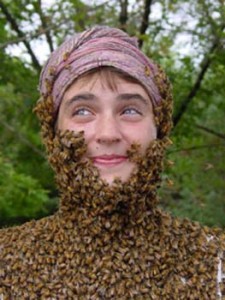
(a fellow docent’s daughter, Megan.  she was a graduate student in the bee department at the time.)

We cracked the parent colony.  Taking the telescoping cover off he placed it bottom side up.  “That’s where I put the supers,”  he said, “Helps you avoid killing bees.”

As I lifted the top two off, he asked, “Any weight to’em?”

“Nope.”

He checked them.  I then took the fullest honey super off.  It weighs about 50 pounds.  Heavy, man.  And the next one.  A bit more weight on that one than last Friday.

We checked the colony itself, in this case I wanted him to take a look, give me his impression.  “That on top is drone comb.  That means you’ve got a happy colony.  Now, I always scrape this off.”  He took his hive tool, scraped along the top of the frame, lifted off the drone cells with their white larvae exposed and dumped them in front of the hive.  “It’s just neater.”

He made sure each box was square and fit perfectly on the next one.  I like to do that, too, but the heat or the weight of the box sometimes makes it hard for me.  I’m a little guy.

After that, we replaced the queen excluder, the honey supers and moved 05-31-10_queenexcluder1over to the divide.  Oh, he did tell me I had the queen excluder on upside down.  Ooops.
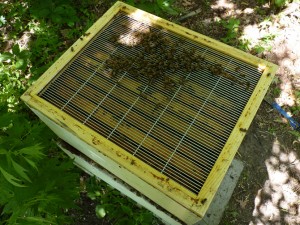
Commercial beekeepers apparently refer to queen excluders as honey excluders.  The bees don’t like to climb through’em, so it slows down honey production.

On the divide, the one that prompted me to connect with him, we removed the two honey supers I’d put on as he suggested.  Then we looked at the top hive box which had honey on almost all of its frames.  There he showed me about moving end frames into the middle of the box.  “The bees won’t draw out comb on the side facing the box.  This way they will.”

“Yeah.  This is plugged with honey.  If you don’t put supers on, they’ll crawl up here (into the third hive box), think, well, we’re done.  Ready for winter.  Then they won’t go up into the supers.”  I’m not clear why putting the honey supers on solves this problem.

He suggested I take the queen excluder off  this one for a week.  That will encourage the bees to go up.  “Bees like to go up.”  Takes one barrier away.

After we closed this colony, he said, “Where did I shake out those bees?”  Dave had shaken bees off the queen excluder as we checked it in the parent colony.  “Oh, yeah.  Let me show you another trick.”  He searched around, found a stick a bit thicker than a thumb and round.  Breaking it off at about 8 inches, he put it in the middle of the bees on the ground and rested the other end against the hive entrance.  “They’ll climb up that and get back in the colony a lot faster.”

As we finished, he said he likes to have all his colonies facing south and in the open. “That way, they come to the entrance, look out, go, Oh, it’s sunny!  Think I’ll go out and go to work.”

A lot of the comments he made were straight forward tips gained from years in bee-yards.  He’s been at it since 1974, 46 years by my count.

(Got this on 7/8 from Bill Schmidt.  Why I’m not a scientist.  By the way, your math on the beekeepers years with bees needs attention.  2010 – 1974 = 36 years, not 46.)

After we finished the hive inspections, “Your bees are doing good.” we sat in front of the honey house and talked bees for about a half an hour.

He keeps about 100 colonies and plans to take them to California this fall.  “Out there they can work.  Get strong.  Here, they’re just struggling to survive.”05-31-10_filledhoneysuper
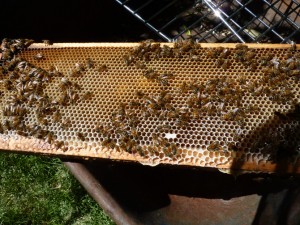
He told about honey extracting, the relative merits of different kinds of equipment, about the high trailer he uses to store honey supers near his colonies, the years he spent working for his brother-in-law, “I wouldn’t take no money.  I was just in it for the education.”

He says 100 doesn’t make him commercial.  When I asked him what does make a commercial bee-keeper, he said, “Oh, 400-500 colonies at least.”

It was a pleasure to have him over and very useful.
Natural Capital

Summer                                    Waning Strawberry Moon

I’ve not written much about permaculture for a while.  Here’s a one-pager* from our landscapers, Ecological Gardens.   It defines a new term for me:  natural capital.  I’ve since discovered that this is a term with a larger history which I haven’t explored fully, but I like the Ecological Gardens version.

Just imagine the kind of revolution we’d have if each person with land–in the whole world or in a whole city or in a whole county like Anoka County–committed themselves to increasing the natural capital of their land.  It’s a little bit like that old boy scout motto:  Leave your campsite better than you found it.

We could, each one of us, take multiple unique tacks on the notion of natural capital.  Some of us might focus on small commercial crops, others might raise chickens for meat and eggs, still others might band together as neighborhoods and grow crops in tandem, some folks doing one thing, others another and producing a local horticultural economy.

A federal or state program that made low cost loans or outright grants for the establishment of permaculture at the local level makes a lot of sense to me.  Like the 160 acres and a mule of yesteryear.  We need a horticulture and an agriculture that increases the carrying capacity of the earth, helps clean up the rivers, streams and lakes.


*Would you like to:
•   Maintain beautiful self-sustaining gardens organically?
•   Pick fresh, nutrient-dense foods from your own backyard?
•   Create habitat for the nature you love?
•   Build resiliency into your landscape to help fight climate change?

These are all products of natural capital. Our first priority at Ecological Gardens is to help you increase the natural capital of your land. This means assessing the unique combination of resources – sunlight, wind, water, and microclimates – and turning them into productive investments that will yield benefits today and for many years to come.
Soil is the foundation for natural capital in our northern temperate climate. Healthy soil creates a condition for healthy plants, produces nutrient-dense foods for humans and wildlife, reduces water use, and minimizes leaching and runoff. Building healthy soil usually requires an investment since most soils are compacted and chemically treated.
Plants are the primary producers of value on the land. They take up sunlight, water, and nutrients turning them into nutritious foods, medicines, fibers, fuels, oils, and wood. Increasing productivity on your land requires an initial investment since plants of low productivity tend to dominate the landscape.
Your return on investment will vary depending on the size of your land and the configuration of resources but will increase exponentially as plant diversity and abundance grows.

Short-term returns (1-5 years)
•   Lower water bills (up to 30%) for yard and garden care
•   Lower maintenance costs for fertilizers and lawn care products
•   Lower food bills as you begin to harvest food, flowers and medicines
•   Greater wildlife value (bees, birds, and beneficial insects)
•   Greater beauty

Intermediate returns (5-15 years)
•   Lower energy costs for air conditioning and heating by strategically locating trees and vines
•   Lower labor requirements as natural processes begin to work for you
•   Increased property values due to abundance and beauty
•   Increased food security as you provide more of your own food

Long-term returns (15 + years)
•   Lower fuel costs as you begin to harvest your own wood [for larger properties]
•   Increased productivity as your land matures

Oh, Yeah? How’d It Go?

Summer                                                  Waning Strawberry Moon

We keep our walkin’ around money at the Credit Union, Associated Health Care Workers.  I like credit unions because they’re small and friendly, unlike our mortgage holder, Wells Fargo, who has shafted us time and again.  The credit union knows who we are.  I went in today to pick up our weekly cash and the teller said, “I’m used to having Lynne pick up the money.”  She doesn’t Lynne goes by Kate, but otherwise.  “Yes, she had surgery.”  “Oh, yeah, how did that go?”  “Well.  She’s walking around.”

I grew up in a small town and I value personal interaction with merchants.  It makes me feel known and welcome in a broad, perhaps shallow way; but a wider net of personal connections away from work or friends gives a sense of density to life often, perhaps usually, lost in the city.

The electrician, Jeff, who works on our stuff from time to time was out today.  He lives here in Andover and we talked about bees and hemp while I tried to identify where the fence guys cut the wire to the sheds.  Again, personal.

alexdowntown

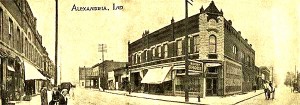
In Alexandria, where I lived from age 2 to age 17, most people knew who I was and I knew who they were.  Alexandria had about 5,000 citizens, but the families were much fewer and knowing a family member meant you had some sense of the rest, too.  Yes, it can be suffocating, perhaps more so as an adult, but as a kid, it meant there was no where in town I felt anonymous, a cipher, just a person paying 4 bucks for a latte or buying a new computer.  Neither of which we had of course when I grew up in the 50’s and early 60’s.

You can take the boy out of the small town, but…

Route 66

Summer                                           Waning Strawberry Moon

Rain beats down and Rigel whines.  We’ve had a couple of dogs with phobias about thunder.  Tira was the most problematic.  She preferred to climb through open car windows in the garage for some reason.  I still have claw marks on the Celica’s leather interior and the Tundra has scratch marks from a frenzied Tira trying to climb the gate closing off the back from the garage and getting hung up, her paws scraping on the hood and her teeth gripping the license plates.  Rigel is not that bad.  Thank god.

Kate’s tired tonight, her muscles aching from a lot of walking and standing.  She’s pushing it, but it’s good.  The doc said no limits, so the more she works it, the faster her muscle tone will firm up and her stamina increase.  Having the hip replaced takes general anesthetic, deep tissue and bone bruising and swelling, so painful  trauma occurs from a bodily point of view, but from a psychic perspective she can tell already that it feels better, way better.

We had our money meeting, discussing the coming of the kids and grandkids next week.  Makes me think of the trips my family used to take from Alexandria, Indiana to Oklahoma City.  Route 66 covered most of the territory, taking us, I remember, right through downtown St. Louis, a bit fearsome for small town folks.  Mom would go in to the motels, inspect their rooms and give them a passing grade or tell us to get back in the car.

Along the way the barns had signs for Meramec Caverns.  Don’t believe I ever saw them.  Sort of the Wall Drug equivalent on Route 66.

There were games involving license plates, 20 questions, word finds and generally gazing out the window as the Illinois, then Missouri landscape rolled by.  I still enjoy that part of traveling, sitting by the window, watching the scenery.  One of the reason I like train travel.

Changing Time

Summer                                         Waning Strawberry Moon

Now that Kate will be home for at least  two months, I’m shifting my going to bed and waking up time.  Got up this morning at 7am and plan to keep that up with a bedtime of around 11:00pm.  This gives me more good hours in the morning, plus it allows me to use the cool of the day for garden work.

Kate’s walking on her own, with a good gate.  She’s so happy, I can see her float as she walks.  It makes me feel good, too.

I went to a CVS pharmacy this morning to pick up a few things we needed.  I don’t go there often;  the combination of heat and dew point with the familiar but still not often experience lay out made me feel, for just a moment, that I had entered a Long’s pharmacy.  Long’s is familiar to those who travel to Hawai’i because its everywhere and carries a lot of stuff tourists need desperately, or feel like they do.  It was a good memory, happy it popped up.

Well.  Went looking for a Longs photo and discovered that, guess what, CVS bought out Longs.  Sigh.

Back to continue house cleaning, garden work for the upcoming July guests.  Not stuff I like, but, hey, it needs to be done.  At least once a year.