Country Club Living

Fall                                                                     Harvest Moon

Just back from Golden Valley Country Club.  Not my usual haunt.  This was a luncheon put on by our financial manager, RJ Devick et al.  Interesting presentation by a guy from JP Morgan saying that the economic outlook has good spots:  corporate profits, medium spots:  growth and jobs and medium to weak but improving:  housing.  He foresees continued growth and a genuine wrestling with the country’s financial situation after the election.  The economy has improved every year under Obama’s administration and the deficit has shrunk.

Also, a presentation on metabolic medicine by a very sharp woman doc.  Will probably be taking some of her recommendations by mouth.

Both of these presentations were worthwhile but neither the setting nor the crowd were mine.  A lot of nervous retirees focused on the bad in the economy and the bad in their health.  Good way to generate gloom.  Bah, humbug.

The Curatorial Burden

Fall                                                                         Harvest Moon

Markers of having come from a different time, a time faraway, in another century, another millennium: sadness at the thought of Museum, Inc. servicing customers.  This is part of the DNA (get it?), the dynamic something or other, that will transform the MIA into a ship able to sail into the waters of the future.  Having led my share of strategic planning sessions, I know well the fervor and excitement that comes from bracing the winds of change, throwing up the collars for a good dose of reality, navigating dangerous waters all the time watching out for shoals.  The cliche police need to patrol these documents.  Come on.

(picture from

When Kate left Allina for retirement, she was so happy to go.  Why?  Because the practice of medicine had gone, in her career, from a profession focused on patients to an organization focused on management by objective.

In the Atlantic online magazine there is an article about the failure of liberal arts colleges.  That failure the author defines as not teaching entrepreneurship. We’re still stuck, he says, back in the 60’s and 70’s when a college degree meant something.  Now history majors are out of work.  We need, he says, history majors who can be entrepreneurs.

Yes, I admit it.  I bought into the liberal arts idea, that pursuing the intellectual path most interesting to you, most worthy of your passion was what higher education was about.  Still buy it.

Here’s the problem.  Museums, especially art museums, do have a higher calling.  These fragile vessels care for the world’s cultural patrimony/matrimony.  That calling, the curatorial burden we might call it, carries our mutual story forward and ensures that the next generation and the next and the next can pick up the narrative, weave it into their own lives.  That they can react to it and to our reactions.  That they can use it as shoulders to stand own when they take up the paint brush, the chisel, the hunk of clay.


This is not a business proposition.  This is a human responsibility, like caring for a family.  Does the family require money?  Of course.  Does money define the organizational structure of a family?  Do we want Family, Inc?  Maybe if your name is Corleone, otherwise probably not.

Medicine is not about numbers of patients seen by the hour.  No, medicine is about the practiced eye, the trained mind, the relationship between one human and another.  Does the practice of medicine require money?  Of course.  Should that mean medicine needs to take on a corporate structure?  Of course not.  When money begins to define the purpose of an organization, that organization has become a business, an Inc.  Fine for making shoes, cereal, cars, widgets.  Not fine for art or medicine or families.

The liberal arts education, whether at college or university, has the same responsibility as the art museum.  It inserts its students into the grand narrative of human history.  As humans we share so much with the humans of the past.  We make the same mistakes, for example.  We wonder about the same imponderable questions.  We struggle to express ourselves through literature, art, music.

Does any of this deny the need for an economy, a place of trade and commerce?  No.  Not at all.  But when the Medici’s made their money what did they do with it?  When the robber barons got their millions what did they do with it?  What’s Bill Gates doing now?  They approach the arts, questions of justice, questions of human suffering.

It is the liberal arts and the arts themselves that frame the questions, have the deep pool of answers, know the roads that lead away from civilization and those that lead toward it.  We can’t abandon these treasures because the business cycle has a predictable rough patch.  We can’t change healing and learning and creation into business models because it’s not their essence.  We will learn this now or later.  History teaches these lessons over and over.


Going to the Dentist

Fall                                                        Harvest Moon

Oh, boy.  Dental hygiene appointment this morning.  Met Stacey at Metro Dental. My first time there.  We switched from Centennial Dental in Edina this summer after Kate retired.  Going to this outfit, which is in a small open plan mall near Round Lake and Highway 10, knocks about an hour + off the trip and visit time.  Much better.


Though there is a difference.  In the waiting room at Centennial I felt young.  The canes, blue hair and walkers of the morning appointment crowd reflect, I’m sure, the location nearby of more than one senior retirement center.  Here in Anoka the lobby had toddlers, teen-agers and young adults.  Mostly.

Another difference.  Country music played lightly in the background.  Centennial had Bach and Mozart, that sort of thing.  I’m happier with the classical music, but for an hour, I can deal.

Now I have to go back in November and have one tooth, a problem root canal on my lower set, planed and scaled.  Sounds like something to be done in a woodshop then passed over to the fish cleaner.  The hygienist mentioned a cavitronic.  I assume it cavitates, but it sounds pretty close to cavity. Still, I trust they’re not in the business of promoting cavities.

(cavitron)

Dr. Lugo, the dentist who examined me, looked like he might be old enough for a Big Wheel, but in spite of that he seemed to know what he was doing.

This was the kickoff to a medical week for me with the hernia repair coming on Thursday.  Big fun.

The Curator’s Code

Fall                                                                              Harvest Moon

I’ve gotten lazy about attributions and I’m gonna fix that.  I will show my source for every photograph I use, not inclusive of ones in my photo files for which I do not have a source.  This means all the photographs or images I use in the future will have some means for you to track back on them as far their original posting allows.


(lacma)


This Curator’s Code, for example, comes from here.

Why Attribute Discovery?

  1. RESPECT & COURTESY

    Every piece of information we encounter was put before us by someone who worked to create it, discover it, or bring it to our attention. Attribution is about acknowledging that labor and simply saying ‘thank you.”

  2. GENEROSITY OF SPIRIT

    Ideas spark other ideas. Attribution lets us give back credit to those who have enriched us creatively and intellectually by exposing us to ideas and content upon which we build our own.

  3. AN INFORMATION GENOME

    In an ideal world, where we all attribute our sources, an information genome would emerge and reveal how information travels on the internet. Understanding that ecosystem would help us evolve and improve it in the long run.

  4. KEEP THE RABBIT HOLE OPEN

    The internet is a whimsical rabbit hole of discovery. Acknowledging where information came from helps keep the rabbit hole open and makes the Web Wonderland better for all of us.

Attribution 101

  • CREATORS COME FIRST

    Attributing your source of discovery should never obscure attributing the creator or originator of the content. For instance, if you repost a compelling poster you found on your favorite design blog, first credit the person who designed the poster, and then attribute discovery to the design blog that brought it to your attention.

  • USE THE UNICODES–OR DON’T

    We’ve proposed two unicode characters for attributing. They’re clean and short, and they help spread the message of The Curator’s Code itself, but they are not the only way to attribute. You can always use words like “via,” or simply hyperlink to your source — the link is the important part.

  • S VS. R

    Part of what The Curator’s Code aspires to do is evolve our thinking about the levels of attribution. “Via” ᔥ tends to denote a direct repost — something you found elsewhere and shared with your audience with little modification or elaboration. “HT” ↬ tends to stand for indirect discovery — something for which you got the idea at your source, but modified or elaborated on significantly when sharing with your audience.

Attribute!Our bookmarklet helps you insert the unicode symbols into any text field, be it on Twitter or the publishing platform of your choice.

I’m Gonna Move To…

Fall                                                                    Harvest Moon

The end of life as we know it.  If [blank] wins, I’m moving to Canada or Monaco depending on the political inclination.  At age 65 I’ve been going through these elections virtually since I was old enough to vote in 1968.  1968!  What a year.

Each presidential election for several cycles, except the first, I voted Gus Hall, a perennial Minnesota favorite son running on the Communist party ticket.  That first election I voted for Dick Gregory, whose Indiana campaign found me heavily involved.  In fact, I voted for Gus Hall until he died.  Basically, my vote said, other, please.

Since Dick and Gus passed from the political scene, I’ve voted Democrat, even in years when I didn’t want to.  Which was all of them except the last election.  When I say I didn’t want to vote for the Democrat, I don’t mean I thought the Republican was a worthy choice; rather, I voted Democrat to show a general tendency, a direction, a prod toward the future.

This year, too, I will vote for Obama.  It will be a much more luke warm vote than in 2008 since his mode of governance has shown little to me except for his health care legislation.  Which, as I reminded us a few weeks ago, had its origin in the Cato Institute, a Libertarian think tank.

Other than that, and even in that with an honest analysis, Obama has been a candidate of the Business Party, as Noam Chomsky refers to both Republicans and Democrats.  I say even in that in reference to health care for this reason.  Health insurance as a benefit has cost many industries a good deal of money and proved impossible for some small businesses.  If the tea party would take its cocked-hat off long enough to let blood circulate through the brain, they would notice that the more aid and stability the government can bring to health care, the better it is for business.

So, even if the unexpected happens and Mitt Romney wins, don’t expect to find my car left running on the freeway or our home empty with dinner in the stove.  We’ll be here.  I might even be hard at work plotting for 2016.

Fall                                                                           Harvest Moon

A challenge.

World history in 100 objects.  British Museum Book, intriguing idea.  What if you had to define your life using, say 50 objects?  What would they be?

I’m going to try to answer this question for myself.

Same as the Old Boss

Fall                                                                             Autumn Moon

Politics is a blood sport.  At almost every level.  Even in classrooms.  I love it, too, but I’ve stepped away this year, maybe for good, maybe not.

(Elbridge Gerry, vice president in James Madison’s second term)

This comes up because of this fascinating article in the Atlantic: The League of Dangerous Mapmakers.  The dangerous mapmakers are the backroom boys (all the ones in this article were men) who help draw and redraw congregational districts after each census.  They’re seeking partisan advantage, safe seats for Republicans or Democrats, or failing that, turning a former safe seat into a swing seat.  They also try to break blocks of the other parties most likely supporters by shifting neighborhoods here and there.

This is all called gerrymandering and I learned, for the first time in this article. the source of the term.  James Madison, the country’s fourth president, had, in his second term, a vice-president named Elbridge Gerry.  He was the governor of Massachusetts in 1812 when partisans created a Boston district that looked like a salamander. (picture)  It was an obvious grab for power and ever since this black art has had a mixed name, one part politician and one part amphibian.

The author of this article makes a cogent argument that gerrymandering, kicked up  a notch and engaged ruthlessly, is behind the hyperpartisan nature of congress.

His reasoning is this:  The intention of gerrymandering is to create safe seats.  A safe seat means a Republic or a Democrat can expect to win every time short of some unusual political year.  In those circumstances elections are not won at the ballot box, but in party primaries.  Party primaries have a much smaller number of voters.   Those who do vote are most often people with a particular ideological knife they wish to sharpen with their district as grindstone.

The impact of this pushing of races out of general elections and into the primaries means that votes in congress are held to a more extreme test.  This is why there are so many tea party congresspeople now and why their votes and their caucuses have little interest in negotiating.

Negotiating is the heart of the political process and these gerrymandered districts, to the degree they are dominant, render negotiations impossible.  Thus, the fiscal cliff.  The constant drawing of lines in the sand.

What to do?  Uncertain.  But it’s something all voters should greet with suspicion.

Does it happen here in Minnesota?  Well, let’s look at the Minnesota 6th district.  My district.  Here’s the map.  I’ve put it on its side so you can compare it to the original, salamander district.  Pretty close, eh?

I don’t know the politics of the Boston district, but I’m willing to bet that, even in 1812, their demographic rationales were similar to those that form the  Minnesota 6th, 200 years later.  Those demographics are, more of our voters in these counties or cities than there are of yours.

The Minnesota 6th district was drawn to create a Republican safe seat by including metro suburban counties and attaching them, through a long neck, to Stearns county, filled with German Catholics.  German Catholics vote a straight ticket based on a single issue:  abortion and they are agin’ it.

Thus, not only does a Democrat have to be able to draw votes in heavily Republican metro suburban counties, but they also have to be pro-life, a rare to so-far non-existent breed of Democrat.

Does it all matter? Well, I’ve had the flakiest, most public, odd, big-haired congressional representative possible since 2007.  Her politics are about as far from mine as it is possible to be, yet she represents me in each vote before the House of Representatives.  It matters.
Real Vikings?

Fall                                                                      Autumn Moon

Are you ready for some football?  OK.  I turned the Vikes on, just to see how bad it was.  They were ahead.  Of the 49’ers.  Who beat Green Bay in their opening game.  What?

So, I watched some more.  They looked good.  Not great.  But, pretty damn good.  I can get excited about pretty good.  We’ll see.  I know.


Ora et Labora

Fall                                                               Autumn Moon

Frost last night, but no freeze.  Either way, not too damaging for us.  Our harvest of above ground bearing vegetables and fruits is almost over.  Left are root crops like leeks and carrots, a few onions, some beets and a late crop of kale and chard.  All of these are frost hardy, even freeze hardy.

I have another leek dish to make, a leek gratin.  Will have several leeks left after that so I may have to return to the chicken pot pies or leek and potato soup.  Both are good.

All in all a good gardening year except for the failure of my bee management plan and the theft of our honeycrisp crop by those #$!%XXX squirrels.  Looks like I pulled out a save with the bees by going with over wintering.  Just no honey this year.  Next year.  Good thing Artemis honey is not a for profit business.

Ruth Hayden commented on our gardening and bees as not about poverty, but “…about creativity.”  In the broadest sense, yes.  In the particular though Kate enjoys the Iowa farm mom aspect of putting food by:  drying, canning, freezing, storing.  Both of us enjoy and I find essential the spiritual aspect of gardening, the close connection to the soil, to the source of our food, to the seasons, to the vagaries of weather and the changing of climate.

You might say our garden is our church, or, better really, our meditation and our sutra, our bible.  Ora et labora.  Work and prayer is the Benedictine motto.  I like it too.  Work as prayer, especially work with plants.


Down to Here, Down to There…

Fall                                                                       Harvest Moon

Kate went, oooh!  What?  She came into the workshop bearing a foot long hank of hair, still gathered in a small rubber band.  Mine.  From the day I decided to stop wearing my hair long.  The thing is.  This is beautiful, auburn hair.  It still has sheen and highlights.  Boy, that must have been a while ago.

Now.  Would have been fit for the gray pony tail radio hour.  Nothing but Jefferson Airplane, early Stones and Led Zepplin.  And my hair.

So ends the play, Hair! in its local run.

Got out the sledge hammer, carried snow fence stakes to the orchard, dug a small pit, pounded one stake into the ground and put a plastic covered wire round the leaning tree of Zestra, pulled and secured.  Pretty good, but it took a two by four wedged in the earth coming from the other direction to secure the tree upright.  Another stake and more plastic coated wire around another leaning apple tree.

Inside I coarsely chopped onions, potatoes, leeks, carrots and simmered them in homemade vegetable broth with a stick of butter and lots of pepper.  25 minutes later I added 6 pealed tomatoes, quartered, a half pound of mushrooms and simmered 10 minutes more.  Winter vegetable soup.

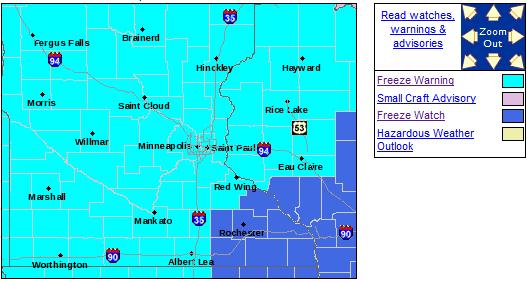
Kate gathered herbs and the last of the tomatoes.  We’ll have to cover the peppers.  Freeze warning tonight:  25-32 degrees.  She also picked raspberries and the leeks I needed for the winter vegetable soup.

(Minnesota freeze map, Sept. 22, 2012)

She also cleaned and stored our Zestra crop.  60 or 70 apples.  The bagged apples were in much better shape than the non-bagged ones.  That was on purpose to see if bagging really helped.  It’s such a pain I wanted to know for sure.