
Northern Burb’s Artists

Spring                                                                          Bloodroot Moon

The Northern Art Crawl.  Up here in the outer reaches of the urb artists live separate lives down country lanes and tucked into cul de sacs.  Up in East Bethel (and south of Eden, I’d like to say) Kate and I visited a glass blower, Doug Becker, glass maestro–on his card–who lives on 40 of the original 80 acres he grew up on.  His brother has the other 40 and is also a glass blower.
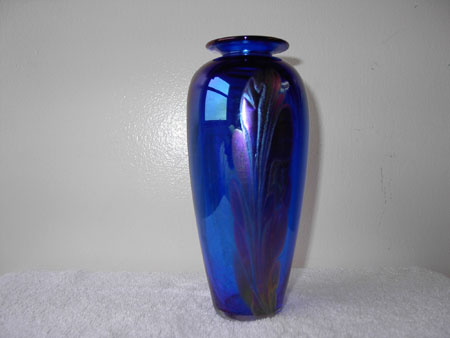
A blue collar artist, he got his start at Anoka-Ramsey Technical College, then went for a brief stint in Sweden.  He had a colleague from Cambridge displaying with him and an apprentice–a guy who kept showing up–working on a piece, opening and closing the door of the oven with foot pedals like an organ, blowing occasionally on a small orange blob of molten glass, then sitting down to rest the blowing pipe on two metal arms, a place to roll the rod while cooling and shaping the glass using a cup like tool with water and on occasion a stack of wet newspaper.

A cute boxer and a water spaniel wandered around, tried to get us to play while we ate sausage from the deli tray and watched.  We left, walking past his sculptural glass flowers planted, he said, where he puts his canna lilies.  The glass flowers light up.

His bass boat sat in the big garage attached to a smallish house.

Next was a domestic quality potter, a good thing for us, since we need to replace some bowls and platters.  His work has a journeyman’s quality, good enough for everyday use.  A friend of his turned wood in the garage, showing a wide array of bowls, mostly bowls.  Some well done and interesting, others finished in a hurry, like the end of Missing.  Need some work.

Perhaps the most intriguing place we visited was a blacksmith’s, Daniel Kretchmar’s Irontree Works.  His items on display were so-so, but I asked a question, had he ever made an ax?  This got the engineer cum teacher cum blacksmith going on iron, steel, carbon steel, quenching and 1800 degrees, orange where things happen.  You can tell, he said, if a piece you’re working is at 1800 degrees by holding a magnet to it.  If the magnet doesn’t work, you’re at the right heat.
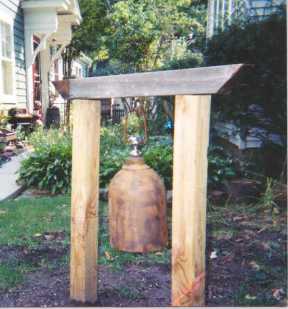
We also discussed, rather he discussed, iron blooms, pig iron, wrought iron–which is not made anymore and he gets his supply from demolished buildings–a great metal to work, and the making of his 81 fold kitchen knife with a random wave pattern reminiscent of the oft folded Japanese katana.  He teaches blacksmithing on Monday nights and I might go.  This craft has its adherents on Tailte.

The next to last stop was another glass blower, Jeff Sorensen.  He had been at it “37 or 38 years” and the fluidity with which he handled the pipe, at one point twirling it like a drum major’s baton to cool the work in progress, showed him a master of his craft.  His work displayed that skill as well.  We talked a bit about slowing down, about letting go of things we don’t need.  “Lots of things!”

I would buy from any of these folks.  Kate suggested we start using local artists as sources for gifts.  A good idea.  It’s another part of the art after the MIA process I’m still noodling.

The last stop of the day.  They had pamphlets about the Promise of Heaven, sappy water colors and pottery with a great glaze, used over and over again in pots of similar construction but different sizes.  Didn’t stay long.

Back to the homestead and a nap.
Not Sleeping

Spring                                                                    Bloodroot Moon

Sometimes my brain does not want to stop doing whatever it was up to during waking hours.  Not often, but sometimes.  Like last night.  Into bed.  Lay there.  Roll over.  Again.  Still awake.  And this after an intense workout with resistance.

Downstairs.  Print out some pages for our family meeting.  Dither here and there.  Read a couple of chapters in Robert Jordan’s Wheel of Time series.  This guy knows what he’s doing.  Or, rather knew.  He died at 58.

Back to bed 2 hours later.  Ah.

Now, though.  A little sluggish.  I gave up worrying about these things, these intermittent sleepless hours.  They’re uncommon enough and I’ve done what I can with a regular routine before bed, darkened room.  After a while I had to let it go and let it be.


Between

Spring                                                                    Bloodroot Moon

A rainy Saturday.  The snow has begun to melt faster and the front yard has a few wide expanses of what looks like moldy grass.  Which, of course, is what it is.  This next week or two will see the daffodil, crocus, scylla and bloodroot bloom.  Then we’ll have emerging and  blooming that will last well into fall.   Work for ourselves begins, too:  planting, weeding, tree felling, fire pit and area finishing, bee keeping, bagging the apple blooms in the orchard.  The dogs of course have hole digging, barking and animal hunting.

These kind of days are the portals between the seasons when one lets go, grudgingly, and the other insists, sometimes gently, sometimes not on ascendance.

A fire in the fire place, a good book.  Or, as I’ve got right now, another sentence from Ovid.

Rewriting

Spring                                                                     Bloodroot Moon

Up early and down to the western burbs to the beautiful home of Lonnie and Stefan Helgeson on the banks of Minnehaha Creek.  Stefan expanded on his written critiques of Missing, all helpful.  Each beta reader has had a different perspective, offering me a valuable look at the manuscript, that of the reader.

Here’s an example.  Each time I had a clearing in the forest, it had a stream.  Trouble is, as Stefan points out, streams don’t often flow through clearings since trees and shrubs tend to grow up along their banks.  What I had done, invisible to me, was provide a stream with a clearing each time the horses needed to stop for water.  In solving one problem I created another.  This kind of thing does not become obvious without help.

Others found the frequent use of the first person distracting from the story; Stefan found it engaging for exactly the reasons I had wanted to use it.  Perhaps the best solution lies somewhere in between.

This is the last but one of the beta readers to check in and I’m almost finished with my read through.  Probably this week.  Then, I begin revising in earnest, going back over everyone’s comments one more time, getting a preliminary strategy and starting the rewrite.

With five other novels written I know this revision process is the piece that has stood between me and publication.  Well, I can hear Kate say, there is that marketing piece, too.  And she’s right.  But the two together.  Then I can start working the various markets.  With the short stories, too.


An Old Idea Whose Time Has Come

Spring                                                                           Bloodroot Moon

In May some docent friends from the class of 2005, a rowdy class and proud of it, will go to
Chicago for a time with the arts scene there.  Like my visit to the National Gallery a couple of weeks ago this too will be an exercise in part in discovering how to keep the arts active and alive in my life.

One of us has decided to offer a mini-tour on an object at the Chicago Art Institute.  I decided I would do one, too.  My plan is to focus on methods of analysis, including the praxis idea I wrote about yesterday.

Ever since I got seriously interested in Ovid, my seminary education in biblical criticism has niggled at the back of my mind.  Why?  Well, biblical criticism, the higher criticism in particular, uses scholarly methodology for exegesis.  Exegesis tries first to get at the plain meaning of the text in its context.  It precedes the task of hermeneutics, that is, interpretation of the text for a contemporary audience.  What’s niggled at me is that neither exegesis nor hermeneutics is peculiar to the study of scripture.

In fact, exegetical method can be applied to other texts, whether in a foreign language or not, just as hermeneutics can be applied to the resulting exegesis.  As this thought persisted I kept wanting to create a method for using exegetical tools designed for literature in the service of art history.

Well, that day has arrived.  “Exegesis includes a wide range of critical disciplines: textual criticism is the investigation into the history and origins of the text, but exegesis may include the study of the historical and cultural backgrounds for the author, the text, and the original audience. Other analysis includes classification of the type of literary genres present in the text, and an analysis of grammatical and syntactical features in the text itself.” wikipedia article

Not sure yet whether I’ll venture into the realm of hermeneutics.  That may, in art, best be left to the viewer.

This also raises another profound idea I learned from the philosopher of religion, Paul Ricoeur, second naivete.  Ricoeur developed this idea to explain how a student of the higher criticism might use its critical methods on scripture, then return to the text later with a second naivete, one that includes the scholarly work, or incorporates it, while at the same time allowing the text to speak again as scripture.

My sense is that the idea applies to analysis of art as well.  That is, we can engage formal analysis, praxis analysis, style and methodological analysis, school, content analysis, then step back from all that and return to the piece with a second naivete which allows that work to enrich our immediate engagement with the work.  Anyhow, this is on my mind right now.

Going Out on the Town With My Sweetie

Spring                                                                        Bloodroot Moon

Kate and I went to the Macy’s Flower Show.  The Dayton’s flower show.  Anyhow, I’d never been but going once came because we’ve agreed that each of us has one time during the month that we can schedule whatever we want.  And the other one has to go along.

Last month we went to the Loring Pasta Bar to listen to Hot Club of France type jazz (Kate’s choice) and to the Cynthia Hopkin’s performance, This Clement World at the Walker.  In a rut already I’ve chosen another Walker performance, a jazz pianist and his ensemble late in the month.

Kate felt we weren’t doing enough together, too much like adults engaged in parallel play.  She quilts; I write.  She was right.  It was a habit and we broke it.  I’m glad we did.

The best part of today’s outing was the Smack Shack.  A food truck that turned in its wheels for brick and mortar the Smack Shack serves po’ boys and lobster boils.  We had the lobster boil complete with the bib, shell crackers and tiny forks.  I haven’t eaten lobster in a very long time and it was fun.

Turned out it was the Twin’s first day-time game this year, so I had to park about 6 blocks, long blocks, away–it’s on 6th and Washington North.  That turned out to be a treat because I could take a survey of this rapidly changing part of the city.  Lofts, luxury apartments, redone warehouses, new apartment buildings, lots of restaurants, design stores, gutted buildings and construction zones.  A fun, energized area, an area that used to be fairly dull commercial.  Not too long ago.

Art and Praxis

Spring                                                                            Bloodroot Moon

Here’s an interesting couple of paragraphs from a NYT article:  My Dinner With Dr. King.

“After dinner Dr. King asked Wanda if he could use the telephone again. When he came back, he settled onto the sofa next to me. I tried to think of something clever to say, but before I could speak, he asked why I was studying for a Ph.D. in art history. He asked what I thought art could accomplish that other forms of communication could not. I remember that he said that he’d rarely discussed art, or even thought much about it. As I stammered an answer I cannot recall, he listened with the concentration of someone who genuinely wanted to understand. Never before, and rarely since, had I witnessed such authentic humility. It was so simple, so powerful a form of energy that for a few moments it freed me from bondage to myself.

A conversation that cannot have lasted more than 10 minutes ended up changing the way I thought about my life. When I got back to New York, my viewpoint toward earning a doctorate shifted. The determination to use my education to become a famous scholar gradually made room for a half-baked resolution to become a useful art historian. I began to consider the moral or religious content of Renaissance art; and once I got a job teaching art history at an institution whose values encouraged me to develop that ambition, teaching became a means for me to help students identify and examine their own values. That remains my goal. The short conversation I had with Dr. King had a lasting effect.”

This touched me in two ways.  First, the power of unclouded attention.  It’s so rare, especially in the age of the always-on.  Consider how this conversation might have gone with I-pod buds in the ear.  Or, checking the smart phone for messages furtively.  Unclouded attention is something we can all offer to each other, the only price is our inner voice that wants to interject, comment, offer an opinion.

Second, it opens yet another perspective on art.  Or, rather, it emphasizes a perspective I search for too little, a particular work’s moral or religious content, and I would add, its political.  One example was the post I made in response to Roberta Smith’s snarky review of the pre-Raphaelite Brotherhood show at the National Gallery (March 31).  This line of inquiry, a mode of praxis analysis, can locate a work in time and space and in so doing also place it in a longer line of argument, comment, ideas.

(Dreaming of St. Adorno, Siah Armajani)

Since the art historical point of view so rarely focuses on praxis, “…the action and reflection of men and women upon their world in order to transform it,” (Paolo Freire), there is little danger to a work’s aesthetic relevance.

This lack of praxis analysis can be easily explained by the peculiar position of the art world when it comes to class structure.  Art is usually made by persons who are poor and who operate on the margins of a society.  Yes, by the time a work hits a museum, the artist may have become at least famous, perhaps rich, too, but the bulk of art comes from people of modest means.  Yet, art in its art historical moment too often has become a captive of the art market, a tiny, a minuscule portion of the global population and a very wealthy one.

Thus when art comes into the lens of history and makes it onto gallery walls it most often gets there as an expression of someone’s power, only after that does it get noticed as art.  Consider how most museums build their collections.  Donors.  Rich donors who often give whole their own collections.  This produces a trickle up, a siphoning of art through a long tube whose vacuum comes from the amount of money at one end.  Hardly the context for consideration of a work’s praxis.


Exciting

Spring                                                                      Bloodroot Moon

Been reading through beta reader #5’s comments in preparation for a face to face on Saturday.  At the same time I’m well into the last third of my own read through of the manuscript.  I’ve taken many notes, lots of ideas, some drastic, many substantial, some cosmetic churning around in my head.

Reentering the fictive dream for Missing will not be hard.  It feels like the Tailte mythos (the world on which almost all of  Missing occurs) has only begun to breathe.  It stretches and spreads its presence out in my thoughts.  I imagine the gods playing more active roles, Asian deities and Middle Eastern, in another set of stories.  The gods will begin to take on more important roles in Loki’s Children and the Unmaking, the two other volumes in this trilogy.

I took a look at short story markets today.  I want to polish up some of mine and get them in circulation.  The energy in the writing and translating has increased markedly, not only over the last couple of years, but even over the last couple of months.  Something exciting is happening and in part I’m just along for the ride.

My Bags Are Packed

Spring                                                                     Bloodroot Moon

Conversation over lunch with a docent friend whose experience at the MIA has grown stale.  The reasons are numerous in both our cases, among them: resenting the time for preparing for tours, no longer finding tours as nourishing (if at all), inadequate continuing education, uninspired leadership from the museum, lack of appreciation, lingering bad feelings over Allison’s sudden banishment.

I realized in this conversation that my dis-ease with being a docent began to blossom when I returned more seriously to writing.  Then, I began to feel tour preparation, the drive into the museum, the time there itself all eating into my creative time.  This changed over time into resentment (maybe too strong a word, let’s say begrudging) of the intrusive nature of the prep, the whole time involved.  The payback no longer balanced the effort.

That has led me to a final decision, I’ve toured my last at the MIA, but I still want to hold up my resignation because there are a few loose ends.  First, perhaps discovering a way those of us out of the MIA might co-operate.  Second, securing some things, like exit interviews and continuing perks for honorary docents.

Like me my friend wants to retain the time commitment to art, just not have it eaten up by the MIA process.  How that might happen is part of the conversation I want to have before finalizing my change.

A Sheet of Light

Spring                                                         Bloodroot Moon

Here’s a clip from a fascinating interview with Al Worden, command module pilot for Apollo 15*.  The interviewer identifies 7 men, all command module pilots for Apollo missions, as holding (having held) the loneliest job in the world.  Of course, it wasn’t in or on the world, but quite far away from it.  When these men were orbiting the backside of the moon, not only were they over 2,000 miles from their crew members; they were also further away from earth than any other human has ever been.

His description of the stars from there.  That’s what got me.


“You were a quarter of a million miles away from home though.

Yes, you’re a long way away but the thing that most impressed me about being in lunar orbit – particularly the times when I was by myself – was that every time I came round the backside of the Moon, I got to a window where I could watch the Earthrise and that was phenomenal. And in addition to that, I got to look at the universe out there with a very different perspective and a very different way than anyone had before.

What I found was that the number of stars was just so immense. In fact I couldn’t pick up individual stars, it was like a sheet of light. I found that fascinating because it changed my ideas about how we think about the Universe.

There are billions of stars out there – the Milky Way galaxy that we’re in contains billions of stars, not just a few. And there are billions of galaxies out there. So what does that tell you about the Universe? That tells you we just don’t think big enough. To my mind that’s the whole purpose of the space programme, to figure out what that’s all about.”

* from NASA Apollo 15 site

Mission Overview

The primary objectives assigned to the Apollo mission were as follows:

  1. to perform selenological inspections, survey and sampling of materials and surface features in a preselected area of the Hadley-Appennius region;
  2. to emplace and activate surface experiments;
  3. to evaluate the capability of the Apollo equipment to provide extended lunar surface stay time; and
  4. to conduct inflight experiments and photographic tasks from lunar orbit.