Coeptis

Beltane                                                                         Early Growth Moon

Greg, my Latin tutor, and I have begun moving through Ovid with an eye to a possible commentary, noting where I have difficulty and where we both have trouble.  These are the kind of things that can be expanded on in a commentary, as both aids to future translators but also as educational tools to broaden an understanding of this particular work and Ovid in general.

It’s difficult to describe my level of excitement about this.  After spending so long getting ready, we’re actually doing it and I’m a full partner, not as skilled as Greg at Latin but I’m focused on Ovid and have a lot bring to the conversation.  My translations have begun to raise fewer and fewer flags and my choices bring a fresh perspective to the work.

It’s fun.  I know that must sound weird, but I really enjoy this.  It’s detective work, history, poetry, mythology, philology and straight out brain work.  Complex and a bit arcane, my favorite.

At this point I can actually imagine translating all 15 books, 15,000 verses.  Who knows?  I’m also expanding my reading to Virgil and Horace, perhaps some Catullus, too.  I need to know other Augustan poets and their conventions to better understand Ovid’s work.

Here’s another oddity in all this.  When I finish a session with Greg, every two weeks, I feel like I’m done with classes and all I want to do is relax, read something or putter in the garden.  This is an old, well ingrained feeling, put into place over many, many years of education.

Latin and Art

Beltane                                                                 New (Early Growth) Moon

I passed some kind of milestone this week with the Latin.  My copy of Anderson, the commentary on Ovid’s first 5 books in Metamorphoses, fell apart.  I went online and found a hard back version, something that can withstand the repeated referencing, turning back and forth, putting my placeholders across it.  That this should happen just as I decided to begin work on the translation/commentary seems fortuitous.

(Daphne and Apollo)

In celebration of beginning the translation I have posted a Translating Metamorphoses page on the site where the most recent work will go up.  At some point I may begin posting work on the commentary, too, but that’s a ways off.  Right now Greg and I have just begun to note stuff down as we move along.

Translating in this manner is harder work than what I’ve been doing up to now, which has been essentially learning through translating Ovid.  Now I want to produce idiomatic English that is still faithful to the Latin text.  Also, I want to know more about the problems and content that I encounter.  That’s why I’ve begun reading the Ovid texts I’ve collected over the last year or so.  This is close reading, a different animal from just translating to learn.

At the same time I’ve created a new page, Art: A Journey.  This page will be the repository for my work on and with art following my time at the Minneapolis Institute of Art.  The first published material there, two sheets of questions answered by me about Edward Hopper’s Nighthawks, represent an attempt on my part to use exegetical techniques I learned studying the Old and New Testaments on art.

This draws me firmly into the realm of hermeneutics, a discipline about which I believe I may have some things to say.  We’ll see.  I’m still reading there.

Dystopia

Beltane                                                                                New (Early Growth) Moon

Dystopian cinema has a long history.  Think back to Mad Max which featured the rise of an unknown, Mel Gibson.   I know it goes further back than that, Planet of the Apes, for example, and Blade Runner and Soylent Green, even Metropolis in the way back, at least as far as cinema goes.  The Road. Minority Report.  Pleasantville. Stepford Wives.

I saw Dredd last night, a remake of a terrible Sylvester Stallone movie, Judge Dredd.  This one posits 800 million people living in an enclosed mega-city stretching from D.C. to Boston, the rest of the US an irradiated wasteland.  Just why the key corridor of power and population remained more or less intact is not explained.

It’s a not unfamiliar story of police trapped inside a high rise controlled by the dark powers, in this case, Ma-Ma, a female maker and distributor of slo-mo, a drug that makes the world slow waaay down, and matriarch of the Ma-Ma gang that runs this 200 story apartment block.  The Raid: Redemption, a recent Indonesian martial arts film, features the same plot line.  This is a much better movie.

It is, in a sense, Vishnu against the dark side of Siva, order trying to rest stability out of chaos.  This type of entertainment might puzzle a viewer who questions the need for this kind of story.  What’s the point?

(Pleasantville)

It can serve a conservative political outlook, highlighting the stakes our contemporary world faces when attempting to maintain order against the forces of social entropy, whether terrorism, drug cartels or low hemlines.  It can serve a liberal political outlook: see what happens if we don’t address social injustice while we have the resources and stability. They remind us of the dark impulses struggling in our own souls, the urges toward incoherence that each of us manages, more or less, each day of our lives.

Darkest of all, of course, they serve notice that the second law of thermodynamics will tear apart everything we love.  Time, that silent executioner, works with it.

(On the Beach)

When we watch these movies, contained in an hour or two of story, of course, we get the pleasant sensation of boundaries to the destruction.  Its story finishes, we turn off the TV or leave the cinema and it’s all over.  In this sense these movies are the opposite of what they seem, a pacifier stuck in the mouth of our infantile desire to live forever.

Over the Years

Beltane                                                                     New (Early Growth) Moon

“When you recover or discover something that nourishes your soul and brings joy, care enough about yourself to make room for it in your life.”

Jean Shinoda Bolen 

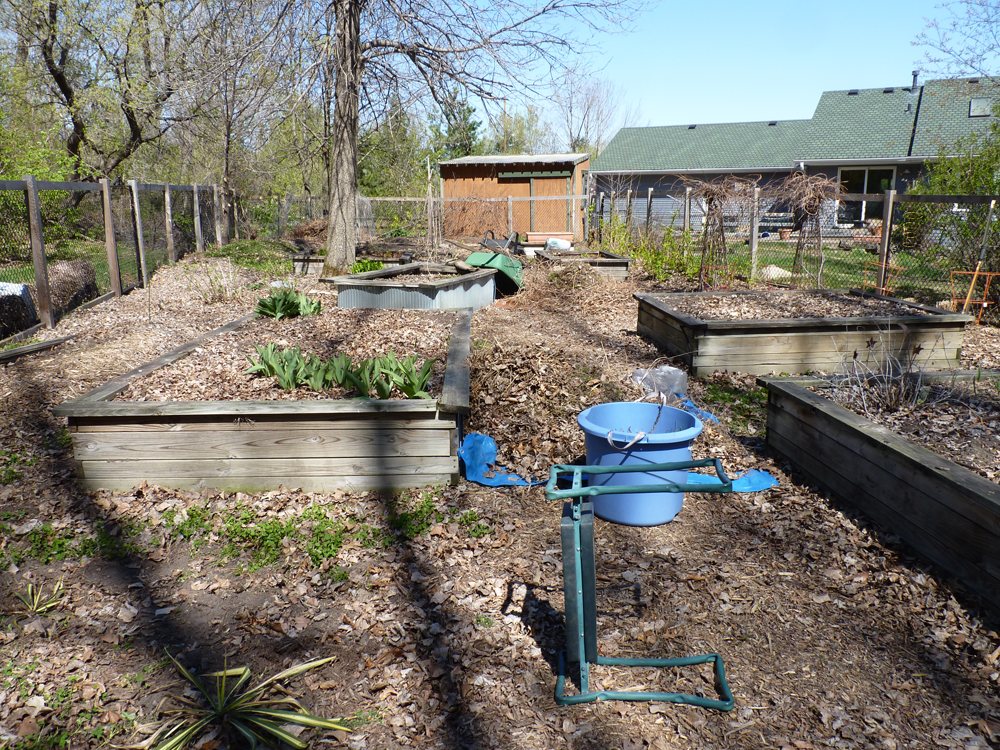
A nice rain, drizzly and over a few hours.  The irrigation folks are coming out on Monday to start up our system.  We’re under way for year 19 at Artemis Hives and Gardens.  We’ve never aspired to large scale production or to garden beautiful flower gardening, but we’ve kept at improving our property over the years, starting when we hired a landscape architect and Otten Brothers Nursery to give us key features even before we moved into this house.

They graded, installed beds, planted trees, shrubs and some flowers, created the terraced garden in the back and laid in the boulder walls.  Over the course of the next year or two I cut down the scrub black locust trees to clear a large area in our back, an area that would eventually become our orchard, our vegetable garden and a general purpose back yard with the grandkids playhouse, a machine shed and a garden shed.

Later we had the permaculture folks, Ecological Gardens, put in our orchard, then they added plantings to our vegetable garden.  We’ve done a good deal with our land over the years, adding value incrementally.  The bees came along five years ago with the assistance of a friend of Kate’s from her work.

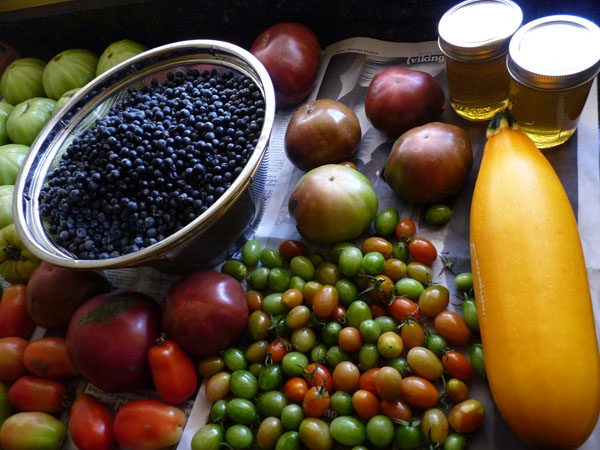
With each addition we’ve increased the level of our interaction with the land here in Andover, on the Great Anoka Sand Plain.  We added first vegetable production that Kate put in, then much more with our raised beds and finally the fruit trees, blueberry and raspberry and elderberry and currant and sand cherry bushes.  Each year we also take wild grapes from the vines native to our small woods.

It’s a good bit of work from May to October, but not overwhelming–except for that time period with the back–and it gives us part of our own food supply.  In the fall we harvest the honey, then Kate cans, freezes and dries.

Not to mention all the beautiful flowers we have all year.


Growing Up

Beltane                                                                   New (Early Growth) Moon

Cold, wet and occasionally sunny the short Minnesota growing season has finally begun.  Our cold weather planting is done, sometime in the next week we’ll put in our tomatoes and peppers.  Then, we wait for the sun to warm the soil, the rain to nourish the roots, carrying nutrients from the soil into the plants, elevatoring it up to the leaves where that true, abundant and necessary miracle photosynthesis will transubstantiate solar energy into the real body and blood.  Each leaf a priest, each plant a diocese.  A garden the whole catholic universe.

It is in here, somewhere, that reimagining faith will finally come home, right down here at that literally elemental level where the chemicals and elements of earth, soldered by sunlight make the essentials for life.  No photosynthesis, no life, at least on the surface of the planet where we live.  I understand there are different processes in the deep sea vents, strange creatures with arsenic in their veins, but up here, in the green world, we depend on–what a weak word–we live or die by this vegetative marvel.

It’s not as if there might not be gods, there may be.  There may be.  But I can think of no god that does more to sustain my life than the least of the leaves.  Here’s the nexus where sin and redemption must occur.  Sin makes our planet less hospitable for these; redemption conserves the planet’s soil, assures the availability of sun light.

(Gods Pantheon.  Ratteau)

Think of the crucifixion each year as soils leach out their nutrients, become so friable that they can blow away in the wind.  Think of the top soil, made fertile over hundreds of years, wasted in a season or two.  Think of the aquifers, draining themselves for our sake with no hope of replenishment in a hundred hundred human lifetimes.

How will we roll away the stone on this deep crime?  Who will stand at the tomb, that fine rising’ up mornin’, when the world cares for its soils and its forests and its lakes and its streams as if life of very life could not do without them?  Someday.  I hope.  Someday.

The Sibs

Beltane                                                                 New (Early Growth) Moon

Wish someone could tell me why the internet or the microphone or the video camera decides to not co-operate when I’m about to call my brother and sister.  Rationally, I know I notice it most when it interferes with something I’m about to do, but it sure seems like some mildly annoying other-world cyber creature gets its kicks on those days.

(Vishnu)

Resolved though and was able to talk to Mary and Mark.  Mark’s navigating a flare-up in his school, apparently not uncommon in Arab related ESL institutions.  A friend of Mary’s who spent 20 year in the Middle East has told her, “Never underestimate the Arab capacity for chaos.”  Mary has a trip planned to Mumbai and Pune with two of her Indian colleagues.

Why They Lectured In the First Place

Beltane                                                                             Planting Moon

I have begun reading various books I have collected about Ovid.  In Ovid Recalled, a book I started today, I found an odd piece of random knowledge that really made me stop.

In giving an example of outdated practices that persist in cultures the author, a Cambridge don, used the university lecture.  The lecture began as a work around because texts were not readily available in sufficient quantities, nor were they affordable.  After publishing became commonplace, the rationale for the lecture no longer existed.  My guess is you sat through as many as I did.

Now this made me think about the recent hooplah about massive open online courses or moocs.  One criticism of moocs from various university faculties is that they ruin the interactive nature of–you guessed it–the lecture.  All this reminds us that there is nothing fixed about professors and lectures and classrooms on physical campuses.  It just represents the most convenient to deliver education based on one set of assumptions; that is, gather students physically then disperse them among classrooms.

We can and should rethink all these assumptions.


Place

Beltane                                                                                 Planting Moon


All of us are from somewhere.  We may love that place or hate it or be indifferent to it, but it remains the unspoken standard against which we judge our present condition.  I understand that military brats don’t consider themselves tied to any location and I hope for their sake that that isn’t true, because a person without a place is a terrible thing to contemplate, so called world citizens to the contrary.

At certain times of the year our old home place gets brought to mind and late May is one of those times for me.  The greatest spectacle in racing, the Indianapolis 500 happens on the Sunday closest to Memorial Day.  It used to be on Memorial Day.

Right now in Indiana everyone’s focused on the time trials, the days preceding the race when pit crews tune the cars and the drivers familiarize themselves with the track and the way their car responds to it.  The Indianapolis Star has an entire section of motor sports and in these weeks it will feature special interest stories leading up to the race itself.

As kids, we would all pour over lap times, engine design decisions, who was driving which car.  We could handicap an upcoming race like old railbirds at the Kentucky Derby. (among whom used to my grandfather, Charlie Keaton)   In the 1950’s the old car design, large tires with a soapbox derby look sported Offenhauser 4-cylinder engines.  It was 1963 when Team Lotus brought in a mid-engine car, which came in second, then dominated until blowing a gasket in 1964 and finally winning in 1965.  That was the first race the Offy’s hadn’t won since their rise to dominance.

It’s hard to describe how radical it was seeing this small car, low to the ground, racing against the older style Indy cars.  This picture shows Jim Graham and the first Lotus entered in the 1963 race.  It looked like a different animal altogether than the old roadsters.  They were almost instantly extinct, along with the Offenhauser engine.

Up until Team Lotus the Indy affair had been a US event, but Jim Graham’s success and the amount of money available to win soon drew many out of the European based Formula 1 racing circuit.  Now the favorite is as likely to be from Brazil as from Noblesville, Indiana.

It’s also a much faster race.  The year I was born, 1947, the Indy was won by Mauri Rose at an average speed of 116.3, a pole qualifying time of 120.0 and a total race time of 4 hours, 15 minutes.  Ten years later, in 1957, Sam Hanks won the race at an average speed of 135.6 and a race time of 3 hours, 41 minutes.  8 years after that in 1965, the year I graduated from high school, Jim Graham won in the car you see above.   Average  speed, 150.7, qualifying speed, 160.7 and a race time of 3 hours and 19 minutes, almost an hour faster than 1947.  In 1990 the average speed was an astonishing 185.9, a qualifying speed of 223.3 and a race time of just 2 hours and 41 minutes.

After that year, as the downdraft devices and the quicker engines began to reach higher and higher speeds, the track began to impose limitations aimed at lowering the overall speeds and reducing the possibility of high-speed, multiple car fatalities.  Safer car designs, cabin designs and suit designs have made the driver risk less now than in the much slower days of the 1950’s, but fatalities still occur.

Dan Wheldon, a two-time Indy winner, and winner in 2011, died that same year in a race in Las Vegas.  (above:  wheldon’s 2011 winning car)

This post is about place, about a place defining event and its embeddedness in my own life.
Writing.

Beltane                                                                            Planting Moon

Writing and revising all morning.  A 1,000 new words.  More thoughts on how the story can unfold with fuller descriptive details, deeper character development and a unified narrative line.

More Ovid this afternoon.

In the wake of my resignation from the MIA I feel liberated, as I knew I would.  The sadness has begun to lift.  I will stay connected to my class, that will suffice in terms of relationships.  Just what it will take to keep me connected to the world of art?  Still unclear, but it’s something I can’t let slide either.

In fact, I’ll also be working today some more on Nighthawks and my interpretive matrix.  The world has so many opportunities, no matter your gifts or motivations.  I’m grateful, as my buddy Bill Schimdt says, to be Still Here to enjoy them.

Pruning. Good-Bye to the MIA

Beltane                                                                             Planting Moon

Pruning allows a shrub or tree to put its energy into productive growth whether it is a stronger trunk or better fruit.  It’s important to prune when a plant gets overgrown or has grown in ways that cut off the flow of air through the branches.  It’s also important to keep a tree, especially fruit trees, at productive sizes, ones where the tree puts its energy into apples, cherries, plums and where the fruit can be harvested easily.

This common garden activity, however, often confronts the gardener with a task for which they feel ill prepared and perhaps a bit nervous.  If I prune too much, will I kill the plant?  You can.  What do I take off?  Why?  It’s not unusual for home gardeners to skip this chore because it feels laden with risk while doing nothing seems to avoid harm.

The third phase requires pruning.  Leaving a job or a career is an act of pruning.  A move to a smaller home is an act of pruning.  Deciding which volunteer activities promote life and which encumber can proceed an act of pruning.

Last year I set aside my political work with the Sierra Club.  Today I have set aside my work at the Minneapolis Institute of Arts.  This is pruning, too, and the kind of pruning necessary at this point for me.

The branches that I want to grow strong are my writing and my translation of Ovid.  They both require regular, sustained hours on a week by week basis.  Both the Sierra Club and the MIA took me away from that concentration.

These were not decisions I made likely, nor are they decisions I made without a sense of loss. In the case of the Sierra Club I gave up my sense of political agency, long a hallmark of my life.  With the MIA I’m giving up a chance to be with kids and adults on tours and the regular stimulation of art in my life.  These are not trivial for me.

Yet.  In this last phase of life I want to focus my efforts in ways that give me a chance to succeed, instead of scattering them in the interest of multiple passions.