Archaeology of the Heart

Beltane                                                                         Solstice Moon

While watching a NOVA program on dogs, a reference was made to archaeology.  I studied archaeology and the broader discipline of anthropology seriously in college.  Seriously enough that I applied for doctoral work in theoretical anthropology.  Why I didn’t follow that up is a story for another time, but archaeology resonates for me and the mention of it in this context triggered a memory only recently interpreted.

Over the course of my life when confronted with the odd plumbing job or carpentry task, you know, the men things, I would fob them off with the stock phrase, “Oh, I learned everything my Dad knew about these things.  Nothing.”  And, as far I know, that’s a true statement in both instances.  I’m still not able in those areas though I admit I’ve never tried too hard to learn.

Kate and I work outside together a lot, though she works in one area and I work in another.  I found myself having a rising sense of impatience, irritation about her work.  Those who know me well would recognize this mood in me.  I’m not proud of it, but it does surface from time to time.  This time I knew my mood simply had no basis in reality.

Kate works hard.  She works well.  And she was doing both of those, as I know she always does, so this mood was about me, not her.  Suddenly buckets of water sloshing in the wee hours of the morning came to mind.  Uh, oh.  When we moved to our home at 419 N. Canal, it was the first, and last, home my father and mother owned.  We moved there in 1959 and my dad had his stroke there in the  1990’s and died after having moved to a nursing home from there.

In my years there, from 1959 to 1965, I don’t recall a service person ever coming to our house to repair anything.  Likewise, I don’t recall anything ever getting repaired.  Must of have happened, but I don’t recall it.  The only such incident I do recall was a recurring one in which our basement, which housed our furnace and little else, would flood.  When that happened, Dad would get me up and together we would bail out the basement, one bucket at a time.

Roused from sleep, cold and wet, these were not my favorite memories.  I do remember that as we worked, Dad would become silent, sullen.  In fact, I remember him being irritated and impatient with my willingness to do this chore.  Aha.  My memory of teamwork seems to be tied to those nights and I seem to have selected my father’s attitudes to carry on, carrying his water into my own life.  As sons often do.

Rethinking this time also made me realize a second thing.  Why didn’t Dad try to solve the problem rather than resort to such a makeshift solution every time?  I don’t know the answer.  It might have been money.  It might have been pride.  It might have been that these matters simply didn’t show up as problems to solve, but rather came up as problems to ameliorate.  Whatever the reason, I learned to be incurious about solving problems around the house.  Doesn’t matter.  Maybe it’ll go away or fix itself.

Now, I have owned homes since 1969, 7 altogether, one in Appleton, Wisconsin, one in Minneapolis, one outside Nevis, Minnesota, 3 in St. Paul and 1 here in Andover.  Over that time I’ve learned some very minor skills in home repair and one big one.  The big one?  Hire somebody.  Works most of the time.  As far as I can tell, solving day to day problems in the house is one of the few things I’m incurious about.  Fortunately Kate is better than I am and together we can call anybody.

The archaeology of our own thoughts and feelings is the most rudimentary and personal dig we will ever engage.  And that, I’m plenty curious about.
 

Are You An Infovore?

Beltane                                                                          Solstice Moon

So many information sources, so little time.  Those of us who are indiscriminate infovores have entered the paradise period of the human era.  It’s not only the internet, though it looms very large in easy access to information (see the snapping turtle info below), it’s also the smart phone and the services that disaggregate television programs and resort them into chunks we can watch all at once with no commercials.

While the physical information stream has begun to dwindle like an old man’s (oh, no, I won’t go there.), the condensation and availability of information continues to accelerate.  The mail box has little of interest anymore and the post office is beginning to hear the hoof beats of the Pony Express.  And books.  Heavy physical paper things.  So yesterday.  Meanwhile, I can get TED talks on so wide a range of topics that interest me that I can spend all day watching them.  And not get anything done.

And there’s the youtube talks I just signed up for from Big Think, mentors giving advice about their areas of specialty.  Also, I get e-mails from Foreign Affairs, the Chinese Human Rights folks, Big Think, Brain Pickings, Delancy Place, NASA, Trendline and others I’ve forgotten, each one with interesting, compelling information about things I didn’t know I had an interest in, but suddenly I do.

Managing our information streams is not something any of us have been trained to do.  Yes, we were taught to read.  And an increasingly small number of people read an increasingly large number of books.  But who was taught to watch youtube videos.  or TED talks.  Or to sort out condensed information like the folks from Big Think and Brain Pickings offer up for germane and reliable data.  Who can manage–and interpret–personal information available both to us as individuals and increasingly to government and large corporations?

Notice that I haven’t mentioned podcasts, audio books or the extraordinary ease with which we can receive music tailored to our tastes.  Pandora.  Playlists on I-pods.  Classical or current or jazz or oldies radio stations  Neither have I mentioned my all time least favorite, the robo-call.  Or, the old fashioned, but still extant slow information venues like theaters, museums and sports arenas.  Real time entertainment?  Now there’s an idea.

I’ve not got a handle on this and I don’t know who has, though I’d sure like to hear from them.  I’m eager to get as much information as I can, but now, like never before in all of history, the inflection is on the can.  And the limits on our capacity to get information are now chronological more than anything else, i.e. we can’t have our ears and eyes occupied 24/7.  God forbid.

How do you manage your information streams?  Or do you?  Do they manage you?  Leave you exhausted?  Or, energized, better informed and more able to be what and who you want to be?  An interesting dilemma of our time.

OMG.  How last century of me.  I left out social media.  Twitter, Facebook, this blog for example.  And, I thought I was being clever in inventing infovore.  Nope.  It’s the title of a book on Amazon.

Another Species

Beltane                                                                            Solstice Moon

Rigel has a small pink abrasion on her right nostril.  Kate showed it to me this morning.  We both concluded it probably got there via snapping turtle.  Here’s the story.

(chelydra_serpentina)

Rigel’s job is to patrol the fence line and warn off any invaders, be they dog, human, cat or, in yesterday’s case, snapping turtle.  Usually we let her do her job without intervention, but while I took a shower, Rigel set up an alarm bark that agitated all the other dogs.  And, in the occasional assertion of her coyote hound genes, she wouldn’t stop.  Usually, she barks at something, then, after a bit, calms down.  Not this  time.

Kate got up from her nap to go investigate.  Rigel had found a snapping turtle just on the other side of our chain link fence and had already expended considerable energy telling it to stay there.  Do not come in here.  This is my yard.  Stay out.  Go away.

Rigel and Kate returned to the house.  After my shower, and unaware of all this excitement, I let the dogs out again.  And.  They found the turtle, this time inside our property and, Kate, again going to see what was up, discovered Rigel  on her belly, legs out in front, barking at the turtle, but this time from a distance.  Vega patrolled the rear, going back and forth around it.  The turtle had gotten about halfway through our woods from our fence line paralleling 153rd to the rear fence line, traveling on a diagonal to a spot that was well over two football fields away.

Kate, who has taken the turtle as her totem animal, recovered the turtle, holding its shell at the rear.  Even then, she said, the turtle’s long neck kept snaking around toward her hands.  She removed the turtle to a position outside our fence line and we’ve not heard any new alarms.

Based on reading the material* below I imagine this was a female hunting for a place to lay her eggs. (see the video)

*Group:

reptile

Class:

Chelonia

Order:

Cryptodeira

Family:

Chelydridae

Habitats:

Breeding takes place any time that the turtles are active, but occurs most frequently in the spring and fall. During June, females travel to open areas that are suitable for nesting, and may travel 1 km (0.62 mi.) or more from water. Suitable nesting areas must be open and sunny and contain moist but well-drained sand or soil. Nesting areas are commonly sandy banks and fields, but also include gravel roads and lawns. The female uses her hind feet to dig out a cavity, and then lays 10-100 (usually 25-50) eggs, using her hind feet to guide them into the nest. The eggs are 2.2-3.2 cm (.87-1.25 in.) in diameter, white, and have a leathery shell. Once the eggs are laid, the female covers the nest with sand or soil and returns to water. Depending on the weather, the eggs will hatch in 50-125 days. Incubation temperature affects the sex of the hatchling turtles, with more females hatching during warmer temperatures, and more males hatching during cooler temperatures. Hatchling turtles use their egg tooth and claws to break out of their shell, and then must dig their way out of the nest and find water. When they emerge, hatchlings are 2.5-3.2 cm (1-1.25 in.) in length. Young turtles are vulnerable to predation and desiccation. From any given clutch of eggs, 60%-100% of the young may be lost to predators. Primary nest predators include raccoons (Procyon lotor), skunks, foxes, and mink (Mustela vison). In addition to these animals, hatchlings are also preyed on by large fish, large frogs, northern water snakes (Nerodia sipedon), and some bird species. Common snapping turtles are slow to mature, reaching sexual maturity in 5-7 years.

It’s Growing On Me

Beltane                                                                                    Solstice Moon

Becoming a horticulturist takes time.  Time learning plants, learning pests, learning flowers and vegetables and fruit.  Learning soil, chemicals.  Time with hands in the soil, with seeds and transplants and irrigation.  It takes failure.  Those tomatoes with the yellow leaves.  The potato leaves shredded by the Colorado beetle.  Over mulching that garlic. (which I did this year.)  It’s been a long time now since I started down this ancientrail.  Slow at first.  That garden at the Peaceable Kingdom.  Heating with wood there, too.

Small efforts on 41st Avenue in Minneapolis and Sargent Avenue in St. Paul.  Some more on Edgcumbe Road.  Mostly flowers.  Then this property.  We hired a landscape architect who laid in the first beds, added some elevation changes, planted the first plants, designed the early iteration of irrigation and rolled out the new lawn.  After that I learned about perennials, trying to get a seasonal symphony, color throughout the growing part of the year.

There was that two year correspondence course from the University of Guelph in London, Ontario.  It was good, laying down the conceptual basis for much of the work, though I feel I’ve under utilized what I learned in it.  Anyhow I have a A.A. degree in horticulture as a   result.

Kate started planting vegetables; I focused on flowers.  Somewhere in there I cut down the locust, as I said a while back.  Bought a big roto-tiller and tried the traditional surface of the earth garden.  Not good.  Got the raised beds.  They helped a lot by keeping grass and other things out of the soil.

That permaculture business made sense to me.  Design your gardens, your whole home around the way nature lays out the land in your area.  Become one with the land and use it to your advantage while giving back to it.  We’ve done some of that but I think it would have been better years ago, when we were just starting, still young enough to have the personal strength to work it.  It’s very complex and required more learning than I felt like giving it.

Now I’m focused on the bio-dynamic agriculture and horticulture of International Ag Labs. I would characterize my approach as pragmatic and eclectic, trying to integrate material from the traditional world, like the Guelph course, the more theoretical models like permaculture, organic and ag labs into usable information for our property.  There is just one permanent goal:  improve the land while providing ourselves with nutrient rich food.

The land and the plants will teach if you see what you’re looking at.  I’m still learning the language of our land.

Outside Inside

Beltane                                                                          Solstice Moon

Bagging apples again this morning.  Another hundred done, a hundred yesterday, at least that many, maybe more to go.  I don’t know how practical this would be for a commercial operation but for our purposes, it’s time well spent.  I have noticed that there are leaf rollers on many leaves and some of the baby apples have already been eaten into by either an insect or something else, but for the most part the trees are healthy and the baby apples are, too.  I also noticed that apple production seems heaviest on branches off branches that attach to the trunk.  Not sure what that means.

Outside and inside.  So this was outside, working with the apple trees, individual apples, leaves, watching as the sky grew cloudy and dark, feeling the heat begin to build.  Using my hands, opening the ziploc bag, placing it around the apple, sealing it with two fingers, checking the seal, moving on to the next apple, checking for fruit I missed.

All the time, too, I thought about how to create a ground cover that would keep the orchard neat, beautiful.  We had clover, but it didn’t fight off the grass and the grass keeps coming. Kate fights it, but the battle is a losing one.  We need a different solution.  I’m thinking suppression with high quality landscape cloth and thick mulch.  Javier, maybe.

Inside.  I’m writing this, reflecting on the time outside.  Trying to fit together a foreground/background idea that has popped up over the last day.  That is, when outside, my thoughts often turn inside, I become meditative, while inside, I often stay on task, up at the conscious level and it takes an effort to get inside.  So, in a sense, when I’m outside I’m inside and when I’m inside I’m outside.  Just a curious bit right now.

Shoulder Pain: The Continuing Story

Beltane                                                                                    Solstice Moon

My shoulder started hurting, bad, sometime in January, late.  Since I had just had an episode of patella-femoral syndrome, knee pain, that I had fought off with rest, I decided to try the same with the shoulder pain.  I stopped my resistance work, then took off for D.C. to see the pre-Raphaelite exhibit.  By the time I got back the acute phase of the pain had ended.  I went back to my regular workouts.

Still, there were lingering problems.  I couldn’t lift a grocery bag from below my waist up on to the counter.  At night, sometimes before sleep, pain localized in my bicep would be so intense I had trouble getting to sleep.  Though I always did.  Putting on a jacket hurt as did flipping the duvet up to get it straightened out after a nap or in the morning.

None of this was enough to cause me a lot of discomfort and most of the time I forgot about it, something I couldn’t do while it was acute.  Still, it was there and when it did appear it made me feel just a little less than I wanted to be.  At some point, too, when I did bicep curls and chest presses, my left bicep would weaken and stop working.  I didn’t want to stop my workouts for this minor of a problem so I just stayed away from the exercises that bugged my arm.

I was, in other words, glad to start physical therapy.  I waited a while to get the therapist my orthopedist had recommended.  It was good choice; David is quick and reassuring.  Over the last two weeks I’ve done the exercises, simple things.  At first mostly stretching.  Last week David added some strengthening exercises.

I no longer have the pain before I go to sleep though I sometimes wake up to some pain.  In general the arm is much less sensitive, though I still have some problem putting on a coat or flipping the duvet, but it is much reduced.  I’ve been able to return to the bicep curls and the chest presses.

It amazes me that this regular series of very small interventions can have such a significant effect.  And what I like best?  It’s non-invasive and non-chemical.


What Comes First?

Beltane                                                                                       Solstice Moon

Still trying to work out a way to give the garden what it needs and my other work what it needs.  Right now, this week, I’ve decided to work outside in the morning (my best work hours) until I’m caught up on critical garden chores:  broadcasting and transplant aids, bagging the apple trees and laying down leaves for mulch for example.

(Reinier Willem Kennedy – The source of life)

I’m done with the broadcasting and transplant aids.  I have the honeycrisp done and will move on to the other two trees tomorrow.  They have fewer fruit sets so they’ll probably be roughly the equivalent of the honeycrisp.  When that’s done, I’ll use the leaves from last fall to mulch the vegetables.  Probably finish on Wednesday.

Then I’ll focus back in on the writing and translating.  Getting a regular rhythm down was a primary reason I set aside the Sierra Club work and the MIA, but this interruption comes from decisions we made long ago to grow as much of our own food as we can and to do it in a way that improves our property over time.  So it may be that the real rhythm lies in recognizing the horticultural imperatives gardening brings during the growing season, making them number one during that time and fitting the other in around them.  Probably the sensible way to go.

Any ideas a reader might have would be welcome.

Quiet

Beltane                                                                             Solstice Moon

Night has fallen, quiet has over taken our already peaceful neighborhood.  Today has just watched yesterday slip into its pajamas, ready now for the long sleep, our past as dead and gone as any mortal perished.

[Gulácsy Lajos – Daughters of the Night (1900)]

I have surfed again on the oceans of mood, now back to shore ready to resume life again.  Writing. Translating.  But first finishing up the work that must be done now:  finish the transplant aids, bag the apples, put down some jubilate along the rows of seedlings.  The natural world does not allow for waiting.  It has its pace and either you adapt to it or it will ignore you.


Moving Toward Optimal

Beltane                                                                       Solstice Moon

In 12 days we will have the summer solstice and it is now 56 degrees and rainy.  A peek at 80’s may come, but until then June will remain like May.

My enthusiasm for various aspects of my life seem to ebb and flow, not so much on tides of the fabled ocean, Inspiration, but more on inner rhythms I do not fully understand.  When I began reading the e-mails from Jon Frank of International Agriculture Labs, he reminded me, again, of the reason I cut down the black locust so we could have space for gardens in the back.  And, again, of the various moments in time when raised beds seemed like something we should have, and which Jon (Olson) built so well.  Then the permaculture river began to run and it turned the water wheel of my energy for a while.

Each one of these impulses has come from deeper roots, seeds sown in the 1960’s back to the land movement, then expressed by the purchase of a farm outside Nevis, Minnesota in northern central Hubbard County.  They have also been nourished by work of an intellectual mentor, Scott Nearing and his wife Helen, who wrote Living the Good Life.

Kate has been there at each of those rhythmic changes, helpful and supportive.  Each one has added a bit to the whole and now I believe we are poised for an optimal garden and orchard, one nurtured by years of steady effort though from episodic sources.  Next year I plan to focus on the orchard in the way I’m focusing this year on vegetables with the High Brix Garden.  My goal is a good quantity of high nutrient food grown in a sustainable way right here at Artemis Gardens and Hives.

My hope is that this is the last piece to the puzzle of vegetable and fruit growing for us.  Then, with the help of Javier and his crew for the heavy lifting and skilled landscaping work, we should be able to stay here and thrive here as long as possible.  Our flower gardens, extensive, we have gradually moved toward very low maintenance and I feel that part of our grounds we understand, have a good to excellent handle on.

With Javier’s removal of the ash tree from our garden area and the addition of the High Brix nutrient program, plus the narrowing of the types of vegetables we will grow and the bagging of our apples, I feel we’re within a growing season or two of being able to say the same for our food crops.

Gardens and Bees

Beltane                                                                 New (Solstice) Moon

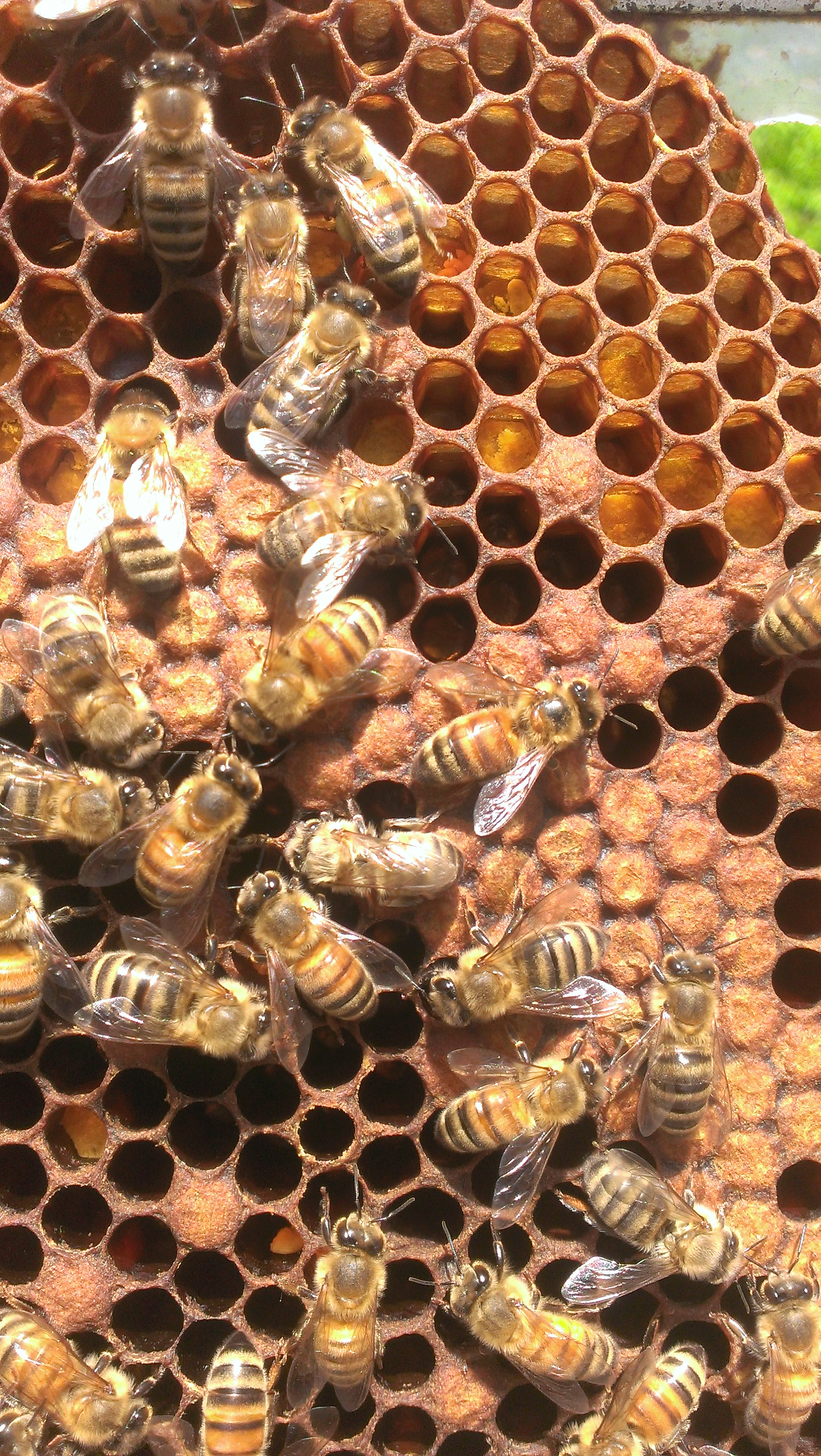
The day began with the bees, lively and growing, now well into the second box, already  filling two frames with brood, making honey and collecting pollen.  After the bees, more honeycrisp bagging.  Yes, this is a pain, but it’s a one and done pain.  That is, after you do it those apples are ok.  I may start a feeding program this year for the orchard,  but that’s separate from the immediate disease and predation prevention.

This is what horticulturists calls IMP or integrated pest management.  Basically you first support the plant because a strong plant can repel invaders.  Then you do physical things like picking the bugs off, bagging the apples.  Only after you’ve done these things–and there are many more than I’ve mentioned–do you consider a pesticide or fungicide.  I don’t resort to those, so my whole strategy comes on the first two legs of the stool.

After I got some bagging done, it was time to go pick up Bill Schimdt and head out to Plato, Minnesota to meet Luke Lemmer of High Brix Gardens.  Plato, Minnesota is about 5 miles west of Young America.  Luke is a husband and father trying to make a living selling bio-dynamic soil nutrients for gardens as an adjunct of International Ag Lab’s agricultural product line.

Luke had mixed the broadcast minerals and put our orders of drenches, foliar sprays and transplant aids in a box.  We spoke with him near the site of a new building he has planned.  He says this year his business has finally begun to take off.  His daughter came out, hugging him and looking down at the ground.  She had what sounded like a summer cold.  He explained the use of the various products and the schedule they require.

The site of his home used to house a hotel and beer garden back when Plato was more of a manufacturing hub.  It now has one factory and the grain elevator.  It’s on an east west railroad line.  A pretty little town, bucolic with all the green thanks to our rains of late.  300 souls.  A true small town.

Back home a nap, then I broadcast the minerals and dug them in on all of our beds and got most of the tomatoes, peppers, egg plants, kale and tomatillos treated with a transplant powder and water.  We’re really a bit behind the curve, since the broadcast will be done in the fall in the future and the transplant aids are made to use when putting the plants in the ground.  But we’re starting when we can.