
Wasted Years?

Spring                                                Mountain Spring Moon

Wondering about retirement, about the third phase, not from an abstract notion of this journey now, but from within it, on the path. I notice things like this. A weather blog I follow talks about the decadal oscillations (Atlantic and Pacific) that have a determining effect on drought patterns in the U.S. When the author says these may not change their influence until 2035, I quickly calculate. 92. That means I may live in the forest fire red zone knowing only drought conditions.

Work. I commented here about work, about Latin and writing, gardening and beekeeping as work. And it’s true that I experience them that way. When I call them work though, I sometimes find myself confused. Am I retired or am I working? Yes seems to be the answer. Perhaps I need a new paradigm.

What came to me as I wrote that last sentence was the Hindu notion I mentioned a while back, action without attachment to results. From within that idea it doesn’t matter, working or retired. Both. The doing, the acting carries the meaning, not the end. Related I think to the idea of the journey as the destination.

Yet, I admit that the culture comes up inside me, makes me wonder about the wasted years, all that time since leaving the church, now 25 years. What have I done? Which really means, of course, besides being alive how have you contributed to the world? I was taught, in that it’s obvious, it’s the way it is manner that culture defines for us, that work means results. A man is his attachment to results and the results make the man.

Results mean new law, building affordable housing, organizing citizen based power to balance philanthropic concentrations of wealth and to alleviate the pains of vast unemployment in Minnesota. Those were results a man could claim and in claiming lay down evidence as to his worth.

But. What if the novel doesn’t sell? What if the effort to market work is so weak that it never really has a chance? Does that invalidate the writing, the patience, the persistence necessary to conceive, execute, revise? Then, if the action does not have the expected result, does it come crashing down on the man, rendering him less a man?

Some days it feels like the answer is yes. If there is no book on the shelf with my name on the cover, then I am less of a man. If in writing, I have taken energy away from the political work which gave me tangible results, then I have contributed less than I could have. Have I allowed fear to dominate my marketing work over the last 25 years? Fear that I would be rejected time and again. Possibly. Does that erase the novels and short stories I have written? Or, to put it in the most blunt way possible, has it called into question all the “work” I’ve done in the past two decades and a half?

Some days it feels like the obvious answer is no. What is the result of loving a woman? What is the outcome of raising a child? Where is the success in a flower bed or a dog? All these most important actions rely not on the actions of the man, or at least not solely. Loving a woman does not make her a better woman, does not create an achievement. Raising a child, though important, does not make the child. Children make themselves, influenced no doubt by the parent, but still, the responsibility is theirs. The same with grandchildren. Flowers and vegetables grow, too, again perhaps aided by the gardener, but it is their task to produce a bloom or a fruit or vegetable. Dogs live their lives in the orbit of the humans who love them, but their life is the result and who can claim ownership of life itself?

Another angle. The taking in of knowledge, developing understanding, all the reading and attending to cultural artifacts like art, theater, chamber music, movies, what does that amount to? What is the result, the thing that matters? Is there any point to it all?

Not to mention that I have made almost no money for the last 25 years. Not none, but not enough to count.

As I write this, see it laid out on the page, though, I’m inclined toward compassion, toward acceptance of the man who has done what he has done with as much energy and passion as he has, a man who has stayed faithful to his wife, his son, his stepson and his family, dogs, gardens, bees, who has remained constant in following his inner path regardless of the outcomes.

Bill Schmidt’s find of this poem says what I feel better than I express it myself:

Love after Love


The time will come

when, with elation,

you will greet yourself arriving

at your own door, in your own mirror,

and each will smile at the other’s welcome,


and say, sit here.  Eat.

You will love again the stranger who was your self.

Give wine.  Give bread.  Give back your heart

to itself, to the stranger who has loved you


all your life…
 

Challenge Perceived Limitations

Spring                                                           Mountain Spring Moon

Apparently the dropout rate for language instruction is incredibly high. I believe it. There were several drop out points along the way in my Latin learning, moments when the thickness of my resistance seemed impenetrable.

Read the other day that it takes 600 hours of practice to become fluent in a foreign language. The same article said that learning a language was just hard, not impossible. Now it’s beginning to appear that this article had it right.

Thing is, it seems like I have way over 600 hours of practice translating. Now this article referred to learning, say, French, and admitted that other languages like Mandarin could take much longer. Maybe fluency and accuracy in translation are different, I don’t know, but it’s taken me a long time to get where I am and that’s still far from 100%.

Like most pilgrims, the journey was key to the adventure, but the destination has proved worthy of the path. Rationales for learning Latin developed over time. One was the third phase desire to keep the brain active, creating new neural pathways. The second, or was it the original one, involved making the stories of the Metamorphoses a deep and accessible resource for writing. The third was to challenge my self-perception as one who could not learn a language.

The first I don’t know how to measure. The second has been happening all along the way and, happily, the third was a successful challenge. Challenging self-perceived limitations is an important facet of life at any age, perhaps more so as we move well into our third phase.


The Mountain Docent

Spring                                                                Mountain Spring Moon

Two years ago this January I did my last work at the Minneapolis Art Institute, a Terra Cotta Warrior tour. Right after that tour I wanted a rest, so I signed out until June of 2103. By April, two years ago exactly, the thought of making multiple drives into the city a week had become less and less interesting, even with the art reward at the other end. By June I’d decided to step back and concentrate on Missing, the novel I finished about a year ago.

It was the right move for me and one I followed by also resigning my position as chair of the Sierra Club Northstar Chapter’s Legislative Committee. In April of 2014 it was time for another Ira Progoff Journal Workshop, this time in Tucson. The impetus to fall back toward home got another push. Kate and I were still in the process of learning about retirement, hers and mine.

Since this post comes from Shadow Mountain in the Rockies, it’s clear–in retrospect–that the homecoming urge had deeper roots. Family. We changed the entire location of our life to reflect that impulse.

But. Sometime in the summer of 2013 I created a file, Art after the Minneapolis Art Institute. Visit galleries. Go to exhibitions. Read art theory. Do research on individual artists. It’s taken until April of 2015 to find a path. The Mountain Docent is a path of discovery.


Even an encyclopedic museum like the MIA has limitations in its collection. Art is not only long, it is also big. An encyclopedic museum strives to have art from each era and each culture. Of course, few but the very biggest, like the Met, the Louvre, the Prado even come close to depth across all the eras and locations of art making and they still fall very short in certain areas. Often modern and contemporary art are weak due to the encyclopedic museum’s emphasis on completeness in telling the art historical story.

The Google Cultural Institute and its Art Project delivers a different work at regular intervals on blank web pages.  That made me see the direction my work with art could take. Here was an opportunity to transcend the limitations of even the most encyclopedic museums since the Art Project draws on work held in museums across the world. It also has the distinct advantage of introducing me to art, artists and artistic movements with which I’m unfamiliar. (Which is, I admit, a lot.)

Once the Art Project began exposing me to new work, options for gaining access to new work in other ways seemed to multiply. The Met’s Artist’s Project, mentioned below, has contemporary artists reflecting on works held in the Met’s collection. A viewer gains exposure to the artist who’s commenting and the art which they discuss.

Other venues will surface as time goes on. The unpredictable nature appeals to me. It allows me to investigate new artists and new works by old artists and share that learning. That was what I always enjoyed most about being a docent, learning and sharing. So the Mountain Docent will travel the world in search of art and artists that will interest and engage you. All without leaving Shadow Mountain.


Moon Over Black Mountain

Spring                                                            Mountain Spring Moon

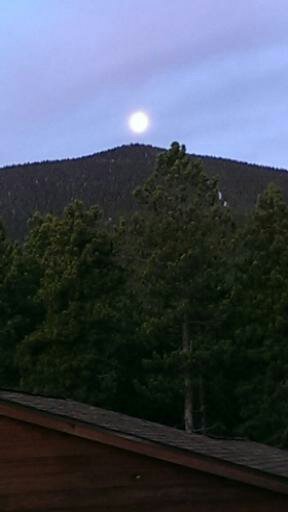
1428323496098Snow last night, not much but enough to coat rooftops and give the moonshine a reflective surface in the back. The moon hung directly over Black Mountain for a couple of mornings. Here’s a fuzzy (phone) photo taken from the deck off my loft.

An odd phenomenon with shifting my workouts to the morning. I get more work done in the morning. Then, though, the afternoon, late afternoon, seems to drag.

This will become my reading time for work related material. Right now I’m studying germline gene therapy for Superior Wolf. I’m also reading an older historical fiction piece called The Teutonic Knights by Henryk Sienkiewicz. Written in 1900 it is a great read. Sienkiewicz was prolific, author of many other works of historical fiction, including Quo Vadis. The Teutonic Knights have a role to play in Superior Wolf,so that book is work related, too.

I count Latin, writing and reading to support them as work, as I do gardening and beekeeping. Some people would count these as hobbies, especially the gardening and the beekeeping, but for me they represent the non-domestic parts of my day and have done for many years now.

At least for me a day filled only with meals, leisure reading, volunteer activities, shopping would be lacking a contrast, the contrast provided by labor with a forward progression, aimed toward an end of some kind. As I wrote before, I’m learning to detach myself from the results of this work, but that doesn’t deflate its value. Hardly. Work remains key to a sense of agency, a sense that does not come from merely sustaining life. For me.

Mentioning work, Kate made me a spectacular wall-hanging with vintage Colorado postcards.

Dazzled

Spring                                                       Mountain Spring Moon

Dazzlejazz is a the kind of jazz joint I’ve always wanted to discover: an intimate space, good food and great music. We heard music by Claude Bolling, four pieces, a couple of folks we didn’t recognize and one composer, a Ukranian, new to us, named Nikolai Kapustin.

The listening room, where we ate, insists on turned-off cell phones and no conversation during the performances out of respect for the musicians. It appeals to me, but it does take away some of the joint nature of the place. But not much.

The first set featured a saxophone quartet. The manner of the composition echoed throughout most of the pieces. The music began in a classical vein, a slow exposition setting up a more complex rearrangement of the initial lines in movements to come. But. Rather than segue into a gavotte or an adagio or a largo the playing took off in a jazzy, sometimes discordant direction. It became plaintive and solos broke out into innovative twists. This was by a composer named Frederickson.

The next set was the Toot Suite by Bolling,  trumpet backed up by a jazz trio. The pianist, in particular, was very good as was the trumpeter. Again, a slow exposition, then, a sudden crash of the drums and the piece was off. The trumpeter reminded Kate of Bradford Marsalis. All the Bolling pieces were wonderful, suites for trumpet, flute, cello and violin.

There were two surprises. The Kapustin piece had a violin and piano, both played by

young women from local universities, both Russian and charismatic. His work is worth getting to know.

The second surprise was the finale, a flamenco played on the harp by a woman introduced as expert in special methods of playing the harp. She glissandoed and strummed, then, near the end, began whacking the harp’s base as the imitated the clacking of castanets. She finished with a flourish, left hand in the air. Ole!

The food was good. The company better and the music just right.


Felix

Spring                                           Mountain Spring Moon

A couple of weeks ago we stopped at the Simms SteakHouse after seeing the Red and Brown Water at Curious Theater. Found the Steakhouse unremarkable, but our waiter told a fascinating family tale. Obviously Mexican, Felix at first observed that he came from a family with 9 sisters so he always gave a woman options. Referring to something he thought Kate might want.

He went on from there to describe his extended family. He has 100 first cousins. When I asked him if they ever got together, he said yes at the patriarch and matriarch’s ranch in the panhandle of Texas near Amarillo. Grandma was the iron law of the clan. One of her rules was never take an argument to the table. “I can fix any argument with food,” Felix said, in explaining this. After the meal is over, the argument is usually forgotten or much reduced.”

Felix, his mother and his oldest sister are the triumvirate. His word. They handle a large family fund, created by donations from all the different family groupings. “We’re basically self-insured. If someone has an unexpected medical expense, repair, that sort of thing, and don’t have enough cash, we loan them the money and work out a payment plan.” This fund also covers the cost of family gatherings at the ranch.

Felix has a restaurant style kitchen in a large dining hall there and he does all the cooking. Before a gathering he announces a menu, the cost and the money flows before the event. At a family reunion, only parts of the family come at any one time, though every seven years they do have a whole family affair, a relative blocks out rooms at a local hotel. “Sometimes every guest at the hotel is a member of my family.”

They organize a shuttle between the hotel and the ranch. Others can stay at the RV park they have built on this 40 acre ranch.

Habits Changing

Spring                                                       Mountain Spring Moon

That new habit? Already changing. Figured out that drinking lots of water during my afternoon workouts made my night’s sleep get interrupted. Often enough to be annoying. So, I moved my workouts to mornings, starting this morning. Several positives came into focus in addition to having the whole day to get rid of excess water: cooler, a good thing for summer days. Leaves afternoons and early evenings free. An endorphin boost in the am is good. No sun coming in through the loft door makes the TV easier to see.

So, I have to rejigger my schedule again, accounting for the first hour of the day as exercise, then breakfast. Thinking about that now.

Tonight Kate and I will go into Denver to Dazzle Jazz for an evening of jazz in classical music. A good mix for us since we’re classical music and jazz fans, about 5% of the musical audience according to a DJ from KBEM in Minneapolis

I just reviewed the first pass at the light and shade study. We may not have many options for vegetables. I’m going to repeat the study in a month with better defined areas and more systematic spots for taking the pictures, make them uniform from hour to hour.

Sombra y Sol

Spring                                                          Mountain Spring Moon

Light and shade photographs. Every hour I’m taking shots of our yard, searching for duration of sunlight at given spots. Vegetables need around 8 hours, a pretty high standard for most yards with trees and buildings. Some flowers and other perennials can get by with less, some thriving in part shade.

Of course, there are other factors at play here, too. One is that we’re closer to the sun and have less atmosphere to block out the UV radiation, so plants can burn. Another is that we’re west of the 20 inches of moisture per year line, meaning that in most years we get less than that. Vegetables, again, need plenty of water. Witness the struggle going on in California’s Central Valley to keep the farms watered. Most flowers and perennials can get by with less than vegetables and here in the West there are many species and varieties already adapted to the xeric environment. That’s what we’ll be looking for when it comes to plantings for aesthetics.

As or more important than all of these are temperature fluctuation and maximum temperatures. Temperature fluctuations can be extreme here, but they’re not a huge problem as long as they remain above 32. The average last frost here is early June and the average first frost around September 20th. Maximum temperatures can interact with aridity and UV exposure to increase the likelihood of burning plants. Also, some vegetables, notably tomatoes, need sustained warmth to fruit.

Not sure how much we’re going to get done this year, probably reconnoiter, meet others who garden up here, try a few things. Next year will be bees and garden. Of course, we still have to sell that Andover house.

A Mountain Spring

Spring                                         Mountain Spring Moon

This morning, as I walked up the stairs to the loft, the full Mountain Spring Moon sat atop Black Mountain. It’s silvered white contrasted with the bulky green of the mountain. Birds chirruped, a cool breeze blew through the Ponderosas. And it was otherwise quiet here on Shadow Mountain.

The snow has uncovered emerald patches of moss against the tan-pink rocky soil underneath the pines. Small tufts of grass have begun to green and the Bearberry, an evergreen groundcover, has toned up its color. All around us the Rockies announce, in ways still subtle and nuanced, that wonder of the temperate zones, spring.

Yes, there are the more metaphorical announcements, pesach (Friday and Saturday) and Easter (today), and they do remind us, in their convoluted way, of new life, life saved by the turning of the Great Wheel and the power of the true god, Sol.

This is the moment promised in the barren days of deep cold when the Winter Solstice gave notice that once again light would triumph over darkness. Then the days began their gradual lengthening, a process about halfway done at the equinox, but done enough that Sol’s waxing power shakes the slumbering plants and animals. Grow, move, live.

The Great Wheel turns, turns, turns. It will keep on rolling through the sky until at the Summer Solstice, when light reaches its moment of greatest advance, the balance will change again, the days growing shorter, the night beginning to expand.

Getting There

Spring                                             Mountain Spring Moon

To get to the seder we left Conifer at about 3:30 and drove into Denver, ignoring I-70 traffic, “that I-70 mess” as our mortgage banker called, we stayed on Hwy 285 to Monaco and drove up through the city from south to north. This has the additional advantage–to my sensibilities–of seeing the city as it changes from southern suburbs to its northern most neighborhoods, passing on the way through an area with streets named Harvard, Yale, Bates, Vassar, then Wesley and Iliff. This last is also the name of a Methodist seminary located on the campus of Denver University.

Going further north Monaco bisects the Cherry Hill neighborhood, a 1% enclave. Further on housing changes from low rise apartment complexes and condominiums to ranch style, one story smaller homes, but with big yards. Then Monaco becomes a four-lane boulevard with a park-like central strip and brick homes, some resembling small castles, others futuristic. Here the flowers bloom. Finally, we get to Martin Luther King, which extends to the eastern edge of Denver through the Stapleton new urbanism development. But we’ll turn on Pontiac, well before that.

On Pontiac we enter a predominantly African-American neighborhood, a couple of blocks west of Quebec, formerly a boundary street for the old Stapleton Airport and along which hotels were built to accommodate air travelers. Behind the hotels grew up a community filled with one story homes with little square feet and often desperate looking lawns, sometimes littered. It includes, too, the same homes with neatly groomed topiary, lush grass and, on Jon and Jen’s block, some older two-story homes, residue of an era before the airport was built, probably of an era before Denver reached this far toward Kansas and Nebraska.

Jon and Jen’s home was, according to house lore, originally a residence for a local farmer. Could be. They’ve done a lot of rehabilitation, adding on a new kitchen and dining area, plus a bedroom for themselves above. Jon’s done the bulk of the finishing work including tiling and plumbing two bathrooms. Outside Jon has several garden beds, fruit trees, a grape arbor, a tree house and a work shed where he produces hand-built skis.