Samain Bare Aspen Moon
 Think I’ve figured out my kabbalah presentation. Still a bit rough around the edges but that’s going to be part of it. It’ll be a how to think with the tree of the life as a touchstone example, using the Great Wheel as an instance.
It’s been a difficult couple of weeks trying to figure out whether or not I’m trying to put the cliched square peg in a round hole. That is, can the Great Wheel be interpreted from within the tree of life’s basic framework? Or, vice versa.
My tentative conclusion right now? Yes, they both speak to the same essence, to a fundamental truth about the nature of reality as we humans experience it. Both abstractions focus us on the dynamic of life arising from the inanimate and returning the borrowed elements to the inanimate at the end of a cycle. We could call it entropy, but entropy does not have the revivifying element of both the tree of life and the Great Wheel.
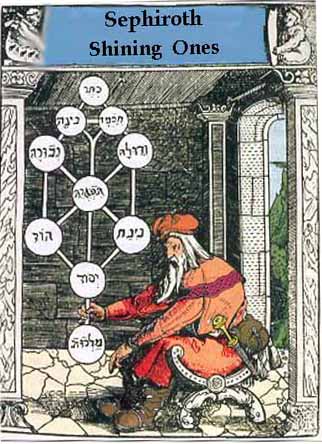 This a crucial difference between a secular, scientific world view and a mystical one. Entropy posits, as I mentioned in a post not long ago, that all things die, including death, I suppose. The Great Wheel and the tree of life challenge that grim metaphysics with an alternative.
In the tree of life emanations from the keter, or crown, flow down through the ten sephirot, emerging after a journey through possibilities and limitations, into malchut, the realm of the Shekinah or the feminine aspect of the divine. This is the daily reality you and I experience. Rabbi Jamie uses the illustration of a fountain with metal leaves (the sephirot) that catch the emanations, then direct the flow downward toward malchut. This could be entropic. Divine emanations could flow down to malchut, exist there for awhile, then simply disintegrate, disappear. Or, they could all flow down to malchut until it was filled, then the flow would stop. The heat death of the universe could be seen as such a result for the big bang.
But this fountain flows both ways. Malchut, as Rabbi Jamie explains it, is also a pump and the fountain sends water (divine energy) back up the tree of the life, returning it to the ein sof, the infinite oneness. Repeat until God is repaired.
 God became fractionated during the tzimtzum, the contraction of divine energy that made the finite possible. This idea is still difficult for me, but I’m just accepting it for the purposes of this presentation. During the tzimtzum the infinite light, ohr, tried to manifest in the finite, filling the space created by the contraction, but the vessel, things, (ein sof = no-things, infinity) could not hold it and shattered. That shattering created all the elements that now make up our universe. (and other universes, too) Trapped inside all of these elements is the ohr. The ascent and descent of divine energy, from the keter to malchut and backup through the sephirot to the keter from malchut, is the way the ohr will once again join with the infinite. How? No clue.
OK. So how does this correlate, if at all, with the Great Wheel? The Great Wheel divides into two halves, a fallow half beginning at Samain and ending at Beltane when the growing season begins. That’s roughly from October 31st to May 1st on the Gregorian calendar, but of course the reality varies by latitude and altitude. The key thing to consider here is a growing time, a time of vitality and, not only vitality, but vitality created from the inanimate materials of soil, air and sun followed by a fallow time when plants die back, when the animate returns to the inanimate.
 This is a malchutian manifestation, I think, of the ascent and descent and ascent again of divine energy represented by the tree of life. Why? Well, until the divine energy passes through yesod and becomes real in malchut, it is hidden, invisible, just like the vivifying function of the soil and the air and the sun is hidden during the fallow time. Both represent the cyclical nature of things coming into existence from apparent no-thing, then returning themselves to the invisible, the hidden.
Whereas the summer solstice could be seen as a major holiday for malchut, so the winter solstice could be seen as a major holiday for the keter and the ein sof. The summer solstice is a celebration of growth and fertility, the winter solstice a celebration of darkness and hiddenness, the depth (or height) of the nine sephirot and their crown.
Now it could be said, and I have said, that the Great Wheel represents cyclical time and that the notion of time itself is a matter of mental organization for the human mind. It could also be said that the very nature of the Great Wheel limits it to malchut since it expresses the seasonal changes of our particular planet. I believe, at least right now, though, that the Great Wheel instead reveals the universal nature of life on our planet, in malchut, as a simulacrum of the energy paths of the tree of life.
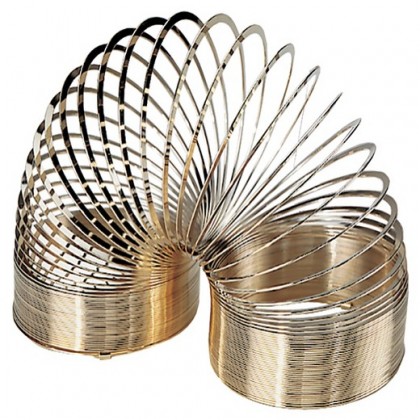
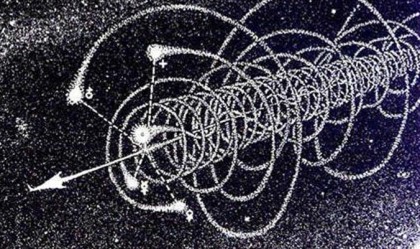 The slinkys I will hand out, tiny one-inch ones, illustrate what I mean. The Great Wheel turns through one year, one orbit around the sun, then repeats and is, in that, cyclical and not chronological. But, if you link this orbit to that one we get a spiral as our rapidly moving planet follows our solar system around the galaxy at unimaginable rates of speed. The Great Wheel then extends in space, in a spiral, this year’s revolution becoming another while the whole planet and its sun captive neighbors push further and further around the Milky Way. And, just to add complexity, as the whole galaxy moves, too.
 Wednesday, adult Hebrew at 4:30 with Rabbi Jamie. Then, kabbalah at 7 p.m. Thursday. Mussar at 1 pm. Then mussar leadership group at 6:30 p.m. Result? Both nights up past my bedtime and an 8 a.m. rising this morning. Oooffdah, as we would have said back in the land of the frozen mustache.
 Judaism is humane and that aspect of it appeals to me. A lot. Example. Rich Levine, the lawyer who did our estate documents, attended the MVP meeting last night. He had, he said, with his brother just unveiled his father’s gravestone. Is this a common custom, I asked? Yes, he said, most if not all Jews follow it. A loved one is buried, then not more than a year later, a gravestone is erected. The wait considers a journey the deceased needs to make that can last as long as a year. But, Rich said, you don’t want to make them think that you think it would take them a whole year, so usually the gravestone goes up somewhere between 10 and 11 months after burial. Much less fraught then.
 My sweetie took me out to lunch at Okinawa Sushi to soothe me. Rigel also ate the mustache trimmer I had received and unboxed only an hour before. So, double aarrggh. We may have to consider where we deposit things. It’s possible Rigel is a neat freak advocating for a clutter free home.
 CC’s work with Maslow sparked a conversation about the difference between human agency in moving up the pyramid as opposed to the necessity of God’s agency. Within my worldview this is a false dichotomy, but the conversation was fruitful. It’s a false dichotomy to me for two reasons. 1. How else would God move someone up the pyramid save through human agency? 2. Since I see energy moving up and down the tree of life, from the invisible to the visible and back through the visible to the invisible, this energy flow is the key agency involved, imh. I might call it chi, or prana, or l’chaim. Could also call it divine or vitality or consciousness. I don’t see that adding God to the conversation accomplishes much.
 In the end I felt heard and honored for my understanding of the relationship between the cyclical turn of the seasons and the meaning of the tree of the life to kabbalists.
 Since I have long believed that the world’s religions are philosophy and poetry accessible to all, I remain eager to learn from them. Since I know their claims cannot all be true, I choose to remain outside them, yet to walk with them as part of my journey. During college, when fellow students were turning to Asian faiths: the hare krishnas, zen, tibetan mysticism, I believed that the religious traditions of the West were most culturally attuned to the American mind. I still believe that and find Judaism and its traditions and thoughts, like Christianity, trigger a depth of understanding I don’t get from the Asian faiths.
 Just noticed a quirky reminder of Coco and the song that saves Hector, Remember Me. Each time I have to login into a site, I enter a username and a password. Then, just below the blanks for those is a small square to check or not. It says, remember me? It reminds me, too, of the posts of the dead on Facebook. I can’t think of anyone else right now, though I know there are others, but I still get the occasional reminder for Kathleen Donahue who died two years ago from lung cancer. In my instance there is the now quite long trail of bytes and bits that breadcrumb my life over the last decade plus. Perhaps we could create


 During the conversation on gratitude we talked about the wonder and awe available to us always, in any given moment. I asked, “I believe the world is always wonderful and awesome if only we pay attention. So then a question is, what blocks us from seeing it. What’s the barrier?” Rabbi Jamie, in his way, came up with seven reasons, three major and four minor. I don’t recall them all, but he included over-sharing and numbing. How can we lean into gratitude, rather than self-absorption?