Fall Waxing Harvest Moon
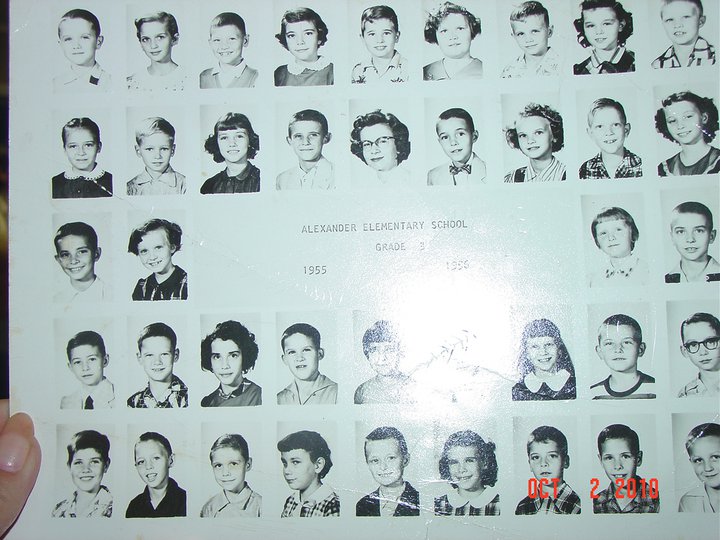
Identification quiz. Can you find Charlie Ellis in this class composite? Hint, for some reason he’s the only one with a sport coat and tie. In the third grade!
Fall Waxing Harvest Moon
Identification quiz. Can you find Charlie Ellis in this class composite? Hint, for some reason he’s the only one with a sport coat and tie. In the third grade!
Fall Waxing Harvest Moon
Carreen Heegaard sent these along. My favorites: Frisbeetarianism and pokemon. What about you?
The Washington Post’s Mensa Invitational once again invited readers to take any word from the dictionary, alter it by adding, subtracting, or changing one letter, and supply a new definition.
>>
>>
>> Here are the winners:
>>
>> 1. Cashtration (n.): The act of buying a house, which renders the subject financially impotent for an indefinite period of time.
>>
>> 2. Ignoranus : A person who’s both stupid and an asshole.
>>
>> 3. Intaxicaton : Euphoria at getting a tax refund, which lasts until you realize it was your money to start with.
>>
>> 4. Reintarnation : Coming back to life as a hillbilly.
>>
>> 5. Bozone ( n.): The substance surrounding stupid people that stops bright ideas from penetrating. The bozone layer, unfortunately, shows little sign of breaking down in the near future.
>>
>> 6. Foreploy : Any misrepresentation about yourself for the purpose of getting laid.
>>
>> 7. Giraffiti : Vandalism spray-painted very, very high
>>
>> 8. Sarchasm : The gulf between the author of sarcastic wit and the person who doesn’t get it.
>>
>> 9. Inoculatte : To take coffee intravenously when you are running late.
>>
>> 10. Osteopornosis : A degenerate disease. (This one got extra credit.)
>>
>> 11. Karmageddon : It’s like, when everybody is sending off all these really bad vibes, right? And then, like, the Earth explodes and it’s like, a serious bummer.
>>
>> 12. Decafalon (n.): The grueling event of getting through the day consuming only things that are good for you.
>>
>> 13. Glibido : All talk and no action.
>>
>> 14. Dopeler Effect: The tendency of stupid ideas to seem smarter when they come at you rapidly.
>>
>> 15. Arachnoleptic Fit (n.): The frantic dance performed just after you’ve accidentally walked through a spider web.
>>
>> 16. Beelzebug (n.): Satan in the form of a mosquito, that gets into your bedroom at three in the morning and cannot be cast out.
>>
>> 17. Caterpallor ( n.): The color you turn after finding half a worm in the fruit you’re eating.
>>
>> The Washington Post has also published the winning submissions to its yearly contest, in which readers are asked to supply alternate meanings for common words.
>>
>> And the winners are:
>>
>> 1. Coffee, n.. The person upon whom one coughs.
>>
>> 2. Flabbergasted, adj. Appalled by discovering how much weight one has gained.
>>
>> 3.. Abdicate, v. To give up all hope of ever having a flat stomach.
>>
>> 4 esplanade, v. To attempt an explanation while drunk.
>>
>> 5. Willy-nilly, adj. Impotent.
>>
>> 6.. Negligent, adj. Absentmindedly answering the door when wearing only a nightgown.
>>
>> 7. Lymph, v.. To walk with a lisp.
>>
>> 8. Gargoyle, n. Olive-flavored mouthwash.
>>
>> 9. Flatulence, n. Emergency vehicle that picks up someone who has been run over by a steamroller.
>>
>> 10. Balderdash, n. A rapidly receding hairline.
>>
>> 11. Testicle, n. A humorous question on an exam.
>>
>> 12. Rectitude, n. The formal, dignified bearing adopted by proctologists.
>>
>> 13. Pokemon, n. A Rastafarian proctologist.
>>
>> 14. Oyster, n. A person who sprinkles his conversation with Yiddishisms.
>>
>> 15. Frisbeetarianism, n. The belief that, after death, the soul flies up onto the roof and gets stuck there.
>>
>> 16. Circumvent, n. An opening in the front of boxer shorts worn by Jewish men
>>
Fall Waxing Harvest Moon
60 pink daffodils have a new home in the soil surrounding two cherry trees and a pear tree. These trees are the first ones visible out our kitchen window, so the blooms will cheer us up as spring begins to break winter’s hold next year. Bulb planting relies on, requires darkness. Beauty, like Snow White, goes to sleep beneath the autumn sun and lies as dead all winter long. With the kiss of the sun prince flowers emerge. Perhaps the years I’ve spent planting bulbs in great numbers, as many as 800 in some years, triggered my affection for darkness. In the first few years of daffodils, hyacinth, tulips, snowdrops and croci I often thought of those bulbs, covered in snow and cold, waiting out the winter in their castle of food and nascent stalks, leaves and flowers, a feeling similar to the one I get now when I’m at work in the garden and a bee, a bee from Artemis Hives, alights on a flower near me. Both of us, insect and human, have valuable work to perform in the garden and we labor there as colleagues in every sense. The patience and persistence of the bulbs beneath the snows and cold of December and January has always touched me, a sweet feeling, a well-wishing for them in their lonely underground redoubts.
That’s part of the darkness focus. Another, earlier part, came when I began to feel uneasy with spiritual metaphors that took me up and out of my body. Heaven. Prayers that go up. God being out there. The minister lifted up above the congregation. A sense that the better part of existence lies beyond the body and this moment, somewhere high and far away. I began a search for spiritual metaphors that took me down and in. Jungian psychology helped me in this search, but the clincher came after I had decided to study Celtic history in preparation for writing my first novels. A trip to north Wales and two weeks in a residential library there tipped me to the existence of holy wells, springs that had sacred meaning to early Celtic religious life, long before the arrival of Christianity. Here was a metaphor that went down and if used in meditation, could stimulate a spiritual journey in the same direction, no longer trying to get out of the body or up and far away.
The spiritual pilgrimage that began from that point has led me on an inner journey, into the deep caverns and cathedrals of my own Self, traveling them and finding the links between my Self and the larger spiritual universe, the connection not coming on an upward path, but on the ancientrail of Self-exploration. I do not seek to go into the light, but into the caves.
Fall Waxing Harvest Moon
Here’s a book recommendation: 36 Arguments for the Existence of God by Rebecca Goldstein. It has the shetl resonance of Singer, the contemporary Jewish life feel of Chaim Potok and philosophical skill worthy of a Talmudic scholar gone over to the dark side. This book recounts a few events in the life of Cass Seltzer, a psychologist of religion whose book, The Varieties of Religious Illusion, contains an appendix-36 arguments for the existence of God. Since he dismantles each argument, he becomes a famous atheist, but “an atheist with a soul.” This book is funny, sad, romantic, disillusioning, deep and wide. An excellent read.
Pink daffodils and the baroque. After I get done here, I plant two bags worth of pink daffodils, then work on Baroque tours for the Friends of the Institute.
On a dog note. Vega and Rigel continue to dig and dig and dig in what I have decided to name the D.R.A., the dog recreation area. This amounts to giving up. After having spent a lot of time keeping Rigel in, expanded electric fencing, new barriers at the upper deck gate and hardening the chain link fences bottom against digging, and after having spent more money than I’m willing to acknowledge on keeping both Rigel and Vega out of the garden and the orchard, I’m gonna give’m this play area. They know have more than hole they can stand in and only their backs show above the ground. I think they’re after gophers, but whatever it is, my dog restraint activities have a limit and I’ve reached mind. Let’em dig.
Fall Waxing Harvest Moon
I have begun to accept that I will never read everything I want to read. Books sit stacked up on the floor in my study; they lie on top of rows of other books on bookshelves; all my 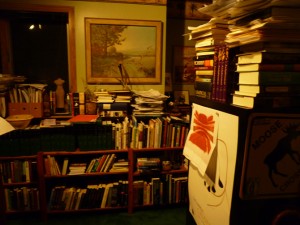 bookshelves are full and many have books piled on top of them. Each one I want to read. Some I want to use only as reference, but most I want to read cover to cover. The books range in topic from fairy tales and folklore to basic scientific texts on biology and geology, from philosophy to theology, art history to renaissance life, china, japan, india and cambodia to single dictionaries and the multiple volumes of the OED and the Dictionary of Art. Of course there is fiction, too, and poetry, works on historiography and works on the enlightenment. This doesn’t count the 90 books I now have on my kindle, many fiction, but many non-fiction, too.
When it comes to books and learning, I seem to not have an off button. Maybe it’s a pathology, an escape from the world, from day to day responsibility, could be, but I don’t think so. Reading and learning feel hardwired, expressions of genes as much as personal choice. So it’s tough for me to admit that I have books here, in my own house, that I may never read. A man has only so many hours in a day and I find spending any significant amount of them reading difficult.
That always surprises me. I love to read, yet it often feels like a turn away from the world of politics, the garden, connecting with family and friends, so it takes discipline for me to sit and read for any length of time. Instead, I read in snippets, chunks here and there. Even so, I get a lot read, finishing the Romance of the Three Kingdoms took a lot of dedication, for example. One year, I put the books I finished in one spot after I finished them. I don’t recall the number or the number of pages, but it caused me to sit back and wonder how I’d done it.
Sometimes I fantasize about stopping all other pursuits, sitting down in my chair and begin reading through the most important books, the ones on the top of my list. Right now that would  include the histories of Herodotus and substantial commentary. The Mahabharata. Several works on Asia art. A cabinet full of books on the enlightenment and liberalism. Another cabinet full on calendars and holidays. I will never do it. Why? Because I do have interests, obsessions maybe, that take me out into the garden or over to the State Capitol and the Minnesota Institute of Arts, the homes of the Woolly Mammoths and our children. Kate and I will, I imagine, resume at least some of our SPCO attending when she retires and there will be travel, too.
This relates to an odd self-reflection occasioned by Lou Benders story of my first day on the Ball State Campus. According to him, there was a picture of the Student Body President, I reached out and touched it and told him, “I’m going to do that.” Three years later I ran and lost for Student Body President. The year was 1969. Recalling this, I wondered if my intention, my ability to clarify my direction had waned. Had I defocused, living my life with no clear intentions, drifting along, letting life happen?
Then I recalled the moment I told Kate I wanted to write, the moment four years ago when I realized I had to put my shoulder behind the Great Work, creating a benign human presence on the planet, the moment I began to pester Deb Hegstrom for a spot in the junior docent class of 2005, the time when Kate and I decided to push our property toward permaculture-the harmonious integration of people, plants and animals in a specific spot in a sustainable way. No, I’ve not lost my ability to focus. Not at all.
This life, the one I’m living now, is the one I’ve chosen to live, a life Kate and I have made together. And that feels good.
Who knows, maybe I will finish these books? Who knows?
Fall Waxing Harvest Moon
A glorious, beautiful day. Who would imagine 81 on October 9th? Tomorrow, for you numerologists is 10/10/10, one more and we’d arrive at the 1o,000 things.
Lions and tigers and bears. Latin and Baroque and legislation, oh my. Life’s back to full tilt boogie and I’m dancing fast to keep up.
Kate just back from learning more about the embroidery module on her Bernina. She can make labels now and personalize other things she makes. A Hanukkah label like a gift tag and an embroidered rose in red and green were the particular things she did today.
Back to the treadmill. Next week, back to resistance work.
Fall Waxing Harvest Moon

Fall Waxing Harvest Moon
Let’s try darkness again. In Taoism the familiar Taiji makes my point about the essential and complementary nature of light and dark. Taoism gives equal weight to the yin and yang* represented in the taiji, the small circle of yin within the yang and of yang within the yin, emphasizing the Taoist belief that all things contain their opposite to some degree. So, one part of my argument simply notes that light and dark are both necessary, necessary to each other, nothing apart from each other. In the Taoist taiji they represent the dynamic movement of heaven to which all things must conform.
In our Western cultural tradition, though, light has taken precedence over darkness, both in a physical and in an ethical sense. Jesus is the light of the world. Persephone goes into Hades and the earth mourns her absence until her return when it blossoms into spring. Eurydice dies and Orpheus goes to the underworld to retrieve her. Dante’s Divine Comedy finds Dante wandering, lost in the dark wood of error, before he begins his descent, guided by Virgil, into the multiple layers of hell. The traditional three-story universe also reinforces these ideas: Heaven above, earth, and the infernal regions below. Milton’s Paradise Lost follows the rebellion in heaven and the casting out of Lucifer, the Morning Star, into hell where he builds his enormous palace, Pandemonium. Our common sense understanding of death involves hiding the body beneath the earth. Why?
Coming out of the spiritualist tradition represented by Camp Chesterfield (see below) death involves a transition into the light, the spirit world. Ghost Whisperer, a TV program, uses the trope from this tradition, as dead souls are led into the light. It is, perhaps, no wonder that darkness, night and the soil come off badly in our folk metaphysic: up and light is good; down and dark is bad.
I wish to speak a word for the yin, symbolized by the moon, the female, the cold, the receiving, the dark. The moon illustrates the taiji perfectly. In the dark of night, the moon, yin, reflects the sun’s light, yang, and offers a lambent light, neither yin nor yang, but the dynamic interplay between the two. So we could look for art that features the moon as one route into the positive power of darkness.
Also, any seasonal display in a work of art, whether of spring, summer, fall or winter can open the question of each season’s value, its role in the dynamic of growth and decay, emergence and return. This can lead to a discussion of the importance of the fallow season, the season of rest, the earth’s analog to sleep. This can lead to a discussion of sleep and its restorative powers.
Art work of mother and child, or especially, mother and infant, can stimulate a discussion, in this context, of the womb, of the fecund nature of the dark where fetuses and seeds develop before their emergence into the world of light.
Similarly, death focused works of art can open up a discussion of birth and death as dynamic moments of change, yin and yang of human (or animal) development. This could lead to conversation about the Mexica (Aztec) belief that life is the aberrant condition and that death is the vital, regenerative moment; we are here, goes one Mexica poem, between a sleep and a sleep.
Winterlight festivals represent a western imbalance focused on the light, the yang, and a tendency to cast the yin in a negative light, something to be avoided or eliminated or held in check. As I said previously, this is understandable given the pre-historical science which made the return of the sun doubtful and therefore terrifying. Many of these festivals are, too, our favorites: Christmas, Deepavali and for a different traditional reason, Hanukkah.
In my own faith tradition, roughly pagan, I look forward to the dying of the light and celebrate as my most meaningful holiday, the Winter Solstice. Of course, I also celebrate the return of the light that begins on that very day, but first I immerse myself in the long night, the many hours of darkness. This affords me an opportunity to acknowledge the dark, to express gratitude for its manifold gifts. In this way my idiosyncratic faith has a ritual moment that honors the taiji, utilizing the cues given by the natural world.
To find art that emphasizes this aspect of darkness I plan to walk the museum from top to bottom, searching for images and objects that can help our visitors understand that when they celebrate the festivals of light that darkness is the reason for the season. I would appreciate any thoughts or ideas.
*In Chinese culture, Yin and Yang represent the two opposite principles in nature. Yin characterizes the feminine or negative nature of things and yang stands for the masculine or positive side. Yin and yang are in pairs, such as the moon and the sun, female and male, dark and bright, cold and hot, passive and active, etc. But yin and yang are not static or just two separated things. The nature of yinyang lies in interchange and interplay of the two components. The alternation of day and night is such an example.
Fall Waxing Harvest Moon
Whew. Sierra Club am. Latin at noon. Touring the Embarrassment of Riches show for Lindquest and Venum from 5:30 to 7:00. A very diverse day. Fun in that respect, but also tiring.
Greg took me through some Latin readings to test my level of retention since we paused back in mid-summer. He decided I was fine to pick up again where we left off in July. Good to know my brain has not gone soft.
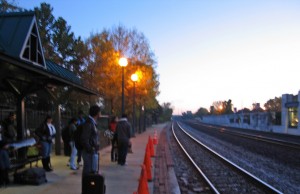
Around 4 pm I took off for the cities and went to the Ford Bridge on 46th street. Jon e-mailed me and asked for me to take some shots from the bridge looking north. He wanted some of the fall colors. Don’t know how good the images are, but I took them, then scooted over to the museum for my stint in the Embarrassment of Riches show.
It came to me while touring this show that it validated many of those who came through in a way similar to African and Chinese galleries for their respective ethnic communities. That is, these folks saw images that were of the world in which they moved. They may not all be in it personally, but in working with clients they cross over many of these thresholds.
A different experience than I had anticipated, but not a bad one. Interesting, rather than revelatory.
Fall New (Harvest) Moon
Just back from the Sierra Club. A real dilemma for me resurfaced here. I manage the legislative process for the Club, as I said, and in that role I organize the legislative priority setting process, its fine tuning and the work of the committee and the lobbyist while the legislature is in session. This means I do not have to have a very deep knowledge of the particular issues since my role has a mostly administrative/managerial focus. Thus, in a meeting like the one this morning with a legislator, where ideas get floated and possibilities discussed about a particular matter, in this case, broadly, energy issues, I simply don’t have the details and background necessary to contribute.
As Kate said, I like to participate and have intelligent things to say, but in this context, I didn’t feel like I had a anything to say. This is disempowering for me. The obvious solution, to learn more about each issue, runs into my other intellectual pursuits, like art history and Latin and liberal thought. Dividing time so I have enough to do solid work in those three areas has not left me with enough left over intellectual energy to dig into the scientifically and often politically complicated waters of particular issues. The fix here is not obvious to me and has me questioning my role. We’ll see where this goes.