Bee Diary: July 7, 2010

Summer                                  Waning Strawberry Moon

Dave Schroeder, president of the Minnesota Hobby Beekeepers, came by this morning to look at my bees.  We opened up the package colony first.  “They’re drawing out comb, look good.”  He gave me a tip about keeping megan173/8″ inch between foundations–bee space. “If they have more space than than, they’ll fill it with comb.  Wasting their time.”  “You moved a frame up from below. Good.  Just like you’re supposed to do.”
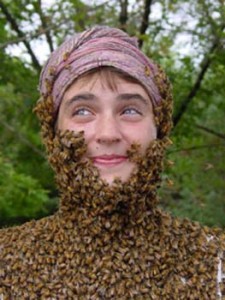
(a fellow docent’s daughter, Megan.  she was a graduate student in the bee department at the time.)

We cracked the parent colony.  Taking the telescoping cover off he placed it bottom side up.  “That’s where I put the supers,”  he said, “Helps you avoid killing bees.”

As I lifted the top two off, he asked, “Any weight to’em?”

“Nope.”

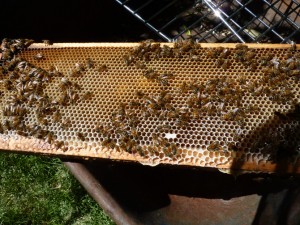
He checked them.  I then took the fullest honey super off.  It weighs about 50 pounds.  Heavy, man.  And the next one.  A bit more weight on that one than last Friday.

We checked the colony itself, in this case I wanted him to take a look, give me his impression.  “That on top is drone comb.  That means you’ve got a happy colony.  Now, I always scrape this off.”  He took his hive tool, scraped along the top of the frame, lifted off the drone cells with their white larvae exposed and dumped them in front of the hive.  “It’s just neater.”

He made sure each box was square and fit perfectly on the next one.  I like to do that, too, but the heat or the weight of the box sometimes makes it hard for me.  I’m a little guy.

After that, we replaced the queen excluder, the honey supers and moved 05-31-10_queenexcluder1over to the divide.  Oh, he did tell me I had the queen excluder on upside down.  Ooops.
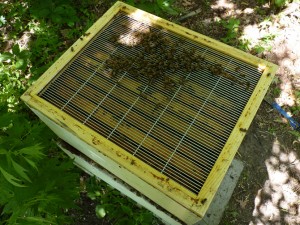
Commercial beekeepers apparently refer to queen excluders as honey excluders.  The bees don’t like to climb through’em, so it slows down honey production.

On the divide, the one that prompted me to connect with him, we removed the two honey supers I’d put on as he suggested.  Then we looked at the top hive box which had honey on almost all of its frames.  There he showed me about moving end frames into the middle of the box.  “The bees won’t draw out comb on the side facing the box.  This way they will.”

“Yeah.  This is plugged with honey.  If you don’t put supers on, they’ll crawl up here (into the third hive box), think, well, we’re done.  Ready for winter.  Then they won’t go up into the supers.”  I’m not clear why putting the honey supers on solves this problem.

He suggested I take the queen excluder off  this one for a week.  That will encourage the bees to go up.  “Bees like to go up.”  Takes one barrier away.

After we closed this colony, he said, “Where did I shake out those bees?”  Dave had shaken bees off the queen excluder as we checked it in the parent colony.  “Oh, yeah.  Let me show you another trick.”  He searched around, found a stick a bit thicker than a thumb and round.  Breaking it off at about 8 inches, he put it in the middle of the bees on the ground and rested the other end against the hive entrance.  “They’ll climb up that and get back in the colony a lot faster.”

As we finished, he said he likes to have all his colonies facing south and in the open. “That way, they come to the entrance, look out, go, Oh, it’s sunny!  Think I’ll go out and go to work.”

A lot of the comments he made were straight forward tips gained from years in bee-yards.  He’s been at it since 1974, 46 years by my count.

(Got this on 7/8 from Bill Schmidt.  Why I’m not a scientist.  By the way, your math on the beekeepers years with bees needs attention.  2010 – 1974 = 36 years, not 46.)

After we finished the hive inspections, “Your bees are doing good.” we sat in front of the honey house and talked bees for about a half an hour.

He keeps about 100 colonies and plans to take them to California this fall.  “Out there they can work.  Get strong.  Here, they’re just struggling to survive.”05-31-10_filledhoneysuper
He told about honey extracting, the relative merits of different kinds of equipment, about the high trailer he uses to store honey supers near his colonies, the years he spent working for his brother-in-law, “I wouldn’t take no money.  I was just in it for the education.”

He says 100 doesn’t make him commercial.  When I asked him what does make a commercial bee-keeper, he said, “Oh, 400-500 colonies at least.”

It was a pleasure to have him over and very useful.
Natural Capital

Summer                                    Waning Strawberry Moon

I’ve not written much about permaculture for a while.  Here’s a one-pager* from our landscapers, Ecological Gardens.   It defines a new term for me:  natural capital.  I’ve since discovered that this is a term with a larger history which I haven’t explored fully, but I like the Ecological Gardens version.

Just imagine the kind of revolution we’d have if each person with land–in the whole world or in a whole city or in a whole county like Anoka County–committed themselves to increasing the natural capital of their land.  It’s a little bit like that old boy scout motto:  Leave your campsite better than you found it.

We could, each one of us, take multiple unique tacks on the notion of natural capital.  Some of us might focus on small commercial crops, others might raise chickens for meat and eggs, still others might band together as neighborhoods and grow crops in tandem, some folks doing one thing, others another and producing a local horticultural economy.

A federal or state program that made low cost loans or outright grants for the establishment of permaculture at the local level makes a lot of sense to me.  Like the 160 acres and a mule of yesteryear.  We need a horticulture and an agriculture that increases the carrying capacity of the earth, helps clean up the rivers, streams and lakes.


*Would you like to:
•   Maintain beautiful self-sustaining gardens organically?
•   Pick fresh, nutrient-dense foods from your own backyard?
•   Create habitat for the nature you love?
•   Build resiliency into your landscape to help fight climate change?

These are all products of natural capital. Our first priority at Ecological Gardens is to help you increase the natural capital of your land. This means assessing the unique combination of resources – sunlight, wind, water, and microclimates – and turning them into productive investments that will yield benefits today and for many years to come.
Soil is the foundation for natural capital in our northern temperate climate. Healthy soil creates a condition for healthy plants, produces nutrient-dense foods for humans and wildlife, reduces water use, and minimizes leaching and runoff. Building healthy soil usually requires an investment since most soils are compacted and chemically treated.
Plants are the primary producers of value on the land. They take up sunlight, water, and nutrients turning them into nutritious foods, medicines, fibers, fuels, oils, and wood. Increasing productivity on your land requires an initial investment since plants of low productivity tend to dominate the landscape.
Your return on investment will vary depending on the size of your land and the configuration of resources but will increase exponentially as plant diversity and abundance grows.

Short-term returns (1-5 years)
•   Lower water bills (up to 30%) for yard and garden care
•   Lower maintenance costs for fertilizers and lawn care products
•   Lower food bills as you begin to harvest food, flowers and medicines
•   Greater wildlife value (bees, birds, and beneficial insects)
•   Greater beauty

Intermediate returns (5-15 years)
•   Lower energy costs for air conditioning and heating by strategically locating trees and vines
•   Lower labor requirements as natural processes begin to work for you
•   Increased property values due to abundance and beauty
•   Increased food security as you provide more of your own food

Long-term returns (15 + years)
•   Lower fuel costs as you begin to harvest your own wood [for larger properties]
•   Increased productivity as your land matures

Oh, Yeah? How’d It Go?

Summer                                                  Waning Strawberry Moon

We keep our walkin’ around money at the Credit Union, Associated Health Care Workers.  I like credit unions because they’re small and friendly, unlike our mortgage holder, Wells Fargo, who has shafted us time and again.  The credit union knows who we are.  I went in today to pick up our weekly cash and the teller said, “I’m used to having Lynne pick up the money.”  She doesn’t Lynne goes by Kate, but otherwise.  “Yes, she had surgery.”  “Oh, yeah, how did that go?”  “Well.  She’s walking around.”

I grew up in a small town and I value personal interaction with merchants.  It makes me feel known and welcome in a broad, perhaps shallow way; but a wider net of personal connections away from work or friends gives a sense of density to life often, perhaps usually, lost in the city.

The electrician, Jeff, who works on our stuff from time to time was out today.  He lives here in Andover and we talked about bees and hemp while I tried to identify where the fence guys cut the wire to the sheds.  Again, personal.

alexdowntown

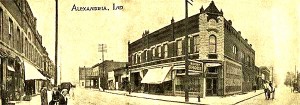
In Alexandria, where I lived from age 2 to age 17, most people knew who I was and I knew who they were.  Alexandria had about 5,000 citizens, but the families were much fewer and knowing a family member meant you had some sense of the rest, too.  Yes, it can be suffocating, perhaps more so as an adult, but as a kid, it meant there was no where in town I felt anonymous, a cipher, just a person paying 4 bucks for a latte or buying a new computer.  Neither of which we had of course when I grew up in the 50’s and early 60’s.

You can take the boy out of the small town, but…

Route 66

Summer                                           Waning Strawberry Moon

Rain beats down and Rigel whines.  We’ve had a couple of dogs with phobias about thunder.  Tira was the most problematic.  She preferred to climb through open car windows in the garage for some reason.  I still have claw marks on the Celica’s leather interior and the Tundra has scratch marks from a frenzied Tira trying to climb the gate closing off the back from the garage and getting hung up, her paws scraping on the hood and her teeth gripping the license plates.  Rigel is not that bad.  Thank god.

Kate’s tired tonight, her muscles aching from a lot of walking and standing.  She’s pushing it, but it’s good.  The doc said no limits, so the more she works it, the faster her muscle tone will firm up and her stamina increase.  Having the hip replaced takes general anesthetic, deep tissue and bone bruising and swelling, so painful  trauma occurs from a bodily point of view, but from a psychic perspective she can tell already that it feels better, way better.

We had our money meeting, discussing the coming of the kids and grandkids next week.  Makes me think of the trips my family used to take from Alexandria, Indiana to Oklahoma City.  Route 66 covered most of the territory, taking us, I remember, right through downtown St. Louis, a bit fearsome for small town folks.  Mom would go in to the motels, inspect their rooms and give them a passing grade or tell us to get back in the car.

Along the way the barns had signs for Meramec Caverns.  Don’t believe I ever saw them.  Sort of the Wall Drug equivalent on Route 66.

There were games involving license plates, 20 questions, word finds and generally gazing out the window as the Illinois, then Missouri landscape rolled by.  I still enjoy that part of traveling, sitting by the window, watching the scenery.  One of the reason I like train travel.

Changing Time

Summer                                         Waning Strawberry Moon

Now that Kate will be home for at least  two months, I’m shifting my going to bed and waking up time.  Got up this morning at 7am and plan to keep that up with a bedtime of around 11:00pm.  This gives me more good hours in the morning, plus it allows me to use the cool of the day for garden work.

Kate’s walking on her own, with a good gate.  She’s so happy, I can see her float as she walks.  It makes me feel good, too.

I went to a CVS pharmacy this morning to pick up a few things we needed.  I don’t go there often;  the combination of heat and dew point with the familiar but still not often experience lay out made me feel, for just a moment, that I had entered a Long’s pharmacy.  Long’s is familiar to those who travel to Hawai’i because its everywhere and carries a lot of stuff tourists need desperately, or feel like they do.  It was a good memory, happy it popped up.

Well.  Went looking for a Longs photo and discovered that, guess what, CVS bought out Longs.  Sigh.

Back to continue house cleaning, garden work for the upcoming July guests.  Not stuff I like, but, hey, it needs to be done.  At least once a year.

You Say You Want A Revolution? Yep.

Summer                                            Waning Strawberry Moon

It’s been done, I know.  Still, I’d like to put in a call for a 2nd American revolution.  Oh, ok, I don’t care what number it is.  I’ll settle for another American revolution.

My American revolution has a bit of  Norman Rockwell, a touch of Helen and Scott Nearing, more than a dab of Herbert Marcuse, Paul Goodman and C. Wright Mills, some Benjamin Franklin, the spirit of pioneers and native Americans alike when they relied upon on this seemingly limitless land for food and space.  There’s a Victory Garden or two in there as well, plus generations of smart women who canned, dried, jellied, smoked and pickled all sorts of produce and meat.  This New American Revolution demands no marches, no banners, no barricades, no guns and no repression.  And you can dance all you want.

What is it?  It is a revolution of and for and with the land.  It is a revolution that takes the wisdom of a 7th generation Iroquois medicine man who said:  “We two-leggeds are so fragile that we must pray and care for all the four leggeds, the winged ones, those who swim in the waters and the plants that grow.  Only in their survival lies the possibility of ours.”

What is it?  It is a revolution of and for and by the human spirit.  It is a revolution that insists, but gently, that we each put our hand and our back to something that feral nature can alter.   It could be a garden.  It could be a deer hunt.  It could be a potted plant outside where the changing seasons affect its growth and life.  It could be a regular hike in a park, through all the changes of the seasons, seeing how winter’s quiet fallow time gives ways to springs wild, wet exuberance, the color palette changing from grays, rusts and white to greens, yellows, blues, reds the whole riot.

What is it?  In its fullest realization this revolution would see each person responsible for at least some of their own food, food they grow or catch or kill.  In its fullest realization each person would use whatever land they share with the future in such a way as to increase its natural capital, using the land in such a way that it improves with age and gains in its capacity to support human, animal and plant life.

What is it?  In its fullest realization this revolution would find each person closer, much closer to the source of their electricity, their transportation and its fuel, their work and their family.  In its fullest realization this revolution would shut down the coal-fired generating plants, shutter the nuclear generating plants and have maximum and optimum use of wind, geothermal, hydro, solar and biomass generation. In its fullest realization each person would eat food that had traveled only short distances to their table, the shorter the better, the best being from backyard or front yard garden to the table.

What is it?  Well, we have a ways to go yet.  Perhaps a long ways, but if we want our descendants to have a chance to enjoy the same wonders in this land that we have known, we will have to change.  We will have to change radically.  We need, as I suggested, another American revolution.

The 4th

Summer                                        Waning Strawberry Moon

The 4th of July.  A time to think about our country, our home, our sea to shining sea.  Are we in decline?  This chestnut has begun hitting the op ed pages again.  I don’t know, they don’t know.  Only history will tell us.  Does it matter?  Not to me.  We’ll still be Americans, just like the British are still British in spite of the collapse of the empire on which the sun never sat.

Are there major problems within our body politic?  Oh, my, yes.  Does this make our time different from any other time?  Emphatically, no.

Here’s an example from a Frederick Douglass speech quoted in the Star-Tribune today:

“Fellow citizens, above your national, tumultuous joy, I hear the mournful wail of millions, whose chains, heavy and grievous yesterday, are today rendered more intolerable by the jubilant shouts that reach them. If I do forget, if I do not remember those bleeding children of sorrow this day, “may my right hand forget her cunning, and may my tongue cleave to the roof of my mouth!”

To forget them, to pass lightly over their wrongs and to chime in with the popular theme would be treason most scandalous and shocking, and would make me a reproach before God and the world.

My subject, then, fellow citizens, is “American Slavery.””

Does this harmony of misery make us any less accountable for the unemployed, the dying lakes and rivers, the immigrants who would live among us and share this land?   Emphatically, no.

Whether in decline or doggedly ascending the hill to that Bright Shining City so beloved of our forefathers, we must attend the great American ideals of liberty and equality, the twin conceptual mounts on which both our past and our future rest.

And not these only.  We now have before us the Great Work, the demanding and joyful task of creating a human presence on this planet that is benign, not malignant.

Here are the things make me believe we will continue to rise to these challenges no matter our relative status in the world:  we ended slavery.  we fought and defeated fascism.  we looked at old age poverty and created social security.  we have a statue at what used to be the main entry point for immigrants; it is a statue of liberty and one which says to the world, give us your huddled masses, yearning to breathe free.  we have brilliant scientists, great laboratories and universities, students even at this moment learning to be the future leaders that we need.  we have poets, movie makers, authors, critics, musicians, painters and sculptors all ready to help us see what we do not see.  we have neighborhood after neighborhood of people who want only a chance, the same chance many of our ancestors have already had.  we are a people who have won great victories for humanity.  we are a land unparalleled in its ruggedness, its beauty, its flora and fauna, rivers and streams, lakes and forests.

All of these things make me happy and hopeful on this 4th of July.

Kate is Home.

Summer                                            Waning Strawberry Moon

Kate is home.  She looks amazing, walking without the characteristic roll she had developed while favoring her right hip.  We went to Lucias, site of our first date, and ate at their outdoor tables.  Kate savored the wind, the freedom and “being on this side of the windows.”  Doc Heller says 2 to 2 1/2 weeks and she should be able to walk without the walker.

While we had a snack at Lucias, a stead stream of young singles and young couples with children came by, strolling in their neighborhood.  I realized I seldom see this many young adults.  The MIA docents are an older crowds, the Woollies, too; only the Sierra Club, of the groups I see with any regularity has a mix of youth and older adults.

One of the younger  couples that came by was a young man in scruffy jeans like I wore at his age and a woman in a print dress, black hair done up in tufts, Goth  eye shadow and lip stick, smoking a cigarette and wearing Doc Martens.  She was not happy with the parking ticket the laid back parking meter attendant had given her only a few minutes before.

Here’s another sign of the shift I’ve made from city boy to exurban man.  The traffic, the crowds, the heat, the buildings felt too close, too vibrant, more energy than I could inhale.  I look forward to breaking free of the urban heat island, the jockeying for position.   Never used to feel that way.  Now I like our little patch of land, the quiet here, our dogs.

Hooray for the Red, White and Blue

Summer                                            Waning Strawberry Moon

Hooray for the red, white and blue.  That is, the blueberries, the raspberries and the white clover among which I picked them this morning.  Worked outside for an hour and a half, moving an outdoor table back to its original place on the brick patio outside our garden doors, a plastic table into the honey house for some  more space.  Can’t set the smoker on it though.

(Georgia O’Keefe, 1931)

This all has two purposes, getting the house nicer and in better shape for our own use as the summer begins to take up residence and for our guests in July:  Jon, Jen, Gabe and Ruth and the Woolly Mammoths.  I also moved some potted plants around and am mulling painting a post I stuck in concrete a few years ago.  Painting it some bright, contrasty color that will make the green pop.

Only 83 this morning but the dew point’s already at 67.  Glad the bee work got done yesterday.  On the bees.  The president of the Beekeeper’s Association lives in Champlin (near us, sort of ) and has offered to come over himself after the fourth.  I’ll be glad to have his experience looking in on my colonies.

While I picked mustard greens this morning, I noticed a bee making a nectar run on a clover blossom near my hand. “Keep up the good work.  Glad to see you out here and hard at work,” I told him, rather her.  She jumped at the sound of my voice.  One of those workers best left to her own initiative.

Haven’t heard yet from Kate but the plan is for her to come home today at some point.

What is the Midwest?

Summer                                           Waning Strawberry Moon

A focus on America hits me about the time the summer heats up.  Something about the lazy, hazy, crazy days tickle my American gene. ( apologies to Carreen, but it’s the adjective of my youth )  I’ll read a novel or history of the American Revolution, look more deeply into some aspect of the civil war, that sort of thing.  Not this year.

May be my immersion in ancient Rome, Kate’s surgery, the bees, the garden, I don’t know, but this year I haven’t got that Fourth of July feeling.   And here we are almost on the date.  My firecracker lilies have more patriotic oomph than I do this year.

Over the last year I’ve watched the HBO series, True Blood.  Yes, I have a thing for horror novels and horror movies that don’t involve slashing, screaming college girls and chainsaws, which, admittedly, pares the crop down pretty far.  OK, there may be the occasional screamer in true blood, but they are adults for the most part.

Anyhow, True Blood is Southern Gothic.  It trips the divisional biases about the south, the bayous and the culture of Louisiana which Ann Rice exploited in her novels like Interview With The Vampire.

Which leads me to my point.  Whew.  Took long enough.  The culture of the south, or the sub-cultures we describe as Southern are well known:  confederate flag, shotgun, pick-up truck with rust or plantation life with mint juleps and chattel slavery or a misty Cavalier life with belles and beaus courting among live oak trees and traveling to Savannah or New Orleans or Mobile.  You know.  The stereotypes, and that’s all they are, are clearly formed and ready for plucking in a fictional setting.

If, however, you wanted to draw on similarly clearly formed stereotypes, let’s say archetypes in both cases to get off that word, of the North, or the Midwest, my home for all my life, what would they be?  I’m not sure.  Farms with cows.  Basketball.  Factories and factory workers.  None of it has the same, pardon the expression, bite.  This is the kind of thing my American jones often picks up on and runs with it.  Maybe I’m not all that far off from the fourth of July after all.