Category Archives: Travel

Wanderers

Winter                                                                  New Moon of the Cold Month

My brother, Mark, is a traveler, a wanderer, a planet.  He can’t sit still, a powerful urge to move comes over him, an urge with plenty of family reinforcement.  Dad took to the road all the time, as often as he could, as long as he could, even if it was to run down the story of a river that went underground only to pop up somewhere else.  He hunted down the ordinary extraordinary.  Mark takes the sensibility a step further.

He has crossed Russia on the trans-siberian railway, picked olives in Turkey and worked on a kibbutz in Israel.  When he finally hit Southeast Asia, over twenty years ago, something clicked.  This was a place he could use as a base.  And he does.  Teaching English in Bangkok, but setting out for journeys into Cambodia, Laos, Vietnam.  He reminds me of the writers who took off on tramp steamers to see the world.  Now, he’s antsy again, wanting to move, needing to move.  Who knows where he’ll go next?  He doesn’t.

Mary, my sister, travels a lot, too:  Tibet, India, Dubai, the Caribbean, England, Greece, Malaysia, Indonesia.  She, too, has a base in Southeast Asia, Singapore, or Asia Lite as she likes to call it.  She teaches, too, at the National Institute of Education, Singapore.

They both have lives that are very exotic compared to Andover, Minnesota.  I’m glad to have their vicarious adventures in my life.

Warp and Weft

Winter                                                                            Waning Moon of the Winter Solstice

Other blogs seem to have a slant, a bias, a thing.  I suppose I do too in a general way, the idea of ancientrails, the Great Wheel, the garden, a po-mo pagan sensibility, but what I’m doing is more like an online journal.  On a bookshelf I have two rows of journals kept in various forms since 1971, many erratic in the entries, then, as life moved on, I became more regular.  At one point I had several journals.  A diary like one in which I wrote short entries about my day, a spiritual journey one in which I recorded my experiences of meditation, lection divina, contemplative prayer, scripture study, another in which I took reading notes while I studied Islam, the year after 9/11, several more with reading notes from a year + when I gave up writing and took to reading the classics:  Divine Comedy, Faust, Metamorphosis, works of that nature.  During the year I studied Islam I read the Koran twice, once just to see what it said and another time during the month of Ramadan as I fasted and read enough to finish the entire Koran in thirty days, as many Muslims do.  Yet other blank books contain notes on art history, taken over many years of continuing education at the MIA, ideas for novels, short stories, about writing.

Writing is the thread, the weft I have chosen to weave the tapestry of my life.  The warp threads, stronger by far, developed in body and mind, feelings and thoughts as this Self has moved through life since birth.  The stuff of my daily existence has been the weft when shuttled through with the language I learned at my mother’s knee and my father’s typewriter.

So, this blog is just another pattern,  a particular tartan for this phase of my life.  It may pass away at some point, I certainly will, but, as I wrote the other day, the Web may have granted us bloggers a type of immortality.

When Kate I and were on our honeymoon, in late March or early April of 1990, the last phase of our trip which started a block from the Spanish Steps in Rome, we took the train from Edinburgh to Inverness.  Inverness is the capitol of Celtic Scotland, the northern reaches of the Picts.  The river Ness, from the storied Loch Ness, runs right through town.  On a stroll one afternoon, Kate and I made our way to a tartan mill, a place where tourists could go in and watch tartans being woven.

That day, the master weaver changed over from one tartan to another.  What this involved has stuck me indelibly since then.  The master weaver carries in his head the particular combination of colors, of large spools of yarn, that make, say, the tartan of the clan Sinclair.  He achieves that  particular combination of colors and patterns not by computer, not by telling weavers what to do, but by placing, on a huge rack of iron hooks, individual spools of yarn.  The number of hooks across the top of the hook rack, maybe 25 or 25, below each hook came at least 20 more, maybe 25 more hooks creating a large frame of individual hooks slanted up.  By his placement of the spools the master weaver achieved his design for the yarn from these spools fed precisely into the looms which clicked and clacked behind them.

Later than night, after we had finished our meal at the Station Hotel, Kate and I walked along the river Ness, tendrils of mist floating up from it, weaving themselves forever into our memory.

Warning: Rant About Hands On Security At Airports

Samhain                                              Waxing Thanksgiving Moon

Boxers or briefs?  Hands on or a nude photo?  When did TSA become T&A?  In Minnesota we often use “you can only take off so many clothes.” to explain our preference for cold weather over hot.  You can always add more layers.  Here’s a real problem with the hands on approach to security:  you can only take off so many clothes.  Inch by inch the guberment has let its security obsession get us to just that point.

It’s nonsensical to ask for no security, but when the creeping hand of government has moved up my crotch, well then by gum, they’ve gone to far.  It reminds me of that mythical frog sitting on the stove in gradually warming water.  The security water has begun to boil and we’ve been the frogs.

A complete rethink has to come.  When thousands of ordinary travelers find themselves treated as terrorists until proven innocent, there has got be a better way.  In no other part of our quasi-libertarian culture would anything even close to this heavy handed be tolerated, but because it’s air travel we’re asked to bend over backward.  Well, actually not yet.  But it could be next.

All funning aside.  Living in a security state has a long and high profile career in science fiction, but it’s not the vision of the future I wanted to see come to pass.

My basic response to all this is to ride the train, drive or just not go, though the last couple of times I’ve flown I’ve actually found the whole process less onerous than before, but this new wrinkle seems designed to push us back in time, not forward.

Canadians: “Build a Damn Fence!”

Samhain                                            Waxing Thanksgiving Moon

From The Manitoba Herald

by Clive Runnels

Canadians: “Build a Damn Fence!”

The flood of American liberals sneaking across the border into Canada has intensified in the past week, sparking calls for increased patrols to stop the illegal immigration. The recent actions of the Tea Party are prompting an exodus among left-leaning citizens who fear they’ll soon be required to hunt, pray, and to agree with Bill O’Reilly and Glenn Beck.

Canadian border farmers say it’s not uncommon to see dozens of sociology professors, animal-rights activists and Unitarians crossing their fields at night. “I went out to milk the cows the other day, and there was a Hollywood producer huddled in the barn,” said Manitoba farmer Red Greenfield, whose acreage borders North Dakota. The producer was cold, exhausted and hungry. He asked me if I could spare a latte and some free-range chicken.

When I said I didn’t have any, he left before I even got a chance to show him my screenplay, eh?”

In an effort to stop the illegal aliens, Greenfield erected higher fences, but the liberals scaled them. He then installed loudspeakers that blared Rush Limbaugh across the fields.

“Not real effective,” he said. “The liberals still got through and Rush annoyed the cows so much that they wouldn’t give any milk.”

Officials are particularly concerned about smugglers who meet liberals near the Canadian border, pack them into Volvo station wagons and drive them across the border where they are simply left to fend for themselves.”  A lot of these people are not prepared for our rugged conditions,” an Ontario border patrolman said. “I found one carload without a single bottle of imported drinking water. They did have a nice little Napa Valley Cabernet, though.”

When liberals are caught, they’re sent back across the border, often wailing loudly that they fear retribution from conservatives. Rumors have been circulating about plans being made to build re-education camps where liberals will be forced to drink domestic beer and watch NASCAR races.

In recent days, liberals have turned to ingenious ways of crossing the border. Some have been disguised as senior citizens taking a bus trip to buy cheap Canadian prescription drugs. After catching a half-dozen young vegans in powdered wig disguises, Canadian immigration authorities began stopping buses and quizzing the supposed senior citizens about Perry Como and Rosemary Clooney to prove that they were alive in the ’50s. “If they can’t identify the accordion player on The Lawrence Welk Show, we become very suspicious about their age” an official said.

Canadian citizens have complained that the illegal immigrants are creating an organic-broccoli shortage and are renting all the Michael Moore movies. “I really feel sorry for American liberals, but the Canadian economy just can’t support them.” an Ottawa resident said. “How many art-history majors does one country need?”

Harvest

Fall                                      New (Harvest) Moon

Second round of apiguard in the parent and the divide.  The top box on the package colony has gotten heavier, but I plan to feed them some more as I will do to the parent once the apiguard comes off in two weeks.  Sometime in early November I’ll get out the cardboard wraps and cover the hives for winter.  That will pretty much finish bee work for the year until late February or early March.  I’ve given away honey and plan to give away more.  Part of the fun.

A quick walk through the vegetable garden shows kale and swiss chard looking good, a few rogue onions that escaped the harvest, plenty of carrots, beets and butternut squash.  The harvest is 2010-10-04_0351not yet over and will go on until the ground threatens to become hard.

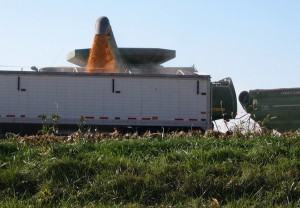
While I drove through the countryside on my way back to Lafayette on Monday, I passed field after field of corn and beans, some harvested, some not, about half and half.  Seeing those scenes put me right back at home, especially the corn fields.  Here’s a field near Peru, Indiana with the combine spilling corn into a tractor trailer for transport either to a corn bin, grain dryer or even straight to the grain elevators, all depending on the price and moisture content of the corn.

Indiana is no longer home, Minnesota is, but Indiana has a large section of my heart, the chamber of childhood and early young adulthood, a room full of corn fields, basketball, small towns, a baby sister and brother, county fairs and James Whitcomb Riley poems.  I was glad to be there the last few days and to walk again in the part of my heart filled there so long ago.

We move now toward Samhain, Summer’s End.  Blessed be.

Quite a Yarn

Fall                                Waning Back to School Moon

October 5th, 2010 Union Station, Chicago, Room 4, Car 0730

Last night I found a Korean restaurant just off State Street in Lafayette. I ordered the Duk Man Guk, a spicy soup with egg, pot stickers, seasoned beef and sliced rice balls. After a quick glance over to t he young woman across the way who looked Korean and had ordered the same thing, I used the long spoon. The owner brought me another dish of kimchee after I finished off the first one fast. She seemed pleased I liked it. There were only Asian students eating there, just off the Purdue campus.

The Hilton Garden Inn had nowhere near the character of the Western Hotel at Camp Chesterfield, but it did have an internet connection. I finished some work I had to stop when I moved into the 19th century over the weekend.

This morning it was up at 6:30 am, shower, pack and walk across the pedestrian bridge over the Wabash to the Amtrak section just at its end. A lovely slice of Back to School moon hung in the dark blue sky while we huddled together in the morning coolness waiting for the train to come around the bend. A young man of 2 or 3 years screamed and hollered. He did not want to go on the train. His mom said he thought it was too big.

It wasn’t.

Three hours later we rolled into Union Station. Backwards. Don’t know why.2010-10-05_0323

Wandered around Chicago for a while, just looking, admiring building facades, enjoying the skyscrapers, blending in with the busy and the distracted. I decided to head down to Printer’s Row, the South Loop, hoping I could pick up a jazz related gift for 88.5 listening wife. There are jazz joints down there. No joy. All closed up at 10:45.

Having missed breakfast I went into an Italian restaurant and had an early lunch.

After lunch I discovered a fancy yarn shop and found a good gift for Kate. She’s a textiles and yarn artist, so I bought her some merino wool yarn. It’s a beautiful multi-colored pattern, 1800 feet worth. Seems like a lot to me.

Back to the Metropolitan Lounge in Union Station and now on the train.  Heading north.

A Life in Ruins: Part II

Fall                                    Waning Back to School Moon

When I visited Angkor in 2005, I wrote a piece for my Pilgrimage series entitled, A Life in Ruins.  Ephesus, Delphi, Delos,Rome. Pompeii, numerous civil war battlefields and Attuthya are among the many ruins I’ve visited, trying to piece together from blocks of stone, information plaques and Blue Guides their meaning and significance. At Knossos I wondered what it felt like to be in the labyrinth of rooms that made up what entered legend as the habitation of the Minotaur.  At Delos I imagined what the birth of Apollo and Diana was like.

Given that history, amazing is an understatement when I discovered my actual life had become a site with ruins, not one, but many.  In my hometown of Alexandria the first factory in which I2010-10-02_0396 worked, Johns-Manville has nothing left but concrete coated pillars and a loading dock.  I worked as a receiving clerk the summer I was there, so I knew exactly what went on there when the trains loaded with coak and limestone rolled onto the factory grounds.

That was the first, but far from the last.  The old High School, my middle school, gone.  Tomlinson, my first elementary school. Gone.  Most of the businesses of my youth, abandoned shells.  This is only in Alex.  In Anderson the mighty General Motors Guide  Lamp and Delco Remy, employers once of 25,000, gone.  Parking lots and concrete factory pads covering thousands of square feet and fenced in with tall chain link are all that remains.

If we had a magic button we could push, one that would light up the home’s lost among those 25,000, we would have a better estimate of the lives ruined along with these structures.  These are the missing elements at Ephesus, Rome, Delos.  What about the lives of the priests, the grounds keepers, the cooks, the sailors?  Like members of my class and their parents forces beyond their control eliminated the places where they earned their livings.  Places made sacred by the holy work of labor.  So much desecration.

These factories, these shops, these shuttered houses, these abandoned people are the friends and family with which I spent the weekend, real people, not statistics.  Never did I think that the mighty flood of cars bearing workers on Highway 9, no absurdly named Highway of Vice Presidents, would dry up.  Never did I think that the vibrant small town of my youth with its mens store, its womens store, two variety stores, two pharmacies, a bakery, two theatres, bars and banks and service stations would fade away only to be replaced by dollar stores and wholesale outlets.

So this weekend, an affair of the heart most of all, a reconnecting with those who lived then, only underscores the pain.  I will never visit a new ruin again with the same detached attitude.  Real people lived there;  real people suffered.

Camp Chesterfield: Blessing of the Animals

Western Hotel, Camp Chesterfield, 8 pm.

This was my day to poke around here at Camp Chesterfield, the reunion over and a day remaining on my stay in the Western Hotel. I picked a poor day. Instead of the usual worship services held today thee was a blessing of the animals. Before that I went back to the gift shop, which has an unusual collection of books and items for sale.2010-10-03_0378

Footfalls on the Boundary of Another World, by Robert Dale Owen seemed the most substantial work on spiritualism, so I picked up a copy. Written in 1860, a California outfit named Health Research has produced a facsimile edition. Most of the works on spiritualism were from the late 19th or early 20th century, the prevailing zeitgeist here at this 124 year old Spiritualist center. It will make for interesting reading.

I looked through many other books, including a series by Alice (?) that fills a bookshelf. A couple of the books interested me: White Magic and Esoteric Knowledge (actually 6 separate volumes), but at $27 or so a copy, I decided to pass. Besides, the book store plans to go online next month, so I’ll have access there whatever titles I want. Most of the ones that intrigued me were by presses I suspect even Amazon doesn’t carry.

Why do they intrigue me you might well ask. In part because this small subculture has shown durability over the centuries, persisting and now beginning, it seems, to thrive again. They tap into the universal hope that something persists after death, that death is not final, rather a transition to the Spirit world, or the non-physical plane. As a writer of fantasy novels, I like to use religious world views grounded in living or once living faith traditions. Not much has been done with Spiritualism and it carries such a strong overlay of Victorian and Edwardian sensibilities, that it makes a good setting for a novel.

As I made away across the grounds from the Western Hotel, the direction of transition in spiritualism, I passed a prayer grotto, a large marble angel, a setting of busts honoring creating of major faith traditions and a setting of concrete tables with two wooden chairs. These last I imagine were at one point the site of outdoor readings.

Just beyond the chairs and concrete tables was the cathedral. That’s what they call it. This is a rather modest cathedral, though it has two ranks of movie style seats and a large stage upon which a pulpit sits. The décor is simple, plain plaster, a couple of small stained glass windows and a statue of Jesus off stage right.

I began with a critical attitude. The nearly bald older woman in the flowery chiffon dress couldn’t pronounce Assissi or covenant, both coming out garbled at best. She also started the service with a CD of a 9/11 fireman singing God Bless America followed by the pledge of allegiance. Peculiar way to start a worship service unless in a militia camp. Then she read a brief bio of Francis, butchering the words yet again.

Once came she came down from behind the pulpit and discarded her professional persona for animal lover, the service got in synch. She loved each animal, from Great Danes to Italian Greyhounds and lively kitties to one brought forward in a roller bag because, as her own said, “She has severe arthritis.”

Our nearly bald celebrant said, “Well, I can identify with that.”

Animal after animal came down, got a sprinkling of holy water and a St. Francis medal and a dose of love. The celebrant assured us that the water and the medallions had been blessed by Fr. Justin. From a traditional theological perspective this was peculiar at best.

One of the Great Danes, almost as big as our Irish Wolfhounds, took it upon himself to lap noisily from the basin holding the holy water. A sanctified stomach.

As a couple of people came up with names of pets who had died, there were asked when the transition had occurred. They were then assured that St. Francis greeted each animals arrival, as did, in one case, another cat who had died—transitioned– in the last year. The grief and the joy which met all the animals or their owners who talked of loss was real and consoling and honoring.

Seeing the animals up there, participating in the service, made me realize how infrequently we give active attention to the sacredness of animals and the human-animal bond. This all felt more authentically spiritual than many services I’ve attended.

I shed a few tears for Hilo and Emma, both recently deceased—transitioned. It was an affecting time and one that convinced me of the sincerity of this unlettered woman who spoke of spirit and transitions.

I hope to get a Tarot card reading before I go, though because this is Sunday it seemed awkward to call people. I’ve got tomorrow morning yet.

Friends

Fall                               Waning Back to School Moon

October 3nd, Western Hotel, Camp Chesterfield 8:35 am

Had breakfast again in the Maxon Cafeteria, just east of the Western Hotel. It was late enough that the crowd here for John “Medicine Bear” Doerr’s workshop, Becoming a Spiritual Warrior, had already eaten, so I dined alone. Oatmeal and bacon.

A good nap after the laundromat yesterday followed by a quick visit to the gift shop here at the Camp. It reopens at noon today. Lots of interesting books and gee-gaws from a wide range of religious traditions. I’ll spend some money.

Big doings last night at the south room of the Norwood Bowl. A cement block addition to the bowling alley, the south room has a parquet dance floor, seating for around 70 which we filled 45norwood-bolw-10-02_0402and a kitchen area;/wet bar raised above the dining and dancing floor by about three feet. It was a perfect space for this event.

Having the homecoming parade float and the impromptu meal at the Curve on Friday night, the Historical Society meeting yesterday morning followed by the tented champagne brunch at Steve Kildow’s place before this sit down meal allowed a lot of mixing and story telling to happen over an extended time. It made for a real sense of having gathered together again as a class.

Toni Fox, a self-described “a bit plump but still cute as a button,” was an early crush of mine. By early I mean first/second grade. She’s retired now and set to go on a 1940’s train ride to Memphis with her now cancer free husband. Louie Bender worked his charm on the ladies as he always did, vying at times with Toni for the attention of the crowd.

Jerry Ferguson, an old buddy with whom I apparently had more good times than I recall, and I had a lot of laughs remembering crazy stuff we did. Jerry remembers, and others did too so I’ll take their word for it, that we painted 1965 on the water tower. He said, “I turned to you and you were high-tailing it for the truck. I yelled, Charlie, what are you doing?” “Man with a shotgun,” I shouted over my shoulder. Tom Urban got behind the wheel of Jerry’s green pickup, we dived in the back and Tom drove across the railroad track. Tony Fisher said, “We could see the whites of the engineer’s eyes.” Big fun. Lucky I survived childhood.

Tom Friend was there. He played coronet in high school and had a way with the ladies like Louie. Tom lived near the Nickel Plate tracks north just off Harrison.

Frank Johnson and Susan Mahoney, high school sweethearts and married since college, live in Fort Wayne. Frank had a benign brain tumor, quadruple by-pass surgery and prostate cancer. “I’m getting all the bad stuff out of the way before retirement.” He should be almost bullet proof. Susan, who looks like she did in high school, now works in admissions for a private school. They attend 1st Presbyterian in Fort Wayne, a congregation that tasted blood about 4 clergy ago and have continued to chum the water with each new pastor. A typical pattern for churches that succeed in ousting a minister, usually to devastating affect on the congregation.

Larry Stafford workdd for GM at Guide Lamp for 42 years until they shut down five or so years ago. Now, at 63, he’s out of a job and trying to find something new, “But, Charlie, there just aren’t any jobs out there. I got my associate degree in information management, too.” A tough spot.

Tony Fisher sells insurance in Liggonier, Indiana. A couple of years ago he won $2,000 dollars at an insurance convention, money for a trip. He chose New York City. “I didn’t know Central Park was so big you could drive through it. I saw Ellis Island and the Statue of Liberty, Ground Zero. I always wanted to see them. Course I also saw the wax museum and Ripley’s Believe or Not, too. I’d go back.”

Traveling is on his to do list. He wants to go Las Vegas for “all the glitz and glamor” and he also intends to take the South Bend to Chicago train and see the Shedd Aquairum and all that stuff. “Ive gotten interested in that stuff as I’ve gotten older.”

Steve Kildow, who paid for and hosted the champagne brunch yesterday worked at GM and lost a good bit of money when GM’s stock tanked. Looks to me like he compensated for it in other areas.

Old groups that hung out together 45 years ago reformed, catching up in the years since 1965 and reliving the ones before. Memories were the token of exchange over the weekend and each person came with a full account and left even richer in them.

A photographer took shots of the whole class, then broke us down by feeder schools: Orestes and Cunningham were outside Alexandria’s city limits, Tomlinson and Clarke were for the southern and northern parts of the city for elementary school. I didn’t even know Clark existed. We were only in Tomlinson and Clark for first and second grades then we merged at what is now Thurston Elementary.

Miss Thurston would come in to the lunch room, go student by student, rapping each on the shoulder, “Now Charles Paul. Eat your peas.”

Toni Fox recalled that when we went to Tomlinson the school took us home for lunch because the school was on Highway 9 and we couldn’t walk home. I didn’t remember that.

Richer Howard told me the saddest story of the evening. Richard Lawson, a good buddy while I was in High School, went to Vietnam and came back disabled. He married, had a couple of kids. A divorce took him hard and he lost his job, became homeless. Richie gave him money now and then.

It got to the point where Richard was living out of his car. He had a stroke and that made getting around difficult. During a recent very cold winter he had returned to his car, opened the door, then slipped and slid under it. They found him there the next morning, blue and solid.

Richie also told a tale about Richard. Richard joined the Navy after his discharge from the Army. Richie got a call at 3 am, “Hey, Richie. What’s you doin’?” “Sleeping.” “Hey, man. How do you cook a turkey?” “What?” Turns out Richie and some other sailors had washed up on the shore of Spain somehow and a farmer gave them a turkey, but non of them knew how to cook it.; Richie put his wife, Becky (Ellis, no relation), on the phone and she walked him through the steps.

There were, as there always are, those who couldn’t come. Ronnie Montgomery I missed most since we had stayed in contact through college. Zane Ward and Larry Cummings, part of the poker playing crew, I’ve not seen since high school. Zane runs the junk-yard and Larry has bait shop in Arkansas.

Jerry said Jack Staley has his own engineering firm specializing in heating and cooling systems. Jack has the controls for Budweiser’s beer storage warehouses in his basement in Indianapolis. The warehouses are in St. Louis. Mike Taylor, the only African-American in our class, who moved before high school, also became and engineer specializing in high-end kitchens.

Willard Grubb, another poker player, is a pharmacist nearby.

We’ve had deaths, mostly cancer and brain tumors, but a heart attack whiled driving, too. That was Rodney Frost, the guy with whom I had my one and only fist fight. Mike Gaunt, my doctor’s kid, died a couple of years ago. One of the pretty girls in our class, Sherry Basset, died in 1989. Two died in Vietnam. I don’t whether 20 or so is a lot or a little for a class of 120. Since we’re all 63, the number will grow faster between reunions now.

The woman I met here yesterday from Bogota said that one of the things she admired about Americans was their loyalty to groups. “Coming all the way from Minnesota for people you knew 45 years ago. In Colombia it’s just go and live your life. That’s it.”

There were, too, the objects and places to which memories adhere, the house on the corner of Harrison and John that has the stone wall running along the sidewalk. When Mom and I would go downtown, I walked up the flat mortared slope and then along the top, watching my mom from high above. At the point where some steps broke up the run of the wall, I always looked in the yard and so the big doghouse built for their St. Bernard. The hill, which felt so big back then, down which I rode my skateboard. I got pulled over by the police and ticketed for being in the street. At city hall I looked up the ordinance and found that wheeled vehicles were required to be in the street.

Those two numinous blocks of Monroe Street where I lived from age 4 or 5 to age 12 were the terrain of magic for me, where nights became playgrounds for hide and seek and kick the can, where a field nearby became a fort, a hide-out, a place of refuge, where Mike Hines and I performed our experiments where explosion was the mark of success.

In 1957 Mike and I were out back in our backyard, we lived across the alley from each other. We looked up and saw three silver shaped objects high in the late afternoon sky. To my recollection this was September or October. We watched those objects for a while, then they went behind the moon. That’s right, behind the moon. Mike and I reported this to my dad who wrote a small article in the paper about it. This was the time of the UFO’s and Mike and I saw some. Nothing ever came of our sighting.

Mike left the US during the Vietnam War for Canada. According to Toni, who saw Mike’s sister Susan not long ago, he’s still there.

Some of us had grown up on the same street together, then gone to elementary, junior high and high school together. We passed from children to youth to teen-agers together. Those memories, those years together in the same place are a powerful bond, one not broken by time or physical separation. We proved that all over again at this weekend.

On the Banks of the Wabash

Fall                              Waning Back to School Moon

Lafayette, Indiana on the banks of the Wabash River.  Home of Purdue, the Boilermakers.

Got in here at 8:58 last night Minnesota time.  But, this being Indiana, it was 9:58 here.  Indiana suffers from chronic ambichronicity with the rest of the country and from county to county within the state.  A pleasant night for a stroll took me past the county courthouse and several college bars to the Holiday Inn.

Tuckered out, as we say in Indiana, I went to bed not long after.

Up this morning with a significant amount of work to do for the Sierra Club; we’re in the legislative priority setting process, so I ordered room service breakfast and tap, tap, tapped my way through saving files, sending attachments and setting up a meeting wizard for a late October meeting.

After that the friendly folks at Enterprise entertained me by sending a man who stood right next to me talking to Kate and asking her where I was.  When he realized it was me, he hung up, saying, That was your wife.  Well.

Now back at the  Hotel, finishing up this and that before heading out to Chesterfield Spiritualist Camp.  If you feel any spiritual vibrations, it means I’ve arrived.  At the camp.  Not the great beyond.

BTW:  I carry this netbook with me as well as my Blackberry and my  Kindle.  An electronic menage a trois.  Keeps me connected, informed and well read.  Not bad for under 2 pounds.