Category Archives: Bees

Experiments in Photoshop

Winter                      New Garden Planning Moon

Sure enough.  Order forms for the 2012 bees came in the mail today.  Order will go out tomorrow.


Went to my first session of Photoshop I tonight.  Champlain High School.  See first rough effort here.  Boy did I need help.  Began to make sense right away as the guy showed us various tools, options to use, but I could make no progress on my own.  Another session next week, then Photoshop II in February.  Finally, I’ll get to use the power of this software I bought last September.

Under the Garden Planning Moon

Winter                                   New (Garden Planning) Moon

In the next couple of weeks I’ll order two packages of bees, 2#, to install in mid-April. Two hives produce plenty of honey for us and some to sell.  I have no desire to create a bigger operation, but working with bees has its soothing aspects and its downright fascinating aspects.

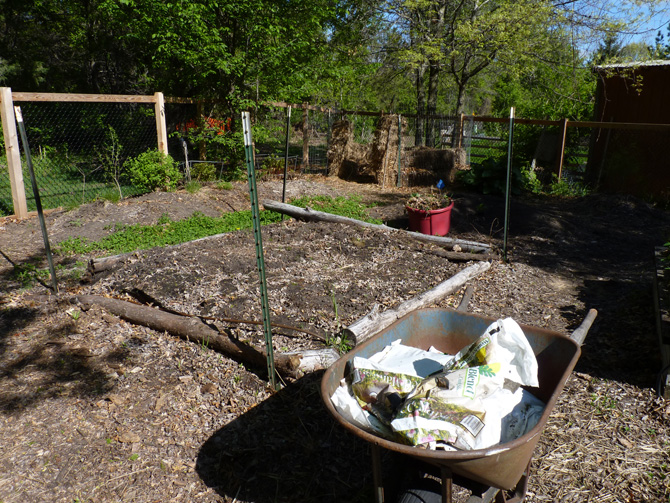
Also, over the next couple of weeks Kate and I will sit down and plan our 2012 garden.  We now have all the beds installed, the orchard has begun to produce, albeit still at modest levels and our perennial beds have taken more or less to running themselves with the occasional weeding foray and bulb planting episodes.

My short burst workouts, which include four sets of resistance work in between the all out sessions of 30 seconds and one minute, have begun to show results, so this summer I plan to have more muscle which makes gardening both easier and more fun.

We have a fire pit, dug out fully by Mark last summer with a large metal fire ring and cooking grates ready to be installed come spring.  Once it’s in place we’ll have a nice area near the grandkids playhouse for twilight and nighttime fires, roasting marshmallows and wienies.

With Kate at home much more now, we’ll be able to take even better care of the yard.  Wisely, Kate let the grass cutting go a couple of summers ago, enabling her to concentrate on weeding and pruning, tasks, for some inexplicable and yet joyous reason (from my perspective), she enjoys.

On Moving Toward Doing the Work Only I Can Do

Winter                              First Moon of the New Year

Spent yesterday shifting to my new work schedule.  A couple of hours on Ovid, plus analyzing some of Caesar’s Gallic Wars.  Edited three portions of the Tailte Mythos:  Book I and began clipping postings from Ancientrails to consult for my first essay in the Reimagining project.

Also learned that I can’t go to sustaining status at the MIA until I’ve had 8 years as a docent.  Sustaining would cut my tour requirements in half.

This means I’m going to have duck out of the Sierra Club sooner than I had planned.

No plant starts this year.  I’m going to buy already started plants and of those only those we decide to grow for particular, planned uses.  We’re going to shift our gardening now toward minimalism, toward those things we’ll preserve.  Two colonies of bees.  Emphasizing less maintenance everywhere, planting towards a time when the gardens will need even less, eventually very little care.

Life’s focus changes as our lives change and now I’ve become focused on those kind of things only I can do.  Only I can write the Tailte books.  Only I can set down my scattered thoughts about a sort 0f ur-faith, a common reverence all of us on the planet might share.  Others might/will translate Ovid, but only I will work toward a beginner’s level commentary, one similar to Pharr’s commentary on Vergil.

Not sure why now for this shift except to say that I know my time is finite.  Yes, it always has been, that’s true, but now it seems existential.  No, I’m not covering something up here, I’m not ill, in fact, I just got a set of labs that Kate says are typical of a 40 year old.

Long ago, in my 20’s, I read an article about when certain professions reach their maturity.  You know the material about mathematicians and scientists, early ripe, but certain other professions matured much later, writers and artists, for example, with the oldest age of maturation according to this reckoning being 50, for philosophers.

Factoring in my drinking and an early career emphasis on politics and the practical side of religion, I don’t find 65 to far out of range for me.  I feel mature in my thinking and writing skills now and I need to deploy them or my unique contribution will be lost.

Reimagine

Samain                          Moon of the Winter Solstice

Jon sent these two links.  Wish I’d had’em when I owned that farm up near Nevis, Minnesota.  I might still be up there, motoring around on some of these very clever inventions.  They show what an ingenious mind can do when rethinking what appear to be over and done with ideas.

http://opensourceecology.org/
http://www.ted.com/talks/lang/en/marcin_jakubowski.html

Makes me wonder what other ideas need a complete rethink.  Computers have followed a pretty standard architecture up to now, one based on a central processing unit.  I read an article in Scientific American last week about a neural computer which, in essence, gives each unit of a computer a cpu, allowing for massively parallel processing as an integral part of the design. It’s modeled on, but not attempting to replicate, the human brain.

How about housing?  Cars?  Or, my personal quest and long time obsession, religion?  The family?  Electrical generation?  I’m interested in distributed generation where a cul de sac or an apartment building or a couple of blocks city residential units might get their electricity from, say, a combination of wind, solar and geo-thermal units sited in their immediate vicinity.

Here’s another one that could use a complete overhaul, reimagining:  nations.  The nation state is a relatively new phenomenon, most experts date its rise somewhere around 1800, perhaps a hundred years earlier in the instance of Portugal and the Netherlands.  In the wake of the globalization of economic life national boundaries have much different meanings that they did, say, 50 years ago.

Let’s go back to religion for a second.  Over the last several years, 23 to be exact, I’ve wrestled with the hole left by Christianity in my life and sought to fill it through what I call a tactile spirituality, one wedded to the rhythms of the seasons, of flowers and vegetables, of bees.  This direction took its initial impetus from an immersion in Celtic lore while I sifted for writing topics.

Then, I began to follow the Great Wheel of the seasons, a Celtic sacred calendar focused on 8 seasons, rather than four.  That led me to integrate gardening with my sacred calendar.  In the wake of these two changes in my life, I began to see the vegetative and wild natural world as more than tools for food or leisure, rather I began to see that they were my home, that I lived with them and in them, rather than having them as adjuncts to my anthropocentric life.

This whole change, this rethink of what sacred and holy mean, what the locus of my spirituality is and where it is, has had a long maturation, much thought and experimentation.  My hope is that my reimagining might provide a common religious base, a sort of ur-religion, which all humans everywhere can embrace.

As in times past this base religion could certainly have others layered on top of it, its essence after all is to be non-exclusive.  What I hope further is that reasserting, inviting, even luring others to see the sacred and the holy in our planet and its other living beings, they will be more likely to join in to see it healthy and vital.

Mi Casa

Samain                                     Moon of the Winter Solstice

Much as I enjoyed the travel, the close time with Kate, the ocean, new cultures and places, I find this computer and my own keyboard, my reference shelf and my library, mementos from past trips, family, collected art like slipping into a pair of comfortable bedroom slippers.  At its best travel allows for renewal, challenge, broadening, but an unexpected and forgotten pleasure, perhaps never noticed before, is this lifting up of home.

Home as reality and as metaphor carries a special valence for all of us, one way or the other.  I moved so often for the first 40+ years of my life I never had the time, the digging into a place where I could really feel home.  Here in Andover, although the burb itself is nada as place, the home Kate and I have created nourishes both of us.  We have space for our mutual creative work, space for mutual work outside and in, leisure space and fitness space.

Over the years, as is the case with most family homes, our sons have developed memories here, now grandchildren and in-laws, too.  Animals, both present and past, inhabit the hallways and the woods.  Storms past, challenges met and overcome, Thanksgiving, Hanukah, Christmas, birthdays, honey harvests.  All here.

Home.  This trip made me appreciate it more than I ever have.

Bee-Keeping, The Third Year

Fall                                                         Full Autumn Moon

Our revels now have ended.  The very last of the year’s harvest, four-foot long decorative squash and birdhouse style gourds, Kate brought in yesterday. 

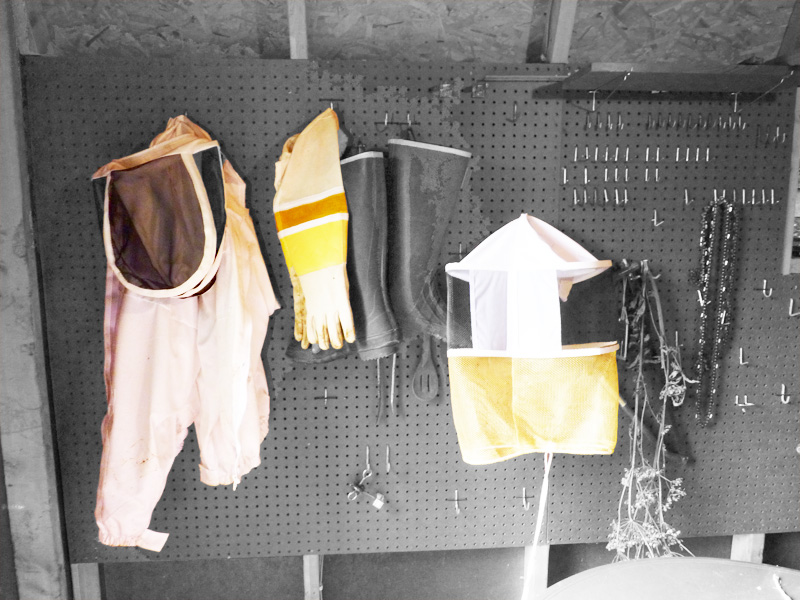
The bees are done for the year.  Two colonies will die over the winter and the third, with luck, will survive.  Even if it does, this is my last  year for overwintering colonies.  The part-time, small quantity operation we have here doesn’t justify the extra work of mite treatments, concern over various ailments only caught by colonies that survive from one year to the next and the inhibited production of the colony developing as a parent colony.

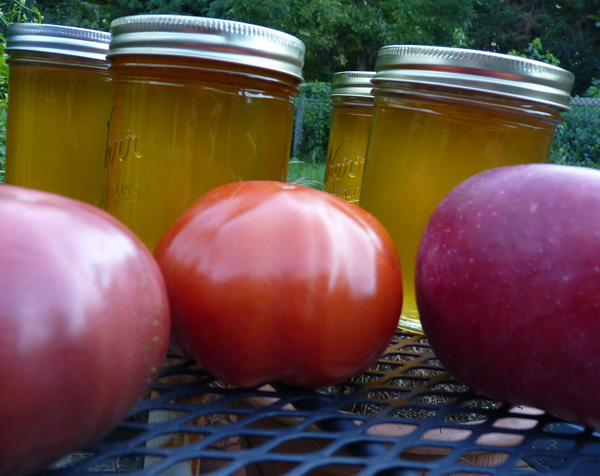
Artemis Hives now has two honey harvests under its belt in this, the third year of bee-keeping here.  Kate and I have developed a work flow.  She takes care of wooden ware, uncapping frames and bottling while I put foundations into the frames, manage the colonies, remove the honey supers and bring them to the house and insert them in the extractor.

Three hives, or even two, will make honey enough for us and our friends.  The process is more straightforward after three seasons, now heading into the fourth.  The bees have become part of our life here, like the perennials, the vegetables, the orchard and the dogs before them.

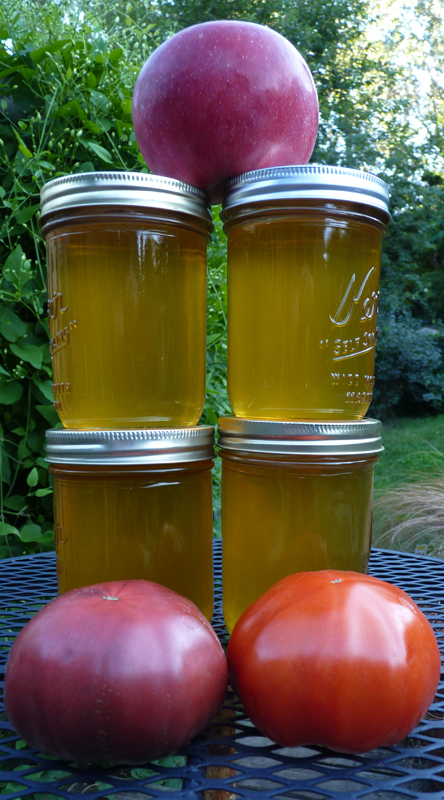
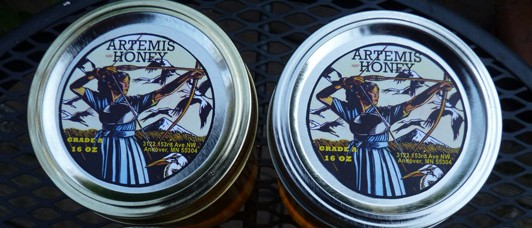
We also have the beginning of a label collection with 2010 and 2011 labels designed and produced by Woolly Mammoth Mark Odegard.

Making Pot Pies

Fall                                                       Waxing Autumn Moon

We had our final straight from the garden meal last night.  Roasted potatoes, onions, fennel, carrots and a lone beet.  Raspberries for dessert.  Marinated chicken for protein, not from here.

Today I cut up the leeks, cooked some chicken breasts, carrots, celery, peas and corn (none of these ours), and cooked the leeks in salt water for five minutes.  After shredding the chicken, a roux thickened the broth with the vegetables.  The shredded chicken went in the pie crust, then the leeks (our own), and after that the thickened broth and vegetables.

A rolled out pie crust for a top to the pies and they went in the oven.  4 chicken/leek pot pies, frozen now, treats we can have when we get back from South America along with raspberry pie.

Had an aha about our garden while cutting up the leeks.  We’re not feeding ourselves in any significant way with our garden, though we do eat several meals a year with our own produce and fruit.  What we can grow, and the leeks, garlic, heirloom tomatoes and heirloom potatoes are good examples, are specialty vegetables that, even if we wanted them, probably wouldn’t be available and would certainly not be available fresh from the garden.

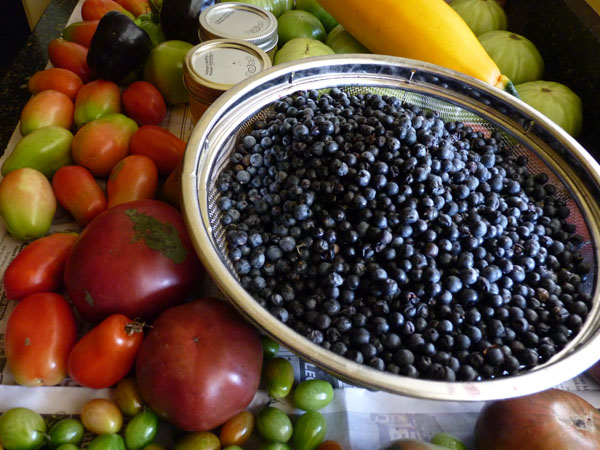
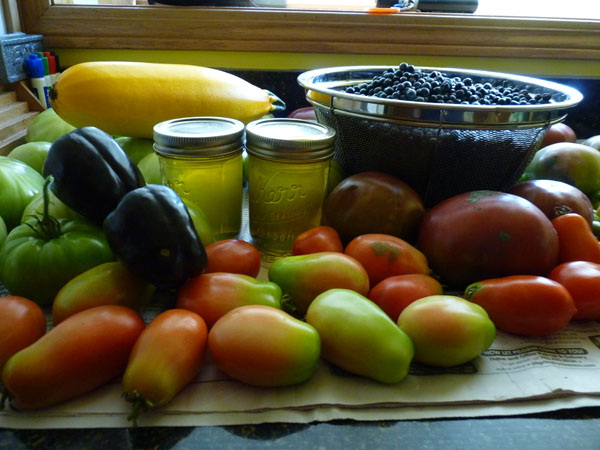
We preserve tomatoes, store potatoes and onions, garlic and honey.  Kate makes currant jam and wild grape jelly.  We have raspberry pies frozen and now the chicken/leek pot pies.  We also freeze chard and spinach.  Our garden supplements our diet in ways that would not be possible without it.

It also gives us a joint project, a place we can work together, while keeping us in touch with the Great Wheel and the ways of the vegetative world.  We get a lot from our garden.

Breaching the Walled Garden of the Self

Fall                                               Waning Harvest Moon

Prepping for a presentation on Spiritual Resources for Humanists.  Reading books, articles, letting ideas slip past as I get ready to sleep, keeping my antennae out for what feeds me now.

The book I mentioned before, All Things Shining, has convinced me of one thing.  It’s important to know why we need resourcing in the first place.

The title offers a rationale, unpacked.  Humanism embraces a world shorn of its medieval metaphysics; the Great Chain of Being has met Nietzsche’s Bolt Cutter, God is dead. God is dead, of course, was not an argument, but an observation, a sensitive man’s awareness that the God drenched era of the ancien regime had been drained by the empirical method, reason and the strangely acidic effect of the Protestant Reformation.

This world, a world with a strangled sense of the sacred, gave birth to the angst and anomie of the existentialist 20th century, a world with no center, or rather, a world with millions of centers, each person a godhead struggling with their own creation.

What can buttress the Self that must navigate these empty places?  Does our supernatural vacuum hold enough air to nourish the isolated self?

We stumble toward wonder, toward joy, hope for a glimpse of the sacred, of the moment that can lift us out of our isolation and put us in communion with others, with the natural world, with the stars which birthed the very atoms which constitute us.

These things we seek not out of some vestigial institutional memory, an anachronistic impulse to live again in a God drenched world.  No, we seek these things because the essential paradox at the heart of our lives is this:  we live alone, the only one with our world; yet we live together, up against galaxies of other worlds, sometimes with other worlds so close that they seem to intersect with ours.  We seek the venn diagram, a mandorla labeled self and other, where the other is another person, a flower, a sky, a lightning bolt.

So, spiritual resources in this context, then, would be those fragments of culture that can weaken or penetrate the walled gardens of our Selves, not in order to breach the walls, but to let in companion armies, allies in our quest.

The quest seems to similar to the one Sir Gawain faced when he beheaded the Green Knight and, in a year and a day, had to bend his own neck before the Green Knight’s sword.  That is, we somehow must will ourselves into a vulnerable, ultimately vulnerable position, to those we have beheaded.  Interestingly, as the story of Sir Gawain and the Green Knight proposes, this vulnerability is not only, perhaps not even mostly, a human to human one, rather, it is human to the whole Green world.

So we seek allies who will keep us strong in our vulnerability, mighty in our humility.  We seek at least love.
The Weekend

Lughnasa                                                 Full Harvest Moon

Kate’s out in Denver visiting the grandkids while Mark and I hold a visa watch, waiting for some word from the mysterious world of Saudi bureaucracy.

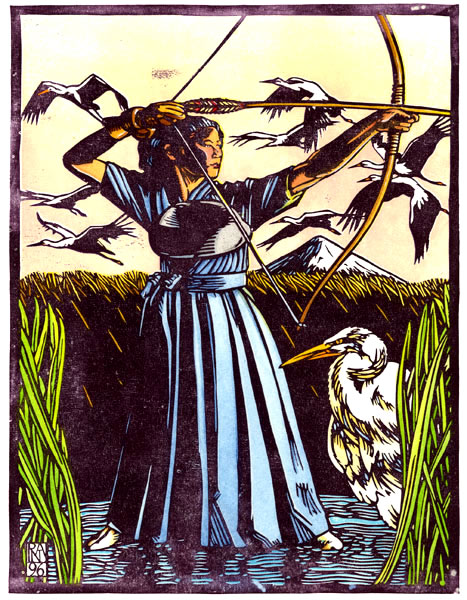
Yesterday I took a trip to Duluth to deliver 3 pounds of honey in payment for use of the image on this year’s Artemis Honey labels.  Kenspeckle Press provided the image through a friend of Mark Odegard, Rick Allen.

Mark turned this image into a beautiful 2011 label for Artemis Hives.  Thanks, Mark and Rick.

Today I moved books off a bookshelf, moved the bookshelf and repositioned a weight rack.  Later I broke ground for garlic planting and split the bulbs into cloves for planting tomorrow.

I also watched the Vikings.  How about those Vikings?  May be a short season for me.  I’m a fair weather fan.

Latin, groceries, planting garlic.  All await tomorrow.