Imbolc Imbolc Moon

1948. Polio at one and a half, paralyzed for six months, some time in an iron lung. Relearned to walk. The beginning of childhood. October, 1964. Mom dies of a stroke. 17, childhood’s end. Just realized this last week that my childhood had these two inflection points. Strange to think of childhood that way.
Hard to know the true pathways of the mind. But. Alcoholism. Smoking. An anxiety disorder. A constant focus on existential questions. Maybe. Maybe these were causative. Or, rather, my responses to them.
At 71 all that seems so long ago. I call those times the long ago and far away. Isn’t true, of course. That little boy still struggles with learning how to walk. That high school senior still grieves, is shocked, stunned. Compassion for the young man in his twenties, the one who lived after, unconscious largely, angry, hurt, determined, passionate. He didn’t understand the powerful psychic currents pushing and pulling him, making him yearn for knowledge, making him demand a changed world. Wish I could go back and hold his hand, comfort him. Reassure him. He needed it.
 No matter our birthday, 19 or 99, our past selves come along to the party. I’m unclear about the reality of self or soul though I believe in them both. Whatever the self is, it’s a composite, a melange of key moments and the reactions to those moments. And, as time goes on, the reactions to those reactions.
Whatever the soul is, it represents that of us common with other souls, that of us common with the unimaginable creativity resulting in life. As such, the soul is our literal birthright, unimpeachable by our actions, our hopes, our nightmares. No matter how sullied or glorious our life our soul retains its pristine quality, its eternal character of universality. The afterlife, if there is one, lies hidden behind the veil; but, if anything passes into it, it will be this. Would the soul be stripped of the barnacles attached by our long or short lives? Hell if I know.
I’m happy to have lived this long, 71 years. And, I can see now that answers are not part of the search. It was always the questions. As Kate and I lived in the move for the 9 months before we left for Colorado, so have I always lived in the questions. Then, in the long ago far away, and now, in 2018 on Shadow Mountain. Tomorrow, too.
 So the Eagles won. My disassociation from the NFL is almost complete though the Vikes sudden run through the playoffs had me reading the sports pages. No, I’ve not gone off football because of player’s kneeling. Hardly. It would be a reason to watch for me. At least the moments before the kickoff. No, I’ve not gone off football because it’s violent with one caveat which I’ll mention in a moment.
 Moving to Colorado two years later reinforced the effect. Bronco’s territory. The Bronco’s fan is similar in nature to the Packer fan. Lots of Broncos on rear windshields. Bronco flags. Bronco billboards. Just too damned serious for me. Not to mention that the Broncos were not the Vikings. No 40 years of memories. Yes, frustrating memories, but still.
 Rigel’s gained 8 pounds on her rabbit protein and potato diet. When we went to the VRCC on Friday, the tech said she’ll probably have to continue this diet indefinitely. She also has to get a B-12 injection once a week, also probably indefinitely. The key word, for us, is indefinitely. This is a better word than terminal, which we had expected.
 The snow drought continues here with snow pack levels about 40% lower than normal. That’s bad news for those of us who live in the Rockies, but also bad news for the Colorado River Basin states that depend on our annual snow fall for a significant percentage of their daily water. This reality will have a definite effect on our summer.
 Sandy, our house cleaner, who is about to have brain surgery for a second time on the 20th of this month, got her quilt Kate made her yesterday. She’s a strong woman and she’s had a very, very tough year. Unfortunately, the tumor did not debulk as they had hoped after the first surgery. It’s benign, but large. The aftermath of the surgery is awful. Disorientation. Nausea. Headaches. And these last a while. A quilt is such a great gift in this situation, since a lot of time in bed is part of the recovery. Covered in love.
 Hippity hop to the ortho shop. Kate’s got an appointment at Panorama Orthopedics today. Her right shoulder. She can no longer hold things up with her right arm and has to use two hands to put dishes away, sometimes to lift a cup. Annoying and painful. Screws up her sleep, too. She needs some kind of solution, more than likely a shoulder replacement. This is the first step, a consult to see what her options are.
 An interesting week ahead. A session on green burial tomorrow night at CBE. It’s part of a conversation about creating a Jewish cemetery up here in the Evergreen/Conifer area. Oddly, I think I’d like to work on that. The next night, Wednesday, is Tu B’Shevat, the New Year of the Trees. Judaism has a lot of pagan inflections, Tu B’Shevat and Sukkot, a harvest festival at the end of the High Holidays, for example. Looking forward to this one because there’s a seder, too, with seven species of fruit and nuts. I’ll explain more on Wednesday. After the this celebration is another Kabbalah session, more double letters in the Hebrew alphabet.
 Rigel has her second appointment at the Vet Referral Clinic with Dr. Bayliss this Friday, too. I’m excited about it because we’ll get a clearer picture of what’s going on with her. And, it’s not the dire prognosis we anticipated when we took her in a week ago last Friday.
 Kate sewed most of the day yesterday. May not seem like a big deal, but it is. Her energy and her energy management skills are both improving and she’s enjoying life more. I’m so glad to see it.
 Work on online education for Beth Evergreen will continue today, too. Marilyn Saltzman found some mussar sites and I’m going to add Coursera and EDx courses. I also plan to look at other, more general online education sites. So far I’ve focused on online education focused on Jewish studies, but I imagine there are more courses. A fun project.
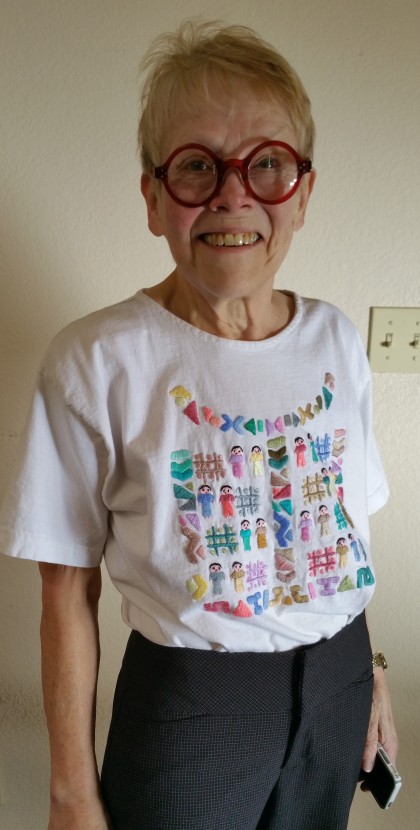 Kate has a good heart. I’ve always known that. Yesterday it took an iv, a treadmill, some radioactive dye, thallium, and a scan, plus all those technicians and physicians, to prove it. Her lungs are good. Her heart is good. Sjogren’s is bad, or at least ornery, but her underlying health is good.
 Rigel’s blood work so far is encouraging. Her liver values are back to normal. This may be a sudden old age shift to intolerance of chicken protein. The rabbit diet food is on its way from Chewy.com. Her appetite is good. If she gains weight on the new diet, that may be all we need to know. Fingers crossed.


 If you have Netflix and Amazon Prime Video, I can recommend three shows: Black Mirror on Netflix, Humans and Phillip K. Dick’s Electric Dreams on Amazon Prime. All three are science fiction, all dystopian to one degree or another, but each is wonderful.