
Samain Bare Aspen Moon
After a very busy week, a good busy with friends and Hebrew, kabbalah and time with Kate, yesterday was a rest day. Wrote, did my workout (which takes a while), napped, had a wonderful lamb supper cooked by Kate, who’s a wizard with meat. Watched some more of the Punisher on Netflix. On seeing that on the TV as she went to bed Kate said, “I don’t like your choice of programs.” “I know,” I said. Eating red meat and watching TV are hangovers from my Indiana acculturation, neither of which would I recommend to my children or grandchildren, but which I also thoroughly enjoy. No excuses.
Admitting to liking television in the crowds in which I tend to run is like admitting you enjoy belching or farting in public. Declassé. And it is, I suppose. My rationale (or, perhaps, as is often the case with rationales, my rationalization) is relaxation, in particular relaxation from a day usually spent in intellectual and physical activity. I love stories and TV, especially right now, is full of good storytellers who use visuals to enhance their storytelling. I’m sure there’s a sophisticated psychology explanation for this habit, but TV serves a purpose in my life. So there.
Thanksgiving this week. I’ve got a Martha Stewart recipe for capon with pancetta and fig stuffing. Which, of course, requires finding a capon, a mystery meat, as I said yesterday, to Colorado butchers. Tony’s Market. I ordered one and I’m going to call them today just to make sure it’s really coming. I did try to find a capon on which to experiment, but the only one I could find was $63.00. Ouch. Thanksgiving will be the experiment.
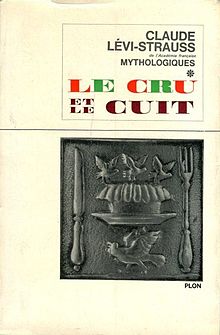
 I really like cooking, used to do a lot more. It requires mindfulness and produces a meal for others to enjoy. Just popping up from my days of anthropology: The Raw and the Cooked, by Claude Leví-Strauss. In this book the French anthropologist talks about the binary of raw food to cooked, prepared food, seeing the development of cooking as fundamental for the human species, a key movement leading toward civilization. (I’m not going to go into it here, too complex, but if you’re interested in dialectical thinking, the raw-cooked distinction is an example of binary opposition, a distinctively French version of dialectical thought which underlies Leví-Strauss’s idea of structuralism, a short introduction to it is here.)
My point in this last paragraph is that cooking is central to being human; so, engaging in it, at any level, links us directly to the story of human evolution. In that way we can look at Thanksgiving, or any big holiday meal, as linking a key step in our change from merely animal to animal with culture, to another key step, the abstraction of particular days, the elevation of particular moments in time, into holidays. The other night I realized that for dogs all days are the same no Tuesdays or passovers or superbowls, no Guy Fawkes or Mexican independence days, rather sequences of day and night, with food and friends, human contact.
 We’re not like dogs in that fundamental sense. As Emerson observed, “The days are gods.” Another binary opposition is the sacred and the profane, like the holy and the secular, ordinary time and sacred time. We imbue, out of our speculative capacity, the passing of time with certain significance. The day we were born. The yahrzeit notion in Judaism, celebrating the anniversary of a death. A day to celebrate the birth of a god, or to remember a long ago war against colonial masters. We identify certain days, a vast and vastly different number of them, as new year’s day, the beginning of another cycle marked by the return of our planet to a remembered spot on its journey.
 When we merge our speculative fantasies with the chemistry of changing raw food into a beautiful cooked meal, we can have extraordinary times. The natural poetics of wonder join the very earthy act of feeding ourselves to create special memories. Very often on those days we gather with our family, a unit that itself memorializes the most basic human purpose of all, procreation of the species. We don’t tend to think of these most elemental components, but they are there and are sine qua non’s of holidays.
So, cook, pray, celebrate. Laugh. With those you love. If you care to, take a moment to consider these amazing things, too. That we know how to transform a neutered rooster into something delicious, something that will undergo the true transubstantiation, the changing of soil chemicals, the bodies of animals and plants into a human body. That we have the idea of Thanksgiving, or the idea of Hanukkah, or the idea of Labor Day and mark out a chunk of the earth’s orbit as special for those ideas. That we choose to gather on them with our small unit of humanity’s long, long ancientrail of development and critical change and doing so honor all of these elementals.
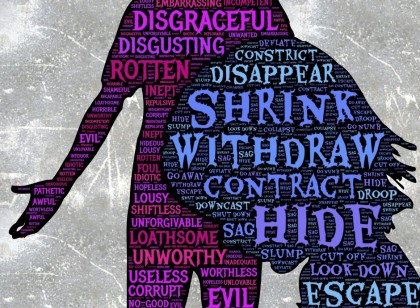
 Shame. It’s a quiet burning just under the skin, a turning of the inner face away from the self, embarrassed. What have I done? I suppose its power comes in the possibility that the person who acted like this could be the “real” me. And, it doesn’t have to be an egregious act to call it up.
 Getting to the point here. I’m a student, probably since my first conscious thought. How the world works fascinates me. History, too. Literature. Art. Religion. Philosophy. Politics. Last night for example, before I went to sleep, I focused on my breath as I often do. I began to wonder, “OK. I know about inspiration, the lungs take in air, blood in the lungs binds the oxygen to the hemoglobin. But what about expiration? How does that work? Where do the exhaust gases, the carbon dioxide, come from? How do they get expelled? Why don’t the two processes interfere with each other?” Still don’t know the answer, btw, but I’m going to ask Kate at breakfast.
 I shrank back in my chair, at least metaphorically, vowing, again, to keep my hand down. To keep that curiosity publically in check. To filter my thoughts, about whether they need to be expressed. Hard for me. I’m eager when it comes to learning and part of learning is bouncing ideas off each other. But there’s that balance idea, the sweet spot between curiosity and taking up too much space, the need to honor the contributions and questions of others, to not privilege my own at other’s expense.
 The tree of life, the tree of immortality guarded by the angel with the flaming sword; the tree itself still growing in paradise, concealed by language, by our senses, by the everydayness of our lives; the path back to the garden often forgotten, the exile from paradise a separation so profound that we no longer know the location of the trail head and even harder, we no longer have a desire to search for it.
 But here’s the trap. Metaphor, of course! I studied philosophy, religion, anthropology in college. Then, after a few years stuck in unenlightened instinctual behavior-the storied sex, drugs and rock and roll of the sixties and seventies-I moved to seminary. The trap tightened. I learned about the church, scripture old and new, ethics, church history. It was exhilarating, all this knowledge. I soaked it up. I remained though stuck in the intellectual triad, pushing back and forth between the polarity of intuitive wisdom, hochmah, and analytical thought, binah, often not going on to daat, or understanding. I learned, but did not integrate into my soul.
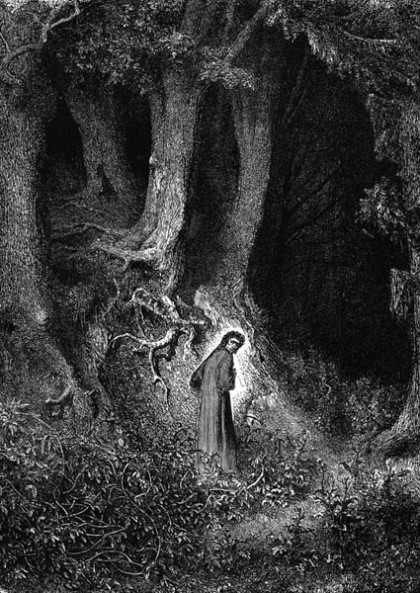 My heart knew I had gotten lost, in exile once again. In Dante’s words in Canto 1 of the Divine Comedy:
 At the time of its crumbling another path had begun to open for me. Fiction writing emerged when, ironically, I began writing my Doctor of Ministry thesis. Instead of working on it I ended up with 30,000 plus words of what would become my first novel, Even The Gods Must Die. Irony in the title, too, I suppose.
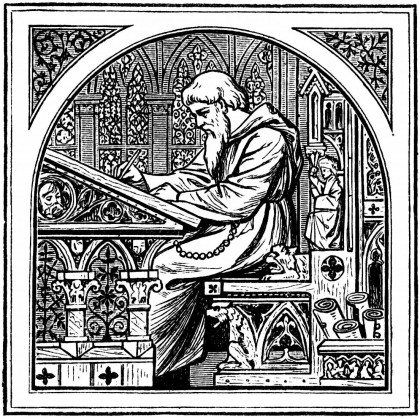 Even so, I sat behind the barrier, the flaming sword, the metaphor trap. Beth Evergreen and Rabbi Jamie Arnold have started me on a journey back to where I began, immersed in the dark. Seeking for the light, yes, but happy now in the darkness, too. The Winter Solstice long ago became my favorite holiday of the year.
 But. At Beth Evergreen I have begun to feel my way back into the fourth triad, the mystery I first encountered on the hard wooden pews in Alexandria, the one pulsing behind the metaphors of tenebrae, of crucifixion, of resurrection, and now of Torah, of language, of a “religious” life. I knew it once, in the depth of my naive young boy’s soul. Now, I may find it again, rooted in the old man he’s become.
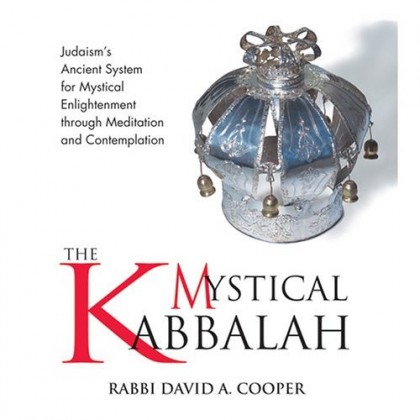
 Three nights in a row at Beth Evergreen. Challenging for this early to bed, early to rise guy. Though. Kabbalah fascinated me. I’m beginning to feel my way into the occult, again. The hidden wonders. This time around I may be able to actually hold at arm’s length the cultural vehicles and not resist the message because of the messengers. That is, kabbalah, in particular, has a poetic, evocative, confounding approach that speaks to my sense of absurdity. And, my in but not of relationship to Judaism also allows me a critical distance that I find very helpful.
 This story works for me. The imagery is something I can relate to because I’m human. Honor is so important and so often gotten wrong. Think, for example, about the instance of DJT honoring America First; just as Kim Jong Un honors himself and North Korea first. Or the gang member who feels dissed, disrespected, dishonored. A sense of kavod would have prevented the shooting in Las Vegas, the holocaust. It would prevent child abuse and domestic violence. Harming another whose dignity and respect is as worthy as your own is just not possible.
 Behind the wilderness. Everett Fox is a Jewish scholar who did a translation of the Torah into English while preserving the Hebrew syntax. He made some startling word choices, too, such as in this verse: Exodus 3:2 “He (Moshe) led the flock behind the wilderness–and he came to the mountain of God, to Horev.” Behind is such an interesting choice.
 Behind the wilderness is the God who is, as Fox translates later in this passage: I-will-be-there howsoever I-will-be-there. It is this God whose messenger Moshe saw in the bush that burned without being consumed. This God’s name, a verbal noun composed of a mashup of past-present-future tenses for the verb to be, does not reveal. It conceals. It means, it does not describe. The messenger in the bush speaks for the vast whorling reality in which past, present and future are one, all experienced in the present and as part of which we are each integral, necessary and non-interchangeable.


 So what I’m proposing is not another religion with a different origin story, a different set of scriptures, different roots from, say, Hinduism, Zoroastrianism, Christianity, Islam. And what I’m definitely not proposing is a reductionistic attempt to find out what all religions have in common, nor am I proposing a sort of tolerance for all faiths, an attempt to learn from each of them (though this is a good thing to do) and out of that shape a new faith.
 So, what are some of those fundamentals? Prayer, worship, gods, ritual, art, revelation, congregations, sacred space, the notion of sacred, divinity, after life, morality and ethics. How might a radical approach take the long history of prayer, for example, and reshape it, reconfigure it, reuse it for the person who chooses to stand outside particular traditions, but still wants to paint? Or, what about gods? How does the notion of powerful, unseen entities with various agendas fit into the life of persons no longer monotheists, no longer willing or able to see many gods?
 That’s especially important for workouts, which are easy to forego. On Mondays, Wednesdays and Fridays, I do 20 minutes of cardio, then resistance work, then 20 more minutes of cardio. On Tuesdays, Thursdays and Saturdays, I do the high intensity cardio plus 50 minutes or so slower cardio. If I miss a Monday, I go on to the high intensity, slow cardio day. If I miss a Monday and a Tuesday, I still go to the 40 minutes of cardio, resistance work day. For me, keeping the same workouts on the same days of the week keeps me from feeling guilty (I’ve missed so many workouts, it doesn’t make sense to even try and get back to my schedule.) and guilt stops the process altogether.
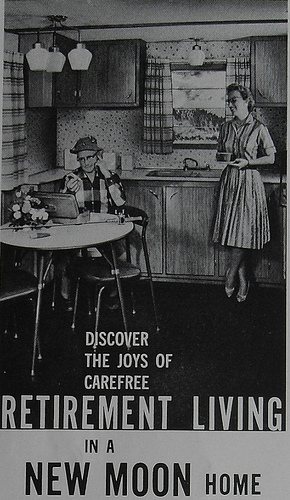 The third phase is new. It used to be that 65 or so meant the end of a working life, retirement happened, then death, often before 70. Those that made it into their seventies were often burdened with serious medical problems that drained energy and created obstacles to doing much else.
 70 is not the new sixty. It’s the new 70. What 70 is the new sixty really means is that for those raised in the 50’s, 70 now appears like age 60 did when we were kids. Big difference though…we’re in that sixties range of health, but we’re 70 and work has fallen away, the kids are gone. What do we do?
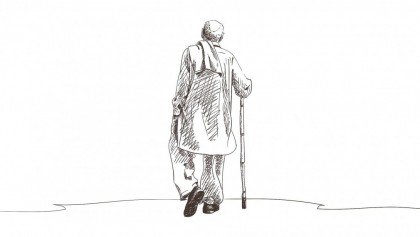 Yes, retirement and the life following it, the third phase as I call it, is just that, a new and different time of life, one in which the question of how do I live can have a radically different answer than in the first two phases. Who are you? Who do you want to be? If you want to be a person whose constant focus is recreation, who gets up in the morning for another day of adult recess, you can. If you want to be a dress designer after years as a forensic engineer, you can. Or, as in my case, the work before retirement age was satisfying, self-directed, so there’s little reason to change just because some age-related cultural turning point has been reached.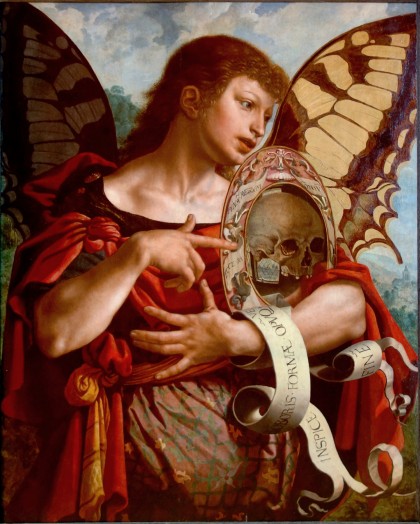
.jpg" title="Fair use of copyrighted material in the context of The Raw and the Cooked">Fair use</a>, <a href="https://en.wikipedia.org/w/index.php?curid=45649279">Link</a>)