Category Archives: Great Wheel

Getting Ready for the Dark Time

Lughnasa                                         Waning Harvest Moon

The museum (MIA) has us check out when we’re going to be gone over our tour days, so I’ve checked out from mid-October through early December.  I’ve not had many tours in August and none in September, just one in October.

That, plus the relatively light schedule for the Sierra Club–the legislature doesn’t convene until February, so no weekly meetings–has given me plenty of time for the late garden work with time left over rearranging the downstairs and reconfiguring my study.

Yesterday I finished swapping out books from the bookcase nearest to my desk.  The desk and the bookcase form the sides of a U, with the bottom of the U created by the computer workstation.  On this bookcase I had collected various art and art history texts as the docent years had gone on, but they were works I did not reference frequently.

What I need near the desk are books I pull off for work.  It’s a working bookcase, not a storage unit.  Now I have near me all my Latin dictionaries, commentaries, grammars and readers; various style manuals like The Chicago, a thesaurus and english grammars plus books on writing.   The works I use most after the latin texts are the oxford dictionary of art, the oxford dictionary of philosophy and the oxford english dictionary.

On the bottom most shelf I have notebooks from docent training and several comprehensive art history texts.

I do have a shelf devoted to a long term project which I’ve shorthanded Ge-ology.  This project has its own page on this website, but I’ve let it dangle, as I have the ecological history of Lake Superior.  Here’s the summary:  This work will gather various strands from ecology, environmental movements, pagan and neo-pagan faiths, literature, art and philosophy.  It will weave those strands into a faith indigenous to the Midwest (and most other places) and universal to Ge.

Having at least some key texts near to hand may spur down time work on Ge-ology.  Oh, hell, why not go for it?  It will produce work.

There are still a few book stacks on the floor and this and that to find new places for, but I’ll finish that today.  Ready for winter.
For Me and My Gal

Lughnasa                                                    Full Harvest Moon

Hay wagons filled with laughing teenagers.  Plants beginning to go brown in the garden.  Root cellars and pantries filling up from a growing season almost over.  Thoughts of how to handle snow removal begin to occur.  The first few leaves begin to turn, russet and gold tips on some maple trees.  Evening cool downs and chilly nights.

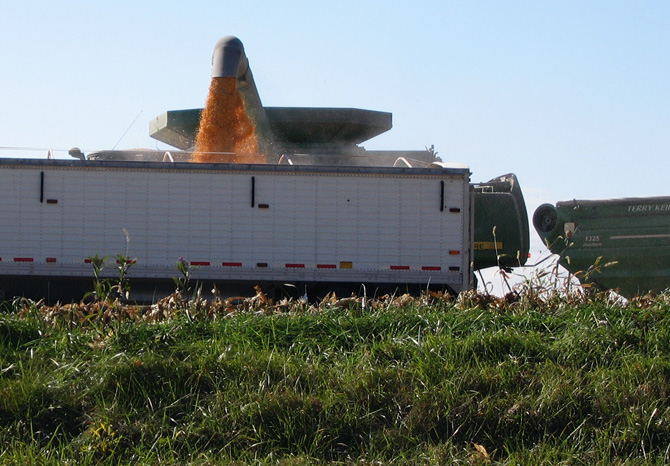
All under a harvest moon.  The harvest moon is the full moon closest to the autumnal equinox, sometimes landing in September (usually), but occasionally in October.  Those who have any rural roots at all here in the Midwest know the scenes of hay baling, corn pickers mowing down corn stalks with their military grade blades, golden streams of corn flowing into the grain truck following nearby.

Bulky combines in the wheat, moving castles of iron and computers guided by the cyber harvesters mounted in air conditioned cabs far above the fields.

Farm implements move now from field to field, 20 mph obstacles on the back roads and highways, one set of tires, the right side, often on the shoulder, as these field creatures crawl along pavement, out stripped by cars and trucks whizzing by, creatures of the highway.

All hale the gods and goddesses of the harvest, of reaping, of bounty.  This is the American advantage.  We have food, acre after acre of food.

Yes, this September issue of Scientific American praises cities as efficient, creative, green.  Cities are the future hope.  Even the present hope.

But let me tell you this.  No farms.  No cities.  Rural counties may be depopulating, and they are, but the need for the products of the country only increases as the greener, efficient, creative cities thrive.  It will always be so on this earth.

So this harvest season maybe we should all put a temporary bumper sticker on our car:  Hug a farmer.

State Fair, Auld Origins

Lughnasa                                                                            Waning Honey Extraction Moon

The state fair has begun:  corn dogs, cheese curds, church run restaurants, politicians of all stripes, trade unionists, farmers and a few cows, horses, pigs, chickens, llamas and rabbits.  Oh, yeah.  That butter sculpture, too.  You know, Princess Kay of the Milky Way.  Or, Queen of the Tao of Dairy.

State and county fairs, occurring in late summer, are the direct remnants of the Celtic festival of Lughnasa, a first fruits market and holiday week which brought farmers, crafts people, villagers and nobility together.  These festivals had a religious beginning, honoring of some god or goddess whose attributes seemed especially apt, in the case of Lughnasa, the Celtic god, Lugh, a god of many skills, whose foster-mother Tailtiu died after clearing Ireland for agriculture.

At Lughnasa handfast marriages were made, hands stuck through a hole in a stone wall and held fast blessed a couples trial for a year and a day.  Games and feats of skill played a prominent part during the Lughnasa festivals, too.  Winter lodging for those without homes was also contracted for during these festivals.

(Lugh had a spear which sought battle, a sling with which he was expert and a raven by his side.  His name means, in Gaelic, long arm.)

The gathering of such diverse groups as 4-H’ers, beekeepers, dairy folk, farm implement dealers, artists, union workers, political aspirants and hawkers of all kinds makes our contemporary Lughnasa as vibrant and colorful as the originals.

I don’t know how many year and a day marriages get sealed at the State Fair, but I imagine many relationships begin or deepen during its run.

However you style it, the State Fair celebrates the many skills and talents in our state and brings folks together.  Lugh, the god of many talents, must feel at home here, too.


There and Back Again

Lughnasa                                                 Waning Honey Extraction Moon

A birthday really marks the spot on the earth’s orbit where you were born.  So, it is not necessarily a function of time in a linear sense, but the count of revolutions on the (roughly) same path.  In other words even the years of our lives do not, at least in this sense, refer to the passage of time so much as they do the passage of the earth around the sun.  I like this because it helps me have a concrete understanding of my years.  I have, for example, gone round the sun 64 times and am about halfway through my 65th.

A space-time co-ordinate.  When we add in our linear sense of time, occasioned by the evident aging process that ends in death (entropy at work), our birthday becomes a space-time co-ordinate, fixing our birth in the 4-dimensional reality of space and time, or Minkowski space.   Our birth date locates not only the 3D version of our birth–the physical locus of our birth–but establishes a reference point in some standard measure of linear time.  In the West we tend to measure time in relation to a fixed point occurring around the birth of Jesus, but it could have as easily been the birth of Socrates or Alexander or Cleopatra.

Linear time, as we measure it, has this odd pliability.  We have no fixed point in reality against which to mark its passage, unless you count revolutions around the sun; but, then we end back in the cyclical view of time, the type of time measured by the Great Wheel, because to indicate linear time we still have to agree on which particular revolution starts our series.

How many revolutions ago was Caesar murdered?  How many revolutions ago was Confucius born?  How many revolutions ago did Homo sapiens emerge out of Africa?  We still have to place our tent peg, our starting point somewhere and it will still be in revolutions around the sun.

No matter how hard we try to escape into chronological accounting, our human estimates still return to our revolutionary experience, the root source, which is, and always will be until we leave this planet for the stars, cyclical.

A Beautiful Moon

Lughnasa                                                                 Full Honey Extraction Moon

The moon.  Tonight.  A darkening sky, blue behind the openings in the clouds and peeking out from behind a modest veil, a full Honey Extraction Moon, its color a silvered gold, honey-like and mysterious.  I love the surprise of a beautiful moon in the sky, looking out on a familiar horizon to see it transformed by the ordinary extraordinary moon.  The moons from now through the end of the year often have a wow factor.  The Harvest Moon.  The Thanksgiving moon rising over stubbled fields coated with snow.  The Winter Solstice moon, sending lambent light onto the snow, casting faint shadows of trees, houses, people.

This moon shone in the eastern sky as I returned from Tai Chi.  This was the 20th week and the teacher, Cheryl, announced, again, that we were close to a third of the way through the form.  “It’s a milestone,” said Cliff, a 13 year practitioner.  A third of the way through.  20 weeks.  At this pace it will be a year before we have worked our way through the whole form.  Being patient with myself.  Learning that in this class.

At points now I feel a grace coming into my motions, a fluidity beyond learning the choreography, beginning to make it mine, to work from the inside out rather than the outside only.  Not often.  But I have felt it.

Thought about Cliff, a younger guy, maybe in his forties, having practiced 13 years.  Realized I’ll be 77 by the time I hit 13 years.  Whoa.

Looking Backwards

Lughnasa                                                                        Full Honey Extraction Moon

Over the last week plus I’ve watched the Starz Network version of the King Arthur legends, Camelot.  I get it streaming from Netflix.  Each time I watch this program I get a shot of creative juices, similar to the ones I got when I first read the Mists of Avalon by Marion Zimmer Bradley.  Those didn’t inspire me to write about the King Arthur material, an area that gets reworked a lot, but it did cause me to think about my own heritage, my ethnic heritage and what might be there as a resource for writing.

At the time I chose to emphasize the Celtic aspects of my bloodline, Welsh in the instance of the Ellis line and Irish through the Correll’s, my father’s father’s mother’s family.  The Celts have a rich pool of legends, religious ideas and quasi-historical accounts.  Most have heard at least something about druids and faeries, both part of the Celtic past.  There are, too, holy wells, a Celtic pantheon and the series of holidays known as the Great Wheel which I celebrate.

I’ve not done much with the German side of my heritage though it is, arguably, more substantial since the Zikes and the Spitlers, my mother’s and father’s mother’s families respectively are both German.  The Keatons, my mother’s father’s family, we think have an English connection though it’s proven difficult to track down.

The legendary and religious aspects of the ancient Celts and Germans are what interest me, the more recent history not so much and by recent I mean from the Renaissance forward.

Roman and Greek mythology and legend has also fascinated me since I was young and my Aunt Barbara gave me a copy of Bullfinch’s Mythology.  Through out my life at various points I’ve read such works as the Iliad, the Odyssey, Hesiod’s Theogony, Ovid’s Metamorphosis, amazed at the richness of these stories.

As you know, if you read this blog with any regularity, that lead me to learn Latin, which I am doing, so I could translate Ovid’s great work, the Metamorphoses, for myself.  The distance between a translated text and its English version has interested me especially since seminary.  In seminary I studied both the Old and New Testaments extensively, learning in the process many techniques for analyzing ancient texts.  It was my favorite part of the seminary curriculum.

When I observed yesterday to Greg, my Latin tutor, that the commentaries I’d found for the Metamorphose lacked a lot compared to commentaries for the Biblical material, he challenged me.  “Well,” he said, “You could write a commentary to it.”  I might just be able to do that.

When I mentioned it to Kate, she said, “Oh, and finish your novels, too?”  And she’s right of course.  I have more than one creative iron in the fire, plus other matters related to art and the environment.

Even so, the idea intrigues me.  A lot.  Now all I have to do is get very facile at translating.


Senescence

Lughnasa                                                    Waxing Honey Extraction Moon

Walked in the garden alone.  Yep, it’s an old time spiritual, much loved in the churches of my youth.  It also describes my morning turn among our vegetables and in our orchard.

The garlic has come out already.  The potatoes have a while yet to go.  The beans have gone from green bean material to soup beans, waiting now for the pods to dry on the vine.  A few onions remain, as for the tomatoes, there are a lot of possibilities, but as the weather cools, will they ripen?  In the orchard we’ve had more productivity than any year so far, a few cherries, lots of currants, many dropped plums, but a few now maturing on the tree.  The apples, in their plastic sandwich bags, have begun to swell on the honeycrisp tree, but on the other, a green apple, they’re not a lot bigger than when the bags went on in July.  Our blueberries came and disappeared into the mouths of birds.

The wild grape harvest looks like it will be a big one this year.  These vines are everywhere on our property, but the ones that produce the most fruit hang in dense layers over the northern fence that fronts our orchard.  Picking the wild grapes usually marks the end of the gardening year here at Artemis Hives and Gardens, at least the food gardening.

The fall flowers of course begin to bloom then, the asters, the mums, the monkshod, the clematis.  It’s also the time to plant bulbs, tulips and daffodils, lilies and croci. It is, too, the time that the garlic bulbs harvested in July, yield up cloves from the largest bulbs for planting.  I like planting the garlic in late August, early September.  Garlic is a counter culture crop, sown in the fall and harvested mid-summer.

Senescence has fascinated me for a long time.  Earlier in my life the process of degradation that rotted wood, turned leaves into humus and prepared more soil got my attention.  An early interest, I suppose, in the great chain of being (note the lower case here, less Scholastic, more Great Wheel).   Now I’ve noticed another key aspect of senescence; it is the time of harvest.  Yes, in the plant world, the dying of the plant’s above earth body follows or is in step with the giving of its fruit.  That is, aging produces

This is also the time when gardening begins to wane in interest for me.  My energies now turn to novels, research for tours at the MIA, preparing for the fall issue selection process at the Sierra Club and the upcoming legislative session.

Now, too, the cruise, which begins in October, looms closer and the loose ends for it need to be tidied.  The Brazilian visa.  New luggage.  Check the clothes.  Rent a tux. (yes.  I’m gonna do it.  3 formal nights a week on the cruise.  i’ll pretend it’s halloween every one of those nights.  i’ll be some seriously weird expatriate Muscovite on the run from Putin’s secret police.  something like that.)

A Season Bent Toward Darkness and Cold

Lughnasa                                                                Waxing Honey Extraction Room

Since March I’ve driven home at 8 pm, each Sunday, from Tai Chi at the corner of Hennepin and Franklin.  As March receded and April arrived, then May and June, the evening drive had light, then light in abundance, with the sun setting well after I got home.  Now we are in Lughnasa, a full six weeks past the Summer Solstice.  This last Sunday night the sun had begun to fall behind the trees as I headed toward Highway 252.  The long downward slide toward the Winter Solstice is well underway, the days growing shorter and the nights longer.

This is my time, now, the season bent toward darkness and cold even while the heat of summer continues to swell the fruits of the garden.  I can already feel the movement inward and down, the contemplative months reaching out from the future, beckoning my soul.

Once the harvest begins in earnest, which it did here in July with the garlic crop, the gardening year moves toward senescence, ripening proceeds the coming of brown withered stalks and leaves turning already to dust.  Nature puts the bounty just before the fallow time.  It is the fallow time though, the time after the sensuality of seed fertility has yielded to summer and produced crops, crops that finish the plants purpose for that season at least, in many cases forever, that leaves room for the imagination, writing its dreams on stubbled fields, carving its fantasies in clouds pushed down from the north, opening the heart to its own rhythm.

(Allison found this Van Gogh drawing.  It even has the hint of melancholy the season brings in its train.)

Lughnasa 2011

Lughnasa                                                          Waxing Honey Flow Moon

The third cross-quarter holiday in the Celtic calendar, Lughnasa follows Beltain and proceeds Samhain, thus it cuts the once much longer Beltain season, essentially the growing and harvesting season, in half.  It marks the first fruits of the harvest, a time of gathering in and being nourished by the summer’s heat, the plants’ flourishing.  Lughnasa apparently celebrates the god Lugh, a sun-god, though the relation between him and this festival is uncertain.  The Catholics honor this pagan tradition through the feastday, Lammas, when parishioners bring in bread from the first grains harvested.

In the old days these festivals lasted a week or more, with farmers coming into the village from the countryside or meeting at a customary spot to set up a market.  Feasting, drinking, games, searching for a mate or for work blended with the serious task of laying up sufficient stores to survive the winter, foreshadowed now by the earlier setting of the sun.

A remnant of these market fairs continues on in county fairs and state fairs where feasting, drinking, games, searching for a mate or work blends with honoring those who still provide our food.  Yes, we have the grocery store now and no we don’t wonder about surviving the winter, at least many of us don’t, but the old need to come together and crown a Princess Kay of the Milky Way, to sculpt her in butter lingers.

Lughnasa here at Artemis Hives will find the honey harvest joining the tomatoes, the potatoes, beets, carrots, beans and onions.  It also finds us reaping the harvest of new learning:  Latin, Tai Chi, quilting techniques, potting and celebrating family.  The dogs have become a calmer pack thanks to an investment of time over the last few months.  Mark has made some progress towards a job and a healthier future.

Celebrate your harvest, too.  Raise a glass of wine or water, eat a meal with friends and loved ones.  Wear a flower garland and go the state fair or the farmer’s market.  Why?  Because these are things we humans have done for centuries, for millennia, they keep us alive and healthy.

To Bee, To Do

Mid-Summer                                                             Waning Honey Flow Moon

Out to the bees in just a few minutes to slap on two more honey supers each, the six I finished varnishing yesterday while Mark put foundations in the frames.  This will find six honey supers on colonies 2 & 3, while colony 1, the parent colony for next year’s only divide, will have four.  Not sure if I’ll need more than these.  I’m having to do this in the early morning, not the best time, but the only time I’ve got today.

At 9:15 Kate and I take off in separate cars for the Northern Clay Center.  Our clay intensive starts this week, 10:00 to 4:30.  I hope to learn how to make Japanese style tea cups and salad sized plates.  Like tai chi working clay puts a premium on hand-eye co-ordination and sense of touch as well overall design skills.

A good while ago my spiritual journey had gone stale in the reading, meditation, contemplative modes I knew best. The next stage of my spiritual practice became gardening, working with the rhythm of flowers, soil, spades and trowels.

That practice went on for many years when Kate and I decided to add vegetables and the orchard with permaculture principles in mind.  That added a good deal of oomph to the tactile spirituality, deciding to keep bees put animal husbandry into the mix.  At this point my spirituality has become more and more attuned to the rhythms of growing seasons, plants and bees, all within the context of the Celtic Great Wheel.

With tai chi and clay my spiritual practice comes closer in again, my hands, my feet, my hips, my arms.  Both clay and tai chi are paths on this nature focused ancientrail, though for me they are quite a bit harder.  But that’s the push I need to grow.

After our first day at Northern Clay, I have my Woolly meeting tonight at Highpoint Print co-operative where we will make prints.  One more step down the ancientrail of the mind/body link.