Category Archives: Great Wheel

Let There Be Darkness

Fall                                                Waxing Harvest Moon

Let’s try darkness again.  In Taoism the familiar Taiji makes my point about the essential and complementary nature of light and dark.  Taoism gives equal weight to the yin and yang* represented in the taiji, the small circle of yin within the yang and of yang within the yin, emphasizing the Taoist belief that all things contain their opposite to some degree.  So, one part of my argument simply notes that light and dark are both necessary, necessary to each other, nothing apart from each other.  In the Taoist taiji they represent the dynamic movement of heaven to which all things must conform.

In our Western cultural tradition, though, light has taken precedence over darkness, both in a physical and in an ethical sense.  Jesus is the light of the world.  Persephone goes into Hades and the earth mourns her absence until her return when it blossoms into spring.  Eurydice dies and Orpheus goes to the underworld to retrieve her.  Dante’s Divine Comedy finds Dante wandering, lost in the dark wood of error, before he begins his descent, guided by Virgil, into the multiple layers of hell.  The traditional three-story universe also reinforces these ideas:  Heaven above, earth, and the infernal regions below. Milton’s Paradise Lost follows the rebellion in heaven and the casting out of Lucifer, the Morning Star, into hell where he builds his enormous palace, Pandemonium.  Our common sense understanding of death involves hiding the body beneath the earth.  Why?

Coming out of the spiritualist tradition represented by Camp Chesterfield (see below) death involves a transition into the light, the spirit world.  Ghost Whisperer, a TV program, uses the trope from this tradition, as dead souls are led into the light.  It is, perhaps, no wonder that darkness, night and the soil come off badly in our folk metaphysic:  up and light is good; down and dark is bad.

I wish to speak a word for the yin, symbolized by the moon, the female, the cold, the receiving, the dark.  The moon illustrates the taiji perfectly.  In the dark of night, the moon, yin, reflects the sun’s light, yang, and offers a lambent light, neither yin nor yang, but the dynamic interplay between the two.  So we could look for art that features the moon as one route into the positive power of darkness.

Also, any seasonal display in a work of art, whether of spring, summer, fall or winter can open the question of each season’s value, its role in the dynamic of growth and decay, emergence and return.  This can lead to a discussion of the importance of the fallow season, the season of rest, the earth’s analog to sleep.  This can lead to a discussion of sleep and its restorative powers.

Art work of mother and child, or especially, mother and infant, can stimulate a discussion, in this context, of the womb, of the fecund nature of the dark where fetuses and seeds develop before their emergence into the world of light.

Similarly, death focused works of art can open up a discussion of birth and death as dynamic moments of change, yin and yang of human (or animal) development.  This could lead to conversation about the Mexica (Aztec) belief that life is the aberrant condition and that death is the vital, regenerative moment; we are here, goes one Mexica poem, between a sleep and a sleep.

Winterlight festivals represent a western imbalance focused on the light, the yang, and a tendency to cast the yin in a negative light, something to be avoided or eliminated or held in check.  As I said previously, this is understandable given the pre-historical science which made the return of the sun doubtful and therefore terrifying.  Many of these festivals are, too, our favorites:  Christmas, Deepavali and for a different traditional reason, Hanukkah.

In my own faith tradition, roughly pagan, I look forward to the dying of the light and celebrate as my most meaningful holiday, the Winter Solstice.  Of course, I also celebrate the return of the light that begins on that very day, but first I immerse myself in the long night, the many hours of darkness.  This affords me an opportunity to acknowledge the dark, to express gratitude for its manifold gifts.   In this way my idiosyncratic faith has a ritual moment that honors the taiji, utilizing the cues given by the natural world.

To find art that emphasizes this aspect of darkness I plan to walk the museum from top to bottom, searching for images and objects that can help our visitors understand that when they celebrate the festivals of light that darkness is the reason for the season.  I would appreciate any thoughts or ideas.

*In Chinese culture, Yin and Yang represent the two opposite principles in nature. Yin characterizes the feminine or negative nature of things and yang stands for the masculine or positive side. Yin and yang are in pairs, such as the moon and the sun, female and male, dark and bright, cold and hot, passive and active, etc. But yin and yang are not static or just two separated things. The nature of yinyang lies in interchange and interplay of the two components. The alternation of day and night is such an example.
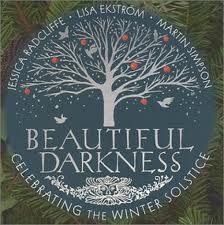
Photocentrism

Fall                                              New (Harvest) Moon

OK,I made this up.  Photocentrism is a focus on the virtue of light that, by implication, puts darkness in a negative or bad relative position.  Just because I made it up, however, does not mean I’m joking.  The context:  the docent annual meeting today and the presentation of a new December of the month called Winterlights.  I agree that Winterlights is a complex noun that has a rich associative feel.  I even agree that the celebrations in what I have long called holiseason–Thanksgiving to January 6th, the traditional 12th day of Christmas, Epiphany (visit of the Magi to Bethlehem), and the date for the celebration of Christmas in the Eastern Church–offer an unparalleled opportunity to learn from other cultures about matters deep in the human psyche:  Thanksgiving, Advent, Deepavali, Hanukkah, Posada, Winter Solstice/Yule, Christmas, Western New Year on January 1, the 12 days of Christmas and maybe Kwaansa, though its constructed nature makes me a bit shy of it.  Eid al Adha, the Muslim holiday that marks the end of Hajj by celebrating the Irbrahim and Ishmael story, falls in November this year, but not within holiseason itself, so I’m going to leave it out of this discussion.

The festivals or holidays of light, in particular Deepavali, Hanukkah, Winter Solstice (although is a special case as we shall see) and Christmas (more for what it replaces, Saturnalia, than what it celebrates itself) do have a common thread.  Deepavali, Winter Solstice and Christmas all relate to the despair felt in subsistence agriculture communities when the light of the sun seemed as if it would wink out and perhaps disappear altogether.  This fear, of the Sun’s final rising, put its mark on well-known pre-historical landmarks like Stonehenge, Chichen-Itza and the great Newgrange dolmen in Ireland.  Without a knowledge of the physics and celestial mechanics of the earth’s orbit and the sun’s central place in our solar system, it was frightening to consider the possibility that this time, this winter, the gradual diminishment of daylight might proceed all the way to an apocalyptic darkness.  No light for the crops.  No crops for the animals.  Cold all the time.

What to do?  According to theories of sympathetic magic, like produces like, so the logical response to oncoming darkness was a bonfire, a torch, a brave manifestation of light and heat in hopes that the sun, since it is like light and heat, will either be rekindled or seduced into rising again.  And these practices work.  Each time the bonfires were lit, the torches paraded, the sun did not disappear, but returned to once again start the growing season and stave off starvation and freezing for another year.

All of this makes sense, granting the scientific understandings of these early peoples.  As cultures grew more sophisticated and astronomical knowledge became a bit more advanced, however, it did put out the lingering fear that the darkness would one day come and never leave.  So holidays that focused on light, especially, but fire, too, became integral parts of the cultural and religious traditions of many peoples.

They all leave out one important thing, though.  The virtues of darkness.  I first became aware of the following arguments when I began to research the goddess, the great mother goddess.  I won’t get into here the debate surrounding the contention by some that a great mother goddess preceded the monotheistic, patriarchal deities of the Abrahamic religions, though I’ll tip my hand enough to say that I don’t find the evidence compelling.

What I found out about darkness surprised me and changed my mind about how I view it.  Darkness is as necessary as light.  Seeds start growing in the dark soil, away from light and even after they penetrate the surface, their roots continue to press their way into the surrounding nutrient-filled earth.  Mammal babies live their first few months of life in the moist, nourishment rich environment of their mother’s womb. (OK, not in the marsupials and the platypus and the echidna’s instance, but you get the drift.)  Darkness creates the time of rest and restoration for us and for many animals.  It is when we sleep and when we dream.  Darkness is the natural condition of space, attenuated by billions of stars only in what amounts to a small total area of the vastness of the universe.  Light itself requires a degree of darkness to create vision.  Anyone who’s ever been in a whiteout where snow and sky mix to create a vertiginous world with no up and down, no distinguishing characteristics understands the problem well.  Or consider a bright, very bright light and its affect on your sight.

This argument can be cast as a feminist one in which the light represents patriarchy and the darkness the creative agency of women.  It can also relate to anti-racism work in that we tend to equate darkness, blackness with evil, with corruption and decay.  This denies the regenerative, restorative and generative nature of darkness and narrows our conceptual world in literally dangerous ways.

How could this relate to Winterlights?  Without this kind of background the celebration of light has a sinister side as well its assumed positive one.  The celebrations of light only make sense in terms of the deep cultural background and when we go there we need to understand the fear that created these holidays has also unbalanced our appreciation of the other state, darkness.  I’ve not given it any thought, but I imagine there works of art that make darkness a central theme, that could be used to help put the other holidays in a balanced perspective.

Hanukkah is a special case here in which the focus does not seem to be on the Winter Solstice but on a cultural achievement by the Maccabees, the expelling of the Greeks.  It does however beautiful-darknessshare a darkness dispelling theme with the others.
There is more to say here, much more, but I’m hungry.  Catch you later.

Harvest

Fall                                      New (Harvest) Moon

Second round of apiguard in the parent and the divide.  The top box on the package colony has gotten heavier, but I plan to feed them some more as I will do to the parent once the apiguard comes off in two weeks.  Sometime in early November I’ll get out the cardboard wraps and cover the hives for winter.  That will pretty much finish bee work for the year until late February or early March.  I’ve given away honey and plan to give away more.  Part of the fun.

A quick walk through the vegetable garden shows kale and swiss chard looking good, a few rogue onions that escaped the harvest, plenty of carrots, beets and butternut squash.  The harvest is 2010-10-04_0351not yet over and will go on until the ground threatens to become hard.

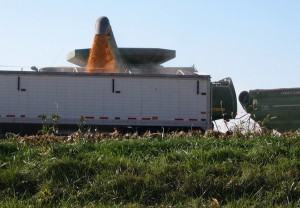
While I drove through the countryside on my way back to Lafayette on Monday, I passed field after field of corn and beans, some harvested, some not, about half and half.  Seeing those scenes put me right back at home, especially the corn fields.  Here’s a field near Peru, Indiana with the combine spilling corn into a tractor trailer for transport either to a corn bin, grain dryer or even straight to the grain elevators, all depending on the price and moisture content of the corn.

Indiana is no longer home, Minnesota is, but Indiana has a large section of my heart, the chamber of childhood and early young adulthood, a room full of corn fields, basketball, small towns, a baby sister and brother, county fairs and James Whitcomb Riley poems.  I was glad to be there the last few days and to walk again in the part of my heart filled there so long ago.

We move now toward Samhain, Summer’s End.  Blessed be.

The Great Wheel in the City

Fall                               Waning Back to School Moon

How can city dwellers, big city dwellers, stay in touch with the natural cycles, with the rhythms of the Great Wheel?  This was on my mind yesterday as I walked around the loop.  There are, of course, the occasional plantings decorating outdoor cafes, the greenery of Grant Park and Millennium Park, even a lushly planted median on the boulevard of Michigan Avenue, yet these seem like captive specimens, botanical exhibits in a zoo for denizens of concrete, stone, metal and glass.

When I went out for a walk this morning, wandering down Jewelers Row, out to Michigan Avenue and down to State Street, building facades began to show themselves.  Here there were floral inspired Prairie School designs.  There were viny elements in tile and plaster ascending the column of a building.

At 30 Michigan Avenue an idea began to form.  There on a frieze perched above a  soulless slab of polished marble that defined a Walgreens were small medallions punctuated by a familiar face, the Greenman.  He looked like this one.  There were four, separated by the flowery medallions.  After that, the plant inspired architectural design appeared, as if by magic.  For those who have eyes to see, let them see.

In a flash I realized what I dislike so much about Modernist architecture.  It does not acknowledge the real context in which it exists.  This Bauhaus influence attempted to rid the world of the Greenmen, the vines, the flowers, the sinuous riverine shapes that the late 19th and early 20th century architects considered essential.

And they were essential.  Why?  In our cities we put on a brave front, raising  our forests of buildings that shade out the sun, paving over the earth so trucks and cars can move about with ease.  Tunneling electricity so even the night cannot dominate us.

We still need to eat. Our lives depend on the vast unbuilt land where the primary things that spring from the earth are corn stalks and wheat fronds.  Where animals may outnumber humans and the humans work with and for the plants.

We still need to breathe.  The lungs of mother earth, the circulatory system that cleans our air consists in large part of trees.  The forests lie outside our urban boundaries, though they do join their city cousins in their work.

We still need to drink.  Fresh water comes from rivers, lakes, streams and aquifers either far away from city centers or buried deep beneath them.  Care for the source of our drinking water means  caring for those ends of the earth from which it comes.

Thus, it is not an idle question to wonder how we connect with the Great Wheel, with the changes of season and the growing of food, the cleansing of water and air.

The design motifs inspired by green leafy beings recognized that dependence and writ its continuing message on the walls of the buildings which we use and which we see each day.  They inspire us and help us recall mother nature in  her beyond the city state.

There was. too, another reminder.  I looked down Washington from Wabash and my gaze carried up the  building led me to a patch of blue sky.  There was the moon, a half moon, the Back to School moon, framed by buildings with leaves and greenmen and flowers.  These are enough.

One thing more.  Remember Ozymandias, King of Kings.  Recall the ruins of Babylon, Xi’ang, Epheseus, Athens.  Cities do not last.  Nature reclaims them all at some point.  What seems so permanent, so imposing, so there only awaits its end.  Which will come, sooner or later.

Following the Old Religion

Lughnasa                                            Full Back To School Moon

Summer has three endings:  Labor Day which marks the end of summer vacation for many school children; and, for many adults like myself, kicks us into serious mode as all those years of conditioning continue to affect our attitude;  Mabon, or the Fall Equinox, which comes tomorrow, that point when day and night balance each other, neither claiming dominance, though the trend matters and at this equinox, the balance tips toward night as the darkness increases, pulling us toward the longest night, the Winter Solstice on December 22nd and Samhain, or Summer’s End according to the old Celtic calendar which divided the year in half, Beltane-Samhain or the growing season, and Samhain-Beltane or the fallow season.  Samhain comes on October 31st and, like all Celtic holidays lasts a week.

The growing season has this triple farewell reflected too in the holidays of Lughnasa, the festival of first fruits, Mabon, the peak of the harvest and harvest home, and Samhain, the end of the harvest season and the end of the growing season.  No matter how you notice or celebrate it these real changes in the agricultural year still happen, they still have critical importance for our human community, and they still deserve our attention.  Why?  Because our ages old relationship with agriculture is what separates us from the hunter-gatherers.  Agriculture allows us to live in villages, towns and cities by producing surplus food on farms in much the same way that the honeybee produces surplus honey while still making enough for the colony to survive on throughout the winter.

Without those who farm, there would be no surplus food.  With no surplus food we would have to revert to subsistence agriculture, growing what we needed every year or hunting and gathering.  This would prove daunting since most of us have forgotten or never been taught how to grow food, how to hunt, how to identify edible plants.

This is the great hidden reality for many, if not most, urban dwellers, who make up, since 2008, over half of the world’s population, a projected 5 billion people by 2030.  Without  a healthy eco-system, one that can support intense tillage, that is, sustainable tillage, the world’s urban dwellers will be bereft of something they cannot do without:  food.  Add to that the pressure on the world’s fresh water supply and two fundamental sustainers:  food and water are at peril.

Granted following the holidays of the Great Wheel will not work magic–sorry to all my Wiccan friends–but it would remind us all, 8 times a year, of the source of our sustenance.  That would help.  Naming our days after these holidays (I do it in the upper left of each post) keeps that reminder fresh.  Our sustainers, mother earth and father sun, do not require us, do not need anything from us, yet they will support us if we live within their limits.  These holidays began when our ancestors realized the need to remind themselves of the delicate, fragile harmony required for human life to flourish.

Over the course of the years and centuries and millennia since, hubris has lead us further and further away from the old religion; we have replaced it with  idols, fetishes, really.  We will, at some point, pay the price for our blasphemy as we upset that harmony, creating an environment that will no longer sustain human life.  Only if we step back from our profligacy can we ensure our survival.

Knowing the rhythms of the natural world, of the agriculture that feeds us, of the systems that keep water fresh and available, is our only chance to avoid apocalypse.  Will we do it?  I don’t know.

The Great Wheel

Lughnasa                                                       Waxing Back to School Moon

Tomorrow we move into the fall equinox position on our yearly orbit.  In this sense time recurs again and again and again, each spot on the orbit revisited as Earth passes along on its ancientrail.  Of course, the orbit changes slightly each year and the solar system moves further and further away from the center of our galaxy, so in a strict sense the spots are not quite the same, but from a terrestrial perspective over the span of a human life, the differences are not noticeable.  Birthdays point as much to a specific point on Earth’s track around the sun as they do to a “time.”  Our age, which we consider linear, really counts the number of times the Earth has revolved around the sun since our birth, not linear at all, but elliptical.

Tom Crane said last night that he and Roxann climb a hill at the Arboretum and each time they see a tree.  At one point the tree has bare branches, at another leaves, at another flowers and fruit, colors change at yet another point.  It feels linear, but, wait…the colors change, the tree has bare branches, then leaves, then flowers and fruit and again the leaves change color.

As he spoke, I thought of our circle, made sacred now by 20 years of showing up, how our hair has gone gray, our flesh taken on wrinkles and on some of us, a few pounds.  Again, it feels linear, this aging process.  Then, the conversation turned to grandchildren who will crawl, walk on two legs, then three, just as the Sphinx had riddled.  Within our species the childhood, maturity, aging repeats over and over again as the fleshly vessel sloughs off, but its genetic information goes on.

For Everything

Lughnasa                                      Full Artemis Moon

A full day today and another one tomorrow.  Late August through early September are busy times here at 7 Oaks and Artemis Hives.  Kate’s worked like a Trojan, the Norwegians of Greece, pulling weeds, making piles, churning through task after task.  She wears me out.  And she’s older than I am.

Each month has its own qualities, tasks appropriate to the time of year.  August’s tasks include harvest, weeding, ordering bulbs for fall, considering the garden for next year, mulching, honey extraction.  It also includes getting ready for the busy season at the MIA, the school year when students come through the museum in amazing numbers and the special expeditions go up.  This year we’ll have the Thaw collection of Native American Art, Embarrassment of Riches, a photography show curated by David Little and the Titian Exhibition.  The State Fair begins, kids get their last fond looks at the lake or the backyard or the baseball field, and adults take advantage of the heat.  In Minnesota we know that often the best month of the year lies ahead, either September or October.

Just finished a book, Blind Descent, that narrates the search for the world’s deepest cave.  The story line gripped me from the beginning, especially the technical descriptions of work in super caves.  It recounts the culmination in 2004 of two of the most promising super cavers of the current era:  Bill Stone and Alexander Klimchouk of Georgia.  It was Klimchouk’s work in the Arabika highlands that yielded Krubera, the world’s deepest cave, at over 7,000 feet below the surface.  Worth reading.

Vega and Rigel have a new project.  They have dug several holes, some of them deep enough that their heads disappear in them.  I can only assume they’re chasing something that burrows, probably a gopher.  They seem to be doing a good deal more digging than catching.  It was this kind of behavior last fall that led to the two fences that we have now.  Seeing them dig as Kate and I worked in the orchard, inside one of those fences, I was so happy we had them.  Right now Vega barks in her crate, ready to go back and hunt some more.  We’ll wait her out.

Lughnasa: A First Fruits Festival and Beginning of the Harvest Cycle

Lughnasa                                                       Waning Grandchildren Moon

Turning round the star wheel we have come again to the first day of the month named after Augustus Caesar, First Citizen of Rome.  In Celtic lands this month was:  Welsh–Awst, Scots Gaelic–an Lunasdal and in Irish:  Lughnasadh.

Though the coming of Autumn is not visible, the wind tells us it has come.   Fujiwara no Toshiyuki

The Japanese word risshu means the first day of Autumn.  By solar equinox reckoning we are a good 8 weeks away from that day, yet Toshiyuki’s poem suggests another way to look for the fall of the year.  Are there signals in the air, in the plant world, among the animals?  Yes, there are. Lughnasa, a cross-quarter holiday in the Celtic calendar, marks the half-way point of the changes from the summer solstice to the fall equinox.

The bees have put away honey all July and August is the month when their honey production wanes.  Many flowers and vegetables have already grown, flowered and fruited:  iris, daffodil, tulip, lily, dicentra, coral bells, hosta and phlox.  The long grasses have seeded as have many of the tall weeds, including the hemp that grows here in abundance.  There are stalks, brown stalks, in the garden, the signs of a more general senescence that will over take all the flowers and vegetables as August continues and becomes September.  Animal babies have begun to mature, witness the opossum pictured here a few weeks ago.

The main signal of seasonal change though, for me, is the change in the angle of the sun light.  By August 20th, the sun’s angle of declination at its highest point in the sky, noon, will be 12 degrees less than the 69 degrees it achieved on June 20th, the summer solstice and the sun’s highest angle at our 45th degree of latitude.  This changed angle, subtle at first, becomes obvious as August moves on and creates the tone of seasonal change in advance of temperature and other meteorological signals. We now journey toward the sun’s lowest angle of declination here, 22 degrees, reached at the Winter Solstice on December 21st.

In many webpages you will find confident reference to Lugh as the Celtic sun-god and to Lughnasa as his festival.  Maybe.  Celtic lore has a number of obstacles to clear understanding.  The most difficult obstacles lie in the sources of information that we have for ancient Celtic life.  Whatever written information, if any, the Celts left behind have been lost in the wake of the Roman invasions that began in 55 BC with the arrival of Julius Caesar.  As a result we always look at the Celts through the eyes of their conquerors.  Tacitus, for example, records the story of the Druids and their last stand across the Menai Straits in northwestern Wales.  It is Caesar’s accounts of the Gallic Wars (Celtic Wars) that gives us much of the scanty information we have about Celtic religious life.

The next main source of information about the Celts comes from the Roman Catholic Church that overtook and weeded out both the ancient faery faith and the peculiar and attractive version of Christianity that evolved on its own before the Roman Church came.  This Celtic Christianity emphasized a close relationship with the natural world and retained practices resonant with the Celtic faery faith.

Nowadays a different, but no less problematic type of interpretation occurs when the neo-pagan community takes up these holidays and puts into them the mythological narratives that appeal most to their sensibility.   They can do this, of course, and, in fact, they do, but it does not mean that the interpretation they place on the sacred days have much, if any, congruence with the practices and beliefs of the ancient Celts.

Thus, the Celts and their ancient life exist behind by shrouds of interpretation motivated by ancient political exigency, motivated by medieval religious arrogance and now motivated by contemporary irrational adoration.

Lugh, in other words, is a name put on a Celtic deity by the Romans, who tended to associate the gods of conquered tribes with gods of their own.  Lugh came to be equated with Hermes, Mercury to the Romans.  We have very little direct information about the Celtic pantheon, though there is some.

What we do know for certain is that on and around August 1, for centuries, Celtic and English peoples celebrated the first fruits of the harvest on a day called Lughnasa.  Brian Friel’s wonderful play, Dancing at Lughnasa, gives an excellent account of the holiday as it was still practiced in the early part of the 20th century.  As the Burns poem below* attests, part of its celebration included going out into the fields of barley or wheat or rye or whatever, to practice human fertility rites.

Like the rest of the Celtic holidays, Lughnasa involved a week of fairs and markets, a time of celebrations, gatherings of people from various rural areas.

These holidays were and are significant in the daily lives of rural folks in the Celtic Countries and England.  The Lammas Meadows are an example.  Lugg Meadows in Herefordshire, England are the largest and best preserved of 20 Lammas Meadows in England today, some of which still follow the medieval land tenure system that created them in the first place.

In this system the lord of the manor, who owned the fields, would rent the prime bottom land to those who could afford the rent.  Bottom land was the most valuable land in the middle ages because it often had a sandy or rocky bottom with layers of fertile silt on top, creating a well-drained and rich field for growing hay.  Hay was critical for it fed the many animals used in farming and in the other work of the manor through the winter.

The fee-holders would mark their holdings with ‘dole stones’, the holding being irregular strips of the bottom land on which they purchased the right to harvest hay.  From Candlemas (the Catholic holiday laid over the Celtic celebration of Brigid, the triple Goddess, Imbolc) to Lammas (the Catholic holiday laid over the Celtic Lughnasa) the fee-holders and the Lord kept the Lammas Meadows ‘shut for hay.’  Over this time only the Lord and the fee-holders could enter the land.  On Lammas Day, however, the fields would open to the commoner–the person who used the common land–who could browse his animals in them until Candlemas, February 1st of the next year.

The farmer making hay from the Lammas Meadows (see pic) has an interesting graphic about his concept of sustainability.  It involves a triple bottom line:  social, environmental and economic.   Here it is:

from a fascinating website:  Wilson’s Almanac

*It was on a Lammas night,
When corn rigs are bonnie,
Beneath the moon’s unclouded light,
I held away to Annie:
The time flew by, wi tentless heed,
Till ‘tween the late and early;
Wi’ sma’ persuasion she agreed
To see me thro’ the barley.

The sky was blue, the wind was still,
The moon was shining clearly;
I set her down, wi’ right good will,
Amang the rigs o’barley
I ken’t her heart was a’ my ain;
I lov’d her most sincerely;
I kissed her owre and owre again,
Among the rig o’ barley.

I locked her in my fond embrace;
Her heart was beating rarely:
My blessings on that happy place,
Amang the rigs o’barley.
But by the moon and stars so bright,
That shone that hour so clearly!
She ay shall bless that happy night,
Amang the rigs o’barley.

I hae been blythe wi’ comrades dear;
I hae been merry drinking;
I hae been joyfu’ gath’rin gear;
I hae been happy thinking:
But a’ the pleasures e’er I saw,
Tho three times doubl’d fairley
That happy night was worth then a’.
Among the rig’s o’ barley.

CHORUS

Corn rigs, an’ barley rigs,
An’ corn rigs are bonnie:
I’ll ne’er forget that happy night,
Among the rigs wi’ Annie.

Robert Burns

A B- Garden

Summer                                              Full Grandchildren Moon

Lugnasa, August 1, the Celtic first fruits festival heralds the beginning of the harvest cycle of holidays.  Lugnasa, Mabon (Fall Equinox) and Samain, October 31st, carry our sacred calendar though the bread made from the first wheat to the last of the crops gathered into storage.  This means that the tenor of the year, changed at the Summer Solstice, has begun to gather force, no longer is the emphasis on growing and nurturing, but on collecting and senescence.   At least in the vegetable garden and at Artemis Hives.

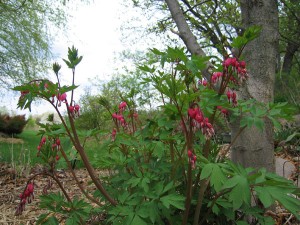
The flower garden still has a few licks to get in yet as the chrysanthemums, monk’s hood, fall blooming crocus, clematis softlily250and asters preen themselves as the light begins to fade from the sky and the air cools.  Right now the hemerocallis are going strong, creating a lively dance of color in the perennial beds.
Truth in writing disclosure:  this has not been the best gardening year.  I’ve not put in the amount or quality of labor I have in the past and the garden shows it.  I’ve had trouble keeping my focus focused, my priorities prioritized.  This is a fact for me in the best of times, but when I don’t pay close attention my center can shift often.   Elsewhere I’ve called this the valedictory life, that is, a life in which I try to get an A in everything I do, instead of settling for a B or a C once in a while.

To make the valedictory life more challenging I find the world has many things that fascinate me, as any reader of this blog will have learned by now.  Right now, at very best, I’d give the garden a B- this year.  Sad to say.

On the other hand, I can make it better and that’s what I’m going outside to do right now.

Seeing What We Really Have Here

Summer                                             Waxing Grandchildren Moon

We are well past midsummer here in the northern latitudes.  The garden’dicentra09s peak bearing season will commence although we have already had blueberries, strawberries, raspberries, currants, garlic, lettuce, greens, onions, parsnips, beets and sugar snap peas.  Ahead of us are tomatoes, green peppers, potatoes, more greens, onions, beets, lettuce, butternut squash, leeks, wild grapes and carrots plus the odd apple.   Our orchard has a ways to go before it matures.  And I have a ways to go before I can care for the fruit trees in the manner to which they need to become accustomed.

All of which opens up the purpose of this little experiment in permaculture and the tending of perennial flowers and plants.  A long while back I bought three quarter-long horticulture classes from the University of Guelph in London, Ontario.  It took me a while to complete it, maybe a year all told.  The course helped me integrate and deepen what I’d learned by trial and error as I cared for the daffodils, tulips, day-lilies, hosta, croci, roses, trees and shrubs that then constituted our gardens.

In its salad days (ha, ha) the notion involved a root-cellar and the possibility of at least making it part way off the food grid.  Fewer trips to the grocery store, healthier food, old fashioned preservation.  A mix of back-to-the-land and exurban living on our own little hectare.  Last year the notion began to include bee-keeping.  Now called Artemis Hives.

As the reality of the size of our raised beds, the likely peak production of the fruits and vegetables possible has become clear to me, I have a more modest though not substantially different goal.  We will eat meals with fresh produce and fruits during the producing part of the growing season.  We will preserve in various ways honey,  grapes, apples, pears, raspberries, strawberries, blueberries, tomatoes, potatoes, onions, garlic, squash, beets, greens and parsnips.  These we will eat during the fallow days that begin as the garden goes into senescence in late August and early September and last through the first lettuce and peas of the next growing season.  We will supplement these with greens grown hydroponically and use the hydroponics to start seeds and create transplants for 2011.

None of this will remove us in any major way from the store bought food chain.  We will not solve or resolve much of our carbon footprint.  But some.  More than most perhaps, but far too little to claim even a modest victory.  So, should we give up?

Not at all.  Why?  Well, there is a richer, deeper lesson here than living wholly off our own land.  That lesson, taught again, day by day and week by week, and again, lies in the rhythm of the plants, the bees, the land and the weather.  An old joke from the 50’s asked, “What do you call people who practice the rhythm method?” (Catholics at the time)  Answer:  “Parents.”  The permaculture and perennial flowers here at Seven Oaks is a rhythm method.  What do you call folks who practice this rhythm method?  Pagans.

Ours is a life that flows in time with the seasonal music of the 45th latitude, the soil on our land, the particularities of the plants we grow, the energy of the bee colonies that work alongside us, the various animal nations that call this place home.  This is the profound lesson of this place.  Seven Oaks is a temple to the movement of heaven and the bees of Artemis Hives are its priestesses.