Category Archives: Great Wheel

Permaculture and the Natural World

Beltane                          Waxing Planting Moon

I’ve not written about permaculture in a while.  The orchard has clover all over, including in some of the plant guilds, but they seem intact.  It has changed the view from our kitchen, a productive part of our property now sits just outside our windows.  The bees fit in well to the permaculture process because they  fertilize the fruits: apples, pears, cherries, blueberries, currants, quince, gooseberries, raspberries and strawberries.

In a modest sense, given the small number of our fruit producing plants, the bee/fruit blossom connection is a complete one.  The fruit grows in our soil, blooms here, the bee comes, collects nectar and in the process fertilizes the fruit.  The fertilized fruit grows large to encase the fertilized seeds.  The bee returns to the hive, uses the nectar and pollen from the fruit blossoms to feed larvae and make honey.  When we eat the honey, the circle includes us in a direct and intimate way.

In a similar way the plant guilds, selections of plants that complement each other by warding off predatory insects, attracting beneficial insects, setting nitrogen and micronutrients into the soil, also have a circle of benefit that, in turn, helps us produce healthy vegetables for our table.  Our gardens and orchard have a more modest impact on our overall diet than a larger plot could, but the very act of growing and eating at least some of our food makes us more conscious of everything we eat.

There is another strong positive, too, perhaps the most important one of all, at least for me.  By working with plants that have specific needs, specific soil temperatures, water requirements, nutrients, length of growing season, protection from pests Kate and I have to orient our lives to their rhythms.  No matter what we do, a plant needs to be planted when it needs to be planted.  It needs thinning when it needs thinning, pruning when it needs pruning.  When harvest comes, it too must be done in a timely manner or the whole process will have gone for not.

The bees, too, have their cycles of birth, maturation and decline.  To work with bees we have to take them as they are, not as we would wish them to be.  We  work with them according to their ancientrails, ones laid down thousands, even millions of years ago and ones to which we adapt, not the other way around.

This act of submission to what could be called biological imperatives does not, surprisingly, chain us, rather, in that wonderfully contradictory way, it frees us to become an active part in nature’s ongoingness.  We become an active partner rather than a dominator, yet another living thing dancing to the music of cold and heat, wet and dry, light and dark.

Yes, it is, of course true, that we run our air conditioner in the summer and our furnace in the winter.  Yes, we refrigerate some of our food.  We close our doors so that we don’t dance to the buzzing and whirring of insects also part of nature’s minuets, gavottes and tangos.  So, no, we are not pure, but that is in fact the human dilemma. We are part of nature, able to respond to and participate in her rhythms, yet we are also creatures of culture, the complex web we weave to make our home on this planet.

This tension creates an angst we sometimes know only when we stand on a cliff’s edge, look out toward the ocean and see the sun sink below the water’s blue margin.  It is an unresolvable angst, this in but not entirely of nature realm we inhabit.  It is, I would argue, an angst that we must embrace, not push away.  Why?  Because pushing away our delicate problem has created an ecological disaster that just may scour us off the face of mother earth.  That’s a good reason, I think.
Bee Diary: May 16, 2010

Beltane                                                     Waxing Planting Moon

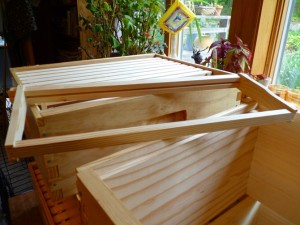
The bee project here has two active workers, a woodenware maker and a bee keeper.  Kate has put together 7 honey supers and 70 frames plus four, and counting, hive 05-15-10_bees_woodenware1colony31boxes and 26 frames.  Without her patient and careful craftswomanship, the hives would not exist.  I’m just no good at the fine, repetitive tasks involved in woodworking, but she is.  She brings an artisan’s hand to her work.  As a result we have beautiful hives.

A possible identity for our hives has begun to take shape.  Artemis is one of the many bee goddesses, but she is a familiar name, at least to some, so Artemis Honey is a strong possible name.  A common offering to Artemis was honeycakes, so we might be:  Artemis Honey, The Honeycake Honey.  When we start getting enough honey to exceed our use, including gifts, then we’ll start selling at farmer’s markets.  We’ll need a name, a label, a brand.  We’ll include a  honeycake recipe with every container sold and Kate has agreed to bake up some honeycakes to use as samples at our stands.  Let us know what you think.

Checked the crops today and harvested parsnips.  One resisted leaving its happy home in the raised bed.  It came out well over a foot long.  Smelling the tiny roots off the parsnip just after pulling, amazing.  A sweet, earthy, pure scent.  Wish I could bottle it.

When I left the MIA on Friday, I noticed on my walk back to the car, a migration of caterpillars.  I believe they were swallowtail butterflies in there can’t fly yet stage.  All of them, scores if not hundreds, chose northeast as their route across the warm concrete sidewalks that run between the Children’s Theater and the MCAD campus.  At first I just noticed their numbers, then I saw their common journey.

Where I wondered, did they begin?  So, I followed them back, moving against the small, humping crowd until I found a crabapple tree along an MCAD sidewalk.  Looking up I noticed caterpillars soon to head north by northeast eating their way out to the end of small branches, then, as the branch bent under their weight, falling to the grass.  Why they decided on their direction, I have no idea.

Death Came Calling

Beltane                                     Waning Flower Moon

Yesterday death came to call.  Dizziness and nausea took over my body while my mind raced back to October, 1964, trying to inhabit, again, the mind of my mother as the stroke hit her, trying to imagine the transition from vitality to powerlessness, wondering what thoughts came to her as she fell to the floor in the basement of the United Methodist Church.  Pushing this thought back, far from me, get thee behind me death, I wondered if she had done the same, imagined that this was like all the other times, a bit more severe than most perhaps, but surely something that would lift.  It didn’t.  She died a week later.

Death had come to call on me as a reminder of the future in the guise of a dark moment of the past.  All that work on Latin, I thought.  Then, just as quickly, would you have done something else?  No.  The answer is no.  At that moment a peace settled over me, if this was my time, so be it.  It’s just fine.  If not, I’ll get downstairs and study my i-stem nouns and ablatives.

Then, today, in a lecture, Nietzsche posed a hypothetical:  What if a demon came to you and said, “You will live and relive your life.  All of it.  The pains and the sorrows, the joys and accomplishments, all of it, even this visit from me.  And you will relive it not only once, but over and over.”  What is your response?  If you can say, Thank you, oh divine one, then you have lived an authentic life and have come to rest with who you are.  Nietzsche called this the myth of eternal recurrence.

I find I’m on the Thank you side of the demon question.  Yes, I’d like another helping please.

Much of my attitude toward life seems to have its roots in Nietzschean thought.  Strange that I’m just now discovering this.

Beltane: 2010

Beltane                               Waning Flower Moon

The old Celtic calendar divided the year into two seasons, Summer and Winter.    Summer began on Beltane, May 1st, and ended at Samhain, Summer’s End, at October 31st.  Summer is the growing season, the time when a subsistence farming economy like that of the Celts in Britain and Ireland raised food stuffs that had to last throughout the long, fallow season of  Winter.

As my inner journey has  changed over the years since Alexandria, Indiana and my received Methodist Christianity the wisdom of these early earth based faith traditions means more and more to me.   The technology of food raising and preservation has changed dramatically, it is true, but the human need for food has not.  We still need enough calories to sustain us throughout our day and most of those calories still start out in the form of plant material.

Taoism emphasizes conforming our lives to the movement of heaven.  At its most obvious level this means making the rhythms of our lives congruent with what the Celts called the Great Wheel of the Seasons.  If you care for flowers, have a vegetable garden or raise bees, then the biological imperative of their seasonal needs tends to pull you into the season.  If you enjoy the gradual and beautiful transition in Minnesota from the growing season to the depths of Winter, the cool days and leaves may call you outside, perhaps to hunting and fishing, perhaps to hiking and birdwatching, perhaps just for the changing colors.  As fall changes to winter, you may, like the bears, begin to  hibernate, turn away from the cold and begin to do inside work.

Taoism also encourages us to conform our lives to the possibilities of the moment.  That is, when standing in a river, pushing it back upstream is foolish, but it is possible to dig channels for it and divert it’s energy.

The Great Wheel is often seen as a metaphor for the human journey:  baby (spring), youth (summer), adulthood (fall), elderhood (winter).  The tao of human life is to act as the moment in life you are in suggests.  A twist on this might be to consider what the adult stage finds calling to it when the season of summer is upon us.  There are many levels.

Beltane offers us a chance to reflect on those things in our lives that have begun to take on real form, that seem poised for a season of growth.  In my case bee-keeping and the translation project come to mind.  I’ve done preliminary work with both of them and it may just be this summer that they grow into regular parts of my ongoing journey.    I hope so.

Whatever it is for you, whatever things in your life  need a long hot summer for maturation, give it to them.  This is the movement of heaven.

Kate’s colleague Dick, whom I have mentioned occasionally here, has come close to the end of his painful last days.  The cancer has proved more than his body and the medical wisdom we have now could defeat.  What comes to maturation for him in these first days of summer is the whole of his life and the transition of death.  None of us know what lies on the other side of the grave, or even if there is another side, but all lives end.  Vale, Dick.

The Great Wheel

Spring                                              Waxing Flower Moon

As spring winds down toward Beltane on May 1st, the green up has taken on an accelerated pace.  We have leaves on trees like the Amur Maples, ash and feathery new leaves on the oaks as well.   The daffodils and tulips have brightened our April for some weeks now.  The more integrated I become to this property and its transitions, the more I can layer them in my head.  That is, as this moment of greening and flowering promises a new season, the needed resurrection of the plant world, I can also see late August and September when the florescence begins to yield to brown, to decay, to dieing back.  The two are not polar opposites but places on a continuum that extends not only from season to season but from year to year, decade to decade, century to century.

This layered sensibility is one of the privileges of staying in place, where the rhythms of the land call different things out of me.   As Rachel Carson said, “There is something infinitely healing in the repeated refrain of nature–the assurance that dawn comes after night, spring after winter.”

This rhythm, the Great Wheel, teaches us about our experience of life, about life’s ongoing struggle against entropy, a struggle always lost, yet a struggle always valiant and often joyful even though destined to end in tragedy.

I hope your life has a springtime right now, one in which the trees have begun to leaf out, the daffodils have bloomed and the first vegetables have started their journey toward your table.

Cry the Beloved Country

Spring                                                      Waxing Flower Moon

The crescent flower moon slung itself just beneath the tree to the west, over Round Lake.  A thin cloud passed across it, perhaps a cloud like the one Muhammad rode through on his way to Jerusalem and the Holy Mount.  These crescent moons have South Carolina and the Arab world in their wake, calling to mind on the one hand a new meaning to hiking the Appalachian trail and on the other lakes and rivers of sand, desert nights with stars so numerous no Caliph could count them all and tents raised near a palm filled caravan serai.

Kate and I watched Cry, the Beloved Country, only about 15 years after it made it to the screen.  I’ve never read this book though it’s one I’ve had on my list a long time.   Richard Harris and James Earl Jones are titans as far as I’m concerned, able to bring gravitas, authenticity and depth to movies in which they appear.  In one of the more memorable scenes in the movies, James Earl Jones and Richard Harris, the father of a murderer and the father of the victim, unknown to each other, yet coming from home ground close to each other, speak about the murder.  If you can watch this scene unmoved, you’ve lost touch with something important.  Four stars.

On a less elevated note I’ve begun watching Spartacus:  Blood and Sand.  It’s on the instant play feature Netflix has available through the wii.  It’s compelling tv, not as good as Cry, the Beloved Country but as a sand and sandal adventure yarn, it’s pretty damn good.

Doing Stuff

Spring                                                      Flowering Moon

The netaphim ruined last year by dogs Rigel and Vega has repairs.  The repairs sit safely inside fences that Rigel has shown either no interest or no capability to penetrate.  They should last.

The bees will wait until a less breezy tomorrow.  Wind blows the smoke around and I have to perform a reversal, hive check and clean off the bottom board.  The reversal of the top 2 hive boxes encourages the queen to move into the top box and lay eggs there to create an ovoid shape of larva outside of which the nursery bees will complete a ring of pollen and a ring of honey.  This makes the planned colony split on May 15th assured of one hive box full of larva, hopefully the top one with new larvae and therefore newly born nursery bees.  Nursery bees take more kindly to moving around than the older worker bees.

Irrigation folks have scheduled Tuesday to come out and turn on the irrigation system.  A good thing.  They usually wait until the second week of May since our average last frost date is around May 15th.  I imagine that’s moved up closer to the first week of May on average, but a frost outside the average is still a frost so most planning still accommodates the old date.

Tomorrow the bees and soil amending, that is, putting in composted manure and humus on the raised beds and adding some sphagnum moss (some more) to the blueberry beds.  The outdoor season with sun.  The great wheel turns.  Again.

Important Document? Read While Driving.

Spring                                                 Awakening Moon

Warning:  Rant ahead.  Not texting, not brushing teeth, not combing hair, not eating cereal or drinking coffee, no, this young woman I passed on my way to the MIA yesterday read while driving.  By reading I do not mean look down, then follow the road, but eyes glued to page, peripheral vision guiding her used buick down Highway 252.  I encountered her three times on 252, each time her head and eyes had the same position, eyes on the page, head tilted down.  Each time.  Then, after I had put her out of my mind, as I drove on 94, the last stretch of the drive in until city streets, she passed me on the left.  Yep.  You guessed it.  Still reading.  At this point I honked several times and pointed.  Exasperated, she looked at me, then put the several page document on the seat beside her and drove on.

I have a clump of daffodils in bloom, tulips with broad leaves and iris beginning to peak back above the ground.  I put cygon on the iris yesterday.  This is my one remaining chemical. It kills the iris borer which lives in the soil and wrecks havoc on iris rhizomes.  If you’ve ever lifted iris rhizomes after an attack of iris borer’s, you will know why I continue to use this one pesticide.

The parsnip and the garlic look good.  I poked into the carrot patch where I left the carrots in past ground freeze last fall.  Sure enough I have carrots composting in the soil already.  Very mushy and yucky.   The garden and my spirit for it are gradually coming to life.  I hope we get some rain.  The plants need it.

A Warm-Blooded Insect?

Spring                                         Waxing Awakening Moon

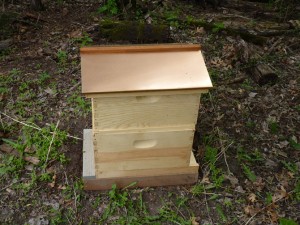
Sunny, but cool though warm weather seems fated to come our way.  Ice out has advanced on Round Lake though there is still rough, weak ice over most of its surface.  Many daffodils have speared their way up through the leaves and other detritus from last falls end of the growing season.  I’ve seen a few hosta roll-ups, too.  I put in my last order of bee stuff yesterday, bringing seven honey supers, 70 super frames and 50 super foundations, a copper hive cover and 75 frame and foundations for the deep hive bodies.

The old machine shed, now to be the honey house needs a thorough cleansing which will be an early task once the weather moves away from soggy and I have some time for outside work.

Today, in just a couple of minutes, I have a call about Matt Entenza’s gubernatorial campaign.  They want my thoughts on environmental issues.  They can have every one of them.  After the call, on to the language of ancient Rome.  Later in the day I may revise Liberal II.  That novel just sits there right now.  Waiting.  Meanwhile my promiscuous creative spirit entertains other guests, a new project, a big project, that will follow After the Hawthorn Wars.

Here’s another jaw dropper that I learned about bees during my bee course.  Over the winter the colony becomes a large cluster with all the bees hanging, literally, together, shivering.  The shivering produces heat and keeps the colony alive during the temperature drops of winter.  This means, said Marla Spivak, that in winter the colony, the whole colony, acts like a warm blooded animal.  The colony is a super-organism that gathers food, births larvae and nurses them, takes diseased and deceased members, defends itself and takes up a lot of time with architecture as well.

Since the cluster happens inside the hive boxes, it is difficult to picture.  I’ve chosen a swarm in the picture here, to show you a cluster, but not like the one I had in my first colony this winter.

Spring

Spring                                  Waxing Awakening Moon

Today is the spring equinox.  We’ve made it through another winter.

The bees have already begin to buzz and plant life has pushed light green shoots through the soil.   The days have begun to warm and yesterday I felt the warmth of the sun on my neck.  What a treat!

Spring, more than anything else, presses us into realm of fertility and abundance, the efflorescence of mother earth that feeds us all.  Birds come back from their winter homes.  Gardener’s start plants for their gardens.  Some folks lift their house, an expression I heard first in Minnesota.  It means spring cleaning.  Or spring cleaning means lifting the house.  Whatever.

This is a good day to consider the things that are tender shoots in your life.  Maybe’s its that new package of bees on the way from California, that novel you finally set down to write, that language you finally got started on.  Maybe it’s a redesign of your living space, your occupational space, your own, internal space.  Remember that tender shoots require care, yes, but also remember that those tender shoots have power behind them, power rooted in the part of you that made them surface.  Some of those shoots, most of them, the best thing you can do, let them flourish at their pace.  Don’t force them.

Watch for baby birds, puppies, infants, kittens, new plants.  They are the concrete hope out of which we make not only this world, but the future one, too.  They are reason you exist, to care for them, to provide a nourishing environment for their growth.  Those tenders shoots in your life are the same.  They are the concrete hope out of which you will make these moments in your life and the future ones.  So, be kind to them.  Let’em grow.