Winter Waxing Moon
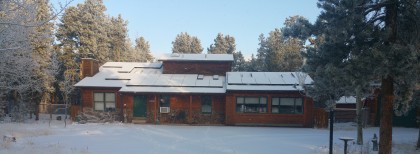
 Our first major snowstorm of the season is upon us. We’ve gotten 4 or 5 inches already and it’s only been snowing since midnight. May get 8-10 inches. Black Mountain has disappeared behind a gray-blue curtain, the lodgepoles look like flocked Christmas trees, and our solar panels have a 4 inch white blanket between themselves and the sun. No appointments today, no meetings. We can take this storm in as it comes, not see it as a barrier. We’ll get plowed today, I’m sure, so no worries there either. Let it snow.
Snow is so important here. Obviously it fuels the winter tourism economy, giving skiers destinations like Breckenridge, Aspen, Copper Mountain, Vail, Crested Butte. It transforms the mountains from gray eminences to white peaks that sometimes look like whipped cream on the horizon. But these are ancillary benefits.
 There are two other effects that are critical to life both here in the Colorado Rockies and in the southwestern U.S. A good snow season reduces the threat of wildfire in the spring and summer until the monsoons come. That effects Kate and me and our neighbors directly. It feels much better going into summer having had plenty of moisture for the trees and the soil. A good snow season also recharges our aquifers, makes sure we’ll have water throughout the next year. This is an immediate, right here result of good snow.
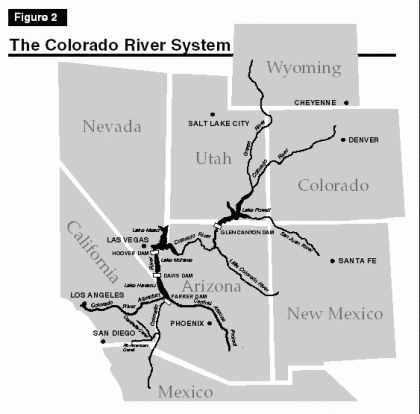
But effecting even more people is the snow melt* carried by the Colorado River downstream. Arizona, California, Colorado, Nevada, New Mexico, Utah, and Wyoming take an allocated and collective 16,400,000 acre feet per year. Problem is this amount, agreed to in a 1928 compact, is an inaccurate estimate of the actual annual flow of the Colorado. Based on tree ring data it’s somewhere between 13,200,000 acre feet and 14,300,000 acre feet a year. This is known by folks who deal with this complicated issue as “the gap.”
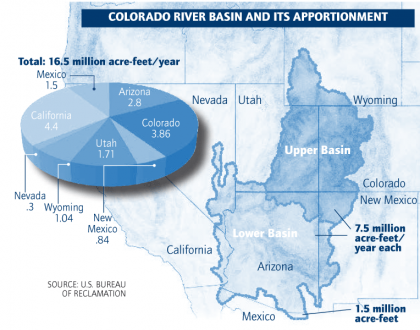 “Total population in the Colorado River Basin (CRB) increased from 4.56 to 9.44 million people from 1985 to 2010. Most of those people were in the lower CRB, with 86 percent of the total in 1985, and 90 percent of the total in 2010.”** The snowpack numbers, created by our annual snowfall, are critical not only here, because the Front Range and the Denver Metro rely on the Colorado River, but throughout the seven state CRB. These figures, almost invisible to the population of the humid east, are never far from the minds of government officials at the state, county, and municipal level here in the arid west, or the population as a whole.
The gap is a problem for obvious reasons. Drought years, like last year when the snowpack was well below normal, and the increasing population in the CRB both reinforce and multiply the effects of the gap. As the Water Defenders fighting the Dakota Access Pipeline repeatedly said, “Water is life.” These are not trivial matters, so seeing a healthy snowfall is a joy and a relief to all of us living out here.
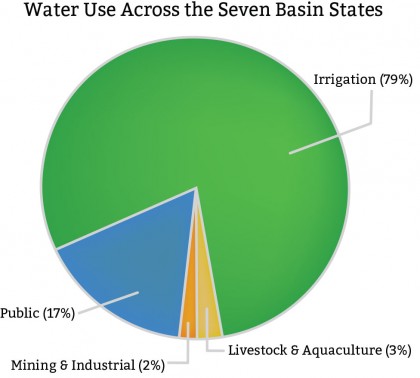 Finally, here is the problem that bedevils all those effected by The Law of the River, a web of compacts, federal laws, court decisions and decrees, contracts, and regulatory guidelines.* As this graph clearly shows irrigation is the largest claim on the CRB’s water by an order of magnitude. Add to that the allocation for livestock and aquaculture and 82% of the allocation goes to agriculture of one kind or another. We need food, those who grow our food need water. With public uses only 17% of the pie even the most draconian water policies in cities and areas like the Front Range will not move the needle much in total water use. Add to this the problem of the gap, droughts, and rapidly increasing populations, five of the fastest growing states in the nation are part of the CRB, then you can begin to imagine the tense negotiations required to maintain the status quo, let alone plan sensibly for the future.
So, as I said at the end of the first paragraph, let it snow. Please.
*data here from this wikipedia site.



 Jon, Ruth, and Gabe came up Saturday evening. The Instapot proved capable of turning a rump roast into a more tender cut of meat. Using a pressure cooker at elevation makes a lot of sense. Almost of all the roast plus potatoes, carrots and parsnip disappeared down mostly functional gastro-intestinal tracts. The gi tract with difficulty got help from Maryjane. (Grandma took 3 hits on a prerolled joint.) That went well.

 The
The  Emily’s father got to the high school using an old mountain goat trail. 285 had both police barriers and a huge traffic jam. When he arrived, he asked if any person could text Emily. Someone did. She texted back, “I love you guys.” A second text went unanswered. She was dead with a bullet wound to the head.
 He started with a tagline: The world we live in isn’t scary, but it is full of uncertainty. He had a reassuring manner, years of experience in protection, and a common sense approach to security. He recommended CBE put a 3M product on the windows, Safety and Security film. “You have a lot of glass.” This film ensures that bullets fired through the glass will not shatter it. The bullets pass through but the glass itself remains intact overall. He also recommended blinds on the windows so a shooter couldn’t see inside and a really good locking system for the sanctuary doors. All of these things made sense to me.
 That sadness has a special resonance here since Columbine was the ur-school shooting. John, the speaker, said he’d been at a conference in D.C. in the last month where a full day and a half was devoted to Columbine. Why? So many of the school shooters still refer back to Columbine for inspiration, for tips. It’s still relevant. Not only has Colorado had Columbine and the Platte Canyon hostage situation, but we’ve also had the Aurora Theater shooting.
 What a remarkable turn things have taken here. After many -oscopies, endo, upper, lower, colon, small bowel follow through, a HIDA test, nuclear med search for bleeding, bowel surgery and even more doctor visits, finally, finally. A consensus. The superior mesenteric artery has sufficient stenosis, severe, to cause Kate’s symptoms. And, there’s a stent for that.
 Happy to have some good news to report about Jon. Went to his court date yesterday. His inner attitude seems to be shifting away from anger about the divorce (understandable, but not helpful) toward getting on with his life, accepting the constraints of the restraining order (unreasonable, but legally enforceable, as he just discovered). He wants to get his art in a gallery or up for sale. This is big because it’s a key part of his identity that lay fallow during the twelve years of his marriage. He needs positive reinforcement and he’s had more than his share of negatives over the last few years.
 He’s a very talented, smart guy who can handle all the work necessary to remodel his home, replace an axle in his car, ski a great line down an A-basin bowl, teach elementary age kids how to express themselves. I hope he can organize his life so these thing line up, move him forward, and make him feel good about himself.
 I’m feeling a bit stressed, a lot going on. Religious school tonight. I’m taking pizza makings and teaching a unit on holidays, especially winter holidays. The kids will reimagine, reconstruct a new winter holiday. Tomorrow morning Kate has two imaging studies, looking for zebras. Tomorrow evening is Gabe’s winter concert in Stapleton. A sequelae of the hearing yesterday is that Jon can’t, for the moment, attend. The old protection order carved out an exception to the 100 yards rule for events with the kids, things like parent-teacher conferences, concerts, doctor visits, but the law is a blunt instrument. Yesterday by default it eliminated those exceptions. Jon wants me to go to represent our side of the family. Important for Gabe. I’ll go.
 Got reinforced shortly after the move out here when I had to deal with prostate cancer. That shook me. I worked hard to keep myself upright and maybe, in the process, began to consolidate a lot of learning. A major part of that consolidation came from the support I got from family and friends. Oh. Life can be good, even when it’s bad. Weird. Since the move, it’s been one damned thing after another, or it feels that way right now. Those things forced a going deep, being honest, being grateful a lot. Now, four years later, our move anniversary is the Winter Solstice, my Colorado Self, the one born in the alembic of all those insults, has asserted itself.
 Warmer, 31, and cloudy. The waning Thanksgiving Moon lit my morning walk to the loft through a veil of patchy cumulus. The neighbor in the rental put up an inflatable turkey with a pilgrim hat a week or so ago. Now there’s a Northpole sign on their mailbox, a Santa Claus and Christmas lights. They did wait until Thanksgiving was over. Most of us on our stretch of Black Mountain Drive have less glam. We have lights on at night all year, but just a strand in the front and along the walkway up to the loft. Holiseason brings out the inner kid. That’s Eduardo and Holly’s lights in the distance.
 I’m finding a peculiar satisfaction in domestic work. Dishes in the dishwasher right after use. Throw a load in the washer when I get up in the morning. Cooking what we have. There’s a thread through the day, things to do that are active and loving. I’ve come to like it. One of the things I noted a long time ago was that women’s work (in a stereotypical sense) dealt with life’s basics. Eat. Clean. Support. Repetitive. The clothes always get dirty. The dishes come after cooking. No matter what groceries and other supplies have to be purchased. Rinse and repeat. It makes sense to me now how homemaking is a noble art, a task unfairly distributed by past gender roles, yes, but so important to the well-being of a family.
 Interesting. First, on Dec. 6th I will join all teachers in the religious school, board members, and staff for an emergency response training evening. Stimulated, as you might expect, by Pittsburgh, but always an active consideration.
 Kate and I got coffee, sat down at our beetle-kill pine dining table, cracked open the mailers from the state of Colorado, and voted. Not a complicated ballot in terms of candidates, though the retention questions for judges left us both scratching our heads. Guess which way we voted? Blue wave, blue wave, blue wave. At least two water particles added.
 Then there were two that make creating both federal and state legislative districts non-partisan. Like campaign funding gerrymandering is currently a cancer in our democracy, both in their own way as serious as the orange tumor in our body politic. Voting yes.
 Colorado continues to be a strange political environment to this native Midwesterner. The libertarian streak in all American politics colors issues with a let me alone and don’t make me pay swoosh, here it’s a swoosh often as big as the entire running shoe. That can drive electoral decisions. There’s also the even more dramatic than in most states divide between the liberal Front Range and the remainder of Colorado. Rural and mountain Coloradans often complain that their views are ignored. True, too, to some extent. The rural vote is often reflexively against candidates and ballot measures that seem to reflect Front Range values.