Category Archives: Judaism

Rocking my inner boat

Winter and the Full Future Moon (98%)

Thursday gratefuls: for the Geek Squad guy who came to install our microwave. for his calling out an electrical problem. for Altitude Electric for coming next Monday. for the Geek Squad coming back next Saturday. for the first session in the Human Narrative, the Kabbalah class using Art Green’s book, Radical Judaism. for Zoom which allowed me to both here and there. Bi-location!

Kate and I have been doing sixty second hugs. As Paul Strickland mentioned in his review of a conference he and Sarah attended. What a great idea! We hug anyway, but often short ones. Sixty seconds encourages intimacy. More intimacy is welcome.

Also, we’re dancing with zero negativity. Same conference’s idea. For us, a real challenge. Not so much because we’re negative toward each other, but because both of us have minds that veer easily toward the critical, the analytical. And, we both know a lot so challenging each other’s conclusions comes with breathing. Still. I know where this concept heads and I would like to get there. So…

I describe myself as a neo-pagan by which I mean that my faith is located in this reality, not in some other, supernatural place. And that my faith reads revelation first from the ur sacred text, the book of Nature. This does not exclude other sacred texts as sources of wisdom, inspiration, even revelation, it places them second to seeing what you’re looking at. (Casey Reams) Or, being mindful. Or, deep listening. Or, respectful touching.

It also means that I’ve backed myself into an interesting corner, or, maybe, an interesting geodesic dome. If the cosmos itself reveals the sacred to those who see, the sacred underlies the whole cosmos. If the sacred underlies, is within, permeates the cosmos, then the Kabbalistic notion of divine light, ohr, waiting for us in everything begins to make sense to me.

If that makes sense to me, then the notion of an underlying unity also can come into focus. Is that unity the shekinah? That is, the feminine aspect of the divine said by the Kabbalists to constitute this material world? Not ready to go there yet, not sure I want to put a label on it. But, the idea of the shekinah does work for me at the level of analogy, metaphor.

Challenging. Rocking my inner boat. Yes.

Seven years, five months, 26 days to go

Winter and the Future Moon

Tuesday gratefuls: Kate removing my sutures. Shelly for a quick and relatively painless shot of Lupron. Ali Baba for great gyros, hummus. Those who built the mountain roads. Those who built and maintain the mountain power lines. Golden Solar for installing our solar panels.

Fourth day of Daf Yomi. Only seven years, 5 months and 26 days to go. I’ve always liked long books, long movies, long tv series. Daf Yomi has a similar resonance though its length puts it in a class all by itself. Well, wait. Not quite. Romance of the Three Kingdoms, the great Chinese classic novel, is well over 2,000 pages, too. It’s not, however, as dense and clever as the Talmud. It took a long while to read, but not years. Months.

Reading the Talmud, as a first-timer, is a challenging and intriguing experience. It swerves from topic to topic, sometimes in apparently unrelated ways, but seems to come back to a particular issue.

Let me give you an example. The major question since the first page has been when to recite the Shema: Hear o Israel, the Lord our God, the Lord is one. (longer, but this is the essential verse.) The affirmation of monotheism is bedrock for Jewish faith and practice.

Reciting the Shema during the night, when to do it, has taken up the first four Talmudic pages. The questions are many. When is it night? When is it midnight? When is it morning? How do we know the three (or, maybe four) watches of the night? In a time before precise clocks these were urgent questions if reciting these prayers was critically important. And, their recitation was critically important.

In the discussion about how we know when it’s midnight, one rabbi answers that David got up at midnight to pray and study Torah. How did he know it was midnight? He hung his lyre by his bed and when the north wind blew on the lyre its sounds marked midnight. On the question.

But then the question becomes one of David’s piety. Raised, I suppose, by the fact that he got up at midnight to pray and study. Several paragraphs go back and forth on the question of his piety, then we return to the central issue, how do know when to recite the night time Shema?

This may sound dry, even Jesuitical (eh, Bill?), but it’s actually lively, full of stories and a certain kind of logic chopping that I’m familiar with from philosophy. In short, I’m liking it.

Better than a Lupron shot in the butt. Which I also got yesterday.

But wait. I can hear one of the Rabbi’s say, the Lupron shot was to save your life, how is reading the Talmud better than saving your life? Because its significance goes beyond life to matters of the soul.

This is tricky for me since my belief system shuttles away from particular traditions, but I recognize the questions and love the playfulness with which they are addressed. Reading Talmud for me, like reading Torah or the New Testament is a lesson in metaphor, analogy, not in prescriptions. More on this later, too.

Daf Yomi

Winter and the Future Moon

later Monday gratefuls: The Talmud, the extraordinary reach of Jewish history, CBE, Rabbi Jamie, Alan. Mussar. Kabbalah.

Because the time seemed propitious I’ve embarked on a seven and a half year journey called Daf Yomi. A Daf is both sides of a page, A and B, in the Talmud. Daf Yomi means “daily page.” It’s an old, old discipline of reading through the entire 2,711 pages of the Babylonian Talmud at the pace of Daf Yomi, a page a day.

A cycle begins every seven and a half years. Jews and other interested folks all over the world follow the Daf Yomi schedule. It’s easy in that Sefaria, an online library of Jewish traditional texts, has the entire Babylonian Talmud (there’s a Jerusalem Talmud, too) online. MyJewishLearning has a set of brief e-mails, one a day, that provide a link to the text on Sefaria, and a short commentary.

Not sure what this will bring, but it’s another way of learning about the tribe among whom I live.

Winter and the Future Moon

Friday gratefuls: Quest labs. Einstein Bagels. Tony’s Market. Walgreens. The Shell station carwash. Ruby, the new Rav4 and its heated seats. The cattle that gave their lives for the meat at Tony’s. Kate’s good seal on her feeding tube last night. Jon and the grandkids coming up for a brisket meal after skiing.

Went to Quest labs yesterday, order in hand for the sensitive PSA test that will tell how well the lupron has worked. As I walked into the lab, everything seemed ordinary, the parking spot behind the Audi, the automatic doors that slid open, the stairs up to the lab. The friendly young lady with the needle.

And, of course, it all was ordinary. Except. This was about cancer. Mine. I’ve become familiar with the dissonance between the ordinariness of these visits and my stake in their outcome. It produces an out of body feeling, not anything dramatic, but a sense that this is happening to someone else. Not true, however.

Will find out soon. My next lupron injection is on January 6th. Great fun. One more in the glutes.

While out I bought bagels, a couple of ribeyes for a New Year’s surf and turf meal, some adhesive bandages, and got the car washed. Just more errands. More ordinary.

Signed up for another kabbalah class, this one using Art Green’s Radical Judaism. Art is a mentor of Jamie’s, still alive in his eighties. His book appeals to me. My own thinking has gone along similar lines though Art’s done a systematic job. Not my style. I lived out my changed attitude toward religion and tradition, writing about it only in shorter pieces. Looking forward to this.

Thought readers of this blog might appreciate these:

The Eleven Awareness Practices of Kabbalah Experience


  1. Pay attention to what shows up as a reflection of what you still need to learn and grow into.
  2. Be present to the moment. This includes fully processing emotions that come from the past and how plans for the future impact your present living.
  3. Accept reality as it is. Live with a deep sense of gratitude. Seek and offer forgiveness in your everyday experiences.
  4. Live by setting intention. Be open to possibility—one door closing opens another. Measure success by effort not by outcome.
  5. Hold opposites and recognize that those qualities you may judge in others are mirrored in you. Seek common ground with others.
    6. Set limits to access greater intimacy and focus in your relationships.
    7. Expand your concern and love for the “other”.
    8. Recognize the multiplicity of masks you wear (so they don’t wear you).
    9. Perceive and understand the metaphors that underlie your life choices.
    10. Witness the masks and metaphors and enter a state of no-thingness.
    11. Flow in the paradox of being and non-being in every moment.

A Holiweek

Winter and the Gratitude Moon

Saturday gratefuls: For this spinning, traveling planet. For ways to get from one spot to another: cars, trains, planes, bicycles, feet. For the new Woolly Calendar, produced again by Mark Odegard. Over 30 years. For cities like Minneapolis, San Francisco, Denver. And for those of us who live outside of them.

The long dark Solstice night still wraps Shadow Mountain, quiet and black. For those lovers of the summer this marks a key moment as the night begins, gradually, to give way to the day. Six months from now the Summer Solstice will celebrate the longest day, which marks the moment when the day gradually begins to give way to the night. A cycle that will last as long as mother earth does.

A cycle that can remind us, if we let it, of the way of life. That darkness comes, fecund and still. That light comes, spurring growth and movement. That we need both the darkness and the light, both are essential. When dark periods enter our life, they are usual, normal and will pass. When light periods enter our life, they are usual, normal and will pass.

Our time with Seoah ends today. She heads off to Singapore for a year, leaving Denver this evening. We’ll head out to the airport early. It’s Christmas travel weekend and the airport will be buzzing.

Her English is much better and she studies hard. She hopes that her time in Singapore will push her all the way to fluency. Mary has a Korean friend who will help Seoah hook up with the Korean community there and English language tutors.

Hanukah starts tomorrow night. The first candle. Tuesday is Christmas Eve, then Wednesday, Christmas Day. Festivals of light. Showing our human preference for the day, for the growing season. Showing our confidence in the long ago, when the Maccabees revolted, kicking the Seleucids out, entering Jerusalem, and rededicating the Second Temple after its profanation by Antiochus Epiphanes. And, when the miracle baby, Jesus, entered this world, like the Shekinah.

A holiweek. Filled with candles, presents, songs, family. The most sacred part of this holiweek is the coming together of friends and family.

The West

Samain and the Gratitude Moon

Wednesday gratefuls: Seoah and her light presence as a guest, Murdoch again, the Grandmother Tree at CBE, the night drive up Brook Forest, then Black Mountain drives, the fox that crossed our path, the mule deer doe standing, looking toward the road, the nightlife of the wild, the ultimate wildness of the heavens

December 20, 2014 “The enormity of this change is still a little hard to grasp. We’re no longer Minnesotans, but Coloradans. We’re no longer flatlanders but mountain dwellers. We’re no longer Midwesterners. Now we are of the West, that arid, open, empty space. These changes will change us and I look forward to that. The possibility of becoming new in the West has long been part of the American psyche, now I’ll test it for myself.”

December 18, 2019 The usual mythic significance of the West, where the light ends, where souls go when they die, seems quite different from its American mythos as almost a separate country, an Other World where you could leave Europe behind, leave the East Coast behind and rejuvenate, remake yourself. (yes, Native Americans were here already. But I’m talking about the frontier, the Old West, the place where Hopalong Cassidy, the Lone Ranger, and lots of versions of John Wayne lived. And, yes, the Spaniards on the west coast and as far north as what is now New Mexico. The Russians, too.)

Seems quite different. Yes. However, “the possibility of becoming new in the West.” The American mythic West is about where souls go when they die, when they die to a past that had not prospered in the East, to a life no longer well lived, to a life lived in the all too usual way, to a life of boredom.

What would we become? When would the West become home? When would this house on Black Mountain Drive become home? All those boxes. All that altitude adjustment. And, we would gradually learn, an attitude adjustment to mountain life.

We have become people of the mountains, in love with them enough to adapt our lives to thin air in spite of the difficulty it presents to us. We have become people of the tribe, of clan Beth Evergreen, part of a strange and intriguing religious experiment, a new community. That was part of what people sought in the West. A chance to build community anew, to different rules.

We have become embedded in the lives of our grandchildren, of Jon. They love the mountains, too. Our choice, to live close, but not too close, has had its challenges, but has worked out well. It’s hard for us to provide day to day support for Jon and the kids. We’re too far away and too physically challenged (of late). We are, however, a mountain refuge for them, a place away from the city where they can come to refresh. We’re also on the way to A-basin, Jon’s favorite ski area.

When we travel now, the return no longer involves a turn north, toward the Pole, but a turn West, toward the mountains and the Pacific. Our friends in the north, in Minnesota have stayed in touch. We’ve not gotten back much; it’s so good to still have solid connections.

We change altitude frequently, often dramatically during a day’s normal routine. No more mile square roads, farmland templates. No more 10,000 lakes. And, up where we live, in the montane ecosystem, no deciduous trees except for aspen. No more combines on the road, tractors, truck trailers full of grain and corn headed to the elevators. (yes, in Eastern Colorado, but we’re of the mountains.)

The pace of life in the mountains is slower. Many fewer stoplights, fewer stores, less nightlife. Service of all kinds is slower, too. Plumbers. HVAC guys. Mail folks. UPS. Fedex. Denver Post. Painters and electricians. Once we quit expecting metro area level of service, especially in terms of promptness and predictability, life got better. The mountain way.

Our life in the West has also been shaped, profoundly, by medicine and illness. Tomorrow.

Long one. About god. or, God. or, Gods. or, nope.

Samain and the Gratitude Moon

Saturday gratefuls: Tony’s Market. And, for all the animal lives represented there. For the wonder of our gastro-intestinal system, all the various foods it will process. A Jewish prayer of gratitude includes those openings in our body that open and close. “Blessed… who has formed man with wisdom and created within him many openings and hollow spaces. It is obvious and known before Your Seat of Honor, that if even one of them would be opened, or one of them would be sealed, it would be impossible [to survive and] to stand before You.”

On that note. While watching and watching and watching and, still watching, Resurrection: Ertugrul, (I’m on episode 250 or so), an Allah saturated drama, and while keeping my inner lens clear in the house of Judah, I’ve begun to think again about God.

Nope. Still gone from my belief system in any form, yet with both Judaism and Islam prominent in my life right now, I’m wondering what I saw in the idea to begin with.

The notion of divine beings, either one or many, monotheism or polytheism, has occurred over and over again, in culture after culture. The early Mongols and Turks, for example, followed Tengrism: “Tengrists view their existence as sustained by the eternal blue sky (Tengri), the fertile mother-earth spirit (Eje) and a ruler regarded as the holy spirit of the sky. Heaven, earth, spirits of nature and ancestors provide for every need and protect all humans. By living an upright, respectful life, a human will keep his world in balance and perfect his personal Wind Horse, or spirit.” Wiki

My introduction to this human need for something beyond us came in the form of United Methodism, a branch of the Protestant reform movement over against Roman Catholicism. The Christians, of course, got their monotheism from the Jews and both were subjected to the firmest flattery, imitation, when Mohamed discovered Allah and the Q’uran.

Since I was in 1950’s America, in small town 1950’s America, in Midwestern 1950’s small town America, and since I was below the age of reason, I fell in with Yahweh, or El, or Elohim, or Hashem, or Adonai. And, because this was the Christian version, his son. Confusingly, too, like the Tengrists, there was a holy spirit: Father, Son, and Holy Ghost. Holy Ghost. Wow.

As I recall, God was sort of the back up band for Jesus in Methodist belief. Sure, he (and He was a he) was the metaphysical underwriter for all things Christian, but belief focused on his boy, his frontman, Jesus. When I prayed, though, my prayers went to an amorphous, cloud of unknowing sort of God, perhaps one more like Brahma than anything else. Distant, important, yet soothing. That there would be such a, what?, being, process, wonder, that would listen to me was, well, wow.

But the question I’m wrestling with here is what need to that fulfill for me? Why go once a week, often as many as three times a week, to a funny looking building, and learn songs, texts, folktales (like Santa Claus and the Easter Bunny, for example)? What was I getting out of it? My parents? That guy in the robe up front?

No question faith was precious to many, many people I knew. If, however, as I now believe, there is no metaphysical underwriter, no need for a frontman, what purpose does believing there is one have? I’m no neo-atheist wondering about everybody’s imaginary friend and how they could be so duped, that’s arrogant and naive at the same time. It’s obvious that faith fulfills an important psychic role for many, though that faith gets directed toward Odin, or Hecate, or Yahweh, or the sky-father and the earth-mother, toward the Great Spirit, or the plethora of Hindu avatars.

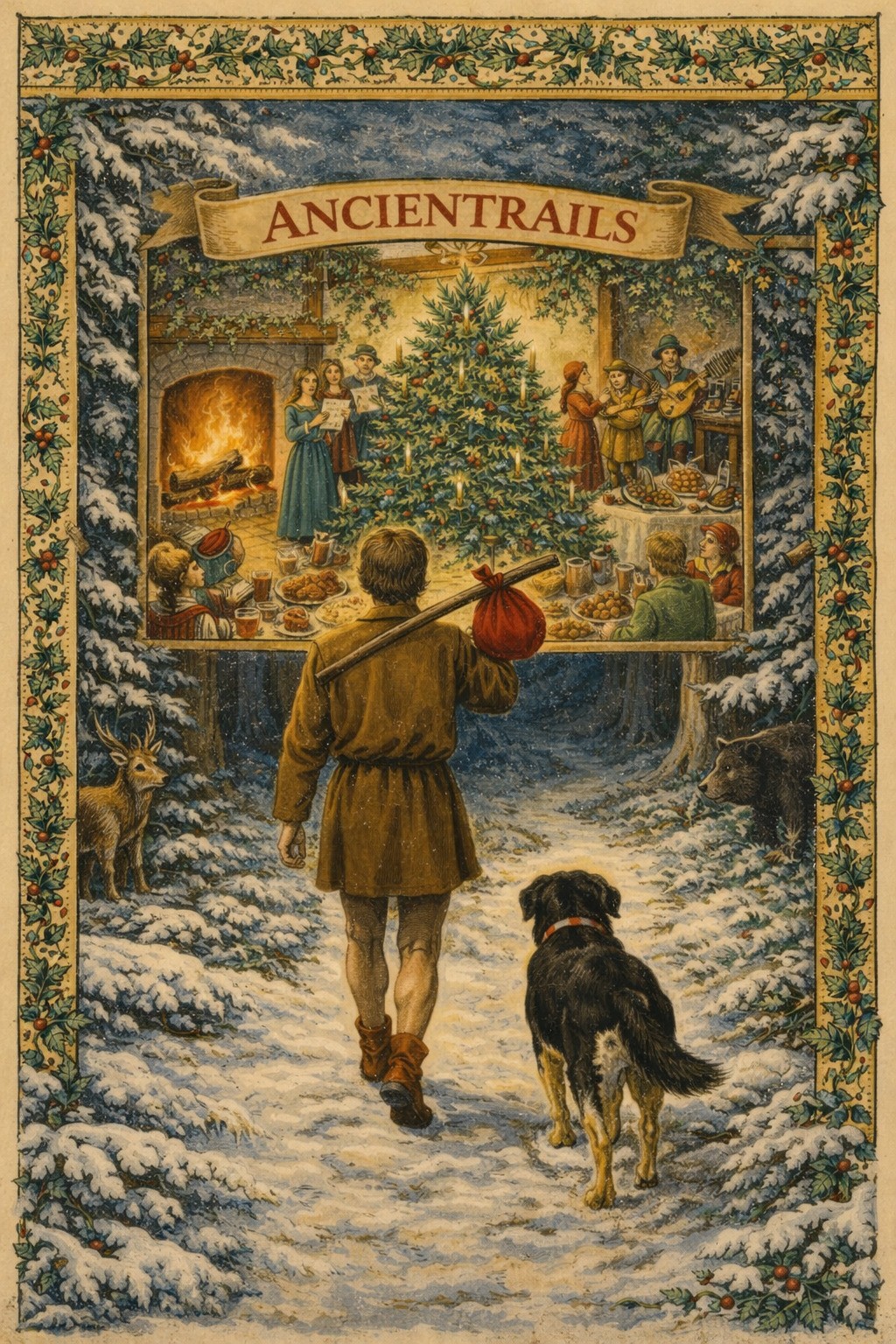
The notion of faith, of giving up psychic freedom to an external influence, one to be either propitiated or submitted to, or both, and the attendant notion of following a path of sorts, an ancientrail if you will, laid out by stories from an oral tradition, or immediately ossified in so-call sacred scriptures, is so common as to almost be a universal in human life. I say almost only because I’m not familiar with all cultures. My suspicion is that it is at least a possibility in all cultures and lives.

In one sense faith means that, somehow, the psychic resources you can muster on your own are inadequate. But, inadequate for what? For developing a Self? For being sure of the world? For understanding how to treat other humans? Or, the natural world? For a sense of safety and security? For personal validation?

Whatever the reasons, and they are pluriform, the answers get called into question by global reality. Is it Brahma or Yahweh? Allah or the Tao? Is it sky-father or Thor? Each of these entities claim total subjection of the believer. It may feel less heavy than that most of the time, but when metaphysical push comes to shove, often around death and the afterlife, the Hindu couldn’t imagine relying on Yahweh. Or, a Muslim relying on the Tengrist’s Sky-Father.

But, when you have a totalizing claim, whether monotheist or polytheist, it cannot be breached by another totalizing claim. Otherwise, how could it have the meaning ascribed? And, since there are many totalizing claims, somebody’s wrong. Without question. Let’s call this the bedrock algorithm for questioning religion. If your faith claims are true, then mine aren’t.

Reconstructionist Judaism has hit on a clever response to this algorithm. We’re going to back off the universal claims, but own the unique culture the Jewish answers created. There’s a strong and tribal tradition that dates back thousands of years. It’s one way of living within this human existence, but very far from the only way.

Reconstructionist’s, for example, eschew the notion of the Chosen People, for exactly the reasons I’m proposing here. Many, probably most, set to the side the metaphysical claims, but listen carefully to ritual, to “sacred” text and its multiple interpretations, to the history of the Jewish people, to the current lived reality.

This is a different solution than the U.U.’s. The U.U.’s have the same algorithmic questions, but toward all faiths. U.U.’s have a curriculum which gives away their fundamental stance: Creating your own theology.

Which is, of course, different from the atheist or agnostic, the pagan or the simply don’t care at all. But, and I’ll stop here for today, if faith is such an important component of human life, what happens when it gets watered down or dismissed entirely. What if you can’t create your own theology?
Monet

Samain and the Fallow Moon

Kate and I went to see the Monet exhibit at the Denver Museum of Art. First outing for Kate in quite a while. Lesley, a fellow mussarite, architect and art historian, led the tour as a DMA docent.

Christoph Heinrich, director of the DMA, wrote his Ph.D. dissertation on Monet and used his scholarly contacts as well as his museum world contacts to organize this show with a fellow Monet scholar from Potsdam, Germany. It has 120 paintings by Monet that show the development of his unique, impressionist style over a period of years.

Leslie had a knowledgeable presentation, for which she had many notecards. The exhibit draws big crowds and the museum supplied ear pieces and a receiver. Leslie stood back and spoke to us through her headset while we looked at the paintings. Could have used this technology in several exhibits at the MIA.

The DMA has a different docent style than the MIA. The docent explains, gives facts and interpretations. The way it used to be everywhere, I believe. The MIA requires the docent to engage tour participants with questions about each work, questions that help them draw their own conclusions, that force them to look and learn for themselves. There’s a place for both styles, imo.

There were some beautiful pieces, some ordinary works that showed Monet working out what he wanted to paint, many showing early experimentation with putting colors next to each other and letting the eye merge them into the color Monet saw as he painted. There were no real show stoppers in the exhibit however. I imagine the cost of getting several haystacks, several Rouen cathedrals (there were none), and the large water-lilly works like hang at the Chicago Art Institute was too much.

While a docent at the MIA, I became friends with the registrar, a position little know outside the museum world. The registrar crew handles the art works, moving them, hanging them, indexing them with the museums cataloging protocols. From him I learned about the intricacies of putting an exhibit together.

Most museums require that works over a certain value, I believe it was two-hundred and fifty thousand at the MIA, are never out of sight of one of their employees. An employee travels on the plane with them, observing them be loaded and removed.

I remember he told me (can’t recall his name) a story about a painting being flown to Australia for an exhibition there. He agreed to go with the painting, but due to his workload, he flew there with it, watched it get unloaded and shipped to the museum, then turned around and got back on a plane to Minneapolis. A long, long time in the air.

Given Monet’s prices at auction I would guess most, if not all, of his many paintings exceed the value limit of the MIA. That would be a lot of insurance, shipping, and travel costs.

Found myself fascinated with his brushwork, color choices. I’ve not spent much in museums or galleries since I started painting. Made me want to start going again to inform my own work.

Midrash Aggadah

Samain and the Fallow Moon

Made it into Evergreen going slow. Some timid Coloradans ahead. Black Mountain Drive/Brook Forest was icy, but Jeffco public works had put down a lot of sand, enough to make it safe to drive normal speeds.

To the Dandelion. A nice little breakfast place, quiet. Not as tasty as the Wildflower, which is in the touristy part of Evergreen, but the Wildflower is small and the dining area noisy. The Dandelion makes the usual suspects when it comes to breakfast and does them well, but with little imagination.

We discussed Chayei Sarah and how to approach it. I gave Alan a commentary by Zornberg’s mentor (whose name I can’t recall and Alan has her book). Forgot that commentaries are really behind the scenes props for clergy. They’re not secret, but few lay folk ever look at them. They usually require some background knowledge and they get technical pretty fast. Alan, who is a bright guy, admitted that he swam upstream while reading it.

We agreed to go with Zornberg’s approach first (see the post The Abyss Stares Back) and if we run out of conversation, Alan will hop in with what he’s learned. Gonna do a bit on exegesis and hermeneutics from the Christian perspective to introduce the Talmudic approach, midrash aggadah*. Midrash aggadah have a playful quality, making leaps, filling in gaps in the Torah narrative, and displaying a rigorous internal logic while suggesting many different ways of looking at a text.

Here’s a summary of a famous example, Abraham Smashing the Idols:

Abram tried to convince his father, Terach, of the folly of idol worship. One day, when Abram was left alone to mind the store, he took a hammer and smashed all of the idols except the largest one. He placed the hammer in the hand of the largest idol. When his father returned and asked what happened, Abram said, “The idols got into a fight, and the big one smashed all the other ones.” His father said, “Don’t be ridiculous. These idols have no life or power. They can’t do anything.” Abram replied, “Then why do you worship them?” Judaism 101

* Midrash falls into two categories.When the subject is law and religious practice ( ), it is called midrash halacha. Midrash aggadah, on the other hand, interprets biblical narrative, exploring questions of ethics or theology, or creating homilies and parables based on the text. (Aggadah means”telling”; any midrash which is not halakhic falls into this category.)

Mundane

Samain and the Fallow Moon

Stayed out late Tuesday, for us past 8 pm. Makes the next day slow. Tried to get into the resistance work, couldn’t. Muscles complained. Did thirty minutes on the treadmill.

In to see my ophthalmologist. (spelling gets me every time) Glaucoma check. Every six months for over 20 years. Now every 4 months. The usual. Eye charts. A small glass instrument pressed against the pupil to check pressures, 16 and 14. Scan of the retinal nerve. Mine’s still abnormal. Has been for as long as they’ve been following me.

Stopped by Tony’s market. Picked up a few things. Cooked supper. The end of the day.

Big day. I’m meeting Alan to go over our bagel table plan for Saturday morning. The Dandelion again in Evergreen. Slippery roads this am, freezing drizzle. Driving freezing drizzle down the mountains can be challenging. The Blizzaks went on Ruby last Friday and she has all wheel drive.

At 12:45 we’re meeting Steve and Jamie at the Staples parking lot. We’re going to a CBE tour of the Monet show at the Denver Art Museum, a four hundred object exhibit arranged by a curator at the Denver Art Museum. This is its only stop. Looking forward to it.

This evening we have MVP, the mussar vaad practice group. Had to be moved from Tuesday due to the shiva at Steve and Jamie’s.

That’s a lot of moving parts for us in one day. Good ones, yes, but still a lot.