Spring? New (Planting) Moon
Well. Throws hands up in a gesture of resignation, frustration. OMG. WTF. April 11 and 8-12″ of snow? Let me say that again. OMG. WTF?!

Spring? New (Planting) Moon
Well. Throws hands up in a gesture of resignation, frustration. OMG. WTF. April 11 and 8-12″ of snow? Let me say that again. OMG. WTF?!
Spring New (Planting) Moon
The story of the golden fleece has been entirely translated, though I’ve not yet checked my work. I feel ready now to go back to Book I and begin the task I set myself a while ago, the translation of the Metamorphoses. As I wrote here earlier, this will mean a change in the mode of translation, with more careful note-taking, review of other versions of the myths in other authors, comparison of my work at some point to other translators, then working toward the best English I can imagine. I will start notes for a commentary, though how long that project will last alongside the primary one, I can’t tell at this time. Maybe the whole way.
(Golden Fleece pub in Heidelberg)
It’s deeply satisfying to have reached this point, the end of the beginning.
Spring New (Planting) Moon
That planting will occur under this new moon is a surety. In fact, if we get warm weather this weekend (after our 6-12 inches of snow. geez.), I’ll plant cold weather crops. Just checked the weather forecasts. Looks unlikely. No warm weather this weekend. Or next week. My bees come a week from Saturday.
“Concerning the Gods, there are those who deny the very existence of the godhead; others say that it exists, but neither bestirs nor concerns itself nor has forethought for anything. A third party attribute to it existence and forethought, but only for great and heavenly matters, not for anything that is on earth. A fourth party admit things on earth as well as in heaven, but only in general, and not with respect to each individual. A fifth, of whom were Ulysses and Socrates, are those who cry:— _I move not without Thy knowledge!_”
Epictetus
Spring New (Planting) Moon
Hegel, from the preface to his Philosophy of Right.
“Only one word more concerning the desire to teach the world what it ought to be. For such a purpose philosophy at least always comes too late. Philosophy, as the thought of the world, does not appear until reality has completed its formative process, and made itself ready. History thus corroborates the teaching of the conception that only in the maturity of reality does the ideal appear as counterpart to the real, apprehends the real world in its substance, and shapes it into an intellectual kingdom. When philosophy paints its grey in grey, one form of life has become old, and by means of grey it cannot be rejuvenated, but only known. The owl of Minerva takes its flight only when the shades of night are gathering.”
Spring New (Planting) Moon
I heard for as long as Kate worked at Allina about corporate culture taking over medicine. The MIA is not alone among museums in taking a “dynamic, new approach”, DNA, which involves wringing more dollars out of the visitor’s “museum experience.” Major league sports underwent their corporate take-overs years ago. When I worked for the church, business oriented members would often explain how it needed to be run more like a business.
A general economic malaise, largely created by two strangely related forces, the anti-tax intransigency of Republicans and the illegal manipulations of debt-related securities, has formed an environment in which non-profit institutions have become starved for cash. Though a non-profit does not, by definition, have making money as its first or even second or third reason for being, all non-profits do have to balance the books somehow.
It is this need that makes them vulnerable to the inroads of corporate cultures for which making money is not only the bottom line, it’s the only line. This leads to medical clinics defined as revenue centers, sports departments milked for their ticket income and docent lead tours to become big ticket items for museum special exhibitions.
The need for a non-profit to have enough income to offset expenditures is nothing new. What’s new is those who make this need the primary objective of a medical group, or a university campus* or a museum department. It’s at this point that the health needs of patients or the educational needs of students or museum goers get shoved down the list of reasons for a doctor or a professor or a teacher or a curator or a docent to do what they do.
You could argue, as many urging corporate style make overs of our most important cultural institutions do, that this is merely correcting an aberration, that these kind of institutions should always have had a sharper pencil, more attention to the time honored counting of beans.
It is not. What this emphasis on corporate objectives does is negate, yes, I would go that far, negates, the long held belief in this country that some communal matters are too important to put at risk of creative destruction: education, performing arts, art museums, science museums, medical care and spiritual welfare chief among them.
This prop 13 mentality has successfully challenged much of the fabric of our communal life, turning us toward the libertarian ideal of one for one and all for none. This is individualism and liberty used not as instruments of freedom, but as wrecking balls.
This is not the country in which I want to live, nor is it the country in which I want my children or grand-children to live. My oldest son and his wife are teachers. My wife is a physician. My youngest son is a captain in the Air Force. All of them dedicated to the welfare of the communal whole. All of them putting their own time and chance of capitalist success aside for a purpose, a reason for being that has nothing to do with the profitability of the school, the clinic or the military.
You could argue, I suppose, that what I’m saying here is special pleading and I would agree. It’s a special pleading on the part of those who believe communal needs come before private ones. I am one such person.
* The University Will Not Be Sold (Chronicle of Higher Education for April 9, 2013)
“Public universities are not corporations. They are not sports franchises.
…The corporate vision of Rutgers’s president, Robert L. Barchi, and his associates centralizes sports branding as an income-generating strategy, clearly at the expense of our student athletes and potentially at the expense of academic excellence…
His administration’s embrace of a corporate vision has led President Barchi to behave like a corporate raider against his own university: He has treated Newark’s campus like a thriving company subjected to a hostile corporate takeover. His administration attempted to underfinance Newark and milk its profits (tuition). Next it plans to strip it of its assets (most-profitable graduate programs). We know how these hostile takeovers usually end—the raided “company” ends up on the junk heap.”
Spring Bloodroot Moon
Still reading through Missing, making notes, trying to integrate beta reader observations and questions. It’s slower right now because I’m also trying to integrate lessons about description and pacing from Robert Jordan’s amazing The Eye of the World.
The general plan for revision III has begun to take shape. Some shifting of certain narrative threads to book II or to a book of their own, expanding the ending, putting the climax in earlier, making descriptions beefier, more lush and adding narrative in sections where what I wrote was, as Judy observed, outline like.
How long will it take? I have no idea. As soon as I can finish it, but just how long that is, I don’t know. Why? Partly the removal of certain narrative lines will create disruption as well as clarification. Partly because the climax I have doesn’t satisfy me and I’m not clear what it should be. Partly because adding descriptive material is a whole manuscript task and a personal style changer, too, since I tend to be spare. There will be a learning curve.
Closing in on the last few verses of the Jason and Medea early story. When I’m done with it, before Friday, and have checked and revised my work, also before Friday, I’m ready to go to Book I and begin the work I first decided I wanted to do back in 2008 or 2009. That’s exciting.
It’s exciting for more than the obvious reason; that is, that I can now do it. It’s exciting in addition because it will feed a new work, one I will not start until all three of the Tailte novels are finished; but, a work I hope will utilize all I’m learning about writing and about mythology and Latin and Ovid and Rome. Working title: Changes.
Spring Bloodroot Moon
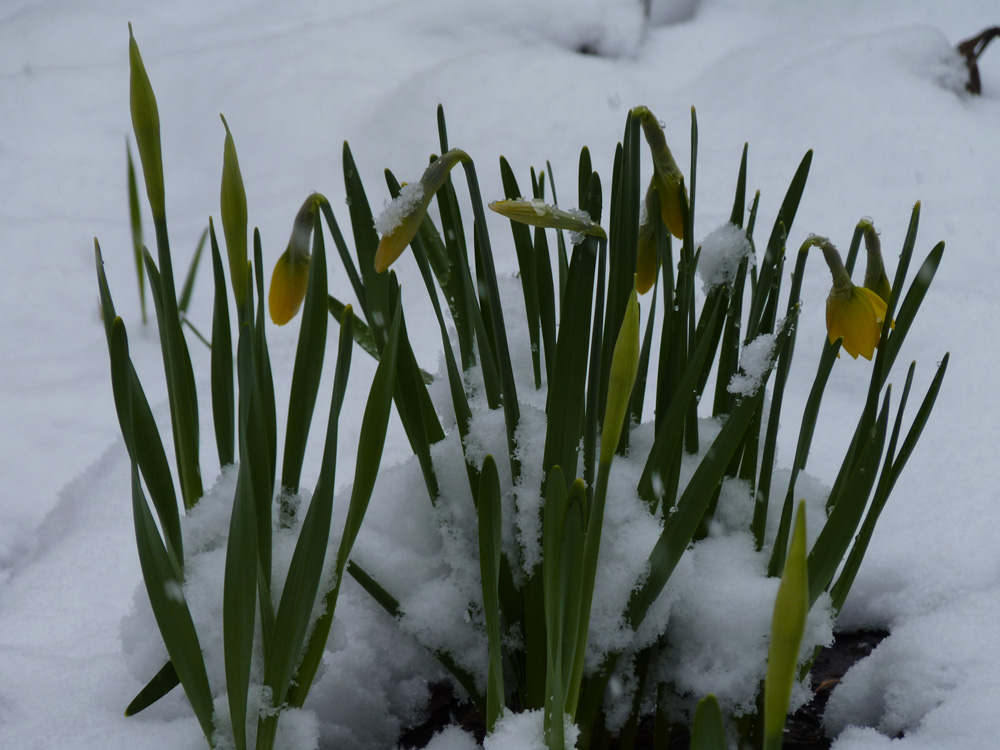
 The Daffodils
by William Wordsworth
I wandered lonely as a cloud
That floats on high o’er vales and hills,
When all at once I saw a crowd,
A host, of golden daffodils;
Beside the lake, beneath the trees,
Fluttering and dancing in the breeze.
Continuous as the stars that shine
And twinkle on the Milky Way,
They stretched in never-ending line
Along the margin of a bay:
Ten thousand saw I at a glance,
Tossing their heads in sprightly dance.
The waves beside them danced, but they
Out-did the sparkling waves in glee:
A Poet could not but be gay,
In such a jocund company:
I gazed–and gazed–but little thought
What wealth the show to me had brought:
For oft, when on my couch I lie
In vacant or in pensive mood,
They flash upon that inward eye
Which is the bliss of solitude;
And then my heart with pleasure fills,
And dances with the daffodils.
Spring Bloodroot Moon
“As our circle of knowledge expands, so does the circumference of darkness surrounding it.” A. Einstein
In one part of my life I chomp down on facts, ideas, connections, linkages. Known and knowable things. Stuffing them in, sometimes sideways, cramming them into the remaining nooks and crannies, or, rather growing dendrites and increasing those neuronal connections. The Connectome. My Connectome.
But. When I write, instead of pouncing on the learning. Trying to take it out for a spin in, say, an essay or a short non-fiction book. I don’t. My fiction comes from the darkness, from the circumference surrounding the knowledge, the place where the knowledge cannot go and would be of little help.
Fiction has its coherence with reality in spite of the definition, say on a continuum from realism to fantasy. Even in fantasy, even one based on a world not this one, the characters are recognizable, they have to be, otherwise the fiction would not be communication but gibberish.
So, yes, there is that leash, but it’s a long one. Often in fantasy long enough to lie useless on the sidewalk next to an orange lawn under an azure sun. Oh, if you wanted, you could pick it up and follow it back to a Dairy Queen and ocean-going shipping, but why would you want to? I mean, the action is at the other end of the leash. That’s where I’d want to go.
And that’s the edge of fiction that lies alongside, shares a border with, the darkness. Out there the leash no longer matters. Except as a reminder that we’re all in this together somehow. Somehow.
Spring Bloodroot Moon
“I want you to understand what my life is like when the sun goes out and the winter enters your bones.”
| — | Michael Gray Kimbe |
“As“Follow your inner moonlight; don’t hide the madness.”
| — | Allen Ginsberg |
our circle of knowledge expands, so does the circumference of darkness surrounding it.”
| — | A. Einstein |
“When I was ten, I read fairy tales in secret and would have been ashamed if I had been found doing so. Now that I am fifty, I read them openly. When I became a man I put away childish things, including the fear of childishness and the desire to be very grown up.”
| — | C. S. Lewis |
“Even in merely reading a fairytale, we must let go our daylight convictions and trust ourselves to be guided by dark figures, in silence; and when we come back, it may be very hard to describe where we have been.”
| — | Ursula K. Le Guin |
“Reading is very creative – it’s not just a passive thing. I write a story; it goes out into the world; somebody reads it and, by reading it, completes it.”
| — | Margaret Mahy |