Cancer and Metaphor

Beltane                                                                  Early Growth Moon

An odd twist in emphasis in the usually technological triumphalist (which I enjoy, even if I don’t always agree with it) Wired Magazine: a sensible article on cancer, one that illustrates modesty in the face of evolution and the dangers of metaphor.

Cellular multiplication and cellular death occur over and over again in the human body from the moment of birth onward. (before birth, too? don’t know)  As cells multiply, necessary to keep replacing the cells that die, mutations creep in.  Cells have elaborate defenses against mutations that bloom into their own activity program–cancer and these work well, as the Wired article points out, most of the time.

But, two factors work against the body’s defenses:  the first is the sheer number of mutations that occur in a lifetime, live long enough and one or two will sneak past the cells defenses, the second I snuck in the last part of that phrase, time.  The longer we live, that is, the more successful we are pushing back disease, certain cancers, too, the more time we have to acquire new mutations that a weakened cellular defense system cannot handle.

Here’s where the Wired article goes radical.  Cancer, it says, is not a bad actor, it is, simply, the bodies on agents acting without proper restraint.  And, given the two factors mentioned in the above paragraph, it must be seen as a normal part of the aging process.  Cancer, then, is not an enemy, but friendly fire.

This matters.  And here we get into the power of language and metaphor.  Remember Nixon’s War on Cancer?  Well, guess what?  Cancer won.  Yes, we’ve developed many treatments that fend off this cancerous assault or another, but in this understanding, all we’ve done is delayed, not defeated cancer.

When we go to war against our body, we end up with the dire consequences of chemotherapy.  All along here, I’ve been thinking about Regina Schmidt, Bill Schmidt’s wife, who died of complication relating to cancer treatment.  She refused to see the cancer as an enemy that she needed to fight.  She did engage in a battle with her cancer.

Yes, she used the tools available to slow it down, stave it off, but when the tools began to overwhelm her as well, she decided to not use them anymore.  This is not the kind of decision you make in a war; it’s the kind of decision you make in a life.

And that’s exactly where the war metaphor gets us in trouble with cancer.  We feel like if we don’t battle valiantly with all the weapons deployed, never mind the battlefield, we’ve admitted defeat.

No.  We admit to being human.  To having a body that cannot defend us forever.  To having cells that mostly, in fact, almost perfectly, recreate us every seven years or so with no major problems, but which eventually face odds they cannot overcome.  That’s not war; it’s time and fate.

We know the dangers of metaphor, those of us have lived through the reaction to 9/11.  Bush invoked the war metaphor and trillions of dollars, thousands of lives and a wasted international reputation later, we’re still fighting.  How much more sensible if we recognized terrorism as a mutation of the body human, not compatible with life, but not something we need to go to war against either; treating it rather as a cell treats a rogue cell, with localized defenses, something more resembling law enforcement than military engagement.

Words matter; lives matter.  Let’s not waste either one.
Ogallala Blue

Beltane                                                                                Early Growth Moon

A post written this time by Woolly Bill Schmidt.  My comment below.

From Bill:

We may be able to ignore the effect that humans have on global warming or even deny that it is happening.  It is difficult to explain away the effect that we humans (farmers in this case) are having on an important earth resource.  And the farmers are crying because they can no longer farm in ways that don’t make sense relative to what they are given.  Maybe it is time to pay attention to our local environments and live/farm within the limits of what is provided by earth environments.  Tapping the aquifers to irrigate farm land is like shooting yourself in the foot.  The aquifer is not infinite and pretty soon you don’t even have enough water to drink.

Here’s a link to a New York Times article about the plight of Kansas (Midwestern) farmers who have robbed the aquifer and now it is drying up.

“And when the groundwater runs out, it is gone for good. Refilling the aquifer would require hundreds, if not thousands, of years of rains.

The irony of using insane amounts of water for fracking to get more oil would be laughable if it were not so sad. Literally hundreds of millions of gallons of water per day are being used for this process, poisoned by who knows what chemicals and with a fraction, if any, of that water being recovered.”


This is the cost of pumping 1,600 gallons per minute to irrigate farm land.  And on page 2 of this article, the same farmer is continuing to drill more wells.  Reminds me of a song:  Pete Seeger “Where have all the flowers gone” —  “When will we ever learn.”


My Willa Cather Moment With This Problem

I’ve told this story to the Woollies and others many times, I imagine, a sort of recurring tale like so many offer to others, unaware of their repetitiveness.  But, it’s worth retelling.

Twice I’ve visited Red Cloud, Nebraska, a small town on the Kansas/Nebraska border, and home to Willa Cather, a favorite American regional author of mine:  Death Comes for the Archbishop, O’ Pioneers, The Professor and many others.

In the Willa Cather Center there I remember, back in 2005 or so, speaking with the folks behind the desk.  It was really hot, 107 or so, and we got to talking about climate change and agriculture.  Since I have a long standing interest in the Ogallala Aquifer, I asked about irrigation.

The conversation became animated because it turned out that in the spring, when the farmers began irrigating their fields, the towns wells would go dry.  It seems they’ve pumped the aquifer out enough that the volume of water available in their area can’t sustain the needs of both town and country.

Here’s a good resource on this issue, which nuances it:  Ogallala Blue.

A Grounded Faith

Beltane                                                                         Early Growth Moon

I walked through the garden alone, while the dew was still on the beet seedlings and apple blossoms.  Oh, wait.  That was roses, wasn’t it, from the old gospel tune.

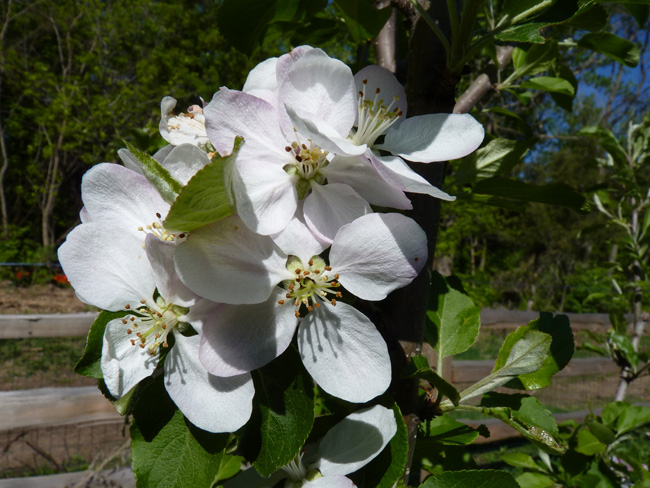
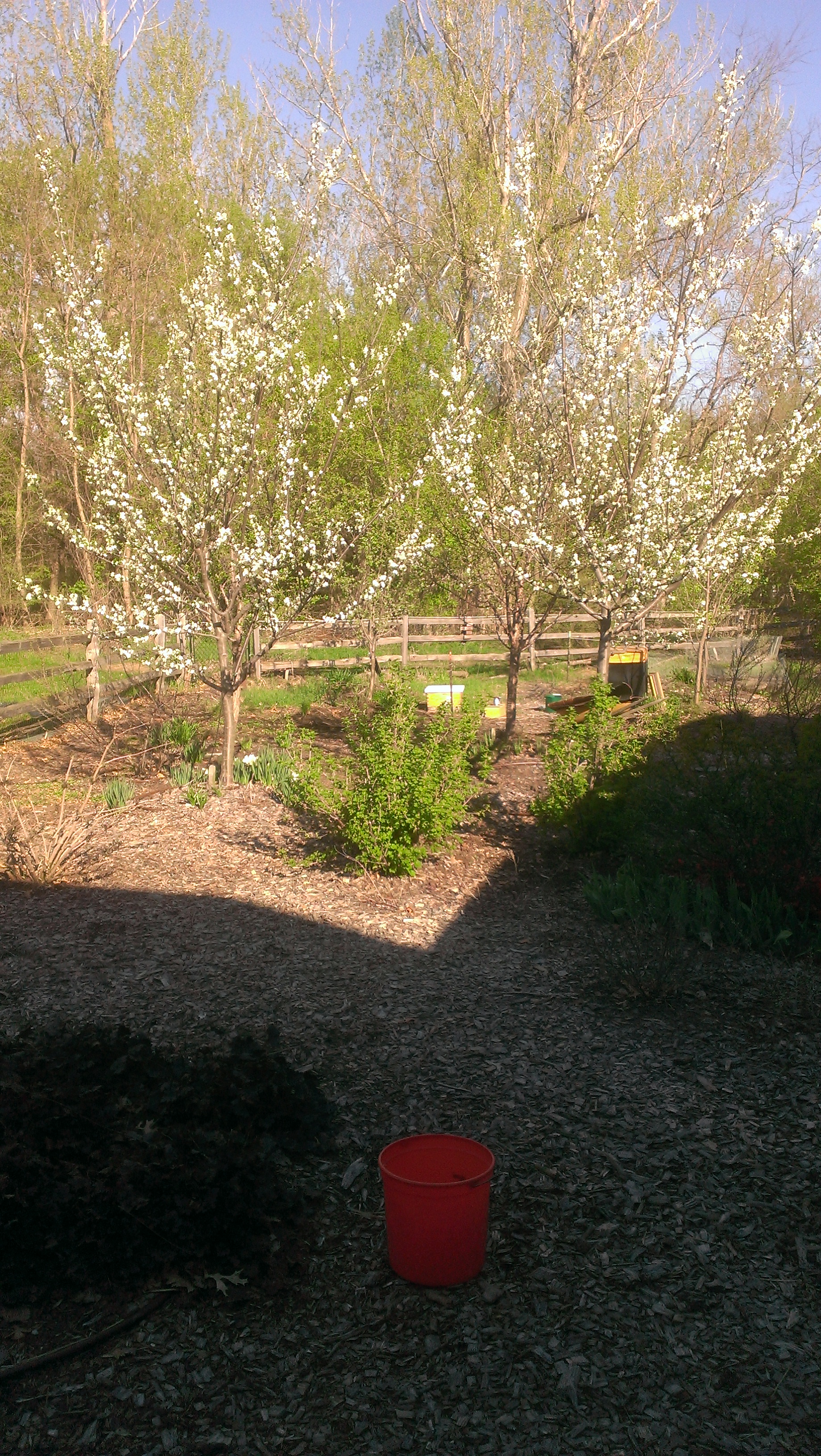
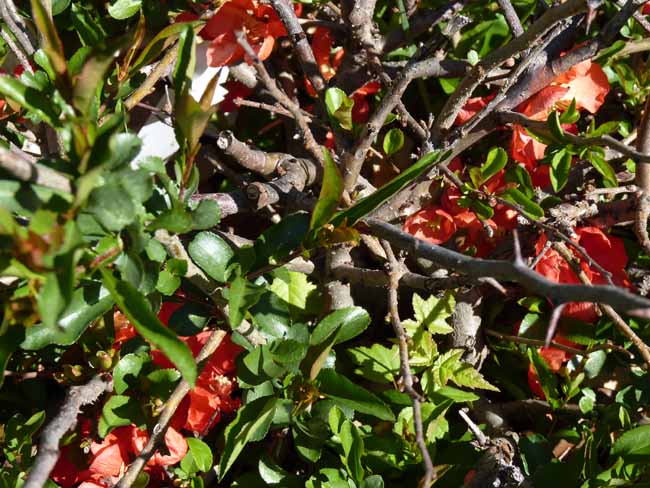
If you want a moment of intense spirituality, go out in the morning, after a big rain, heat just beginning to soak into the soil, smell the odor of sanctity, in this case fertility, coming up from the plants and their medium, see the beets and kale and carrots and cucumbers and sugar snap peas on the rise, look at the onions and garlic and leeks filling out, getting greener, taller and fatter.  Take a stroll past the cherry blossoms, the pear and plum blossoms, the apple blossoms that came out yesterday, past the bee colony hard at work, over to the blueberries and check out the new growth on the hard pruned wild grapes.   The sand cherries and quince and even the currants with their modest, tiny green flowerettes, all showing to the bees their best and sweetest offerings.  Each petal, each flower, each stalk, each leaf is a miracle, a wonder of the evolutionary path on which that particular organism travels, its genetic ancientrail.

(our quince)

That walk, by the way, is not the walk of an individual, self-reliant and independent, but of a dependent creature glorying in the symbiotic relationship between his cells and these plants.  This is a community enterprise, the humans here, Kate and I, in partnership with the vegetables, the flowers, the fruit, the bees.

(our honeycrisp tree in bloom)

Which reminds me of the other partners, or co-habitaters at least, all the wild animals that live in the soil here, the gophers and earth worms and grubs and snails and voles, those who use the trees the squirrels, the woodpeckers, pileated and red-tailed, crows, hawks, Great Horned owls, robins, chickadees, blue birds, those who live on the land, under buildings and in brush piles the rabbits, chipmunks, woodchucks, opossums, raccoons, mice, the interlopers the wild turkeys, the deer, the coyote.  And of course, the woods themselves the ironwood trees, the poplar, ash, cottonwood, red oak, burr oak, cedar, spruce, yes even the black locust and the buckthorn.  The grass, yes, the dogwood yes, the amur maples yes, the alicanthus yes.

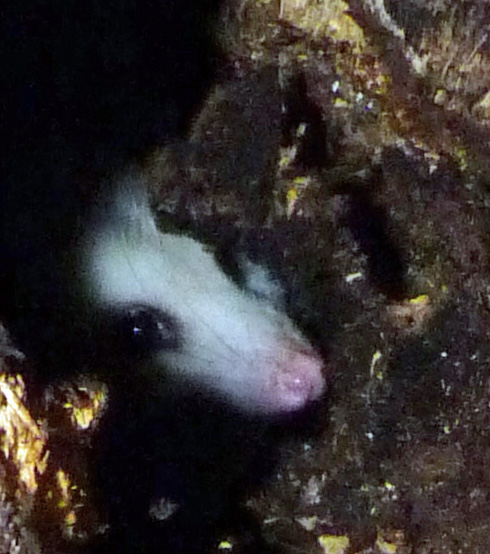
(a baby opossum in a dead tree in our woods)

We all share this land, to which we have the deed, but so little else.  When Kate and I leave, as we will one way or the other, the rest will continue, unaffected, unmoved by our passing.  Land is not for owning, but for cohabitation.  We know this, if we bother to look.

Root and Branch

Beltane                                                                       Early Growth Moon

Water and heat.  Sun and soil.  Roots, stalks and leaves.  There you have it.  And we’ve got it this week.  Rain, rain, rain.  Then some heat.  Seeds germinating, bursting up, ready to transubstantiate.  All for the great cycle of life, churning, moving, flowing, surging.  I can feel it, smell it at this time of year.  And I love it.

Just finished Dan Brown’s Inferno.  If you read the NYT review, you will discover that Dan has a mundane talent for words.  And that’s true.  The reviews I read didn’t add, but they should, that he throws in potted art history and architectural criticism, not to mention some odd rant on transhumanism.  Yet, did you notice, I finished it.  Why?  Well, reading like a writer, this guy knows how to plot.  He can make you wonder what’s coming next.

He pulls off one big twist in this novel and it’s a dandy, but it feels very contrived even though he sucked me in completely with it.  That’s sort of the thing he’s got going, you can see the holes in his works, where I wondered were the editors who could have easily fixed much of this, but you pass them by to find out what happens next.  That’s story telling and it’s the true game which every writer plays.

(Lucifer, trapped in the 9th circle. Canto 34, lines 20–21  Gustave Dore)

Hey, listen!  Have I got something to tell you.  Clumsy sentences, wooden metaphors, filler pages, yes, they matter, but in the end not as much if you keep me interested.

coda next morning:  I will buy and read your book if you can entertain me.  Whether I remember it or learn from it and, most important, whether I will return to it, however, depends on those skills Dan Brown seems to shunt aside as unnecessary.  No, I won’t be re-reading any of his work.

Beets, Romans and High Fantasy

Beltane                                                                       Early Growth Moon

Kate has been trying to reconstruct an amazing beet pureed soup we had at Fika in the American Swedish Institute.  The chef gave us some of his or her ingredients, all of them?  I’m not sure.  But Kate’s done a good job of closing in on it.  It’s delightful, tangy and creamy with a great feel in the mouth.

I’ve spent the Sunday beginning to check my Latin translations against the commentaries and entering notes into the file I’m keeping for the commentary Greg and I may write.  This is fun work, finding better words, puzzling over the thoughts of Ovid scholars.  Once I’ve finished the recheck, I’m going to start reading the Ovid scholarship I’ve collected.

In the afternoon I’ve proceeded with the revision, rewrite of Missing.  I’m well into the first third, adding thicker description, plumping up character development, making the narrative a more coherent whole.  This is fun, too.

Even so, my mind can only take so much fun before the brain that supports its work begins to wear out the rest of my body. That’s where I am now.  Tired. Enough for the day.


Mars. We Are There.

Beltane                                                             Early Growth Moon

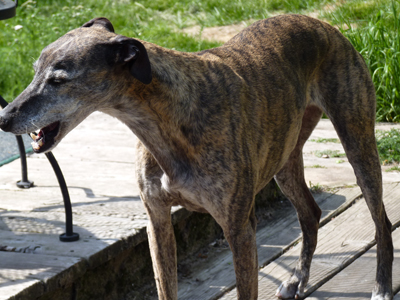
Got outside yesterday during the sunny hours and put a pollen patty on for the bees, laid down some weed preventer and left Kona outside.  She stuck around the house, though, wondering when she could get back in, but not, I imagine, very unhappy with being left on her own.

Kate and I watched a Disney special on the Opportunity and Spirit rovers sent to Mars in 2004.  This film was made in 2006, so I went to the NASA websites to check up on them.  Spirit stopped phoning home in 2010 and NASA stopped revival efforts in 2011.  Even so, that means Spirit went exploring for 6 years, 5 years and 9 months past its mission plan.  Even more remarkable, Opportunity continues to motor along,

In fact, just yesterday it relayed data:

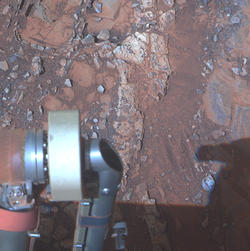
Mars Rover Opportunity Examines Clay Clues in Rock

Rock Target ‘Esperance’ Altered by Wet History (False Color)

The pale rock in the upper center of this image, about the size of a human forearm, includes a target called “Esperance,” which was inspected by NASA’s Mars Exploration Rover Opportunity.

PASADENA, Calif. — NASA’s senior Mars rover, Opportunity, is driving to a new study area after a dramatic finish to 20 months on “Cape York” with examination of a rock intensely altered by water.

The fractured rock, called “Esperance,” provides evidence about a wet ancient environment possibly favorable for life. The mission’s principal investigator, Steve Squyres of Cornell University, Ithaca, N.Y., said, “Esperance was so important, we committed several weeks to getting this one measurement of it, even though we knew the clock was ticking.”

Opportunity on May 16th also broke the existing NASA record for distance traveled on either the moon or Mars by going over 22.2 statute miles, longer than Apollo 17’s Eugene Cernan and Harrison Schmitt drove their Lunar Roving Vehicle.

(curiosity rover parachute flapping view from Mars Reconnaissance)

Curiosity, the most recent Mars rover, landed in 2012, and on May 9th proceeded to a second round of drilling at a site where “(In February) Curiosity took the first rock sample ever collected on Mars…called “John Klein.” The rover found evidence of an ancient environment favorable for microbial life.”

Also in orbit and currently at work is the Mars Reconnaissance Orbiter, launched in 2005, arriving Mars, 2006.


Paradise (Just another day in)

Beltane                                                             Early Growth Moon

For Bill.  He’ll know why.

“Since [landing after Apollo 12], I have not complained about the weather one single time. I’m glad there is weather. I’ve not complained about traffic. I’m glad there’s people around.  One of the things that I did when I got home, I went down to shopping centers, and I’d just go around there, get an ice cream cone or somethin’, and just watch the people go by, and think: “Boy, we’re lucky to be here. Why do people complain about the earth? We are living in the Garden of Eden.”


— Apollo 12 moonwalker Alan BeanVia Brainrow: “Perspective

Bell, Book and…Gun?

Beltane                                                                            Early Growth Moon

So, I went into the St. Louis Park Public Library, looked around for the session on literary agents (see below) and noticed an armed and uniformed policeman talking with a librarian. When I left, the same policeman was still there.  I didn’t ask if this was part of the NRA initiative to make all schools safe by putting police with guns in them (and, BTW, arming teachers and administrators, too), but a part of me retreated at the sight, a sanctum of my childhood, and there was, in fact, a boy of maybe 8 or 9, pulling books off the shelves and examining them, invaded by guns and police.

Police powers and the rights of free speech and learning live an uneasy balance, one that needs to be uneasy, one that should not be thrown off balance by seeming to grant police powers the right of access to a place devoted to freedom of thought.  This is inappropriate to the young one hunting for just the right book, the immigrant hunting for clues to American politics and the radical hunting for information for their arguments.

Police presence has a chilling effect on freedom of thought and freedom of action, as, of course, it is meant to have, but in the street, at the bar or the broken in house or where shabby accounting practices prosper, but not, I would go so far as to say never, in a library.

Agency

Beltane                                                                     Early Growth Moon

A sunny afternoon, a thundery morning.  Snow this evening?  No.  Just kidding.  I think.

Anyhow we’re in the midst of a high humidity moment, again.  65 dewpoint and 78.  Not the end of the world, but this is after all, just May 18.

Went to a Hennepin County Library presentation on how to pick a literary agent.  It was actively bad.  The woman, whose name I will not reveal to protect the innocent, gave as her qualification for making the presentation her failure as a literary agent.  There you are.

Unfortunately I arrived a half-hour late and had to sneak into a spot where I couldn’t leave gracefully.  This is Minnesota.  So, I endured.  I had no way of knowing in advance that she would be terrible; it was a Loft sponsored event and I thought it might give me another slant on the whole agent side of publishing.  Sigh.

This is the second time this week I’ve gotten times bollixed up.  The first time we went to the American Swedish Institute and got there around 10:45.  When I tried to buy a ticket for the Sami show, the lady said, “The museum doesn’t open until noon.”  “Oh,” I said, “That wasn’t clear on your website.”  Yes it was she said.  Then, I thought it was them.

Two times and I’m the connecting link; I have to look at how carefully I look.  Hmmm…

The Howdydoody Season: Winterspringsummerfall

Beltane                                                                          Early Growth Moon

In a long ago time I took a group of youngsters from Brooklyn Center United Methodist Church on an outing.  Wherever it was we ended up, there was a beanbag toss game that featured Howdydoody characters.  The kids, as kids always do, said, “What’s that?”  And I, as unsuspecting aging adults always do, said, “Why, that’s Howdydoody.”  The blank stares gave me my first frisson of growing old though I was only 27 at the time.

On this now very outdated program there was a character whose name describes for me the season we’ve been passing through since, oh, March or so:  Winterspringsummerfall.


This is not a new phenomenon, though, as James Russell Lowell’s poem shows:

Under the Willows [May is a pious fraud of the almanac]

by James Russell Lowell

May is a pious fraud of the almanac,
A ghastly parody of real Spring
Shaped out of snow and breathed with eastern wind;
Or if, o'er-confident, she trust the date,
And, with her handful of anemones,
Herself as shivery, steal into the sun,
The season need but turn his hourglass round,
And Winter suddenly, like crazy Lear,
Reels back, and brings the dead May in his arms,
Her budding breasts and wan dislustred front
With frosty streaks and drifts of his white beard
All overblown. Then, warmly walled with books,
While my wood-fire supplies the sun's defect,
Whispering old forest-sagas in its dreams,
I take my May down from the happy shelf
Where perch the world's rare song-birds in a row,
Waiting my choice to open with full breast,
And beg an alms of springtime, ne'er denied
Indoors by vernal Chaucer, whose fresh woods
Throb thick with merle and mavis all the year.

– See more at: http://www.poets.org/viewmedia.php/prmMID/22956?utm_source=PAD%3A+Spring+Song+by+Sherwood+Anderson&utm_campaign=poemaday_051813&utm_medium=email#sthash.6TuB0x7D.dpuf