Loki Gives Birth

Fall                                                                    Harvest Moon

In the Asgard myth a builder offers to build the walls and palaces of Asgard in three years if he can have the sun, the moon, and Freyja.  The gods tell him he can have one year and no help. He asks to have his horse help and Loki advises agreement.  The horse works very hard and the gods see, with three days left, that the man might finish in one year.

(Thor & Loki being adoptive brothers is an idea from comics, not myth)

They panic and demand that Loki prevent him.  Loki turns himself into a mare and distracts the man’s horse by neighing until he comes to her.  Though he tried, the man did not succeed in catching his horse and flew into a rage.  The rage revealed him to be a giant.  Thor came back to Asgard and slew him.

Some time later Loki gave birth to Sleipnir, Odin’s eight-legged mount.

The Sacred and The Profane

Fall                                                                         Harvest Moon

Kate and I ate at Gather last night before seeing Episode 1, the Nature Theater of Oklahoma production in the Walker’s McGuire Theater.  We had a table beside the window that projects out over the side walk, giving a panoramic view of the Basilica, St. Marks Episcopal, Hennepin Avenue Methodist, Loring Park and part of the Sculpture Garden while Hennepin Avenue, filled with bustling cars and bicyclists and individuals walking, walking ran just below.

On the east side of Hennepin, the location of the three churches, the transcendent has precedence.  And the past.  The deep Western past. On the west side of Hennepin though modernity has sway.  The noumenal realm swept away in favor of the phenomenal, the religious by the secular, the surface and the particular gaining favor over the ideal.  It fascinates me that we have here in our built environment such a bald dividing line and that that line either begins or ends in a cemetery and disappears among the industrial detritus of the early part of the last century.

Hennepin Avenue runs roughly north and south in front of the Walker Art Center, coming up from Lakewood Cemetery, then taking a gentle right, curving until it runs east and west through downtown Minneapolis and across the Mississippi to peter out among the brick warehouses, off brand filling stations and small manufacturing businesses of east Minneapolis.

( CLAES OLDENBURG, COOSJE VAN BRUGGEN   Spoonbridge and Cherry, 1985-1988)


Right at the Walker though it creates an interesting division between then and now, past and prologue, the modern and the pre-modern.  On the west side, fittingly, sits the Walker Art Center, a premier museum of contemporary art with a wide-ranging performing arts program that brings globally significant musicians, dance, theater and film to the Twin Cities.  North of the Walker building complex is a sculpture garden filled with modern and contemporary sculpture including the iconic spoonbridge and cherry.

On the east side of Hennepin, beginning diagonally south from the Walker and in order moving toward the north are Hennepin Avenue United Methodist Church, St. Mark’s Episcopal Cathedral and then the Basilica of the Archdiocese of Minneapolis and St. Paul. These churches are, respectively, dominant congregations in the case of Hennepin Avenue and St. Marks and the second congregation of Roman Catholicism in the state. (after the Cathedral of St. Paul)

These days I find myself a west of Hennepin sorta guy.


The Kafka Quote Behind the Nature Theater of Oklahoma

Fall                                                                           Harvest Moon

Personnel is being hired for the Theater in Oklahoma!  The Great Nature Theater of Oklahoma is calling you!  It’s calling you today only!  If you miss this opportunity, there will never be another!  Anyone thinking of his future, your place is with us!  All welcome! Anyone wants to be an artist, step forward!  We are the theater that has a place for everyone, everyone in his place!  If you decide to join us, we congratulate you here and now!  But hurry, be sure not to miss the midnight deadline!  We shut down at midnight, never to reopen!  Accursed be anyone who doesn’t believe us!

Franz Kafka, Amerika

The Nature Theater of Oklahoma

Fall                                                            Harvest Moon

Just back from the Walker and the Nature Theater of Oklahoma’s unusual theatre piece. As improbable as it may sound, the entire presentation consists of a single phone call in which one of the company members began to tell her life story.  The theater, which gets its name from a Franz Kafka quote in Amerika, has now produced five complete theater pieces which continue this method, that is, each one is a further phone call transcribed and each one represents a continuing part of the same woman’s story.

The piece is 3 1/2 hours long.   The script, or better, the book, because this is a musical, does not change the transcription at all.  Every uh, um, yeah and wait is in it.  And it is all sung.

It affected me on several levels, the most obvious its evocation of childhood and what it was like to remember things from the perspective of a child.  The Nature Theater uses what they call extreme movement, a form of dance that is difficult to describe, but it has the effect of enhancing and expressing emotional content.  The libretto or whatever you would call it is a wonder, giving musical expression to the ums and the yeahs as much as the story lines about her father, the silent strong person or the time she jumped off a fixture in the front yard with a home made parachute.

Both men and women perform, coming on and off the stage at intervals that did not make a lot of sense to me, but they seemed to work dramatically.  Both men and women sing, too, so sometimes the words of a young girl have a bearded bald man giving them voice.

Worth seeing if you have the chance.

What I Learned in Seminary

Fall                                                                         Harvest Moon

A fascinating journey into Loki scholarship and through it into international scholarship on folklore has made me blink more than once in its equivalency to the methods of biblical scholarship I learned in seminary.  First, there is textual criticism.  That is, did this instance of a Loki tale originate in an Old Norse tale or a broader European context?  If it originated in an Old Norse tale we imagine it may accurately reflect the actual sentiment toward Loki held by those who followed the old Norse faith.

However.  Even if it originated in an Old Norse folktale, does it have antecedents in either nearby folkloric material, especially Celtic since the Norsemen conquered and occupied Ireland, or in traditions from a larger ambit, say Greek or Roman mythology?  To the extent the story reflects Greco-Roman or Celtic material it cannot be said with confidence to reflect the view of the ancient Norse.

Here’s an example.  There is, in a tale in which Loki, traveling, takes a staff to a large eagle, really a giant named Thjassi in animal form.  The staff sticks to Thjassi and Loki to the staff through the giant’s magic.  In return for his release Loki agrees to get Idunna and her apples for the giant.

(Edward Burne Jones the_garden_of_hesperides_1870)

Once released Loki goes to Idunna and tells her he’s seen better apples in the forest.  She wonders at this, gathers her apples for comparison and leaves Asgard with Loki.  When she does, Thjassi in his eagle form swoops down and gathers her up.

Without Idunna’s apples the gods and goddesses of Asgard wrinkle and turn gray, beginning to grow old.

There’s more, but there’s enough here to make the point.  Here’s a paragraph from Wiki on the Garden of the Hesperides:

The Garden of the Hesperides, Atlas’ daughters, was Hera‘s orchard in the far western corner of the world, where either a single tree or a grove of trees bearing immortality-giving golden apples grew. Hera placed in the garden a never-sleeping, hundred-headed dragon (named Ladon) as an additional safeguard. The 11th Labor of Hercules was to steal the golden apples from the garden. He stole the apples by asking Atlas to steal the apples and in return he would hold up the sky for him. After Atlas picked the apples Hercules asked Atlas to hold up the sky for him while he made a pad of the lion skin. He never took back his job of holding up the sky and ran away.

So this Loki story recapitulates a Greek story about the hero Hercules.  Not likely to be a source of good information about Loki and the ancient Norse faith.

Here’s one other thing I’ve relearned in this foray.  Folklorists have a numbered system for the appearance of story types.  In the myth of Baldr, after he dies from an arrow made of mistletoe, an attempt is made to bring him back from Niflheim, the realm of Hel, Loki’s monstrous daughter.   In the Aarne-Thompson system of folklore classification this is a 931, in essence a variation on the story of Orpheus.
I Like Getting Old. Patti Smith

Fall                                                                     Harvest Moon

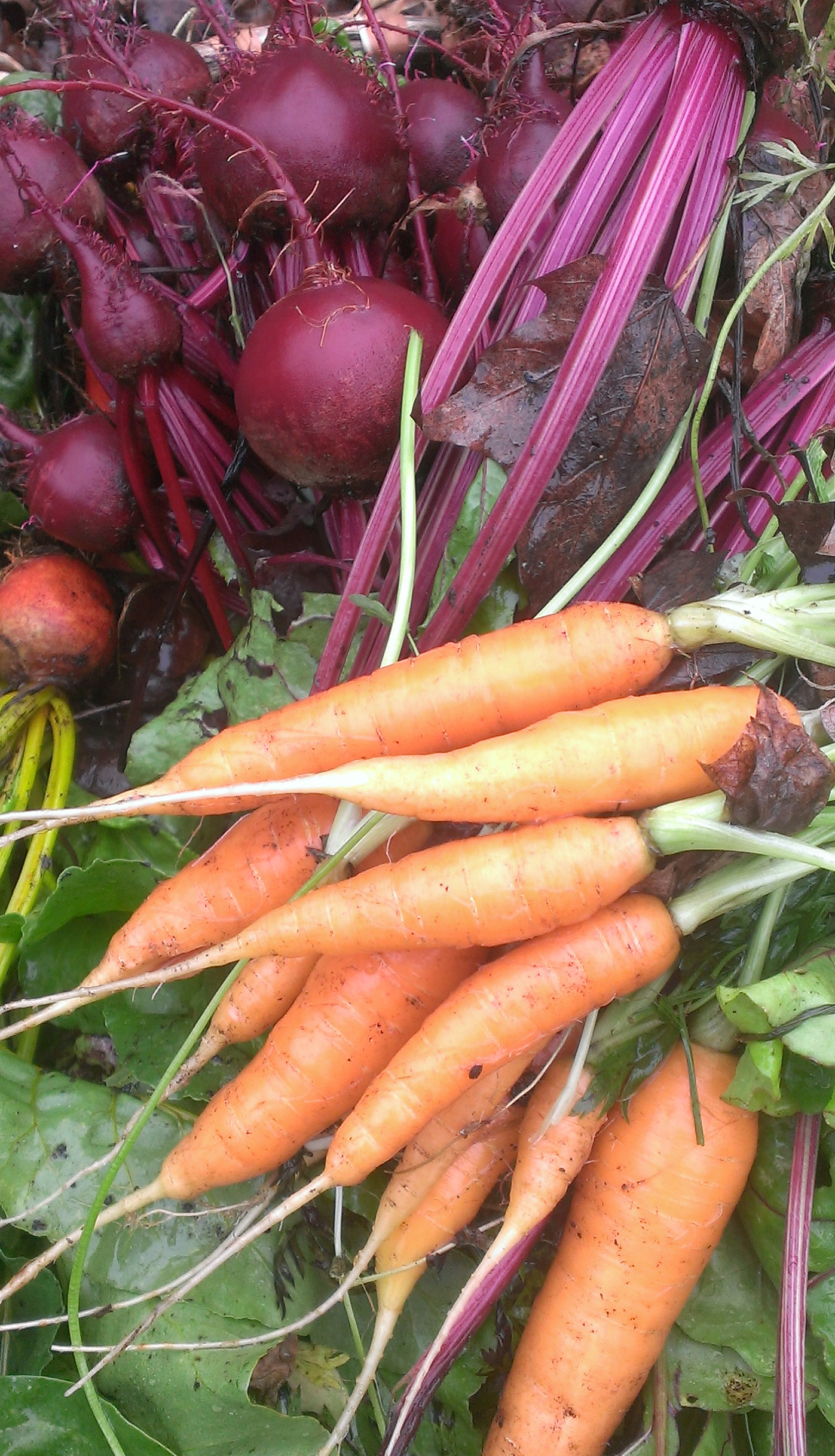
Something’s happening here.  What it is is not exactly clear.  At the end of this gardening year I feel like I’ve finally gotten it.  That is, I believe I now understand how to grow fruits and vegetables in quantity and of high food value. As Kate said, moving her hand in a low but upward swoop,  “Sometimes the learning curve is long.”  And it has been.  Over 20+ years.  Today though I feel good about my gardening skill.

On the writing front I’ve rounded up several agents to query when Missing comes back from its beta readers and has gone through the copy editing process.  I’m deep in the research phase for Loki’s Children, focused right now on the text, Loki in Scandinavian Mythology.  No matter how all this turns out in the matter of publication, I’ve let the inner and outer censors go.  I don’t know how or why, but I freed them and they left.  So now the process is all good.  Research.  Critique.  Feedback.  Submission.  Writing.  All good.

The MOOC’s have retaught me a valuable lesson.  When I’m engaged in scholarship, I’m happy, in my element.  I hit flow most often while learning.  That means the work with Ovid, which begins again on October 4th, is another chunk of the same.  Happiness is a warm book.

Last night I had a dream in which a person ridiculed me for not being spontaneous, being disciplined to a fault.  It bothered me as I slowly rose to consciousness this morning.  Am I so focused on a few things that I’m missing life?  Has my willingness to change directions, chart a new path receded?  Been suppressed by all this?

No.  I don’t think so.  But I’m open to other perspectives.  To me my life is full, rich.  There are friends and family whom I see or communicate with regularly.  There is a creative life partnership with Kate here.  The dogs alone provide many spontaneous moments because dogs live only in the now.  In the past I have initiated change in the world through political action.  Now the action is more at home and in the family.  Seems just right for the third phase.


Interlibrary Loan

Fall                                                                  Harvest Moon

Certain last century, even last millennium information transfer methods still have traction.  After a frustrating search through various book selling websites, Loki in Scandinavian Mythology was not available.  There are also no e-books of it online.

A library search did turn up a copy in the University of Minnesota Wilson Library.  But Andover occupies the exurban fringe, so close to the cornfields, so far from the U.  At first reading it at Wilson seemed like a good idea.  No.  Too much driving.  Hmmm.

Aha.  Interlibrary loan.  Sure enough, I went on the Anoka County Library Website and located a way to enter a request for this book from Wilson library.  The system, for free, delivered it to my local library, the Rum River Library and on Monday I went over and picked it up.  It has to be back in three weeks, by October 14th, no renewals.  Doesn’t matter.  I’ll finish with it well before then.

Let’s hear a cheer for physical copies and librarians.

Yes, but.  Let’s hear another cheer for the folks busily scanning books in to great digital depositories so maybe the next time a hard to locate book is needed, it has a copy in the Great Library, the one in the Cloud.

A Good Year for the Crops

Fall                                                                       Harvest Moon

Got my soil tests back and the recommendations for next year’s garden.  This time I asked IMAG0650cropped for specific information about beets, allium crops (onion, garlic, leeks) and tomatoes.  I will use a broadcast for all the beds but use special supplements for these three crops.  That way I can keep them in the same beds year after year unless some kind of disease problem occurs.

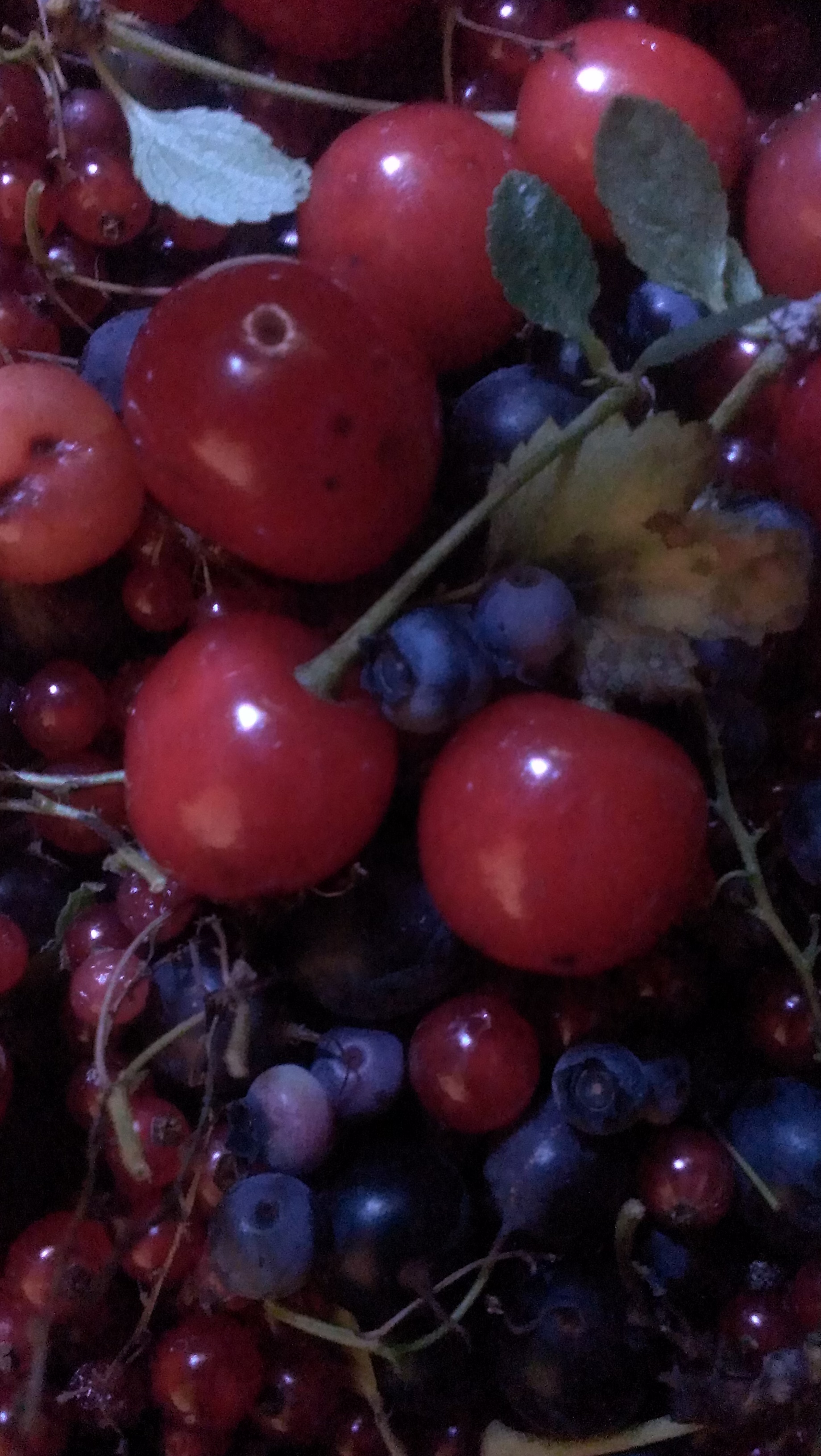
This time I included soil samples from the orchard, so I have recommendations for broadcast and sprays for it, too.  With a winter pruning that Javier and company will do we should have a better and more consistent fruit crop next year.  This year the cherries, currants, honey crisp and sweet tango were good.  Plums and pears and blueberries not so much.

Since I decided a couple of years ago to get more and better crops from our limited space, I’d rate this last year a definite step in that direction.  It was IMAG0689a weird year weatherwise and I have no way of knowing how that helped or hurt us, but the International Ag Labs feeding program did help.

A key aspect of the International Ag Labs program is its movement toward biosustainability so as I use their products my soil becomes better and better, not poorer and poorer as happens in much of U.S. agriculture.  There are two primary goals here: soil made better by our growing and the production of higher nutrient quality produce.  That’s a solid win for us and the planet at the same time.  It is the Great Work in miniature, right here in Andover.

Given the outsized (for us) honey crop this year I’ve also decided to scale back my bee plans.  Provided this colony survives the winter, and I think IMAG0873it will, I’ll just divide it next year and not buy another package in 2014.  Maybe in 2015.  2015…geez.  That still seems like flying cars, shuttles to the moon and computer created meals at home.  Guess I’m now the 20th century, second millennium guy anachronistically positioned in the future.

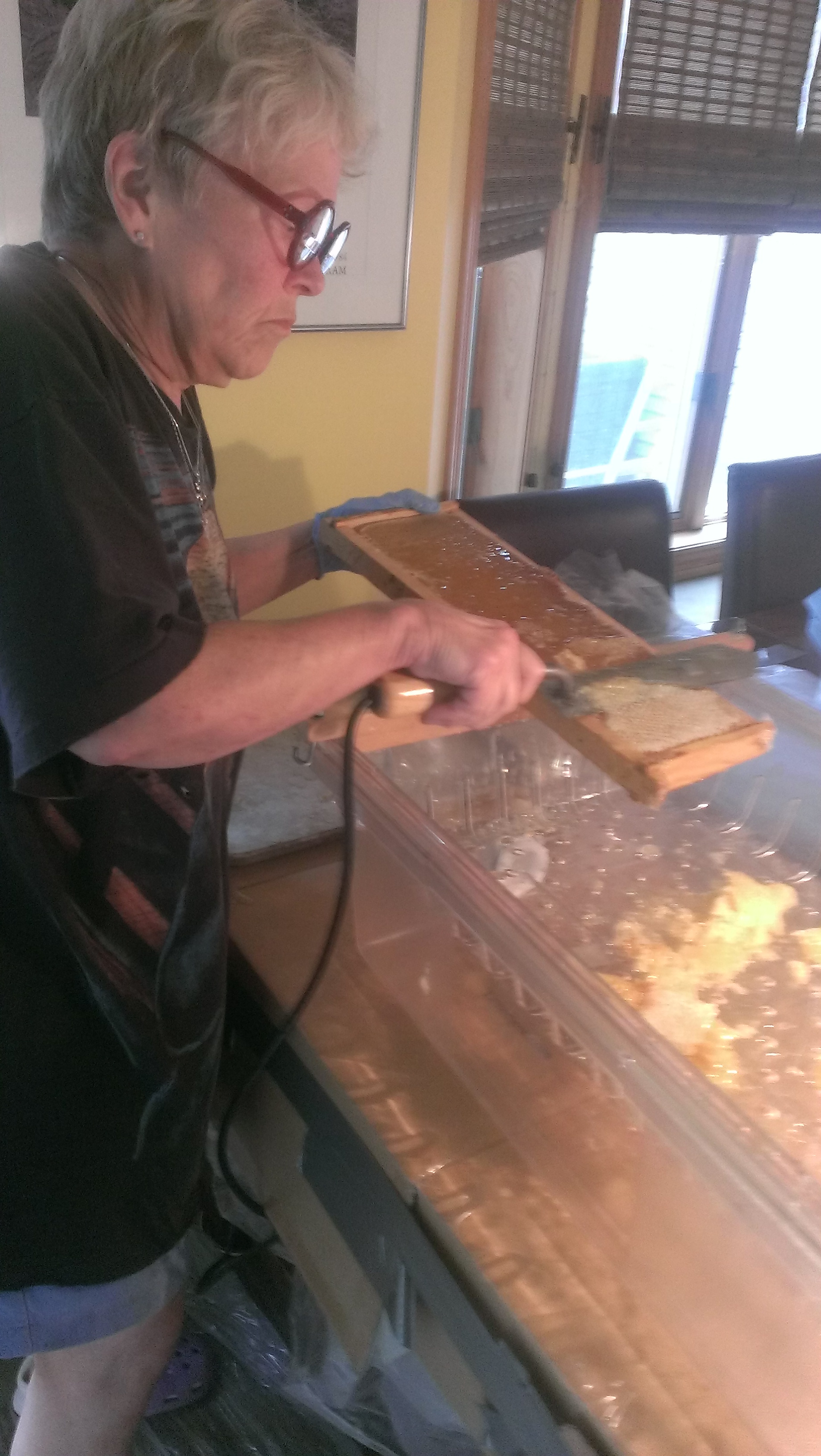
Kate uncapping the honey.  We’ve developed a rhythm, a working partnership when it comes to caring for the land and our plants.  We share the space and the work with bees, the living organisms of the first six inches of the soil and the dogs who keep critters out of our garden and orchards.

A Perfect Day

Fall                                                                     Harvest Moon

If there is a perfect day, it falls in September with a light breeze, a blue sky with a few clouds and a slight chill in the air.  Over our 20 years I’ve come to associate those days, and today is such a day, with the planting of bulbs.  Sometimes the days fall in October, too, and I’m grateful for them then, too.

To celebrate this bulb planting weather I took to the brick patio and the three-tiered perennial garden we have there, digging out the hardy hemerocallis so I can have space for my bulbs.  In late summer I usually have an Allan Greenspan moment, you know, irrational exuberance, and order far more bulbs than I have room in which to plant them.

Each year I have to remove plants that have overgrown, often they are hemerocallis, so that I can find the space for the bulbs soon to arrive.  This year my exuberance was more irrational that ever, so I’m doing my space clearing a bit earlier and more comprehensively.

When I’m doing this work, I turn on FolkAlley.com and listen to folk music streamed from Kent State in Ohio.  Seems to fit.