
Family Themes and Existential Aloneness

Lughnasa                                                                Lughnasa Moon

Two widely divergent thoughts today. The first about family. Families have themes, melodies that play themselves out in different keys and different arrangements, using the instruments available.

Take mine for instance. Both mom and dad had a desire to travel, to see the world. Mom realized hers, making it to Italy and northern Africa as a WAC during WWII. Dad had a dream, a boat, some time in the Gulf of Mexico, then a book about it. Yet he never left the U.S. with the exception of Canada until very late in life when he flew to Singapore to visit my sister. He did, however, take short trips to odd places in Indiana, making do with what was available.

So, travel is a theme. I’m the less traveled of my siblings, only visiting foreign countries, never staying anywhere longer than a week. Mary has traveled a lot, spending years in Southeast Asia working, visiting Tibet, India, Indonesia, Europe, the Emirates. Mark has lived the travel theme most adventurously. He’s been across Russia on the Trans-Siberian railway, picked olives in a kibbutz in Israel, taught in Thailand, Cambodia and Saudi Arabia. We’re a gradation of the wanderer archetype, the one who visits but doesn’t stay.

Then, there’s the fascination with writing and language. Dad was a journalism major and well thought of at Oklahoma State University, a school with a respected journalism department. He wrote professionally, as a reporter and an editor, most of his life.

Mary and Mark advanced this theme by teaching English as a second language (ESL). I’ve advanced this theme through novels, short stories, sermons, essays, this blog. In this instance we’re a spectrum of the Hermes archetype, the one who takes messages and delivers them.

Mom was a teacher. Many of my cousins are teachers, on both sides of the family. Mark has taught ESL as an instructor while Mary has advanced from that role to that of University professor, teaching teachers of ESL for the nation of Singapore. I’ve never taught formally, but many of my roles have involved teaching of one kind or another. Here, we’re a spectrum of the elder archetype, when the elder is one who passes on the tradition.

There are other themes, some more subtle, but these three: wanderer, Hermes and elder seem most predominant. We did not engage these archetypes; these archetypes engaged us, shaped us, set us on our paths.

The second thought is about being alone in our interior. Reading an article in the New York Times today about Hinduism, a comment made me stop, think. The interior life is one path to liberation, the interviewee said, but at bottom the life of devotion and meditation is decidedly anti-individual. What? Yes, he said, at bottom we find in ourselves a deep oneness with all creation, with the brahma. So, at our most interior we are also at our most connected.

So this bounced around for a while. Then, a thought occurred to me. How does he know?  We can say for certain that we know each person’s interior life is unique and private. We can say this much based on our own experience and the mediation of other’s interior experience through interaction. Since those interactions are not identical, hardly identical, we can infer with confidence that the interior life of those we know is different from ours and different from others. It is also self-reported as different by those we know.

It’s an attractive idea, the idea of a substrata of oneness to be found at the end of our meditation, an idea known in the west through Carl Jung’s notion of the collective unconscious. But I don’t see how it can possibly be proven and without proof the notion of a layer of oneness underneath it all seems far fetched to me; as does, too, a layer of oneness that transcends our individual state.

 

Sex Scandal (there. that should grab you interest.)

Lughnasa                                                                Lughnasa Moon

A few Woolly Mammoths thundered down Nicollet Avenue to Christo’s Greek Restaurant. Warren, Frank, Bill and I broke pita together and made various comments about Nienstedt, Archbishop of Minneapolis and St. Paul, the sex scandal that dominates the news about Catholicism here, then the Jesuits.

We talked about family and suicide, the cruise Warren and Sheryl have signed up to take, Bill’s trip to his family reunion. This last included only Bill’s brothers and sisters and their progeny-120 strong. Wow.

We stood out there on the sidewalk after dinner talking for a bit and I noticed we all had white hair (or a white scalp in my case). Four old men talking. Four old men who know each other, who see each other as friends and brothers. A gift for all of us.

Weighty

Lughnasa                                                       Lughnasa Moon

Today I’ve had constant reminders of the physicality of books. They’re wide and their width has to be considered when packing them. Individually, as a rule, books are not heavy, but in the aggregate, they can be very heavy. Art books, printed on paper adequate for taking and retaining high quality color prints, are even heavier and today I have packed box after box of books on aesthetics, modern and contemporary art, art history, Chinese and Japanese art.

Over the course of these months since deciding to move, I’ve often wondered, is the last time I’ll do this in Minnesota? But packing these books, I wondered, am I among the last of those who will pack books for a move? Books are physical objects, present at the human level of perception in the world. The books I read on my kindle though are not physical objects, at least not in this macro sense. I cannot see the individual books, heft them, page through them, smell them.

This bothers some people a great deal, but not me. I’m not a bibliophile. I’m a lover of content and the medium is not so important to me. Reading the physical books is better for scholarly purposes, at least for now. In those books creating marginalia, paging through to a new idea, then back again is all part of the process of learning, at least for those of us who use texts. My guess is that there will come a time, not too long from now, when the readers will be what are often called digital natives. They will demand tools adequate for scholarship on their books of bits and bytes. And they will get them.

Then books will join scrolls and papyri as mediums for containing the word, the word having moved on to other less weighty realms. When I put my kindle in my backpack on that last day headed for Colorado, I’ll have 1,000 books or so along. And they’ll weigh less than a pound.


A Purging We Will Go

Lughnasa                                                     Lughnasa Moon

Over the weekend and as deep into this week as I need to go, I’m packing up my former study. I’ve purged one file cabinet and consolidated its content into boxes for moving. A horizontal cabinet awaits attention. A large plastic tub full of art supplies went into the move with care pile. One small bookcase has been emptied and moved. The shop work bench I’ve used for storage is empty, too. That old printer, the one I bought in 1994, is in the truck and ready to go to a recycler.  An HP laserjet, it still functions.  That leaves three larger bookcases and some miscellaneous things on various surfaces, plus the art on the walls.

(what I hope to create in Colorado, my own version of this.)

When this room has been tidied up, the next and last big push begins. My study. This room has walls of books. Many will go in boxes with red tape, but most will not. The other areas have gone well, but this one will present some difficulty. So many projects. Some of the past, some of the future, some of today. Which ones do I imagine I’ll continue in Colorado? Which ones have enough spark to be valuable in the final third of my life? These are hard decisions for me and packing this room will be both valuable and difficult.

This is a chance to prune my work over the last third of my life, clear out the branches that have grown across each other. Take out that large branch that flourished then died. Increase the circulation amongst the remaining branches so they have air, can breathe. Pruning gives renewed vigor to plants and I hope to achieve the same thing when I pack up these materials, those closest to my heart, leaving behind what I no longer need.

Headline I Never Thought I’d See. Wonder if they were made by 4-H’ers?

Lughnasa                                                                    Lughnasa Moon

a headline I never thought I’d see, in the Denver Post: handmade bongs and marijuana laced brownies. Colorado here we come.

Blue-ribbon weed: Denver County Fair pot showcase kicks off

“DENVER — Marijuana joined roses and dahlias Friday in blue ribbon events at the nation’s first county fair to allow pot competitions.

Edible products did require tasting. A secret panel of judges sampled brownies and other treats earlier this month at an undisclosed location.

“At first the judges were eating them all, but by the end they were really feeling it, so they just tasted them and spit them out,” Cain said with a laugh. “We offered them cabs home.”


The winning brownie was made with walnuts and dark chocolate. Top prize was $20 and a blue ribbon…

“For the handmade bong contest, three industry insiders judged 17 entries for craftsmanship, creativity — and functionality.

“It has to be something special, something you’d want to use,” said judge Robert Folse, who works at a pot dispensary as a “budtender,” sort of a sommelier for marijuana.”

Nocturne

Lughnasa                                                          Lughnasa Moon

There is the decreasing light, the gradual slide into darkness now over a month underway, heading toward a culmination in December. There are nocturnes. There are evening prayers and compline. There is sleep, rest from the day. There is darkness now, a world which would be, without electricity, lit only by fire and the light from celestial furnaces burning bright.

(Evelyn de Morgan (1855-1919) – The Sleeping Earth and Wakening Moon)

This time comes each day, in its repetitive way soothing, not unlike the liturgy of the hours. Call this the liturgy of light and dark. In composing these nocturnes the night becomes a moment for reflection, meditation, consideration. These sorts of routines can simple our lives, give us dependable pillars that can see us through the storms on which we ride.

My wish for you tonight is the peace of sleep, the refreshment and joy of awakening to a new day tomorrow. Earth speed.

What Lies Beneath?

Lughnasa                                                                 Lughnasa Moon

Clearing out files this morning. When I came to a group of dog related files, vet records, 1000P1030765pedigrees, lure coursing material, I got stopped for a while. In Sortia’s file, our second Irish Wolfhound, a black bitch that weighed 150 pounds, I found a letter from the University of Minnesota Veterinary Hospital. Sortia was euthanized there against our wishes during an overnight stay.

(Rigel and Vega taking the sun on our new deck)

Though the care our dogs have gotten at the U was usually exemplary, this event prevented us from saying good-bye to Sortia. Reading this letter about the incident brought it back to me in a flash. A wave of sudden sadness and deep grief gripped me for a moment, so strong that I had to put down the file and sit back while I stabilized. This feeling surprised me, came up strong from dead stop.

I also had an unexpected response a few weeks back while watching How To Train Your Dragon II.  In a reunion between the lead character, a young man, and his mother whom he thought dead, a wave of yearning swept through me. I wanted my mother to hug me. She’s been dead 50 years this year and I can not recall a feeling this strong about her in decades.

Here’s what I’m wondering. Do these strong feelings lie waiting for the right triggers, somewhat like PTSD? Or, do they swim around in the neural soup, always this strong, but engaged in another part of our psychic economy? How many of these knots of emotion exist within us, still tied to their original sources, and what significance do they have?

I may not be saying this well. As a general rule, I’m not in the grip of strong emotion unless something political is going on or I haven’t had enough sleep. Politics taps into something primal, as if a god within wakes and demands action. (I use this analogy with some reservation because I don’t believe my politics are divinely inspired, but it gives the right tone to the depth of my political feelings.) Being sleep deprived makes me irritable and far from my best self, so anger comes more easily then.

Now, maybe strong emotion could ride me more often.  Maybe I’m missing out on some part of life that flies those colors with some regularity.  But as a white middle-class guy, educated and with northern european ancestry, friends and spouse of the same, my emotional range is muted and these events, like the ones I describe, are rare.

No conclusion here. Only questions.


Among the Gooseberries

Lughnasa                                                                     Lughnasa Moon

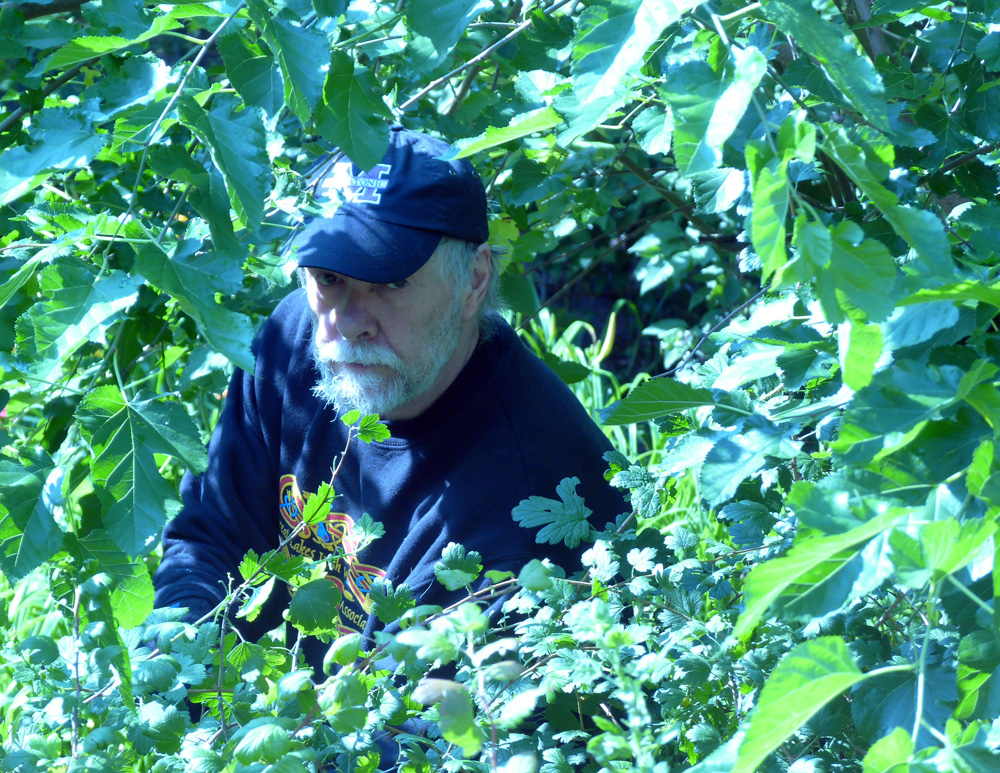
1000P1030763Gooseberries favor the small animal, especially birds, who can either land on the stem among their thorns or reach up with small paws to retrieve the prize. The larger animal like the one seen here must carefully grasp the branches where the thorns are not, wear protective clothing for vulnerable skin and have on gloves to guard the even more sensitive fingers and palms, the hand as a whole. Having done that, though, the gooseberry rewards all of them with a tart sweet berry that might make the body of a clever purple or green goblin, especially if he were fitted with an acorn head carrying its jaunty cap.

Oh, and the smart gardener (not me) would plant them with sufficient room around each bush to easily access the branches. This cramped planting requires perilous maneuvers.

On the other hand this gardener (smarter in this instance) did move all these gooseberry bushes. They languished in the shade during the day and he dug them up and replanted them in this sunny spot where they thrive. This is about learning the language of plants. They speak with leaf color, insect infestations, poor fruit production, spindly branches. The gardener must listen intently as the plant communicates its needs, then do what is necessary to meet them. If a plant can be placed in a location right for its health and provided with adequate nutrition and water, then it will produce and produce and produce without much care.

Live the Questions

Lughnasa                                                                   Lughnasa Moon

I must have had this insight at another point, or been taught it or read it somewhere, but I don’t recall any inkling of it from any source. That is, the study of religion is important not for the answers religions give, but for the questions they ask.

Buddhism, in its emphasis on enlightenment and liberation from the ensarement of the senses is asking questions I’m not asking. It sees, in other words, human dilemmas, yes, but not the ones that are important for me. This is not surprising since Buddhism arose as a response to the harsh laws of karma that bound early followers of the various Hindu faiths-Shaivite, Visnhuite, followers of Kali and Ganesh-to the priesthood and temple. Karma, in spite of its cultural adoption into English, means little to me. I do not feel bound to the karmic wheel, so I have no need of release from it.

Judaism, Christianity and Islam, on the other hand, and the various pagan faiths of the Western tradition have shaped questions in response to the urgent questions felt by those of us influenced by Greek and Roman thought. What does it mean to be alone, as an individual entity? What does death mean, since it is not followed by reincarnation? What is justice in a culture ruled by tyrants or oligarchs? What is the nature of human community in light of all of these?

This is not to say, of course, that Eastern traditions don’t ask questions relevant to us. They do. Guilt can be understood as a form of karma. Why are we guilty and what can we do about it? Is forgiveness possible? Does it cleanse the soul or unburden our conscience? Are those the same things?

Taoism, for me, asks the profoundest questions of all the religious traditions with which I’m familiar. Is it better to take action against a sea of troubles and by opposing end them, or does it make more sense to learn how to live with the energy of tides, adjusting our actions to their ebbing and flowing? Is life better served by intention or attention? Do we need to know the nature of reality or just how to accommodate ourselves to it?

And underneath the questions of both Western and Eastern traditions are the fundamental questions: does life have meaning? are there actions that are required of us? who or what can we trust? with our lives?

All of these questions are important not because some guru, imam or monk said so, but because they are the questions that occur to the conscious animal, the reflective species. And they arise because we know certain things: we are alive. we will not be. we are bunkered within bodies, walled off by flesh and inner life from all others, yet desirous of living with them.

The answers to these questions are so various and so different that a thinking person cannot credit anyone as the truth. So, it is not the answers that are finally important, but the questions themselves. Are the answers important? Sure. They can point us toward a glimmer on the horizon. They can flash in our personal heavens as bright aurora, illuminating for a time our night sky. But in the end, unless capitulation is your thing (and it is for very, very many) you will be left wondering about the answers. But never the questions.

And it is the questions that bind us together. It is the questions that define the ancientrail of pilgrimage through this chance occurrence we share, life.

Again, I’ll quote Jim Morrison of the Doors. Into this world we’re thrown…riders on the storm.


Nocturne

Lughnasa                                                          Lughnasa Moon

from the Episcopal service for Compline:

Psalm 91

3    He shall deliver you from the snare of the hunter *
and from the deadly pestilence.

4    He shall cover you with his pinions,
and you shall find refuge under his wings; *
his faithfulness shall be a shield and buckler.

5    You shall not be afraid of any terror by night, *
nor of the arrow that flies by day;

6    Of the plague that stalks in the darkness, *
nor of the sickness that lays waste at mid-day.

There was a time, during the mid-1980’s, when I shared an office with an Episcopal priest. During those years, we often said the daily prayers out of the Book of Common Prayer. It was soothing. Its repetition brought a sort of order to the day, or, in the case of Compline, to the coming night.

(Hieronymus_Wierix_-_Acedia)

Religions take key moments of the past and preserve them, some might say in amber, others would say in a living tradition. The emphasis in the religious life, no matter how it might claim otherwise, is to repeat the message over and over again. Taoist and Buddhist, Jew and Muslim, Hindu and Parsi all return to certain truths learned by the great men or revealed by the great gods, all in times that have long ago faded out.

The Compline service for instance promises surcease from the sorrows of life: night terrors, the sickness that lays waste at mid-day (acedia*), the arrow that flies in the day, the snares of the hunter and the deadly pestilence, by quoting the 91st Psalm. And by using it night after night.

The surcease depends on faith, of course, faith in the God who covers you with pinions (the feathers on the outer edge of the wing) and the wings, whose faithfulness to you is a shield and buckler.

There is a comfort here for me as I read this Psalm. It is a message about the universe coded for me, that is, it is a religious message within the Western tradition and even more, in the Judaeo-Christian tradition, the tradition that shaped our civilization and much of our values.

This faith is no longer my faith. There is, however, in its quick outline of anxiety and its profoundest sources, a knowledge of the existential dilemma we all face. In this I see my daily struggle acknowledged by the Psalmist, a Jew of ancient times. His answers may not be my answers, but his sensitivity to the human condition, my condition, makes him my brother. His search for a solution to acedia, to the night terrors, to the snares of the hunter makes my quest for answers to these very questions one with his.

I’m glad he has an answer. It is not the answer that is the key to the comfort in these words, but in their recognition of the question, or rather, questions, that confront us all. That’s what I find so useful about religion, its willingness to define, to name the psychic and spiritual ills that plague us all. Even the answers, though I may not share them, can point to paths I might take. (more on this one later.)


*Acedia (also accidie or accedie, from Latin acedĭa, and this from Greek ἀκηδία, negligence) describes a state of listlessness or torpor, of not caring or not being concerned with one’s position or condition in the world. It can lead to a state of being unable to perform one’s duties in life. Its spiritual overtones make it related to but arguably distinct from depression.[1]