Step Outside

Spring                                                    Bee Hiving Moon

Boy, have you caught the sliver moon with Venus above it and Jupiter below?  Soon there will be tulips and crocus and snow drops.  The magnolia already lights up our patio.  A soft torch of white burning quietly.  Round Lake just a quarter mile from our house looks great right at sunset and in the dark with stars and the moon reflecting in it.

The climate may be playing havoc with the seasons but the inescapable beauty of the natural world remains.

Keats may have stretched it a bit, but not too far.  Truth is beauty.

The good news here is that no .5%’er will ever corner the market on sliver moons or magnolia blossoms or reflections in that pond near your house.  These, the original art works, the masterpieces of our everyday world, belong to the commons.  All we have to do is step outside.

Late Breaking news:  as of 9 pm tonight

At noon, local time (10 p.m. ET),James Cameron ‘s “vertical torpedo” sub broke the surface of the western Pacific, carrying the National Geographic explorer and filmmaker back from theMariana Trench ‘s Challenger Deep—Earth’s deepest, and perhaps most alien, realm.

The first human to reach the 6.8-mile-deep (11-kilometer-deep) undersea valley solo, Cameron arrived at the bottom with the tech to collect scientific data, specimens, and visions unthinkable in 1960, when the only other manned Challenger Deep dive  took place, according to members of the National Geographic expedition.

The Garden in Early June. No, Wait…

Spring                                                          Bee Hiving Moon

Seasonal craziness note:  both of the photographs here were taken in our garden on the same day, April 20th, 2011.
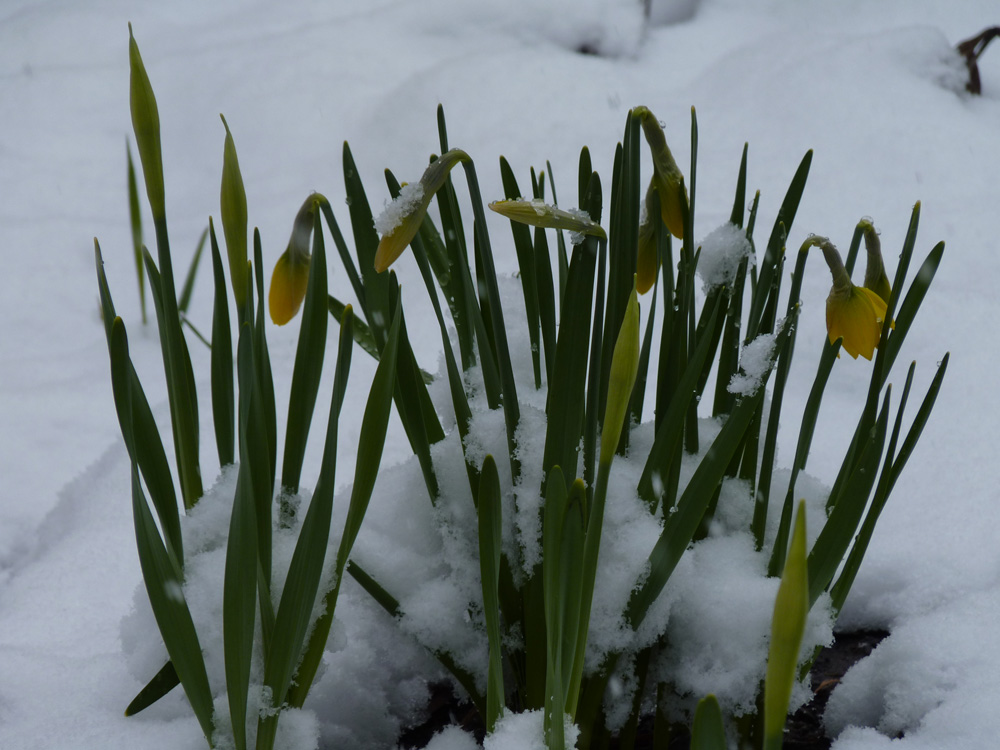
Chainsawing today.  Cutting back aged amur maple branches, considering eliminating all of these fragile little trees and starting over with something new.  Kate raked out fallen leaves and I moved them to a place where they can rest.  Both Kate and I cut down perennial stalks and grasses left in place over the winter.

Tulips and iris and crocus have all begun to push out of the ground.  None of these will be injured if a frost comes; they’re spring ephemerals or early risers.  Their strategy is to get up, bloom, go to seed and store food for next spring’s big push before the leaves come out and other plants get in their way.  It’s a smart plan and one that gives us beautiful blooms often as winter seems to have barely left the building.

We’ll work away at it, an hour or two at a time and by the end of the week we’ll have those we can reach without compacting soil spruced up and ready for the growing season.
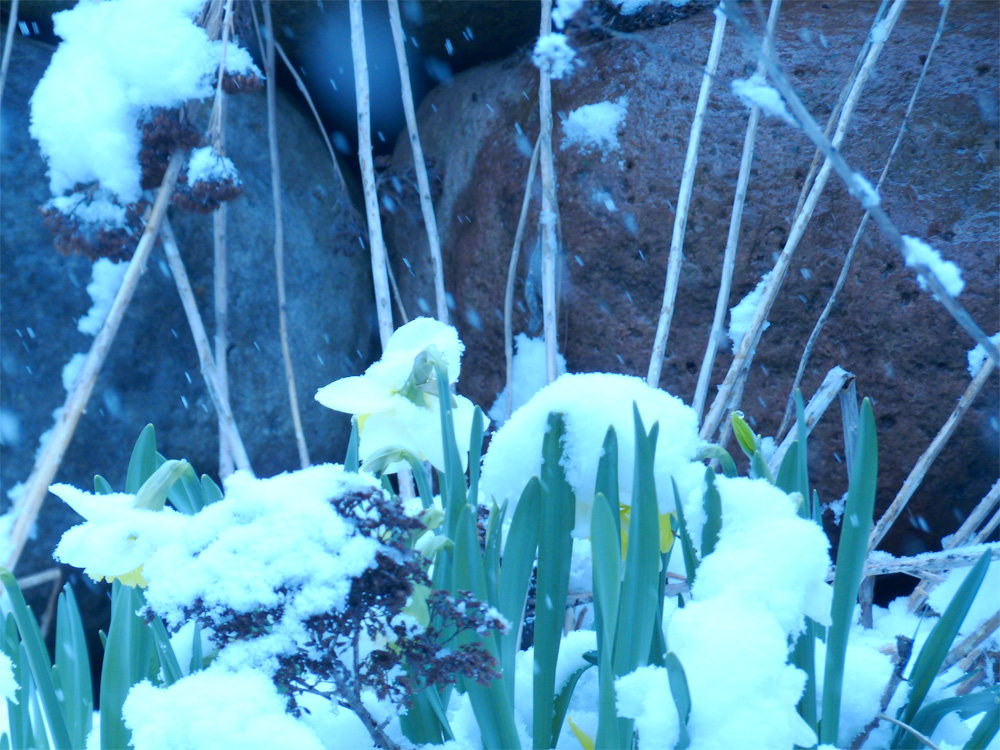
Our magnolia is in full bloom right now, a white torch in an otherwise brown world.  Kate wanted a magnolia and she got one.  If we don’t get the severe cold, say -30, it gives us an early spring pick me up.

It always feels to good to get outside, shake off the gardening rust and slowly get up to speed with the yard again.  When we bought this house 18 years, we spent a fair amount of cash upfront on landscaping, figuring that we wanted to enjoy while we lived here and that’s its maturation would swing into place just when we needed it.  We were right.

This year and the next couple we’ll focus on preparing our flower beds, vegetable beds and orchard for minimal maintenance, keeping active as far as planting and intensive tending only those areas we can manage.
Reimagining Faith: Tree of Peace

Spring                                                              Bee Hiving Moon

The essence of the Peacemaker legend follows as told by Mohawk chief Jake Swamp at the planting of a Tree of Peace in Philadelphia in 1986. “In the beginning, when our Creator made humans, everything needed to survive was provided. Our Creator asked only one thing: Never forget to appreciate the gifts of Mother Earth. Our people were instructed how to be grateful and how to survive. But during a dark age in our history 1000 years ago, humans no longer listened to the original instructions. Our Creator became sad, because there was so much crime, dishonesty, injustice and war. So Creator sent a Peacemaker with a message to be righteous and just, and make a good future for our children seven generations to come. He called all warring people together and told them as long as there was killing there would be no peace of mind. There must be a concerted effort by humans for peace to prevail. Through logic, reasoning and spiritual means, he inspired the warriors to bury their weapons and planted atop a sacred Tree of Peace”

It is said that the Tree of Peace given by the Peacemaker symbolizes the Great Law of Peace. The symbol is a great white pine, and it is said to shelter all nations who commit themselves to Peace. Beneath the tree are buried the weapons of war of the original five nations. Above the tree is an eagle that sees far. Also, four long roots stretch out in the four sacred directions, and they are called the white roots of peace. The Peacemaker invited any man or nation desiring to commit to the Great Law of Peace to trace the roots to their source, and take refuge beneath the Tree of Peace. The Peacemaker’s teachings stressed the power of reason to assure righteousness, justice and health. Faithkeeper Oren Lyons, an Onondaga, states that the Great Law of Peace includes freedom of speech, freedom of religion, and the right of women to participate in government.

The seed-idea underlying all Iroquois philosophy is that peace is the will of the Creator, and it is the ultimate spiritual goal and natural order of things. The prayer below comes from the people of the Iroquois Confederacy. The prayer is based on the tradition of interconnectedness that the Iroquois or Haudenosaunee possess. This prayer is said to be the backbone of the Iroquois culture. The prayer expresses the belief that rather than take the world for granted, it must be respected, and that we must thank all living things in order to align our minds with creation and the Creator. Usually, a faithkeeper is selected to share the prayer of thanksgiving at the opening and closing of social, government, and ceremonial events. The prayer is comprised of three levels:


Spiritual Forces on the Earth, Spiritual Forces in the Sky, Spiritual Forces beyond the Sky

The Spiritual Forces on the Earth are:
the People, our Mother Earth, the Waters, the Fish, the Grasses, the Plants,
our Sustenance, the Animals, the Trees, and the Birds.
Throughout the year we bring our minds together as one
We give thanks to one another
All year long she gives us all that we need

We give thanks to our Mother Earth
Everyday it quenches our thirst
We give thanks to the waters In winter it replenishes the lakes.
We give thanks to the waters

During the year they purify the lakes
We give thanks to the fish
When the wind turns warm a green blanket appears
We give thanks to the grasses
In early summer the flowers turn sweet
We give thanks to the medicinal plants
In early summer they help us survive
We give thanks to the food plants
In midsummer we dance for the green corn
We give thanks to our sustenance
In midsummer we dance for the red beans
We give thanks to our sustenance
During the winter their pelts warm the soul
We give thanks to the animal creatures
Since early times they have been our companions
We give thanks to the animal creatures
In early spring we are glad they reappear
We give thanks to the animal creatures
At one point in time it became a symbol of peace
We give thanks to the trees
At the end of spring the sap will flow
We give thanks to the trees
In early morning they carry messages
We give thanks to the birds
In times of danger he warns the people
We give thanks to the birds
In the summer they sing sweet songs

We give thanks to the birds Spiritual Forces in the Sky are:
the Four Winds, our Grandfather Thunder, our Elder Brother Sun, our Grandmother Moon, and the Stars
Throughout the seasons they refresh the air
We give thanks to the Four Winds
In early summer they bring the falling drops
We give thanks to our Grandfather Thunder
Every morning he brings light and warmth
We give thanks to our Elder Brother Sun
Every night she watches over the arrival of children
We give thanks to our Grandmother Moon
In the night their sparkle guides us home
We give thanks to the stars
The Highest Spiritual Forces beyond the Sky are: our Protectors, Handsome Lake, and the Creator
All the time they remind us how to live
We give thanks to our protectors
At one point in time he brought back the words of the Creator
We give thanks to Handsome Lake
Everyday we will share with one another all of these good things
We give thanks to the Creator.
– Prayer of Thanksgiving, Iroquois Confederacy

Why I Read Less Non-Fiction

Spring                                           New Bee Hiving Moon

Not much up.  Finished the Latin, worked out, worked on my presentation:  Reimagining Faith, watched one TV program and read some.  Vince Flynn, local author of the Mitch Rapp counter-terrorism novels, writes in the foreward to his book, Kill Shot, that he has prostate cancer.  This is the book I began last night.

I’m still poking around in Autumn in the Heavenly City (Taiping Rebellion) and Quest (a massive on energy and security by a guy who’s supposed to be the best in the field).  I read them more slowly.

Why I read non-fiction more slowly than fiction (usually).  During the bulk of my day I work with my brain, writing my own fiction, writing these blogs, studying for MIA tours, doing Latin translations, reading material from magazines and websites and books.

In the evening, when I turn to recreational reading, I find non-fiction often seems like an extension of my day; that is, it requires thought and careful attention, plus I’m learning something.  Most often, in the evenings, I’m ready for something mindless.  Fiction usually (not always) qualifies.  Some TV, occasionally, too.

Latin

Spring                                                New Bee Hiving Moon

Worked on Latin this morning.  Greg (tutor) wants me to prepare for sight reading.  That is, I read the Latin out loud, then translate it, using my memory of the work I’ve done in preparation.  This is very demanding and requires, for me at least, going through the same material at least twice, once checking out definitions and grammar, putting together a more or less good literal translation, then going back over the same material a second time–which is what I did this morning.

(Pentheus has real mommy issues.  That’s mommy to his right.)

The second time I check my first translation with my notes and sight reading, correct for errors, display considerable frustration where I miss obvious things or, more fruitfully, where I identify things I just don’t get and then try for an idiomatic translation.

I’m still not what I’d call fast or reliable, but I’ve improved a good deal over the place I started two years ago.

At my age I have to block out the mornings completely so I can get into flow with these projects.  I’m no good with shifting out of them into something else.  Maybe I never was, now I’m sure I’m not.

An American Tour

Spring                                             New Bee Hiving Moon

Preparing an American History tour, from the earliest inhabitants through the Civil War.  A more interesting assignment that I had imagined.  My oldest object will be the birdstone, an atlatl weight made during the Archaic period of the Woodlands culture in what is now Ohio.  That puts it well back in the 4,000 year old category.  Beautiful, simple, abstract and made with a real feel for the stone, it is an object that could have been made yesterday by a skilled contemporary artist.

I’m also including a memorial screen from the Ijaw people who lived in and on the Niger River Delta on the west coast of Africa.  These screens, of which this is the only example in the US, commemorate the head of Ijaw trading houses.  These trading houses began exchanges with Portuguese and Dutch merchants in the late 15th century. They rivaled in wealth the European merchant princes of the time.

Why are they on an American history tour?  They offered gold, ivory and slaves for European goods.  The slave trade began long before the Europeans arrived.

A Dakota honor shirt, a Haida pipe (non-functional) carved of argillite for sale to whalers, the Gilbert Stuart George Washington, the Charleston room (based on wealth created by slave managers and slave labor in the Lowlands), the trompe l’oeil piece, Reminiscences, a wonderful crazy pot made by the Anna Pottery that features Jefferson Davis trying to escape northern troops while dressed as a woman, the view of Ft. Snelling with the Dakota encampment and Fournier’s soulful depiction of a trading ship on Lake Superior in the late 19th century complete the tour.

And that’s what I did with my Wednesday morning.

Feeling better today and I have no idea why.  Weird.


Leave Taking

Spring                                                           Woodpecker Moon

At the dentist this morning I told them Kate and I planned to use a dentist closer to our home here in Andover.  This was what got me thinking about leave taking.  We’ve been with Centennial Dental for over 22 years and making the change was not a trivial decision.

In part we switched because our new dental insurance doesn’t include them, reason enough for sure; but, this was more a decision about not wanting a trip to the dentist to take three hours or so.  Centennial Dental is in Edina near the Macy’s Homestore.  They are great dentists.  That’s why we stayed so long.

After that, a nap, and then off to Champlain High School and my third and last, for now, class on the Adobe Creative Suite.  This class is on Adobe InDesign. I’m cranking up to sell my books on Amazon, through the Kindle store.  InDesign will let me format my books myself and save them in a file congenial with the Kindle operating system, perhaps others, too.

Then there’s the verdammt melancholy.  After the dentist I drove right at a car coming from my left.  I missed her, but my attention was not there.  Vacillating now between acting as if I’m fine and seeing if that will lift my spirits or biting the bullet, calling my old analyst John Desteian and my gp Tom Davis, take arms against this sky of clouds and by opposing them grow more cheerful.


Spring 2012: Were You Around for It?

Imbolc                                                      Woodpecker Moon

Spring.  Whoa!  A season that came and went on the day of its inauguration.  A high of 79 here yesterday.  79!

Yes, that’s right, it’s the Spring Equinox again, we’ve reached that point halfway between the Winter Solstice and the Summer Solstice, the time when light begins to dominate in the division between night and day.

Bruce Watson and his son, local weather geeks, publish an annual meteorological calender with lots of nifty data.  Just pulled it out for grins and looked up the Summer Solstice, that’s right, exactly three months from now–IN JUNE–and checked out the average 30 year high for June 20th.  Yep.  79.5.  Now wow.

However the season came and went this year, I’ll always remember spring as a spunky little season that used to hang around and tease with gentle breezes one minute and foot-high drifts the next.  We don’t need to get all weepy, but those were good springs weren’t they?  Hockey and blizzards, they just sort of go together.

Not this year.  Nope, it’s a couple a rounds and a Bud at the 19th Hole.  Outside.

Ostara in the pagan calendar, this holiday nods toward the fertility spring carries in its changeable weather. Continue reading Spring 2012: Were You Around for It? →