Winter Waxing Moon
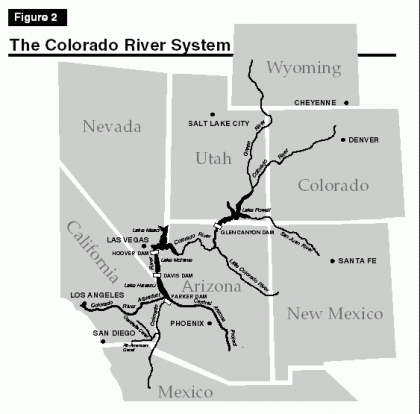 Our first major snowstorm of the season is upon us. We’ve gotten 4 or 5 inches already and it’s only been snowing since midnight. May get 8-10 inches. Black Mountain has disappeared behind a gray-blue curtain, the lodgepoles look like flocked Christmas trees, and our solar panels have a 4 inch white blanket between themselves and the sun. No appointments today, no meetings. We can take this storm in as it comes, not see it as a barrier. We’ll get plowed today, I’m sure, so no worries there either. Let it snow.
Snow is so important here. Obviously it fuels the winter tourism economy, giving skiers destinations like Breckenridge, Aspen, Copper Mountain, Vail, Crested Butte. It transforms the mountains from gray eminences to white peaks that sometimes look like whipped cream on the horizon. But these are ancillary benefits.
 There are two other effects that are critical to life both here in the Colorado Rockies and in the southwestern U.S. A good snow season reduces the threat of wildfire in the spring and summer until the monsoons come. That effects Kate and me and our neighbors directly. It feels much better going into summer having had plenty of moisture for the trees and the soil. A good snow season also recharges our aquifers, makes sure we’ll have water throughout the next year. This is an immediate, right here result of good snow.
But effecting even more people is the snow melt* carried by the Colorado River downstream. Arizona, California, Colorado, Nevada, New Mexico, Utah, and Wyoming take an allocated and collective 16,400,000 acre feet per year. Problem is this amount, agreed to in a 1928 compact, is an inaccurate estimate of the actual annual flow of the Colorado. Based on tree ring data it’s somewhere between 13,200,000 acre feet and 14,300,000 acre feet a year. This is known by folks who deal with this complicated issue as “the gap.”
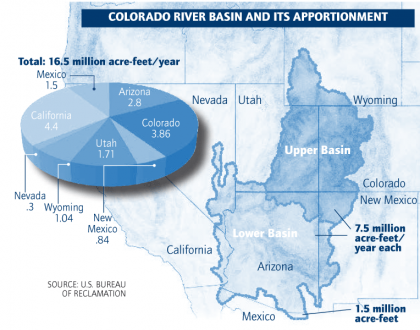 “Total population in the Colorado River Basin (CRB) increased from 4.56 to 9.44 million people from 1985 to 2010. Most of those people were in the lower CRB, with 86 percent of the total in 1985, and 90 percent of the total in 2010.”** The snowpack numbers, created by our annual snowfall, are critical not only here, because the Front Range and the Denver Metro rely on the Colorado River, but throughout the seven state CRB. These figures, almost invisible to the population of the humid east, are never far from the minds of government officials at the state, county, and municipal level here in the arid west, or the population as a whole.
The gap is a problem for obvious reasons. Drought years, like last year when the snowpack was well below normal, and the increasing population in the CRB both reinforce and multiply the effects of the gap. As the Water Defenders fighting the Dakota Access Pipeline repeatedly said, “Water is life.” These are not trivial matters, so seeing a healthy snowfall is a joy and a relief to all of us living out here.
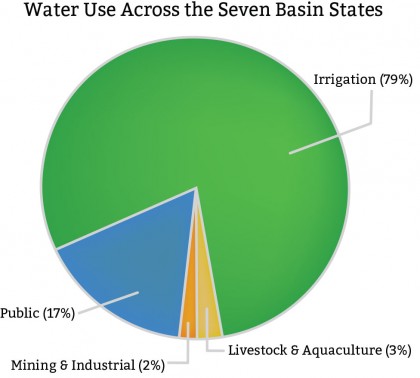 Finally, here is the problem that bedevils all those effected by The Law of the River, a web of compacts, federal laws, court decisions and decrees, contracts, and regulatory guidelines.* As this graph clearly shows irrigation is the largest claim on the CRB’s water by an order of magnitude. Add to that the allocation for livestock and aquaculture and 82% of the allocation goes to agriculture of one kind or another. We need food, those who grow our food need water. With public uses only 17% of the pie even the most draconian water policies in cities and areas like the Front Range will not move the needle much in total water use. Add to this the problem of the gap, droughts, and rapidly increasing populations, five of the fastest growing states in the nation are part of the CRB, then you can begin to imagine the tense negotiations required to maintain the status quo, let alone plan sensibly for the future.
So, as I said at the end of the first paragraph, let it snow. Please.
*data here from this wikipedia site.
 Made a big circle yesterday. Drove into Denver on 6, a six lane version of 6th Street between hwy 470 and Santa Fe. Wanted to try LeMar’s Donuts since Kate needs weight and likes donuts. It’s right at the intersection 6th and Santa Fe. I like Bismarck’s and crullers, Kate prefers original glazed. The Bismarck at LaMars was about twice the size of the usual. It was quiet there, mid-morning, after the before work rush. This picture is the counter.
 Kate wanted more mushroom empanadas, corn, and spinach. Lisa Gidday, our internist, had recommended the spinach. “Your new favorite food.” I got an Argentina which has steak, onions, and red peppers.
 As I drove further on the Green Mile, I came across Goddess Isis books. I thought it was on Colorado. I’d always wanted to stop and this was my chance. I’d accomplished my errands and had some free time.


 Next stop Stanley Marketplace. It’s one of many repurposed aviation buildings in Stapleton, a new urban development project on the site of the old Denver Stapleton Airport. SeoAh, Ruth, and I all love sushi and the Stanley has Misaki. We got ourselves a table and ordered. Two wooden serving platters later we were all full. I went next door to Maria’s Empanada’s and bought Kate, as requested, two mushroom empanadas. I also picked up a couple of italian sausage and beef empanadas, too. Dinner.
 Went to
  “Back there, where the Help Desk sign is, we have our inventory. Customers can’t go back there, but it’s all searchable and staff will bring you anything you want to see. 8 million comics in inventory. 2 million on display. 10 million all together.” He seemed sincere, but the numbers seem pretty damned high to me. Even so, there’s no doubt there were a vast amount of comic books.
 In addition to the 10 million comics several different displays featured toys related to the various universes represented in the comic book world. A true multiverse of the mind. There were Star Wars toys with death stars and yodas, Empire fighters and Millennium Falcons. Star Trek toys with Data, Captain Picard, models of the Enterprise. A large Ironman statue. Intricate modeled scenes from Batman, Superman, the Marvel comics sat alongside small action figures. There were chess pieces made of comic book figurines, including one full chess set with pieces modeled from Batman characters.
 The
The  Emily’s father got to the high school using an old mountain goat trail. 285 had both police barriers and a huge traffic jam. When he arrived, he asked if any person could text Emily. Someone did. She texted back, “I love you guys.” A second text went unanswered. She was dead with a bullet wound to the head.
 He started with a tagline: The world we live in isn’t scary, but it is full of uncertainty. He had a reassuring manner, years of experience in protection, and a common sense approach to security. He recommended CBE put a 3M product on the windows, Safety and Security film. “You have a lot of glass.” This film ensures that bullets fired through the glass will not shatter it. The bullets pass through but the glass itself remains intact overall. He also recommended blinds on the windows so a shooter couldn’t see inside and a really good locking system for the sanctuary doors. All of these things made sense to me.
 That sadness has a special resonance here since Columbine was the ur-school shooting. John, the speaker, said he’d been at a conference in D.C. in the last month where a full day and a half was devoted to Columbine. Why? So many of the school shooters still refer back to Columbine for inspiration, for tips. It’s still relevant. Not only has Colorado had Columbine and the Platte Canyon hostage situation, but we’ve also had the Aurora Theater shooting.
 Kate and I got coffee, sat down at our beetle-kill pine dining table, cracked open the mailers from the state of Colorado, and voted. Not a complicated ballot in terms of candidates, though the retention questions for judges left us both scratching our heads. Guess which way we voted? Blue wave, blue wave, blue wave. At least two water particles added.
 Then there were two that make creating both federal and state legislative districts non-partisan. Like campaign funding gerrymandering is currently a cancer in our democracy, both in their own way as serious as the orange tumor in our body politic. Voting yes.
 Colorado continues to be a strange political environment to this native Midwesterner. The libertarian streak in all American politics colors issues with a let me alone and don’t make me pay swoosh, here it’s a swoosh often as big as the entire running shoe. That can drive electoral decisions. There’s also the even more dramatic than in most states divide between the liberal Front Range and the remainder of Colorado. Rural and mountain Coloradans often complain that their views are ignored. True, too, to some extent. The rural vote is often reflexively against candidates and ballot measures that seem to reflect Front Range values.
 Lughnasa and the Harvest Moon. We are in the season of reaping what has been sown. From the first of August or so until Samain on October 31st gathering in is the main theme on the Great Wheel. The fall equinox, Mabon, is near. September 22nd. It comes with the Harvest Moon, that fluke of planetary dynamics that has lit up farm fields at just the right moment for as long humans have been farming.
 The Great Wheel turns, but its turning is the original local expressing a universal. Here the golden aspen in the Midwest the great harvest machines lumbering through fields. In the Midwest stunning colors here a dichromatic palette. How the harvest season manifests depends on weather and here in the Rockies altitude. Pikes Peak and Mt. Rosalie near Bailey, for instance, have already had their first snow, passing out of the harvest season.

 It was the kickoff event last night for the religious school and it was well attended. Each kid came with one or both parents. Usual glitches. Somebody forgot to order food. Solution: Dominoes. I forgot the beachballs. Solution: listen. Facilitation was by committee. Alan did the introduction. Jen Kraft, the regional person from Moving Traditions, spoke about the development of the curriculum. Jamie facilitated a piece about what the sages thought was appropriate for ages from 5 to 100. Tara facilitated a group exercise in which adults and kids called out descriptors for child, teen, adult.
