Category Archives: Bees

Hooray for the Red, White and Blue

Summer                                            Waning Strawberry Moon

Hooray for the red, white and blue.  That is, the blueberries, the raspberries and the white clover among which I picked them this morning.  Worked outside for an hour and a half, moving an outdoor table back to its original place on the brick patio outside our garden doors, a plastic table into the honey house for some  more space.  Can’t set the smoker on it though.

(Georgia O’Keefe, 1931)

This all has two purposes, getting the house nicer and in better shape for our own use as the summer begins to take up residence and for our guests in July:  Jon, Jen, Gabe and Ruth and the Woolly Mammoths.  I also moved some potted plants around and am mulling painting a post I stuck in concrete a few years ago.  Painting it some bright, contrasty color that will make the green pop.

Only 83 this morning but the dew point’s already at 67.  Glad the bee work got done yesterday.  On the bees.  The president of the Beekeeper’s Association lives in Champlin (near us, sort of ) and has offered to come over himself after the fourth.  I’ll be glad to have his experience looking in on my colonies.

While I picked mustard greens this morning, I noticed a bee making a nectar run on a clover blossom near my hand. “Keep up the good work.  Glad to see you out here and hard at work,” I told him, rather her.  She jumped at the sound of my voice.  One of those workers best left to her own initiative.

Haven’t heard yet from Kate but the plan is for her to come home today at some point.

Bee Diary: Supplemental

Summer                                Waning Strawberry Moon

Got this note back from the Beekeeper’s president:

“Also, add supers ASAP. Many hives are plugged with honey in the top box and have swarmed or starting to swarm (They think they have run out of run and most have.) There is a major nectar flow going on right now so the more supers right now the better.”

I just came inside from a quick move on the divide.  After his advice, I reversed the bottom two boxes, left the honey filled hive box on top, added a queen excluder and tossed two honey supers on top.  Good to have folks willing to help and with knowledge based on experience.

Kate’s beginning to get curious about inside of the hives.  She wants to see.  I can show her the package colony because they’re not so defensive.  She has a veil and upper cover for insects that should be ok as long as she’s not in the hive itself.

Science Is A Poisonous Net

Summer                                            Waning Strawberry Moon

The bee goddess piece in this video comes over half-way through, but the rest got my attention as well.  The quote in the title comes from the bee goddess shaman.

In addition, I saw an animated movie last night called The Man Who Planted Trees.  It is a fictional account of a shepherd who begins to plant oak trees.  He goes on to plant beech and birch as well.  He plants 100 trees a day and the story follows the eventual growth of the forest and how it transforms a barren and desolate mountain into a watery, fertile realm.  It’s a beautiful fable, well worth seeing.

In this video the old woman planting rice reminded me of the Man Who Planted Trees.  I think these folks are Hmong or close relations thereto.

Bee Diary: July 2, 2010

Summer                                   Waning Strawberry Moon

Just sent an e-mail to the Minnesota Hobby Beekeeper’s Association.  I need help.  We’re in mid-season now and I don’t understand what I’m seeing in the hives, nor do I understand enough about where things should be right now.  The two  make a whole.  That is, I don’t understand what I’m seeing because I don’t know where things should be right now.

I did a reverse on the parent colony, the last one, according to the book.  I do have more weight in the second honey super, but little action in three and four. This colony continues to be defensive, much more so than the package and about on par with the divide.

The divide has filled the third hive box with honey, no brood at all.  I don’t know what that means, though I suspect it might mean I’ve had a swarm and am now queenless.  I did see brood, but workers will lay if a queen is gone.  Trouble is, since they’re not fertile, the only thing they can produce are drones.  There did seem to be a number of drone cells–they have a higher cap to accommodate the drone’s larger body.

The package colony looks pristine, the larvae laying pattern seems ok and there is a general air of healthiness.  Not that there isn’t in the other two, but this one is like a puppy, all fresh and perky.  It has not, however, done much work at all on the third hive box, a bit of drawing out comb, but that’s about it.  Again, I don’t know what that means.

I did get stung a couple of times, but I smoked the stings, scraped them off–rather than pull them out which injects more venom–and applied sting-ease.  The parent and the colony both have a more defensive posture than the package.  It could be, too, that I’m still somewhat clumsy with my frame inspections and crush the occasional bee.  There are many more bees in both of these colonies, so more chance for accidents.

So much to learn.

Pictures

Summer                                                 Waning Strawberry Moon

The scientific theory I like best is that the rings of Saturn are composed entirely of lost airline luggage.
Mark Russell

You can go a long way with a smile. You can go a lot farther with a smile and a gun.
Al Capone

I didn’t know there was another theory about Saturn’s rings.

That Al, what a kidder.

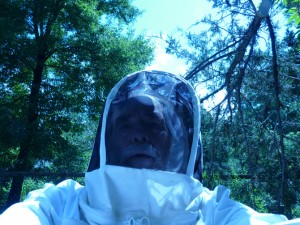
06-27-10_beekeeperastronautBeekeeper as Backyard Astronaut

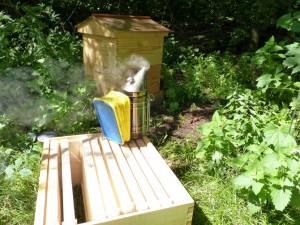
06-27-10_smokerReady to add the third hive box to the package colony

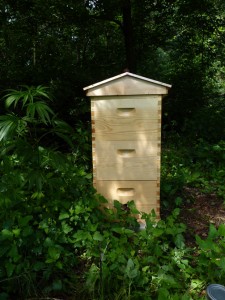
06-27-10_package-colonyAfter the addition

06-27-10_inthehoneyhouseSupplies

06-27-10_hiloHilo

Kidneys and Bee Stings

Summer                                Full Strawberry Moon

The dew-point and the temperature are one, 67.  That means a cloud hangs not above us but around us.  It’s a drippy, soggy Saturday fit for neither garden work nor bees.  And I have work to do in both places.  There’s always Latin.

Hilo now takes naps with me every day and sits upstairs with me longer at night.  I want to have as much time with her as possible before her kidney disease takes over.  Kidney disease is strange.  As long as there is at least some kidney function, the disease doesn’t manifest itself much except in heavy drinking of water.  The creatinine level and other measures of kidney function reveal a different, starker picture.  They show the gradual, then exponential depletion of effective kidney reserves.  Once the body tips over into renal insufficiency, things can get bad quick.

As the universe would have it, at the same time Hilo had her labs confirming her problem, I had to go to the lab at Allina Coon Rapids to get my creatinine levels.  Witnessing the steady and relatively rapid deterioration in Hilo’s situation, I awaited my lab results with somewhat more intensity than I might have.

Mine remain unchanged from December and not appreciably different for several times in the past.  Looks ok for now.

After my thumb got all black and blue following my last sting, I began to investigate bee defensive behavior.  I learned a lot of interesting things, a few very practical that I hope I remember the next time.  It seems that when a bee stings it releases an alarm pheromone that attracts others to the location of the sting.  So.  I should scrape off the stinger (not pull it out because that causes the stinger to pump more venom into the wound), then smoke the area stung to mask the pheromone.  I also learned that the same alarm pheromone expresses when a bee gets crushed during hive inspections.  Of course I try to avoid this but it happens.  That situation, too, calls for smoke.  Last, and most obviously, if the bees are ornery on a particular day, put on gloves.  Oh, yeah.

Bee Diary: June 24, 2010

Summer                              Waxing Strawberry Moon

I got through 2.5 hive inspections.  The package colony has beautiful comb, an excellent egg-laying pattern and is now ready for the third hive box.  That’s as far as it needs to go as soon as it fills out at least 8 frames in the new hive box.  That should happen over the month of July.

The divide has had three hive boxes for a week now and has begun to fill up frames in the third hive box though they are far from full.  I see no evidence that either of these two have swarmed and I saw few swarm cells.  Still a bit difficult for me to recognize for sure.

All of the colonies were a bit more aggressive than usual this morning, a surprise to me since it’s sunny and warm, a good day to go gather nectar and pollen.  In my opinion there was no need to harass the bee-keeper, but the divide began whacking at me and got me in a tender space right on top of my thumb’s joint.  That hurt!  I completed that inspection, too, trying to follow the check every frame idea.

When I got to the parent colony, I removed the two empty honey supers I put on last week.  Nothing.  Nature’s Nectar, a blog about bee-keeping kept up by the guy who sold me my queen and my package, however, said he had little new honey, too.  He’s thinking it will pick up this week.  It’s nice to have that kind of confirmatory message since it makes me think things are ok here at Artemis Hives.

When I got the honey supers removed, I began my inspection of the top hive box.  It is full of bees.  Mad bees.  I to about half way through the inspection of the top box and the bees had begun to dive bomb my hands as I reached for a frame.  Game over.  I’m not willing to spend a week with swollen hands.

I’ll go out tomorrow or Saturday to finish the inspection.  I don’t know for sure whether the irritation of hive inspections transmits from colony, but if it does, then the parent colony was ready for me.  I may try starting with it next time.

Other than that my fears of a foul-brood infection seemed to be misplaced.  I saw none of the signs.  The egg laying pattern in the parent colony seems uneven to me, where the other two looked more compact. (better)  I’m still a long way from feeling sure about what I see and what to do with the information.  But, I’m much further along than I was in April.

Bee Diary: Supplemental

Summer                            Waxing Strawberry Moon

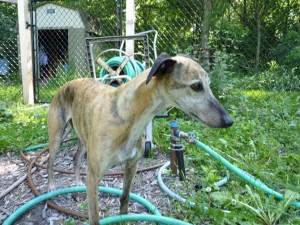
Vega took a nap on the couch this afternoon.  Not unusual.  She likes that spot. When I came upstairs after my workout, she was still on the couch and I went over to pet her, as I sometimes do.  In looking at her I noticed that her eye looked strange, swollen.  Oh, boy, was it swollen.  Her muzzle, too.  Vega had become curious about the bee colonies.

Bees know how to deal with curiosity, nip it in the muzzle and the eyes and the mouth.

When I took the bee course, more than one person asked about dogs, concerned that the dogs would attack or knock over the hives.  Each time the question was raised, I could see a slight sense of amusement on the bee folks.

“You don’t have to worry about the bees,” they said.  But, they might have usefully added, you might need to worry about the dog.

In other bee news I forgot to mention that during hive inspections last week, I saw a new bee work its way out of the hexagonal cell in which it had grown from egg to larvae to pupae to adult bee.  She gnawed away the cap, wriggling to get out, but needing to remove almost all of the cell’s beeswax cap before she could get free.

When she emerged, she looked like a puppy, all shiny and eager, untrammeled by the world.  Then, she flew off and got to work.  That’s the way bees are.

Summer. It’s About Time.

Summer Solstice                                      Waxing Strawberry Moon


The longest day of the year.  Light triumphant, streaming, steaming.  The darkness held at bay.

Summer Solstice

This is an astronomical phenomenon transformed and translated into a spiritual one.  We humans have over millennia taken solstice and equinox alike as moments out of time, a sacred caesura when we could review our life, our path as the Great Wheel turns and turns and turns once again.

The Celts first divided their year into two:  Beltane, the beginning of summer, and Samhain, literally summer’s end.  As their faith tradition developed, they added in both solstices and equinoxes.  Since Beltane and Samhain occurred between the spring equinox and the summer solstice and the autumnal equinox and the winter solstice respectively, they became known as cross-quarter holidays.  Imbolc and Lughnasa filled in the other two cross-quarter spots.

It is the eight holidays, the four astronomical ones and the four cross-quarter, that make up the Great Wheel.  In the most straight forward sense the Great Wheel emphasizes cyclical time as opposed to linear or chronological time.  This seems odd to those of us raised in the chronological tradition influenced by Jewish and Christian thought in which there is an end time.  With an end to time the obvious influence on our perception of time is that we progress through the days until they become years, which become millennia until the Day of the Lord or that great risin’ up mornin’ when the dead live and time comes to a stop.

That this is an interpretation rather than a fact rarely crosses the mind of people raised on birthdays, anniversaries, celebrations of one year as it comes followed by the next.  Our historical disciplines from history itself to the history of ideas, art history, even geology and the theory of evolution all reinforce the essentially religious notion of time as a river flowing in one direction, emptying eventually into an unknown sea which will contain and end the river.

Immanuel Kant, in attempting to reconcile the dueling metaphysics of two apparently contradictory philosophical schools (rationalists and empiricists), hit on the notion of time and space as a priori’s, in a sense mental hardwiring that allows us to perceive, but is not inherent in the nature of reality.  That is, we bring space and time to the table when we begin ordering our chaotic sense impressions.  My interest in the Great Wheel and in the traditional faith of my genetic ancestors came in part from a long standing fascination with the question of time.  We are never in yesterday or tomorrow, we are always in now.  What is time?  What is its nature and its correct interpretation relative to the question of chronological versus cyclical time?

I have not settled these questions, not even in my own mind, and they continue to be live topics in philosophy.  Learning to pay attention to the Great Wheel, to the now, and to the specific place where I live has pushed me toward the cyclical view, as has gardening and now the keeping of bees.  It is, today, the Summer Solstice.  Again.  As it was the last time the earth visited this location in space (ah, yes, space.  another conversation which we’ll bracket for now) and as it will be the next time.  This is a literally cyclical view of time based on the earth’s orbit around the sun, one which returns us, over and over to much the same spot.

Next summer when the solstice arrives the asiatic lilies will be ready to bloom, Americans will be getting ready to celebrate the fourth of July and kids will be out of school.  The mosquitoes will have hatched, the loons returned and basketball will finally be over.  These kind of phenological observations depend on the repetitive, cyclical character of natural events.  There is a real sense in which this time does not move forward at all, rather it exists in a state of eternal return, one solstice will find itself happening again a year later.  Is there any progress, from the perspective of the solstice, from one to the next?  Not in my opinion.

I don’t deny the intellectual value of arranging knowledge in what appears to be a rational sequence. It aids learning and explanation, but it may well be a mistake to think that sequence exists outside our mental need for it.  It may just be that time is, in some sense, an illusion, a useful one to be sure, but an illusion none the less.

Even if it is, we still will have the Summer Solstice and its celebration of light.  We will still have the Winter Solstice and its celebration of the dark.  We can see each year not as one damned thing after another, but as a movement from the light into the dark and back out again.  We can see the year as a period of fallowness and cold (here in the temperate latitudes) followed by a period of fertility and abundance.  This is the Great Wheel and it currently makes the most sense to me.  That’s the light I have today anyhow.  Let’s talk next year at this time.
Bee Diary: June 16, 2010

Beltane                           Waxing Strawberry Moon

My inexperience is showing. At the Hobby Beekeeper’s meeting they suggested we look at each frame.  I did that.  With three colonies that’s a lot of frames.  In the package colony it seemed to me that there were not as many bees as there should be right now, though I stopped here to read Nature’s Nectar and it sounds like other beekeeper’s with packages from his second load (mine) have about the same activity as I do. I put in another pollen patty and left the syrup the same since it was down only about half from the last week.  There were larvae so it’s still queen right.  It needs to get to three deeps by the fall.  I imagine it will make it.

I put a third hive body on the divide.  The bees had drawn out comb on the second hive body I put on last week and there were frames with brood.  The overall colony looked pretty good.  I guess.  It’s hard for me to judge since I don’t have an exemplar outside of my own colonies.  There were swarm cells and some of them looked chewed.  At the Beekeeper’s meeting last week they said that usually means the bees have swarmed.  I can’t tell.  When bees swarm, they leave a colony behind and a new colony takes off with a queen.

The parent colony has one honey super that is heavy.  Really heavy.  A second one has some honey and the bees have begun to draw comb on the other two, but not much.  Since the bees don’t go out on rainy, cloudy days, the production of honey has slowed down.  We need a run of sunny, warm days.

Since I’m studying bee diseases in an online course right now, I imagined I saw disease.  Don’t know if it was or not.  A learning curve.