Category Archives: Weather +Climate

So, Why Get Up At 4 AM?

Spring                                                 Waning Bee Hiving Moon

As the bee hiving moon fades to black, it makes way for the last frost moon.  Our last frost up in the northern exurbs of the Twin Cities comes somewhere between May 15 and May 20 on average.  May 15 is the date I use because I haven’t experienced a later frost, but it could happen.  That’s the date the tomato plants go out, the kale and chard I’ve started (though I’ve also sown them outside, too), the beans, cucumbers and various annual flowers.

Tomorrow the Celtic calendar, the one I follow in addition to Gregorius’s, turns over to the season of Beltane.  More on that Sunday.

Today is a rainy, cool day unfit for working with bees.  Good for transplanting though, but I don’t have any more to do right now.

There was a royal wedding, wasn’t there?  No, I did not get up at 4 am for a breakfast party to watch it, nor did I watch the 68 minute version Kate and Mark watched yesterday.  I did scroll through pictures on the LA Times website.  Got me wondering.  Why all the attention in this, the most plebeian of powerful nations?

I stipulate the romantic notion of princess and prince, especially the steroidal version that involves a commoner elevated by marriage to royalty.  We have a 5 year old grand-daughter who would have no trouble seeing herself in Kate Middleton’s role.  Middleton, eh.  Even the name reeks bourgeois. I stipulate further the fascination of any marriage as a symbol for that fragile, wonderful, ordinary miracle of love.  I know these two play a factor, a large factor.

But 4 am?  What’s up with that?   Rather, who’s up with that? Continue reading So, Why Get Up At 4 AM?

Getting Technical

Spring                                                         Full Bee Hiving Moon

Over to Hennepin Technical this morning for earth day.  I’m responsible for a Sierra Club table there during a three hour long green event.  Not sure what this will be like, but it sounds like an interesting day.  I’ve already worn myself out this week and I have two tours tomorrow, plus Latin on Friday.  Worked yesterday on my art student tour for portraiture, then went into St. Paul for a meeting with non-traditional allies for the Sierra Club.

Snow.  Snow.  Go Away.  Come back around All Saint’s Day.  I love winter, but I’m ready for spring.

Gotta go.  On the flipside.

I Roll Over On My Belly

Spring                                              Full Bee Hiving Moon

OK.  Enough.  Uncle.  I give.  I yield.  I roll over on my belly.  Please let us have spring.  Snow?  More snow?  Just when the Himalayan inspired mounds of soot black snow have begun their glacial retreat?  This is not insult to injury, but insult to insult.  Well, all right.  If it’s coming anyhow, but could this be the last one for this season?  Please.  I have plants that need to get back to growing.

T’ai C’hi.  Coming along.  I am within one move of learning how to grasp the sparrow’s tail, then one more, the long whip, of having the basic moves in some sort of order and execution.  My teacher says, insists, promises it will all get easier.  But, it took her, she also says, 30 years to get her form to its current level.  Wait.  I’m not sure I have 30 years of T’ai C’hi practice in me.  On the other hand, maybe with T’ai C’hi…

T’ai C’hi feels like Latin for the body.  It’s taking all of my concentration to stay with it when I practice and the learning is slow.

Then there’s that radiation problem in Japan.  Good news on it.  The power company says it can have things cleaned up in 6-9 months.  6-9 months?  We’ll see.

This is the time to move the bees.  Bee colonies do not like to have their homes moved once they’ve learned where they are.  Even a move of 2 feet can be too much for them.  If you want to move existing colonies, you have to do it in slow, incremental steps.  Right now, since I have no bees, I can put the hive boxes wherever I want.  Still mulling.  I want to put them in the orchard, but that will entail switching out the gear from the front garden shed to the back shed where I currently have all the bee equipment.

Week’s End

Spring                                                          Waxing Bee Hiving Moon

Kate and Annie (her sister) are off to Omaha, Kansas City and various quilt shops in between.  When asked what they do on the bus (she’s done this before), she said, “Talk.”  Me, “No quilt-road-tripsinging, no poker, no beer?”  Nope.

Brother Mark is here, decompressing from a tough six months, and inhaling American culture, “Something there, but being brought forward from far back in the mind.”  He’s not been back to the US in over 20 years.

Today is the first day I’ve had any lengthy time to myself this whole week.  Gonna spend it doing Latin.

The kale and chard starts have germinated; the tomatoes have yet to break the surface.  All this is under the lights.  I’ve not checked the beets, spinach and lettuce planted outside earlier in the week, but they should get started in the not too distant future.

Next weekend the bees should arrive, so there are bee related chores this week:  cleaning frames and hive boxes, moving everything to the orchard, checking the honey supers.  The smoker needs cleaning out, too, a lot of soot collects over the course of a season.  Tomorrow I have advanced bee keeping, open only to those who have kept bees at least a full season or two.

But, since this is Minnesota, first we may have to have some snow.

In Spring A Man’s Heart Turns to…Yard Work

Spring                                                             Waxing Bee Hive Moon

The weather has turned gray, inclement, wet.  The snow continues to melt, but not wholly disappear, as if it has gotten used to the yard and wants to stay as long as possible.  Where the snow has melted, there is mud.  Mud that tracks it on little dog’s feet.  And big one’s, too.  The spring cleaning season has begun.

This morning I look outside and see only work:  the trees to repair, various objects that need to get picked up and burned or trashed, the bee hives I need to move, old plastic that has to come so we can plant underneath it.  This last is a method for killing weeds without herbicides.  Leave the plastic in place for a couple of years and seeds germinate but die for lack of sun.  Works pretty well.

Of course, there’s the garden that will need planting, too.  Perennials left in for winter interest must come out now to make for their 2011 versions.

Tomorrow I plan to have a meal of greens from the hydroponics and next Monday I’ll use the basil grown there for a caprese salad for an afternoon meal with my docent friends.

Mark, my brother, e-mailed me and says his flight comes in on Saturday at 1 pm.  I’ll be there.

Have to practice my Tai Chi.

Changing Seasons

Spring                                               New (Bee Hiving) Moon

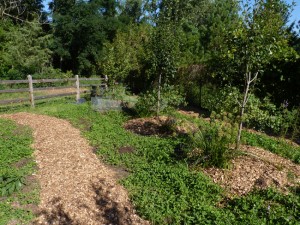
We are now over three months away from the Winter Solstice.  The spring equinox has come and gone, yet our yard still has snow, maybe 5 0r six inches, more in spots where the snow plow moved our many snow falls to the side of the driveway.  In the orchard the snow has begun to melt around the apple, pear, cherry and plum trees.  The currants have no snow around them at all and the huchera is free of snow, too.  Those gooseberry plants I didn’t move last fall are still in the orchard, but their destination is the sunny slope of our 650-orchard-late-summer-2010_0175third garden tier.

I have a sizable number of trees with broken branches, many large ones.  They will have to be cut down and moved.  The chain saw!

As soon as the soil becomes workable, I’ll get the cold weather crops in the ground, something I’ve not done so well in the last three years.  The bees will move into their new homes in the orchard where I hope the protection of the garage on their north/northwest side and the sunny aspect of the southern exposure will help them in the winter.  They will be closer to the house, which may prove to be a problem.  If so, they’ll have to go elsewhere next year.

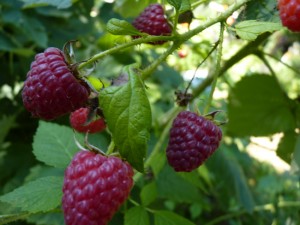
In the spring this man’s heart turns to the garden, the bees, the trees.  I’ve been preparing my body for spring, but I’m a bit 650-raspberries-late-summer-2010_0199further behind than I thought I’d be.  The resistance work has taken a while to work its way into my exercise cycle, but it’s there now.

Learning the language of plants, flowers and vegetables, is a life-long pursuit.  Another school year begins in just a few weeks.

A Jinn Out of the Bottle

Spring                                                                Waning Bloodroot Moon

Round Lake still has ice, April 1st.  Ice out is way late this year.

Put Kate on the Northstar this morning, headed for MSP, terminal 2, for her Southwest flight to Denver and granddaughter Ruth’s 5th birthday.  Kate gets a real kick out of visiting the grandkids, a sort of grandma thing.  It’s great to see.  Being retired makes all this much easier for her.

Fukushima nuclear disaster appears to grow worse though sorting out the news reports is difficult.  The utility company appears less than forthcoming with data and the Japanese government has been unusually slow, too.  As Bill Schmidt said at Sheepshead, the tsunami and the earthquake have created much greater human tragedy so far.  Over 10,000 dead found and probably and equal number sucked out to sea never to be found.

Those folks need our attention and our care, as do humans experiencing disasters natural or manmade anywhere.

And yet, the media focuses on the nuclear story.   This is a genie that we know, one loosed from its billions of years old bottle, a source of energy confined to the bright heart of stars until the last century.   We say we control it, but like fire, if it gets away from us, its elemental nature can overwhelm our defenses, poison our world.  The record is mostly good, consider all those reactors functioning all these years without an accident, but three, three acknowledged accidents, roils the psyche.  What have we done?  Could such an unusual confluence of events happen here or over there, or over there?

This is a story whose end is not yet written, one whose significance will become clear later, perhaps years, maybe even centuries from now.

Our Own, Original Relation to the Earth

Spring                                                            Waning Bloodroot Moon

I’ve discovered an analogy between translation and science.  Coming to a premature conclusion about the meaning of a passage causes chopping and cramping to fit meanings, declensions and conjugations into the preconceived notion.  The better way lies in suspending judgment, collecting all the possibilities, then, sorting them out in context, both with the larger work and among themselves, to find the probable meaning the original author had.  In science, the old method, the deductive method, began with a premature conclusion about the nature of reality, say, the earth is the center of the solar system and then made observational data fit the conclusion.  Francis Bacon summed it up well.  If method were a foot race, then the wrong method would take you further and further from your goal, no matter how fast you ran; the right method (the experimental method) carries you toward your goal, again no matter how fast you run.

Biblical translation often suffers from this very problem.  Predetermined theological or dogmatic conclusions force particular choices in translation, choices that support or reject a sanctioned premise.

It is, too, unfortunately, a trap fallen into by many folks I know.  Using second or third removed “sources” for so-called teachings is not new, but it’s phony baloney and muddies even the best minds.  Let me give you an example.  Many of the Wiccan or neo-pagan folk refer with confidence and certainty to certain Celtic religious practices.  Here’s the rub.  All we know about the ancient Celts in other than an archaeological sense, comes from three exceedingly suspect sources:  Roman writers like Julius Caesar and Tacitus, Roman Catholic monks who wrote down some material about the Celtic folk religion and a romanticized version of Celtic lore that surfaced in 18th century England.  The Romans conquered and subdued the Celts militarily; the Catholics oppressed them spiritually; and  the English treated the Celts as second and third class subjects.  Yet it is the literature of these three sources that contain the deposit of information about early Celtic religious practices and beliefs.

Now, even this data, through careful scholarship and skilled literary criticism, can yield solid or at least strongly suggestive information.   We learn some things about the Triple Goddess Brigit, for example, through material written about the Catholic saint who co-opted her place in Celtic lives, St. Bridgit.

It’s an odd field, these contemporary attempts to recapture a relationship in the present with the attitudes toward the earth held in our deep past.  I count myself as part of it, though with a twist, rather than retrieving the thought world and ceremonies of our ancestors, I’m following Emerson.  We need an original relationship to the earth, one based on our experience, not theirs, a religion of our own “revelations” gleaned from the earth as she is now, not the record of theirs.

As one way of getting at it, I take a cue from an Iroquois shaman I met long ago who prayed for the winged ones, the four legged, the ones who swim in the rivers, lakes and oceans, the flying ones and the ones who crawl.  When I asked him why he didn’t he pray for the two-leggeds, the answered, “Because we’re so fragile we depend on the health of all the others.”

We don’t need to become faux Iroquois to grasp and incorporate this sensibility.  All we need do is realize the onrush of climate change and the danger it poses to our species.  In that one move we can shift over to a deep respect for mother earth and all her parts, the living and the inanimate.

That is the fear based way and I’m perfectly ok with it if that’s what it takes to move you because not all fear is baseless.

Another way is to step up your own intimacy with the living world by growing vegetables, keeping bees, growing flowers, participating in the local foods movement, shopping at food co-0ps,  This web of activities coupled with mindfulness about where you are and what you eat can increase your sensitivity to the thrumming, vital interdependence of which we are a real and intextrictable part.

Many use camping, hiking, bird-watching, weather forecasting, fishing and hunting to put themselves into this I-thou relationship with the earth.

There’s so much more here, but I want to plead for direct experience, not the cadging of other cultures, not the assumption that by associating ourselves with indigenous persons we become somehow more in tune with the earth.  No, the one you need to be associating with is yourself and your daily, lived experience.  Can we learn from others?   Of course.  Can we become them in any authentic way?  No.  Absolutely not.
Weather Complaint

Spring(?)                                                    Waning Bloodroot Moon

Well.  About a foot of new snow.  A foot.  Heavy, heart attack snow, too.  It’s hard to imagine a less welcome weather pattern at this time, with the exception of a hard rain.  Oh, yeah, we had a hard rain most of yesterday.  Both of them up the ante for the flooding season and seem to put the growing season still further and further away.  These kind of complaints often come in Minnesota about this time, stimulated not so much by the fact of snow or the extension of winter weather, but from a calendar encouraged yearning for a new season, a different form of weather.  We temperate folks like our weather, all four seasons of it, but we want all four seasons.  You know, a cool clear fall, a cold snowy winter, a bright colorful spring and a hot productive summer.  If it appears the weather gods have forgotten a season and just might skip one, we can get cranky.

Kate came into my study this morning and said, with some surprise, “You’re putting something together!”  And she was right.  I ordered another editor’s desk from Levenger’s so I now have a continuous run of inclined desk space about three feet long.  When juggling books, note pads and more books, these inclined desks make work a lot easier.  Now I have enough space at the same height.

More Latin, translating the Metamorphoses, and later, the legcom call for the Sierra Club.

Clean Teeth. Legislation. Western Civ.

Spring                                                                       Waning Bloodroot Moon

Dangerous driving conditions tomorrow. Winter storm warning.  Who stole my spring?

Into the city twice today, once to get my teeth cleaned and a second time for a Sierra Club meeting on legislative basics.  The teeth cleaning, an every 6 months visit, has become routine by now.  Mary, the dental hygienist I saw today, complimented on my teeth-brushing.  That feels a bit to me like being told, good boy, you cleaned your plate.  Mary has a gentle way with her and worked hard to convince me to take extra good care of my teeth.  It’s important for overall health, especially as we age.

On both trips listened to another lecture series, this one on Western Civilization, part II.  It focuses on the 500+ years in which modernism arose.  This is ground I’ve been over from several perspectives over the years, but each time it gets a bit clearer and the puzzle pieces seem to fit together better.  Modernism and the Enlightenment are key to understanding our current political, cultural, social and economic conditions, so it’s hard to become over educated about them.  What I enjoy now is finding connections between, say, Chinese history and Western.

I’m on lecture 9 already.  Just finished the Reformation, ground I know pretty well, but it never hurts to hear it put in the larger socio-political context.

The economic and environmental situation we find ourselves in now can be traced back to this period, both the good and the bad.  More later.  I’m tired.