Category Archives: Humanities

Ai Weiwei In Jail

Spring                                                                  Waxing Bee Hiving Moon

In all the tsunami/earthquake, nuclear crisis, air strikes in Libya, brother coming, dog biting haze I missed this story about Ai Weiwei, a Chinese dissident artist whose marble chair is in our Wu Family Reception Hall.  I’ve attached a summary from the Financial Times and a video interview with Dan Rather (see above).  Especially in the Rather interview I can see the problem he poses for an autocratic regime.  He gets the notion of freedom, of individuality, of free expression.  That’s frightening stuff to autocrats.

As a man who admires Chinese civilization, its arts, its literature, its inventiveness, its long, long history, I know China and Chinese civilization has room for Ai Weiwei and his kind.  Wandering Taoist sages, eccentrics all, the mountain poets, literati painters are just the ones who come to mind right now.

The more I read Chinese literature and history I do know that they inflect the dialectic rebel/government in a way not easily understood by Americans.  That is, the rebel is bad and the government good.  Or mostly, anyhow.  This has to do in part with the notion of the mandate of heaven.  As long as the government achieves order, the people are fed and happy, then the government reflects the will of heaven.  But, if the people are starving, crime and violence becomes rampant–see the Warring States period and the end of the Han Dynasty as examples–the government has lost the mandate of heaven and must be replaced.

I have also added a TED video (above) about China, one that defines it as a civilization-state rather than nation-state and speculates on the impact of China’s rise.  I think the idea is germane to this topic.

Enough.  I’m thinking about how to impact this man’s detention in a positive way.  If you have any ideas, let me know.

Fears grow for Ai Weiwei’s safety

By Jamil Anderlini in Beijing

Published: April 5 2011 15:22 | Last updated: April 5 2011 15:22

Fears for the safety of China’s most famous artist are growing amid international condemnation of his extralegal disappearance at the hands of the country’s increasingly repressive state security apparatus.

Family members of Ai Weiwei, whose “Sunflower Seeds” installation is currently on display in London’s Tate Modern gallery, said on Tuesday evening they still had no idea of his whereabouts after he was detained at Beijing airport on Sunday and led away by airport security.

Friends, family and associates have been warned not to speak to journalists and Mr Ai’s wife and eight employees were temporarily detained on Sunday after police raided his Beijing home and studio. Beijing police have refused to provide any information concerning his whereabouts.

A member of Mr Ai’s family said at least one of his associates remained in custody after being detained on Sunday but the others had been released.

Human rights groups and associates of Mr Ai say he is in grave danger of being tortured and is probably being deprived of medicines he needs to take regularly.
Habitus

Spring                                                                   New Bee Hiving Moon

The dogs, that is, Sollie and Rigel, still have energy for the fight.  Damn it.  I’ve not yet figured out a foolproof strategy for keeping them away from flashpoints.  I will.

Kate called and she says both Ruth and Gabe have had a change in habitus.  That’s pediatric speak for body change.  Gabe is taller and thinner.

Ruth’s face has begun to elongate, moving from pre-school to school age.  This means, Kate says, that Ruth will hit puberty early.  Uh-oh.  She’s already lost a tooth.  This is stuff that usually happens around 6 and she was still 4, turning 5 on Monday.  Ruth is bright, athletic, blond and blue-eyed.  Can you imagine that combination in junior high?

Meanwhile I have a quiet weekend to devote to the novel and to Latin.  Novel first, then Latin.  Probably a trip to the grocery store and definitely another go at seed starting.  I still have some tricks.

A conference call at 5:00 pm about making a Sierra Club endorsement in a special election, the seat, Senate District 66, vacated by Ellen Anderson when she took a position on the Public Utility Commission.

Walking Toward the Bomb

Spring                                                           Waning Bloodroot Moon

Last night, in conversation with Bill Schmidt, cybermage and nuclear engineer, the Sheepshead group turned to Fukushima.  Bill built an identical plant on the west side of Honshu, across the sea of Japan from Korea.  That lead the conversation to Hiroshima and Dick Rice’s story of a Jesuit who picked up a medical bag and walked into ground zero after the blast to help the injured.  Since then, Dick said, all Jesuits have “walked toward the bomb.”  May all of us do the same.

p.s.  Bill sent me a note about Father Arrupe, S.J.– He was the man referred to above and a former Superior General of the Jesuit order.

(Visitors walk toward the Atomic Bomb Dome, at the Peace Memorial Park in Hiroshima, western Japan, Wednesday, Aug. 4, 2010. Hiroshima will mark the 65th anniversary of the world’s first atomic bomb attack on Aug. 6. (AP Photo/Shuji Kajiyama))

Not joining protests of the policies that will soon affect poor Minnesotans disproportionately, gives me a sense of not walking toward the bomb,  sitting on the sidelines as our state turns its back on those most vulnerable.  Four years ago I chose to throw my political effort behind the Great Work, moving humanity to a benign relationship with the earth.  I’ve done this because the Great Work, to me, weighs in on the side of our species as a species, conserving a safe place for us in a cold universe.  This is a very long range perspective, the seventh generation view of the Iroquois, and it comes with some pain.   I’m glad others are there to carry the fight to the capitol about health care and human services cuts.

Gotta get ready for the Institute.

Ovid and Me

Spring                                                               Waning Bloodroot Moon

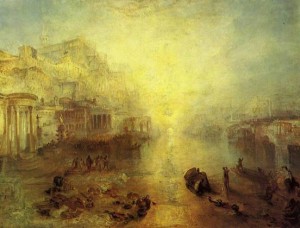
The Latin work has gone past difficult learning, though there is still that, too, into a different, almost ecstatic place.  Reading the words of another language and making sense, poetry, from them still seems magical to me.  I’m really doing it.  The closest analogy is my first set of glasses that corrected my far vision.  All of a sudden I saw individual stars in the sky.  william-turner-ancient-italy-ovid-banishedThe moment was extraordinary.  What had been a fuzzy, blurred night sky became black velvet set with bright points of light.

Now it appears I will finish Diana and Actaeon before the Titian show closes on May 1st and I might make my way through Diana and Callisto, too.  I’m enjoying translating the different stories, so I think I’ll move on to Medea, Pentheus and other discrete stories rather than try the full frontal assault I had planned, start with Book I, verse 1 and soldier through to the last verse of Book XVI.

Another idea that seems possible now is to investigate the Latin texts behind other objects in the museum:  Theseus and the Centaur at the Lapith wedding,  Ganymede and the Eagle,  Lucretia,  Germanicus.  I’m sure there are other objects that have particular Latin texts behind them.  I have no particular reason for doing this except to deepen my knowledge of mythology and of the specific objects in our collection with Latin connections.

Taking up a new intellectual challenge later in life is not only possible, it’s exhilarating.

Our Own, Original Relation to the Earth

Spring                                                            Waning Bloodroot Moon

I’ve discovered an analogy between translation and science.  Coming to a premature conclusion about the meaning of a passage causes chopping and cramping to fit meanings, declensions and conjugations into the preconceived notion.  The better way lies in suspending judgment, collecting all the possibilities, then, sorting them out in context, both with the larger work and among themselves, to find the probable meaning the original author had.  In science, the old method, the deductive method, began with a premature conclusion about the nature of reality, say, the earth is the center of the solar system and then made observational data fit the conclusion.  Francis Bacon summed it up well.  If method were a foot race, then the wrong method would take you further and further from your goal, no matter how fast you ran; the right method (the experimental method) carries you toward your goal, again no matter how fast you run.

Biblical translation often suffers from this very problem.  Predetermined theological or dogmatic conclusions force particular choices in translation, choices that support or reject a sanctioned premise.

It is, too, unfortunately, a trap fallen into by many folks I know.  Using second or third removed “sources” for so-called teachings is not new, but it’s phony baloney and muddies even the best minds.  Let me give you an example.  Many of the Wiccan or neo-pagan folk refer with confidence and certainty to certain Celtic religious practices.  Here’s the rub.  All we know about the ancient Celts in other than an archaeological sense, comes from three exceedingly suspect sources:  Roman writers like Julius Caesar and Tacitus, Roman Catholic monks who wrote down some material about the Celtic folk religion and a romanticized version of Celtic lore that surfaced in 18th century England.  The Romans conquered and subdued the Celts militarily; the Catholics oppressed them spiritually; and  the English treated the Celts as second and third class subjects.  Yet it is the literature of these three sources that contain the deposit of information about early Celtic religious practices and beliefs.

Now, even this data, through careful scholarship and skilled literary criticism, can yield solid or at least strongly suggestive information.   We learn some things about the Triple Goddess Brigit, for example, through material written about the Catholic saint who co-opted her place in Celtic lives, St. Bridgit.

It’s an odd field, these contemporary attempts to recapture a relationship in the present with the attitudes toward the earth held in our deep past.  I count myself as part of it, though with a twist, rather than retrieving the thought world and ceremonies of our ancestors, I’m following Emerson.  We need an original relationship to the earth, one based on our experience, not theirs, a religion of our own “revelations” gleaned from the earth as she is now, not the record of theirs.

As one way of getting at it, I take a cue from an Iroquois shaman I met long ago who prayed for the winged ones, the four legged, the ones who swim in the rivers, lakes and oceans, the flying ones and the ones who crawl.  When I asked him why he didn’t he pray for the two-leggeds, the answered, “Because we’re so fragile we depend on the health of all the others.”

We don’t need to become faux Iroquois to grasp and incorporate this sensibility.  All we need do is realize the onrush of climate change and the danger it poses to our species.  In that one move we can shift over to a deep respect for mother earth and all her parts, the living and the inanimate.

That is the fear based way and I’m perfectly ok with it if that’s what it takes to move you because not all fear is baseless.

Another way is to step up your own intimacy with the living world by growing vegetables, keeping bees, growing flowers, participating in the local foods movement, shopping at food co-0ps,  This web of activities coupled with mindfulness about where you are and what you eat can increase your sensitivity to the thrumming, vital interdependence of which we are a real and intextrictable part.

Many use camping, hiking, bird-watching, weather forecasting, fishing and hunting to put themselves into this I-thou relationship with the earth.

There’s so much more here, but I want to plead for direct experience, not the cadging of other cultures, not the assumption that by associating ourselves with indigenous persons we become somehow more in tune with the earth.  No, the one you need to be associating with is yourself and your daily, lived experience.  Can we learn from others?   Of course.  Can we become them in any authentic way?  No.  Absolutely not.

Lost In Translation

Spring                                                             Waning Bloodroot Moon

Just wanted to post a notice here that I have several verses of Ovid’s Metamorphosis translated, about a fourth of his version of Diana and Actaeon, the subject of one of Titian’s paintings at the MIA’s current exhibition.  This level of translation is a first pass, so is not meant to be in idiomatic English.  That’s a next step.  I’m excited that I’ve gotten this far.

The task of translation is far more complex than it appears, involving inevitable personal choices that reflect not the original work, but the mind and culture of the translator.  I suspected this, but now I know for sure.

This work has become a hobby for me, something I enjoy picking up in spare time, a jigsaw puzzle or a model.

Those of you who’ve mastered another language or languages, I’m getting to the place, at 64, where I may join you.  I have a lot of respect for any who have stuck the course with another language, we are so inept here in the US.  It’s been a fun ride so far.

The OWM

Spring                                                    Waning Bloodroot Moon

The Order of Woolly Mammoths, or OWM, the sacred sound that created the world, met tonight at Frank’s for our annual corned beef and cabbage feed.  Bill Schmidt gave us an insiders perspective on the nuclear crisis, explaining the safeguards in place and said, with some emotion, that if called and if he could contribute, he would go.  It gave me a personal connection to the brave, even heroic effort that engineers and other workers at the Fukushima facility have already offered and confirmed what I suspected.  These are men and women who have a wartime level commitment to their jobs, knowing that if doing them costs their lives; it’s a sacrifice both necessary and worthwhile.  They deserve our deepest admiration and respect as humans tested in a type of cauldron most of us will never, thankfully, see.

Tom, a new grandfather-to-be, asked for advice, stories, thoughts from current Woolly grandfathers.  He has chosen to devote his meeting, our next one, to the topic.  Gray heads discussing gray-headdom.

Stefan and I discussed a possible visit to Aerquipa when our cruise hits Peru.  It would involve a plane flight from Lima of about an hour and a half.  I want to make it work, seeing Lonnie and her folks at work, visiting someone I know.  Some planning to be done.

These men, this crowd of silverbacks, men I knew when our hair had color are a central part of my life.  It was good, as it always is.

Welcome Home, Tai Chi

Spring                                                   Waning Bloodroot Moon

Once in a while something comes into my life and it feels like a part of me already, as if a missing piece had come back home.  Meeting Kate was like that for me.  My split-off.  When the Wednesday classes for the two-year docent program began, art history came home.  When I found a Jungian analyst over 25 years ago, my Self began to return.  Last night I attended my first Tai Chi class.  Another wandering aspect of myself has joined the others at the hearthside.

When my hands floated up last night into the second position, I felt an energy pushing away from my body, just I felt it collecting as I pulled my elbows in and those same hands back toward my body.  A sense of inner peace, momentary, but real, emerged.  My first class, but not my last.

It may be true as an article in the Star-Tribune this morning claimed, that memory takes longer to cement as we grow older, may be, but for me, I hold out for variability, that some things to take longer to seat, yes; but others, because they’re compelling or because they’re split-offs that have found their back to the homestead, just rejoin as if they’d never left.

I’m going to confess something here.  There’s a part of me, a looky-loo part, that hopes disasters will go all the way like the earthquake and the tsunami in Japan or the financial crisis or the riots sweeping the Middle East.  A part of me wants to see what a nuclear meltdown would entail.  What if that chief villain of high tech actually happened?  What would the consequences be?  Really?  This is not at all a desire to see more disasters or worse catastrophes, rather it is a sort of morbid curiosity, a curiosity about extremes.  What if a volcano like Mt. Rainier or Mt. Fuji erupt at full force?  What if the sea levels do rise by 2 feet or more?  This is the immoderate part of me, that aspect that wants thing to extend to their logical conclusion.

I wouldn’t feel embarrassed about this at all if there wasn’t the possibility, the great likelihood, of serious injury and death to people and eco-systems.  So, I feel embarrassed, but still interested.

Carpe diem

Imbolc                                 Full Bloodroot Moon

Got my novel a boost by going out to Blue Cloud, got back and dove into the legcom, MIA, Latin sequence plus finishing my presentation,  Redefining the Sacred, and have gotten little novel work done.  The times.  Now the air has begun to warm up and the snow to melt.  That means more time outside, which I’m eager to get started, but that, of course, means less time inside and all of the winter work is desk bound or at the museum.

When I talked to Kate about my despair for human life on this planet (see yesterday’s post), I also commented on my zest for life.  It’s never been higher, I told her.  OK, yes, the sun shone, the sky was blue and it looked warmer, all boosts to the life zestometer, but it’s more than that.  Kate’s retired and that’s removed a lot of stress from my life as well as hers.  I know this for sure because I have a mild case of psoriasis and its gotten much, much better since her retirement in January.

I’ve also got two challenging volunteer roles, docent at the MIA and the legcom at the Sierra Club, each of them test different skill sets every week.  The Latin work has given renewed confidence in my learning capacity, plus it’s fun in ways I hadn’t anticipated.  We have two grandkids with birthdays coming up.  The dogs are healthy.  Our orchard should begin producing this year.  I know what seeds I’m going to start and what I’m going to plant outside, early.  There’s a novel underway.  I’ve made new friends at Bluecloud and through the MIA and Sierra Club work. This will be my third year as a beekeeper. The Woolly’s are in our 25th year.  Finally, Kate and I have started new physical routines.

Said another way I get to be around art, practice politics, create, grow, love, laugh, visit with friends and family.  Life is full of matters that can keep us excited and eager to get up in the morning.

No matter what the world may be like tomorrow today is a day filled with promise.  So, like my friend, Bill W., I’ll take my life one day at a time.

They’re just being Republicans

Imbolc                                                          Waxing Bloodroot Moon

Latin.  Subjunctives, indirect questions, tense sequences.  Done in a bit of a fog, almost like school.  The verb conjugations still have not taken full root in my mind, though at this point I have had exposure to all of them, for all four tenses.  I’ve had exposure likewise to five noun declensions, comparatives, superlatives, pronouns, interrogatives, adverbs, adjectives, ablative uses, dative uses, participles and participial clauses, and subordinate clauses of several types with more  to come.  I’m almost three-fourths through Wheelock and have now translated  75 verses of Ovid’s Metamorphosis.

As unintended outcome, I have found myself metamorphosed, changed.  Just how, right now, is not all clear, but it has something to do with facing a challenge, a language, and coming to grips with it, incorporating it into myself.  Just why I waited until I was 63, I don’t know; fear, yes, time, yes, but the largest barrier was lack of purpose.  When I began to want to know what was behind the translator’s veil, and, in particular, when I wanted to know what was behind the translations of Ovid’s master work, the purpose emerged and a teacher appeared.  There is no time when we stop growing, learning.

Later in the day I prepped for and ran the Legislative Committee for the Sierra Club’s weekly meeting.  This political season will not be kind to our lakes and rivers, our forests and wildlife, our prairies.  The burden will be laid at the foot of the Republicans, but really, they’re just being Republicans, giving political expression to the wills of those who support them.  No, the burden lies squarely at the feet of those of us who want to see our forests, rivers, moose, wolf, prairies and lakes healthy and whole now and into the future.  We have not fought with the same passion today as the Tea Party folk or the Christian Right or the Libertarians.

Over the retreat at Blue Cloud I read two novels focused on the political life of Cicero.  At the end of a brutal period for his political perspective he said, “All regimes come to an end.”

I agree.